



Abstract
Sociologist Erik Love reviews the books Islamophobia and the Politics of Empire and Terrifying Muslims. Each move beyond “post 9/11” explanations for anti-Muslim sentiment, showing how Islamophobia is best understood not as a temporary backlash, but rather as stemming from longstanding and durable forms of racial bigotry and colonialism.
Keywords
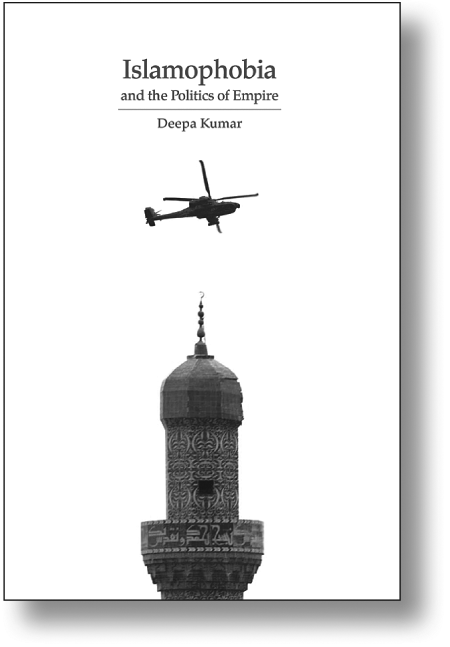
Islamophobia and the Politics of Empire by Deepa Kumar Haymarket Books, 2012 238 pages
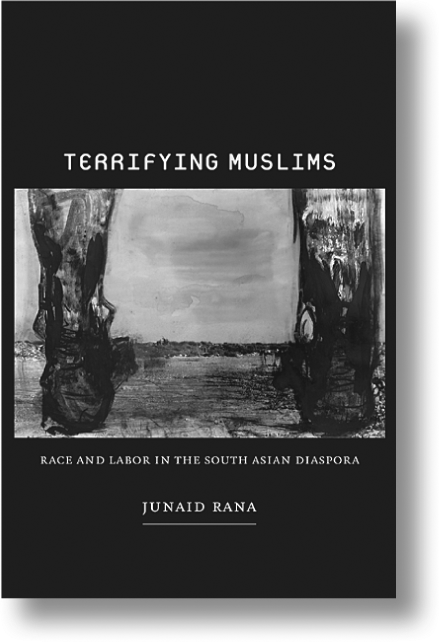
Terrifying Muslims: Race and Labor in the South Asian Diaspora by Junaid Rana Duke University Press, 2011 229 pages
September 11, 2001, was a long time ago. Unfortunately, the present moment is still described as the “post 9/11” world—a world of “post 9/11 backlash,” “post 9/11 security,” and “post 9/11 communities.” After last August’s attack at the Sikh Temple of Wisconsin, for example, many analysts relied upon the simplistic idea that “post 9/11” dynamics could explain the motives of the white supremacist terrorist who killed six worshippers and wounded many more. By calling upon the memory of the 9/11 attacks to explain such incidents, we obfuscate the history of discrimination against Arabs, Muslims, Sikhs, and South Asians in the United States that long predates 2001. The “post 9/11” genre suggests explanations for discrimination that remain tethered to the false idea of a limited, temporary backlash.
Fortunately, a recent crop of books has begun to eschew the “post 9/11” terminology, casting a broader look at the phenomenon of anti-Muslim sentiment. Deepa Kumar’s Islamophobia and the Politics of Empire and Junaid Rana’s Terrifying Muslims both represent a new generation of scholarship on the racialized discourses that today we refer to as “Islamophobia.” This problematic neologism is currently the most popular way to refer to racialized bigotry, discrimination, rhetoric, policies, and practices directed toward a wide range of ethnic and religious groups, including Muslims. Rather than use a limited “post 9/11” perspective, Kumar and Rana analyze the ways that Islamophobia is part and parcel of colonialism and racism, along with other longstanding forms of discrimination in the West. This perspective helps us understand why Islamophobia has been such a durable and potent phenomenon.
A recent crop of books has begun to eschew “post 9/11” terminology, casting a broader look at the phenomenon of anti-Muslim sentiment.
One of the most important debates about Islamophobia centers upon whether it might properly be considered a form of racism. Some contend that because Islam is a religion, and because Muslims come from all walks of life, Islamophobia is not a form of racism. Therefore, the argument often goes, it is appropriate to level certain criticisms about Islamic theology and Muslim cultures. If we label critical discussions about Islam and Muslim cultures “racism,” we censor these debates.
Taking these two works together, Kumar and Rana put forth a strong argument that while Islam is certainly a religion, and not a race, and Muslims (like all religious communities) are a highly diverse group in terms of ethnicity, nationality, and even racial backgrounds, Islamophobia is in fact a form of racism. Both books effectively provide historical accounts showing the parallel development of Islamophobic discourses alongside other forms of racial bigotry and discrimination. This history allows a more complete understanding of the persistent hate attacks on Sikh Americans. Sikhs are mistaken for Muslims because of how they look—because of race. Muslims are not at the center of Islamophobic discourses, policies, and practices. A racialized caricature of Islam and Muslims whose roots stretch back to the founding of Islam and the imperial struggles between “East” and “West” is at the center.
Kumar begins her study with the founding of Islam in the seventh century. She emphasizes that contrary to the pervasive idea that the Muslim world has been locked in eternal struggle with the West, the political rivalries between empires in Europe and Asia have always been in flux, with cultural and economic exchanges alongside periods of war and conflict. The images of Islam and Muslims that began centuries ago in the “West” have undergone frequent shifts that often line up with political conflicts. This is the thesis of literary critic Edward Said’s Orientalism, which Kumar usefully extends. Present-day Islamophobia thus follows an old pattern; the demonization of a “Muslim” caricature emerges because it is politically beneficial for powerful elites who use it to achieve their desired ends: war and economic domination.
Rana’s analysis gives a clear picture of the role that racialization plays in creating the caricature of the “Muslim,” following the familiar pattern of other racial stereotypes. Drawing on racial formation theory, Rana describes how the state reifies perceived racial categories through policies that reinforce racial conceptions. He gives examples like FBI “Most Wanted” signs, which describe terrorism suspects of “Middle Eastern descent” who can presumably be visually identified. Since the term was first uttered by British military strategists, the meaning of “Middle Eastern” has been malleable; Rana laments how today’s “Middle East” has been extended to reach from Morocco all the way to Pakistan. In short, today we have a global racial system that has produced a category encompassing Muslims, Christians, Sikhs, Hindus, Afghanis, Pakistanis, Yemenis, and more. While lumping together so many different ethnic, religious, and national groups makes no sense, racial categories have always elided boundaries and ignored diversity, substituting crude shorthands based on visible, physical, and often irrelevant markers of difference.
While Islam is certainly a religion, and not a race, and Muslims are a highly diverse group, Islamophobia is in fact a form of racism.
Kumar notes the existence of this crude “Muslim” shorthand, moving from there to a devastating critique of American imperialism. She begins in the Cold War, making the case that after the collapse of the Soviet Union, the Red Scare gave way to the Islamic Scare. In her view, President George W. Bush and the neocons should be placed alongside President Barack Obama’s “liberal imperialism”: both Republicans and Democrats use the so-called “Islamic threat” to justify massive expansion of the military industrial complex. Kumar describes the economic, social, and political factors that gave rise to political movements like the Muslim Brotherhood, Hezbollah, and Hamas. The failure of the left’s pan-Arab nationalism, coupled with economic crises and the impact of Zionism, together created a context in which conservative political movements could emerge, she argues. While noting that such movements have destructive potential, Kumar remains cautiously optimistic that “political Islam” might provide effective resistance to American imperialism.
To make her case that the United States has expanded in its military interventions around the world, despite President Obama’s anti-war reputation, Kumar quotes from the Obama administration’s own reports. She notes that a 2012 defense document outlined how to continue Bush’s “War on Terror” under the guise of countering “violent extremists,” promising to attack al Qaeda and other dangerous groups in Pakistan, Yemen, Somalia, and elsewhere. In the Obama years, Kumar sees a shift away from massive, single-location interventions, toward a larger number of interventions across a much wider area using drones, small teams of special forces, and tools of cyber warfare. In the end, as Kumar convincingly shows, it is the specter of an “Islamic threat” that drives United States policies and practices, damaging the lives of people across the Muslim-majority world.
While Kumar’s sweeping global-historical analysis is echoed in Terrifying Muslims, Rana’s focus is on the lived experience of Islamophobia. He provides rich details of Islamophobia’s direct impacts on transnational migrant workers as they move around the globe looking for economic opportunities. Rana’s insightful discussion is empirically grounded in 100 interviews he conducted between 1998 and 2008 in Lahore and New York City, supplemented with ethnographic observations in Dubai and other locations. Rana provides nuanced descriptions of the aspirations, goals, and tribulations of working class Pakistanis as they depart from Lahore. He finds that global labor regulations rely on insidious racialized concepts that mark these migrants as dangerous before they even leave their home country. The level of detail in Rana’s work is extraordinary. He finds evidence of off-the-books privatized labor recruiting, resulting in human trafficking carried out under the approval of government officials in multiple countries. In the process, migrant workers get “represented in relation to trafficking in humans, drugs, and terror” no matter where they go, whether it is Dubai or London or New York. Even as he describes the systematic forces that work to exclude them, he shows these workers’ agency, and how courageous workers’ protests over withheld wages brought changes, solidarity and hope across boundaries. Rana largely succeeds in his stated goal for his book: to place “working-class migration in the foreground of the global racial system, and “to expose how labor migrants are made illegal.” He shows, too, “the reign of racial terror and violence that is at the heart of the imperial War on Terror.”
There is a straight line from the Asian exclusion and internment efforts in the nineteenth and twentieth centuries to the construction of Islamophobic policies and practices in the twenty-first century.
Both books successfully bridge a discussion of global forces with the development of domestic American Islamophobia: bigotry, hate crimes, and state policies that discriminate against the racialized groups that are included under the “Muslim” caricature. There is a straight line from the 1790 Naturalization Act, which restricted naturalized citizenship to free white men, through the Asian exclusion and internment efforts in the nineteenth and twentieth centuries, and the construction of Islamophobic policies and practices in the twenty-first century. All of these policies rely upon racialized xenophobia, which holds that certain groups are by their very nature incompatible with American life.
Rana describes how varied legal and pseudo-scientific justifications classified Indian and Syrian immigrants racially. Likewise, Kumar draws a parallel between justifications for the internment of Japanese Americans in World War II and extensive surveillance of Arab and Iranian Americans beginning in the 1970s. Such blatant discrimination from intelligence and law enforcement agencies, which targeted Arabs and Muslims simply because of their ethnic and religious backgrounds, continues. Kumar describes the use of confidential informants hired by the authorities to infiltrate Muslim American groups. By offering financial rewards, these agents provocateurs convince a particularly vulnerable or pliable individual to carry out a fake terrorist attack—a plot that in reality was mostly designed and executed by the authorities. The dumbfounded fake terrorist is then arrested on very real terrorism charges, and subsequently sent to prison for decades, while the authorities revel in a well-publicized success of “preventing terrorism.” These efforts are targeted almost exclusively at immigrant Muslim communities, and the repeated public shaming of these fake terrorists contributes significantly to the caricature of the dangerous Muslim. Kumar describes a wide range of similarly discriminatory policies, along with anti-Muslim rhetoric that is all too familiar to anyone who has watched television news in recent years. Discussing the (misnamed) “Ground Zero Mosque” controversy, Congressional hearings on Muslim radicalization, and hysteria over Sharia law, among other Islamophobic spectacles, she then looks for ways to move forward.
But Kumar’s analysis falls short of its goal to describe ways we might confront Islamophobia. She allots only seven pages to the topic of “fighting Islamophobia,” and much of that space is devoted to cataloguing the failures of the Obama administration and the Democratic Party more generally. She briefly describes the efforts of advocacy organizations like the Council on American Islamic Relations and Desis Rising Up and Moving. Though these two organizations each have multifaceted campaigns, Kumar offers only a brief description of them. She concludes by approvingly recalling the (unsuccessful) effort of Occupy Wall Street to remove New York Police Department commissioner Ray Kelly from office for racial profiling in black, Latino, and Muslim communities. Efforts to combat Islamophobia urgently require more careful attention, as Kumar asserts; her book is one of very few that even nods in this direction. Along similar lines, Rana’s descriptions of labor protests raise the possibility of connecting groups that are usually separated along lines of ethnicity, race, and class. Understanding how grassroots-based advocacy might disrupt Islamophobia requires a conversation that moves beyond “post 9/11.” Thanks in part to the careful work of these two scholars, that conversation has begun in earnest.