




Abstract
Sociologist Helen Moore discusses how capitalization of academic faculty roles raises questions of whether or not we have adequate theories to assess such changes. She argues that labor market fragmentation, racialization, and gendered faculty roles provide new frameworks for these theories.
Most new faculty arrive on their hiring campus with one dominant model of faculty roles: their recent doctoral training program. Although an innovative liberal arts undergraduate experience may have fueled the aspiration to be a professor, most faculty attend research-intensive programs with an emphasis on grants and publishing. Yet most will be employed in colleges and universities that differ significantly from the institutions in which they were trained. How these new professors navigate the expectations of faculty roles, both at their home institution and within their academic discipline, is shaped by multiple, often-contradictory factors. These include: differential valuation of various teaching and scholarly activities, gendered and racialized organizational structures and job queues, as well as increasingly market-driven employment practices.
Preparing Future Faculty (PFF) initiatives through the American Sociological Association (ASA) and on partner campuses have heightened my understanding of the complexity of faculty roles. The dilemma for any mentor, and for new faculty members in particular, is to identify the moving targets we call faculty roles within a context of shifting values and rewards. The academic market reality is that some 90 percent of doctorates build careers outside of a research-intensive campus. Their teaching and scholarship will be shaped, evaluated and rewarded based on local institutional practices that may be vastly differently from the norms they encountered in graduate training. Many campus activities, such as community engagement and service learning, may be differentially valued within the home institution, reflecting discipline-based and elite academic traditions. This differential valuation results in stratification processes. How we address these issues, and how we incorporate them into the training and mentoring of rising faculty members, will shape our own destinies, especially as we redefine faculty governance and faculty roles.
Ken Bruzenak

Are faculty being trained to understand the fragmented organizational realities of contemporary colleges and universities?
Fragmented Faculty Roles
Observers of higher education agree that faculty roles are a moving target under pressures of increased accreditation, reduced public funding, and external market factors. Yet our disciplinary ideas of faculty roles remain imbedded in models first described by sociologists Theodore Caplow and Reece McGee in The Academic Marketplace. They define academic careers as focused primarily on scholarly reputation (journal publication, citation, and disciplinary honors). Sociologist Joseph Hermanowicz describes a model of the early career that falls into cascading tiers of elite, “particularistic,” and “communitarian” campuses. Each campus mission distinguishes and differentially values the balance between teaching and research. Faculty members in elite institutions maintain unilateral investments in the progress of their research and reputation. They view faculty members hired at pluralistic institutions as becoming “utilitarian”; research aspirations dwindle, reflecting the bifurcation of research and teaching on their campuses. The missions of community outreach and community colleges, the “communitarian” campuses, reflect further displacement from research and the elite faculty career as they define it.
Most current models of faculty development do not question the ongoing stratification of faculty roles and provide few options for a more holistic academic career. The narrow focus on research publications cements the problematic assumption that faculty authority and autonomy reside solely in the context of strong research. For professors employed primarily as instructional faculty, this is far from their reality. As many newly trained faculty move further from the influence of their doctoral advisers and campus, they experience the stigma of downward mobility, or so they perceive, toward four-year, non-doctoral academic programs and two-year colleges.
What are we to do with these intense, expanded, contradictory faculty roles? At its extreme, current practices push us toward the brink of a “two tier” academy: those faculty who crank out student credit hours in contrast to those who generate research for profit (recognizing that profit can be market based or can reflect “indirect returns” to departments that are equally greedy organizations). Doctoral students on the job market understand these balances at some level and seek equilibrium in their own research, teaching, and learning. But are they being trained to understand the fragmented organizational realities of contemporary colleges and universities? Can they analyze how time divides operate within multidisciplinary departments on a liberal arts campus? Do they have the insight and skill to defend a reasonable academic workweek, or to question the encroaching linkage of research to department “returns”? For the long-term viability of faculty roles, are we teaching them to recognize and critique campus prestige systems with the intent of establishing more integrated models?
Stratification of Faculty Roles
Sociologist Joan Acker is one of several theorists who demonstrates how the organization of work and faculty roles creates everyday gendered and racialized inequality regimes for women academics and faculty of color. The day-to-day interactions within a department will have different meaning at a liberal arts campus with two full-time faculty members and one adjunct who are positioned differently in terms of race and gender or sexuality. Underrepresentation in key research sectors of the discipline may translate into underrepresentation in particular departments. Acker encourages us to interrogate the organizing of class hierarchies, hiring, and promotion. When particular subdisciplines and methodologies attract large federal grant dollars this may realign how faculty members integrate with the mission and practices of their institution or community.
The stratification of faculty roles across campuses is made more complex when new generations of scholars are motivated to act outside of narrow faculty “roles” to explore public sociology, or service learning, or to better understand the everyday expressions of inequality regimes that will operate in their own workplace. However, these activities continue to be undervalued within most academic disciplines, including sociology, when the focus is on elite models of training. Furthermore, these scholarly and teaching directions are more likely to be pursued and valued by women, ethnic minority faculty, and LGBTQ faculty. One consequence of this is that some of the potentially most innovative faculty work may occur among minority faculty who work in institutions that are stigmatized by the disciplines as “lower tier.” Do faculty mentors contribute to this stratification (with the resulting lack of diversity in the production of knowledge) or do we provide new faculty models that are valued and integrated more holistically into reward and promotion standards?
Some of the most innovative faculty work may occur among minority faculty who work in institutions that are stigmatized by the disciplines as “lower tier.”
Ken Bruzenak
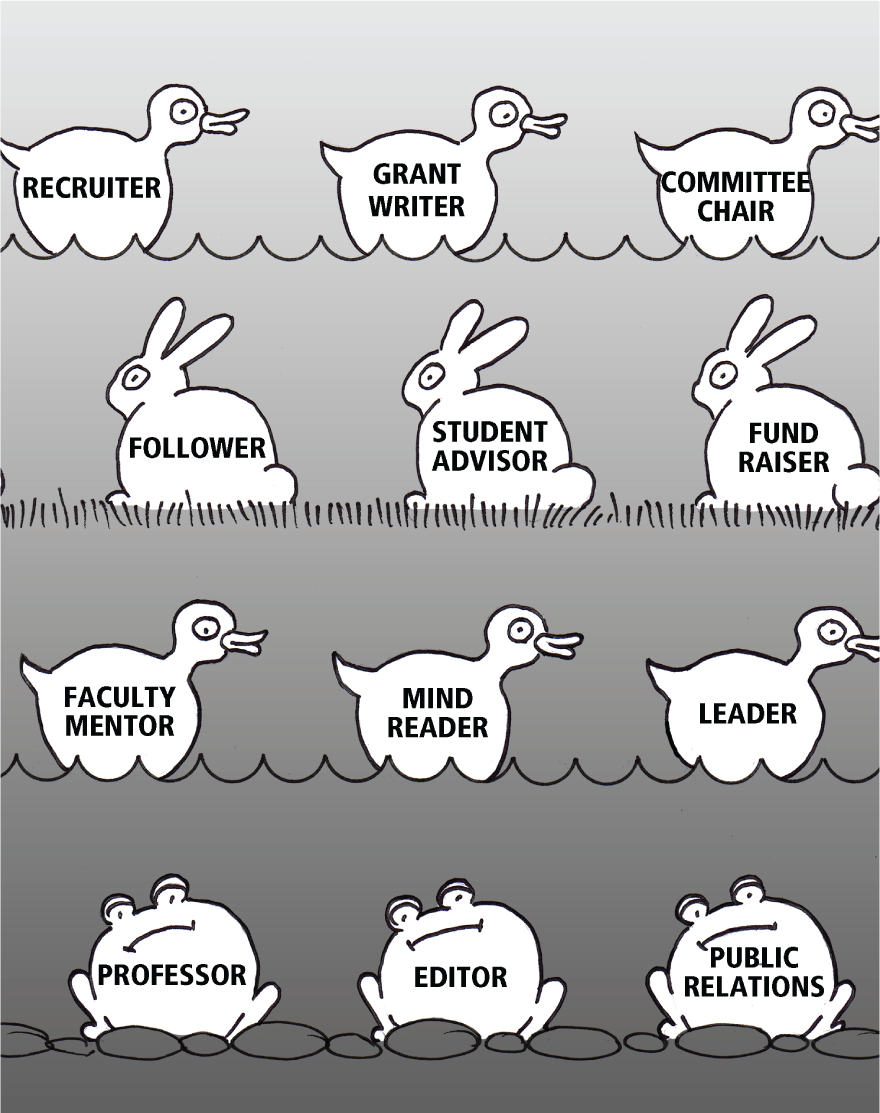
Faculty roles across varying organizational types are clearly demarcated in wrangling over reputations and resources. Eminent advisers at elite institutions steer top students to apply at prestigious post-doctoral sites and to interview at favored departments. The traditional circulation of elites has two disadvantages. The first of these is that the pipeline of truly superb human capital that is fostered in doctoral students on campuses outside of “top 10” institutions may never permeate and infuse the discipline with new perspectives. The second is that those in positions to theorize and conduct research on academic roles are the most sheltered from the full threats to faculty careers. Our current approaches are not realistically informed or flexible. They do not acknowledge the invisible work placed on the shoulders of new and diverse faculty members. These diversity issues are pertinent to faculty members who intersect their lives with: minority racial groups, non-hegemonic cultural backgrounds, different sexualities marked by stigma for informal or formal discrimination, transnational statuses that increase job insecurity, parenting and caretaking positions, as only some examples.
Academic Capitalism and Marketization—Cui Bono?
Academic culture is shifting toward market interests, and is departing from higher education’s traditional focus on promoting research and learning for the public good. Observers such as Derek Bok in his book Universities in the Marketplace note the contradictions between market-oriented values that stress the importance of external funds, establishing a good reputation within funding agencies, cost-effectiveness and efficiency, and sustaining large collaboration networks within academia. Higher education scholars Sheila Slaughter and Gary Rhoades, in Academic Capitalism and the New Economy, describe this as the advent of an academic capitalist knowledge/learning regime. These shifts (as described throughout this issue of Contexts) create fault lines that rupture traditional modes of organizing faculty roles, and we are pushed toward the commodification of higher education among students and faculty alike.
When faculty advisers seek to replicate themselves and cement their department’s prestige level by focusing on a narrow range of faculty roles, we are working at cross purposes with other disciplinary goals.
Capitalized labor markets drive toward the lowest cost of production. For instance, The Western Governors Association has argued for “unbundling” complex teaching and learning activities into component parts. (For elaboration on the WGA see Neem, in Viewpoints, this issue). From a sociological perspective, this opportunity to “expand student access” is, in reality, a process of “deskilling” faculty roles. The most flexible assets in higher education are faculty positions, time and effort; they are also what make innovation and teaching possible. Replacing faculty with canned curricula violates the optimal settings for student learning: interaction, challenge, innovation and research.
Sociologist Jerry A. Jacobs and others remind us that marketization and academic capitalism thrive best on fragmented, isolated workers: adjuncts, visiting assistant professors, and temporary instructors. This split labor market pits privileged, tenured academics against the interests of those seeking job security for themselves and their families.
Ken Bruzenak

As the University of Phoenix and other for-profit entities use distance education to deliver “curriculum” and control costs, higher education is pushed to reconsider faculty roles from a market perspective. The long-term effects on the academic labor market may well be an “unbundling” of the academic career in total by bureaucrats and capitalists more interested in budgets than knowledge or learning. If administrators or state policy makers are reconceiving instruction and faculty time as an institutional asset, then our new generations of faculty need apprenticeship in faculty governance and gaining their voice in these debates now more than ever. We are at a critical point where the institutional knowledge of tenured faculty about governance issues, the academic job market, unions and the capitalization of our faculty roles must be passed on to our job candidates moving into an increasingly fragmented labor sector.
New Theories of Faculty Roles
Who benefits from the pressures to unbundle, fragment, deskill, and devalue our challenging and complex faculty roles? Do we have a “90 percent” faculty occupying faculty roles outside of the elite who need new mentoring strategies? Will an elite model of faculty roles survive and continue to dominate job queues and hiring processes? Have we fully considered the consequences to academia of organizationally devaluing the labor that most professors do most of the time?
A more elegant model of faculty roles would include full consideration of all academic work activities, regardless of their market value or the preferences of individual academic entrepreneurs. We must actively value the full range of faculty roles. We should move to help rising faculty view their early choices as a career launch, rather than career atrophy. And we must equip rising faculty members with commitment and skills to appreciate the full academic enterprise and how it benefits our communities, our learners and our discipline.
As we observe the commodification of faculty roles, we need models that challenge the inequality regimes within academic departments. If our models serve only to justify a circulation of elites, that circulation will be constricted more and more in tough economic times. Preparing future faculty occurs on every graduate level campus—every day. If faculty advisers seek to replicate themselves and cement their own or their department’s prestige level by focusing on a narrow range of faculty roles, we are working at cross purposes with other disciplinary goals. We need to advise graduate students at appropriate times in their programs to widen their contacts with faculty holding different constellations of teaching and scholarly roles.
We can launch doctoral students with all the disciplinary capital needed to conduct research, publish, engage in the scholarship of teaching and learning, but we do little to prepare them to negotiate the stratified academic market and build a coherent profession that can push back against the capitalization of our faculty roles. Learning about faculty governance is learning about faculty authority and autonomy, about ethics outside of the research process and about the benefits of the full diversity of academic life. When department chairs in resource rich departments shelter new faculty members from service roles, we then hobble the development of faculty governance.
We need models of faculty of roles that interrogate the connections of faculty activity to marketization and profits, the student loan debacle and higher education finance. We should develop doctoral students’ ability to assess the scope and indicators of departmental inequality regimes, as well as the networks to survive in isolated or fragmented work settings. The symbolic recognition of the full range of faculty endeavors begins at the home department. As Jacobs has argued so persuasively, by improving the status and roles of part-timers and outsiders through organizational access, all faculty will better be able to address the excessive and increasingly contradictory demands that make up our profession.
When we ask the classic stratification question “Cui Bono?” (Who benefits? To whose good?), we have an appropriate point to begin the debates about the future of faculty roles and the preparation of future faculty. Using Acker’s insights, we might usefully start with Research I campus conversations of inequality regimes and highlight how some forms of gendered or racialized scholarship are privileged over others in the promotion and tenure process. On a campus with comprehensive master’s degrees, we might question the functionalist model that routinely privileges the starting salaries of business college faculty, considering current economic conditions. At teaching-intensive campuses, we can interrogate the fluidity of teaching roles as these are fragmented and restructured, and the costs and benefits to students and to part time careers. As for-profit electronic campuses credential full-time students one night a week, we should ask about the role of faculty members in their for-profit accreditation agencies. We may never have a comprehensive model of faculty roles, but we can certainly ask the right questions. Cui bono, indeed.