




Abstract
Sociologist Michael Schudson reviews the book The Space of Opinion. He argues that this full-length study of opinion journalism in the United States makes a strong case that the mix of diverse opinions, formats, and personalities in our era of op-ed pages, talk radio, and cable TV helps engage citizens with politics and improves democratic deliberation.
Keywords
The Space of Opinion: Media Intellectuals and the Public Sphere By Ronald N. Jacobs and Eleanor Townsley Oxford University Press, 2011 312 pages
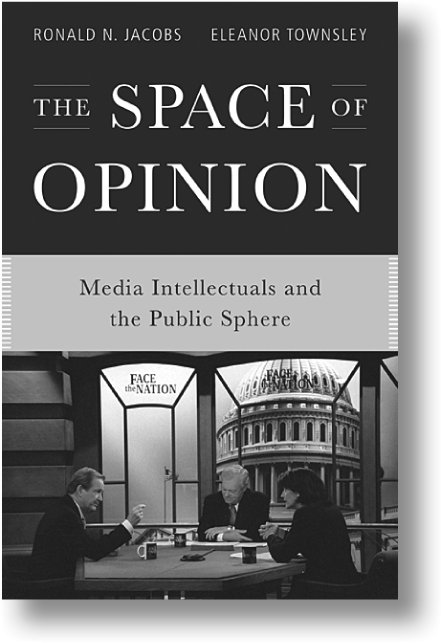
In the American news media, “opinion space” has been growing rapidly relative to news or information space, thanks to the growth of cable TV, and the emergence of popular opinion news stations and news shows. CNN began in 1980 and its popular opinion show Crossfire in 1982, Fox News Channel and MSNBC both launched in 1996, and Comedy Central’s The Daily Show With Jon Stewart started in 1999; on radio, Rush Limbaugh’s political talk show was nationally syndicated in 1988, Sean Hannity’s in 2001, and Glenn Beck’s in 2002.
Ronald Jacobs and Eleanor Townsley’s The Space of Opinion is the first serious full-length study of opinion journalism in the United States.
These developments came on the heels of an intense Vietnam-era critique of the claim that conventional journalism offers “objective” reporting. I think there’s much to be said for aspiring to objectivity in science or journalism or history—that there’s real integrity in preferring to get a story “right” than to win an argument. Still, proponents of objectivity have been on the defensive since the 1960s, when left-wing critics blasted journalists for deferring to government sources or, on the other side of the political spectrum, Spiro Agnew and Richard Nixon fired away at “the liberal media.” Such debates continue, notably over the polite coverage in the New York Times and the Washington Post of trumped-up Bush administration claims that Iraq held weapons of mass destruction.
Of course opinion has been a significant part of journalism from its earliest days. U.S. newspapers provided very little except opinion from their early eighteenth century beginning until the early nineteenth century when they began to hire those novelties called “reporters” as full-time staffers. Still, for the rest of the century, most took for granted that newspapers were party mouthpieces; few people imagined that reporters could or would act independently of the political leanings of their publishers. Only in the 1920s did a sense of professionalism, professional ethics, and aspiration to “objective” reporting begin to assert themselves. By the 1950s, this aspiration came to represent a dominant position in mainstream journalism. Even so, editorial pages were treated with respect throughout the twentieth century, and political columnists were taken seriously as they emerged and became widely syndicated in the 1920s and 1930s, settling in the 1970s into their esteemed “op-ed” page (“opposite the editorial page”) spot.
Ronald Jacobs and Eleanor Townsley’s The Space of Opinion is the first serious full-length study of opinion journalism in the United States. Few scholars before them deigned to write about this stuff because, I suspect, they admired the hard work of good reporting more than the spouting of opinion, and they saw opinion—when it seeped into the news columns—as pollution that mired the journalist in the muck of partisanship or the mess of entertainment values.
Jacobs and Townsley, in contrast, respect what opinion journalism does for readers and for democracy. They discuss Fox News without breaking out into a cold sweat about the decline of American civilization. In fact, they argue that the proliferation of new “opinion” formats, particularly on cable television, enhances rather than diminishes the quality of public deliberation. “On different issues and at different times,” they write, “the newer formats arguably did a better job at providing a wider range of representative points of view and new information on an issue than the more traditional formats did.” They showed more autonomy from the politicians they interviewed and a greater willingness to challenge even high-level politicians than more traditional television shows.
There is even the possibility that when opinion comes personalized in a George Will or Paul Krugman or Bill O’Reilly, it promotes political participation. Either loving or hating Krugman or O’Reilly is good for democracy—when people get attached to some of these characters in the space of opinion, they are more able to “sustain a regular level of participation in (or enjoyment in) the informal publics of civil society.” While there is no data in the book to substantiate that claim, it seems to me both interesting and plausible.
Jacobs and Townsley come neither to boost nor to bury a particular format. What they praise is the meshing, mixing, and clashing of formats with one another in the cultural space of opinion. As far as they are concerned, the beauty of the public sphere lies in its pluralism. As they see it, too many media critics assume that a democracy should run the way an idealized college seminar does, with a collective assessment of evidence and argument, and all emotion, personality, appearance, and charisma factored out. Instead, they align themselves with a “cultural sociology” perspective (borrowing from sociologist Jeffrey Alexander’s work) that holds that people enter politics through hearts as much as minds, through locations, connections, and solidarities more than through cerebral judgments or cool calculations. For Jacobs and Townsley, that’s just how life is (and probably even seminar life). For them, a realistic model of democracy would “expand the list of preferred media formats,” and recognize that “drama, disagreement, and strategic communication do not necessarily undermine democratic deliberation (but) can actually improve deliberation.”
Not everything in the opinion space receives their friendly embrace. They prefer opinions that reveal the complexity of politics over those which are reductive, and particularly those which are reductive in a simplistically partisan fashion. Therefore, they give the nod to print over television. Still, as they show, it is not just a matter of medium. The New York Times offers op-ed real estate to a wider variety of voices than does USA Today. It also gives contributors nearly double the number of words that USA Today’s columnists receive. And it does not straitjacket them (as USA Today typically does) in a “pro” and “con” debate-like format.
There is even the possibility that when opinion comes personalized in a George Will or Paul Krugman or Bill O’Reilly, it promotes political participation.
My summary shortchanges the empirical content analyses that underwrite Jacobs and Townsley’s judgments. But much of the content analysis is not very illuminating. One is more impressed with how much conscientious work they did than with what that work yielded, and the book can make for sluggish reading. But is it worth the trek? Easily. Their critique of an overly rationalistic model of public life is one of the most convincing I have seen. They show that people’s engagement with the news media is guided by emotions, friendships, and positions they can’t be reasoned out of because they were never reasoned into. Their evidence that the much disparaged opinion formats often approach powerful figures in more tough and probing ways than conventional news (which emerges from their content analysis) is important.
Their data mainly come from media samples from the early 1990s and the early 2000s in print and in television, and the book has little to say about the online environment or the blogosphere specifically. Everything they say in The Space of Opinion is therefore magnified in the world we live in now. That makes their book even more important.