




Abstract
Sociologist D. Randall Smith argues that a segment of big-time college sports has embraced the corporate model and this has led to a steady increase in the revenue gap between the “haves” and “have nots.”
Ever since a railroad supervisor provided an all-expenses-paid, eight-day trip to the Harvard and Yale crews in 1852, college sports have criticized for being overly commercialized. The powerhouses at the time—Harvard, Princeton, Yale, and others—went on a facilities-building spree to complement newly developed rational and scientific training methods, and applied a business model to college athletics. Since then, four major reform conventions have bemoaned the increasing commercialization of intercollegiate athletics, though none have successfully reduced the march toward commercializing college and university teams. And though the costs of college athletics programs have risen precipitously, revenues have not kept pace.
Athletic departments now mirror the business world. Senior athletic directors are sometimes referred to as “chief financial officers.”
Off-the-field shifts in how athletic departments are run are now more accommodating to the business model, exemplified by organizations such as the National Association of Collegiate Marketing Administrators, founded in the late 1980s. Following broader trends in the hiring of college presidents, it is increasingly common to hire athletic directors with business experience. Administrative titles in athletic departments now mirror those in the business world, and senior athletic directors are, at times, referred to as “chief financial officers.” Some schools have dedicated fundraising staff housed entirely in the athletic department. Others have outsourced their season ticket sales or facility concessions, in an effort to increase sales while cutting costs.
These changes have been confined to a relatively small group of schools that are at the top of big-time intercollegiate athletics. The National Collegiate Athletic Association’s (NCAA) top level of competition is Division I, which is further subdivided into the highest level of football competition (the Football Bowl Subdivision, or FBS), other schools with high-level football (the Football Championship Subdivision, or FCS), and schools with Division I basketball but no football. Each contains about one-third of Division I members. FBS football drives the economics of big-time college sports, and it is at FBS schools where one is most likely to find administrative changes that indicate a trend toward corporatization.
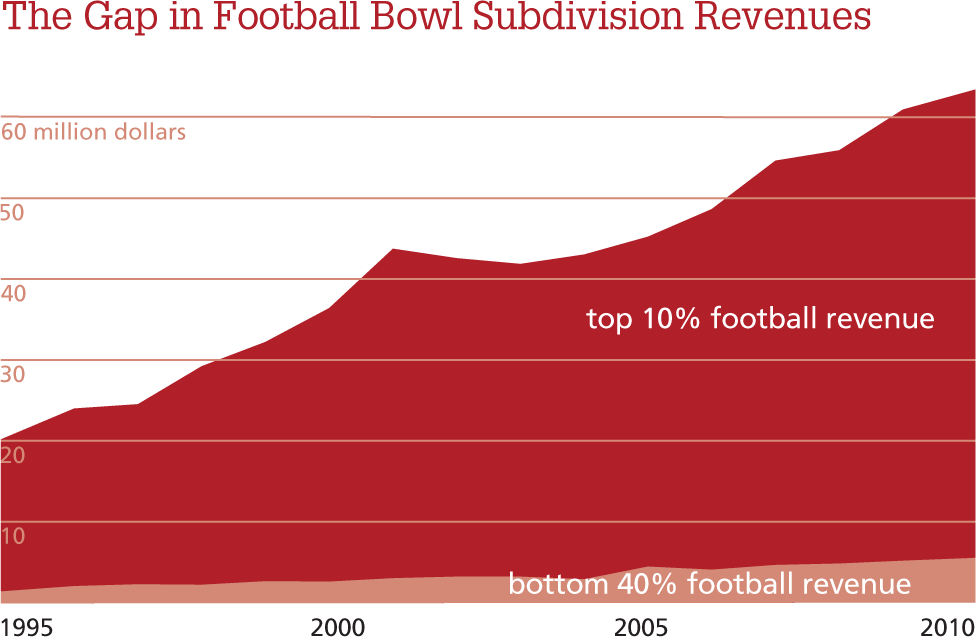
These trends are familiar to those who study economic inequality. As journalist Jay Weiner found in his report for the Knight Commission, the revenue gap between wealthy conferences and the rest of college sports has been growing. Economist Andrew Zimbalist’s (and others’) research found the revenue generated by the top tenth of athletic programs to be 16 times that generated by the lowest tenth. The chart on the bottom left shows the increasing gap, from the mid-1990s through 2010, in the average football revenue for schools competing in the FBS. As one can see, the top decile’s average revenue steadily increased while the revenue for the bottom four deciles remained relatively flat. (All revenues are expressed in constant 2004 dollars.) The rise in income for the top programs mirrors the rise of societal economic inequality in general in the United States.
The increasing gap in revenues does not necessarily mirror other aspects of the economics of higher education. Looking at all schools competing in Division I basketball, we find a different group in the top deciles. If one compares the top decile football revenue schools to the top decile of tuition (or to tuition, room, board, and fees combined), for example, there is little overlap. Just 4 percent of the top revenue-generating schools are also the most expensive schools to attend. Only two schools in the top decile of football revenue—the University of Michigan and the University of Notre Dame—consistently are among the top 10 percent in terms of average salaries paid to full professors. Only four schools appear in the top decile of endowment value for at least half the 16-year period. The reason for this disparity is, of course, that almost all the leading revenue-generating sports programs are part of large, public institutions.
The Gap in Football Bowl Subdivision Revenues
Source: Equity in Athletics Disclosure Act data—The Chronicle of Higher Education and ope.ed.gov/athletics
Recent Trends in Royalty/Licensing/Sponsorship Revenues
Source: USA Today
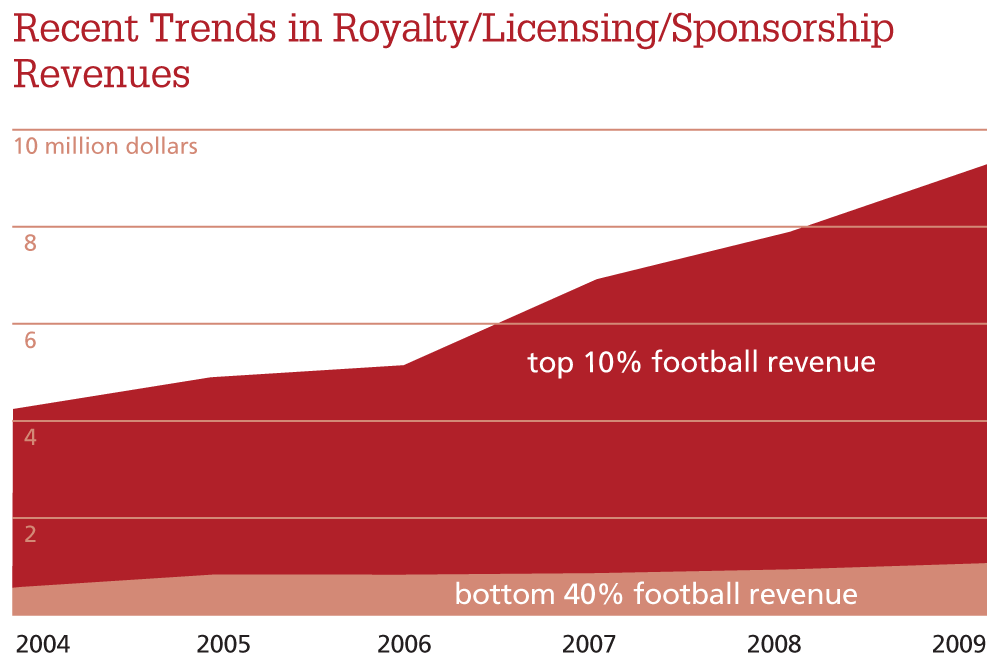
So how do the schools in the top decile of football revenue maintain and increase their economic advantage? Not surprisingly, part of the gap is due to ticket sales; high-revenue generating programs play in stadiums that average nearly 90,000 seats. Less obvious are the ways in which schools market their athletic programs. Data collected by USA Today via public records requests provide a glimpse of how the athletic departments of public institutions increase their revenues. It is here that the increasing corporatization in intercollegiate sports is most evident.
Recent Trends in Rights/Licensing/TV Contracts/Sponsorships/E-commerce
Source: USA Today
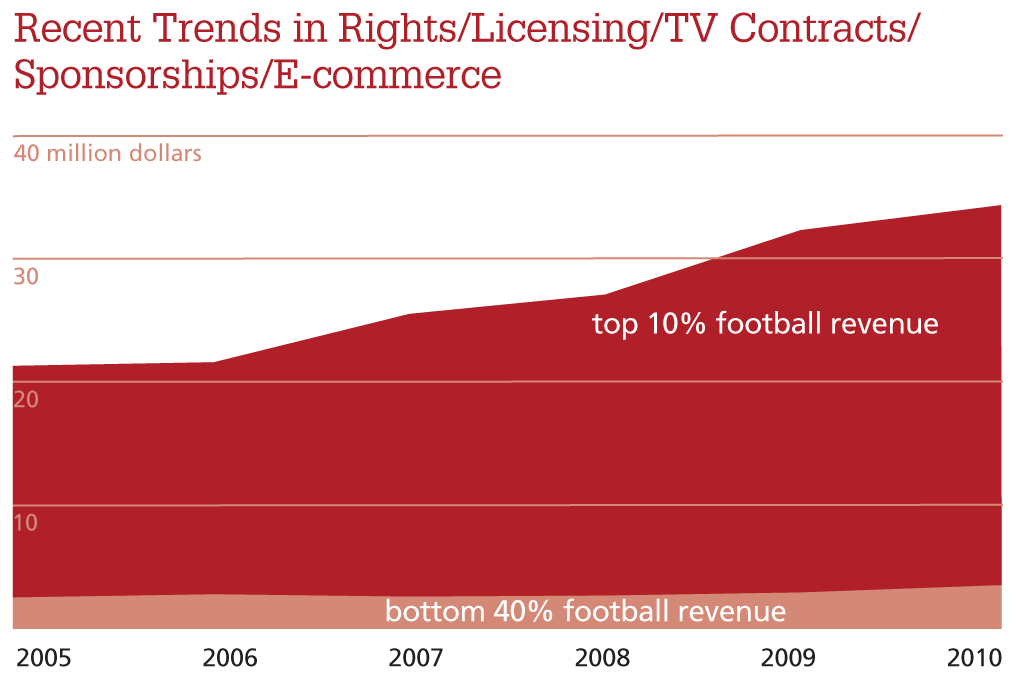
As the chart on the bottom right of the previous page shows, the top football revenue programs reside in athletic departments that have been aggressively marketing themselves. Since 2006, there has been a noticeable increase in income from sales of school-licensed apparel and memorabilia, advertising, and business sponsorships. Other data compiled by USA Today show an even broader scope of revenue streams. The chart on the bottom left combines sources of revenue that include broadcast rights, income from e-commerce and the Internet, NCAA and conference distributions, corporate sponsorships, licensing, advertisements, trademarks, royalties, and even the value of in-kind services. Under this definition, the revenue gap between the haves and have-nots is in the tens of millions, increasing by nearly 50 percent since 2005.
Eric Hood/iStockphoto©

The revenue gap between wealthy conferences and the rest of college sports has been growing.
The economic inequalities linked to college sports are likely to increase even more in the near future. A new round of television contracts is due to go into effect shortly, bringing even greater revenue to schools belonging to the four major athletic conferences that historically produce the top revenues in FBS football. The colleges and universities in those conferences have already been very successful in marketing their brand and adopting the corporate model. Much like income inequality in the United States in general, there are few signs that revenue inequality in college sports will decline significantly in the near future, or at all.