Abstract
Sociologist Andrea Press discusses the recent firing of President Teresa Sullivan, the first woman and first sociologist serving this role at the University of Virginia, by Helen Dragas, the first woman rector directing University of Virginia’s Board of Visitors. She analyzes the role of gender in these events and also examines the importance of social media in relation to facilitating faculty governance.
Keywords
Ashley R. Guillory
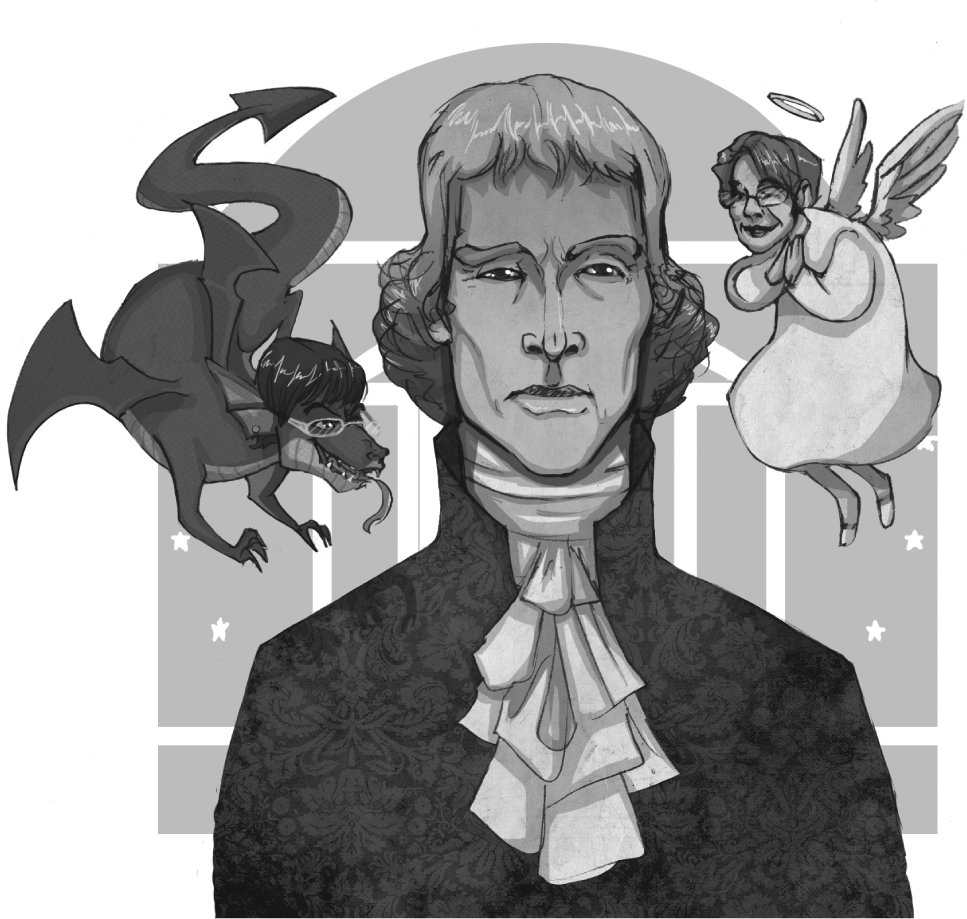
When Thomas Jefferson founded the University of Virginia in 1819, he sought to minimize internal hierarchies. Architectural tours of the historic campus reveal a semi-circle of original buildings constructed on a cleverly disguised incline to make the buildings appear to be of equal height. Jefferson also warned against establishing a president. Concentrating power in an executive, he believed, would undermine his vision of a new type of institution: an excellent, egalitarian, public university. Nearly two centuries later, Jefferson’s vision of UVA continues to inspire.
But this reputation became the subject of national scrutiny last summer when the university’s first woman president, sociologist Teresa Sullivan, resigned abruptly—after Helen Dragas, the first woman to act as rector, or head of the university’s Board of Visitors, threatened to dismiss her. The faculty senate and council of chairs lost no time in pressing the rector and other board members to account for their decision. They unearthed emails that spoke of the need for a long-range plan to make money from online learning; “strategic dynamism,” which described a system of frequent, top-down changes; and unspecified “philosophical differences” between Sullivan and the board. No concrete reasons for Sullivan’s ouster were ever offered, however.
The board’s actions exemplified a top-down style of governance, and emphasized its unilateral power to control the executive position. Board members are appointed by the state’s governor and these appointments often go to those able to write large checks to state political campaigns. The unwillingness of the rector to specify the “philosophical differences” to which she alluded reflects the fact that other constituents—faculty, staff, and students—lack a voice.
Emails published in response to a Freedom of Information Act filed by the local Charlottesville newspaper the Hook, reflect the board’s lack of coherent philosophy of education. Email correspondence between Dragas and board members express concern that the university was at risk because it lagged behind in the purportedly profitable online education recently implemented by MIT, Harvard, and other universities. The emails generated by board members indicate that they did little more than read and circulate a newspaper article that touted the cost efficiency of online education before moving to call for the president’s resignation. Despite the flimsy rationale, the closed-ranks, top-down power structure of the board enabled it to oust Sullivan on the grounds that she was costing the university money by her refusal to get on board with online education, as well as being unwilling to make other unpopular decisions in the wake of the budget crisis (one rumor alleged that board members urged closing of the small philosophy department).
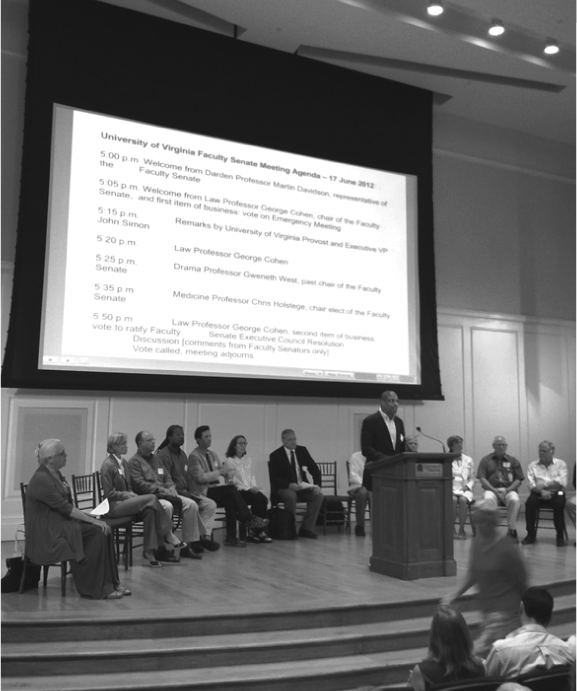
June 17: Faculty Senate
The Faculty Senate votes “no confidence” in the Board of Visitors and calls for Sullivan’s reinstatement.
Timeline photos by John Edwin Mason
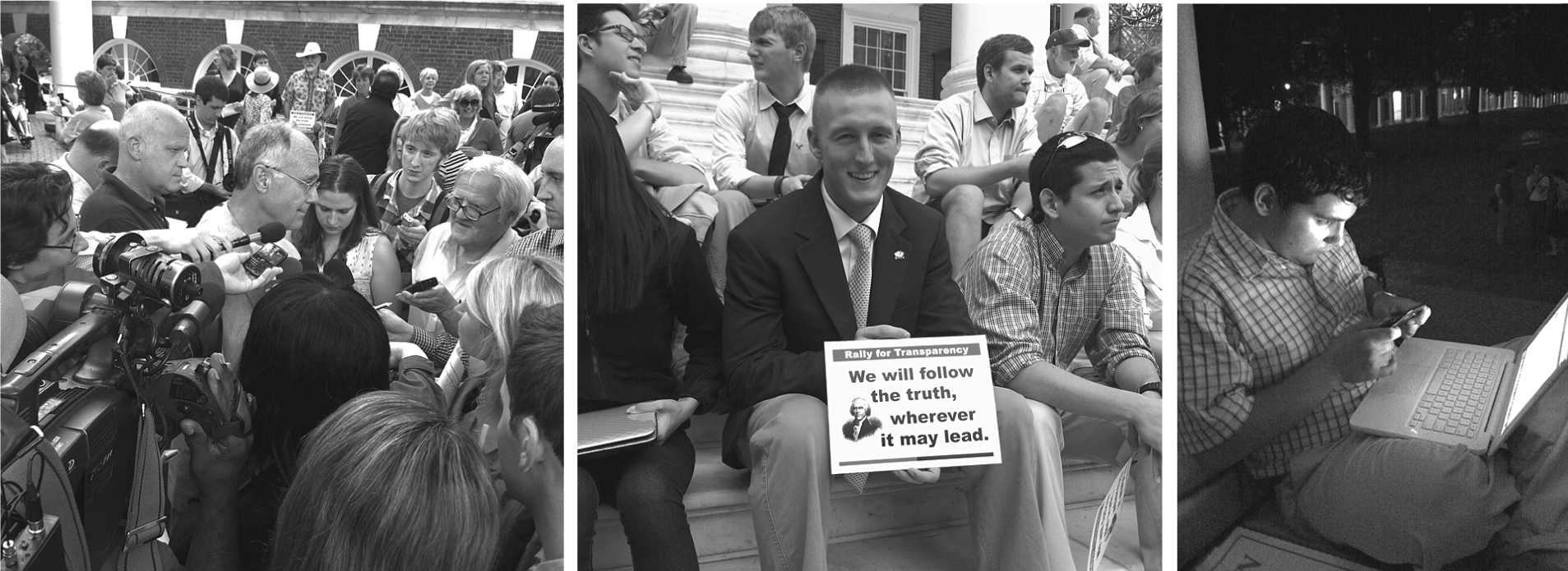
June 18 & 19: Rally and Vigil at the Rotunda
Former president John Casteen criticizes the board’s actions and supports Sullivan.
The student body demands transparency from the board.
Sullivan supporters publicize the events unfolding on campus via social networking sites.
Timeline photos by John Edwin Mason
Sullivan lacked an inside “leak” to warn her of the coming coup.
Challenges, questions and protest began immediately. The “absolute power” aspect of the board’s actions clashed with the sensibility of the faculty, who continued to hold that they work on behalf of an institution that was, and should be, run according to different principles than those governing profit-making businesses. The unprincipled exercise of power by the board spurred an outrage that reverberated across the nation. Faculty, staff, and students fought back. They organized their outrage via a Facebook page dedicated to protest and held several demonstrations and vigils demanding both an accounting of the university’s actions and Sullivan’s reinstatement. In the end they were successful. On June 26, President Sullivan was reinstated.
How much of the success of the pushback effort was due to the effective use of Facebook and Twitter to organize protests and demonstrations? As bloggers and Facebookers triumphantly noted, social media played a big role in this activism. But how had such an egregious misuse of power occurred at all? The story has been the subject of considerable speculation among media pundits recently, but most of these stories neglect the mediating role played by gender and its interaction with wealth and power.
Press coverage and informal blogging about the debacle rarely mentioned either the gender issue or the wealth of board members. When gender was mentioned it was in trivializing or misogynistic ways. The Washington Post described a “catfight” between two “dragon ladies,” citing the oft-repeated dictum that women disadvantage other women in the workplace. The Charlottesville Hook mentioned “plus-size bullying,” citing and in part using language which contributed to the widespread unconscious prejudice against and defamation of women, particularly if their appearance deviates from narrow, sexualized parameters. These charaterizations sensationalized the Sullivan-Dragas story, rather than citing the body of research that demonstrates concrete and measureable gender differences shaping the path to success for high level leaders.
Certainly the gender of the key players cannot be overlooked. How much of the protest’s success was due to the fact that still in twenty-first century capitalism, women, even wealthy women, wield less power than rich men? Media treatments dubbing Dragas “dragon lady”—and worse—underscore that, in addition to genuine philosophical disagreement, sexism inflected the way her actions were received and interpreted, and perhaps contributed to her immediate, almost universal unpopularity. The “edict-style” exercise of power might arguably have been more acceptable, even seen to be a sign of strength, were Dragas a man.
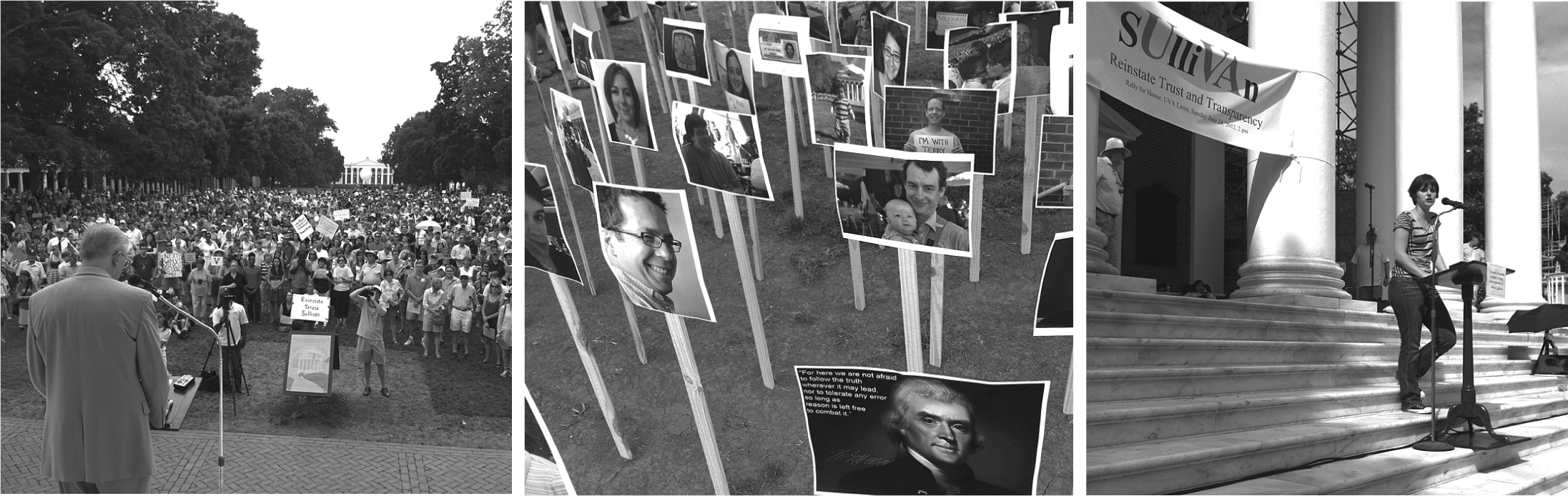
June 24: Rally
Faculty stand united in calling for Sullivan’s reinstatement.
Those unable to attend the rally show their support by sending testimonials and photos.
Student leaders speak on behalf of Sullivan, mobilizing student support.
Timeline photos by John Edwin Mason
Sullivan, for her part, faced heightened vulnerability because of her status as the University of Virginia’s first woman president. Business professor Lyda Bigelow and her colleagues found that women CEOs face a “green ceiling” effect in attracting venture capital. Investors are hesitant to support female-run firms. A persistent thread in the rumors surrounding the Sullivan firing questioned (without evidence) her effectiveness as a fundraiser. Other studies of woman leaders have found that female executives may also have a disadvantage relative to males in accessing inside information. Sullivan lacked an inside “leak” to warn her of the coming coup and allow her some time to mobilize her forces; this kind of inside information is crucial to the success of high-profile executives and is demonstrably less accessible to women.
In an article entitled, “From Where We Sit: Women’s Perspective on the Presidency,” Gladys Brown and her colleagues at the University of Maryland note that female university presidents are more likely to experience problems in retaining the confidence of the boards of trustees who hired them, and are less likely to obtain “second chances” by those boards for unpopular decisions or errors. Business psychologist Michelle Ryan refers to the “glass cliff” phenomenon, where women are more likely to be appointed to executive posts of organizations in crisis, partly because they are seen as possessing stereotypically feminine qualities like compassion and the ability to listen, qualities perceived as necessary in crisis situations. Women leaders are overrepresented in precarious organizational leadership situations so are more likely to fail. The appointment of Marissa Mayer as CEO of the troubled Yahoo is a recent potential example. Sullivan assumed the helm during one of the most serious budget crises in the University of Virginia’s history, a time when state support for higher education was decreasing markedly and with disastrous implications for our ability to maintain the quality of education for which the University of Virginia has become known.
Women are more likely to be appointed to executive posts of organizations in crisis, and not given second chances when they fail.
The final chapter of this story is ironic. In a system where wealth is often synonymous with political clout, Dragas’s money may have led her to assume that she really did know best. But her gender made others less willing to accept her leadership in the face of an unpopular decision. After an unprecedented uprising by students, faculty, and alumni, statements by the ACLU, extensive media coverage in the Washington Post and the New York Times, and social media campaigns (through Facebook, Twitter, and blogs), Sullivan’s unwarranted dismissal was reversed. While the outcome was just and UVA faculty are relieved, the mass-mediated process through which it occurred was sexist. It should be possible to uphold academic values without the attendant sexism we viewed in this case.
June 26: President Sullivan Reinstated
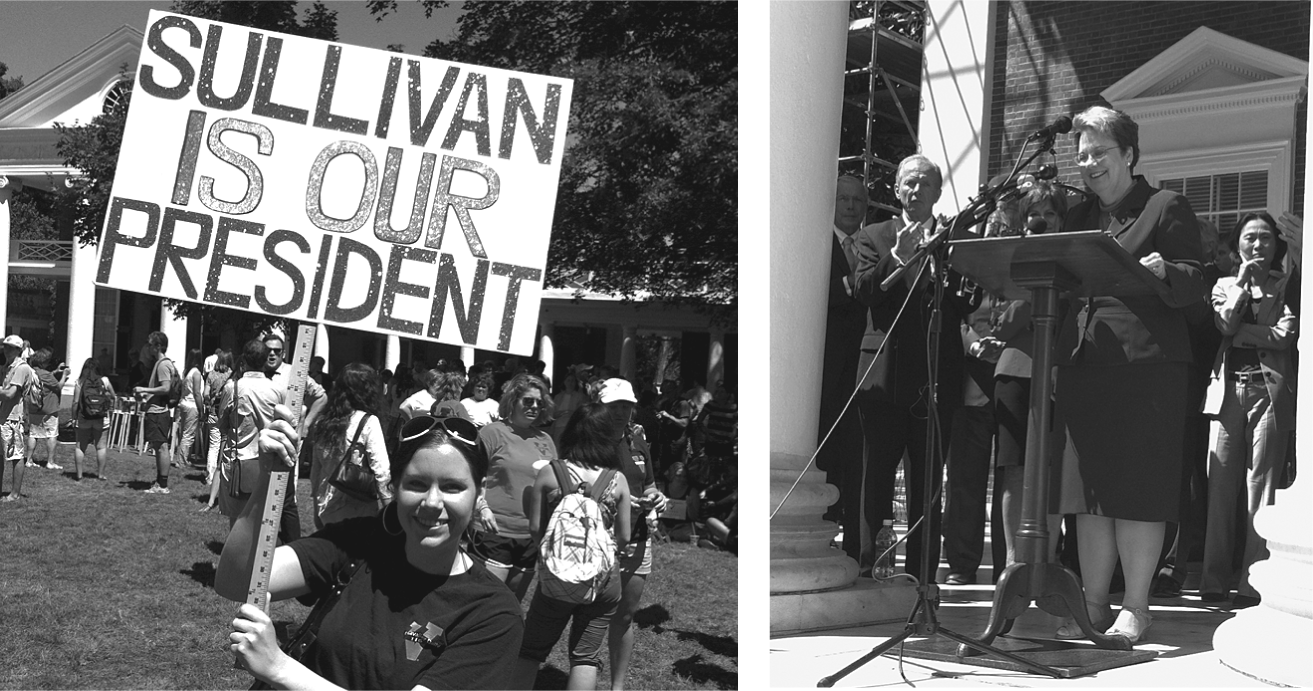
The UVA community forces the board to reconsider its decision to oust Sullivan.
A jubilant Teresa Sullivan addresses the crowd after her reinstatement.
Timeline photos by John Edwin Mason