



Abstract
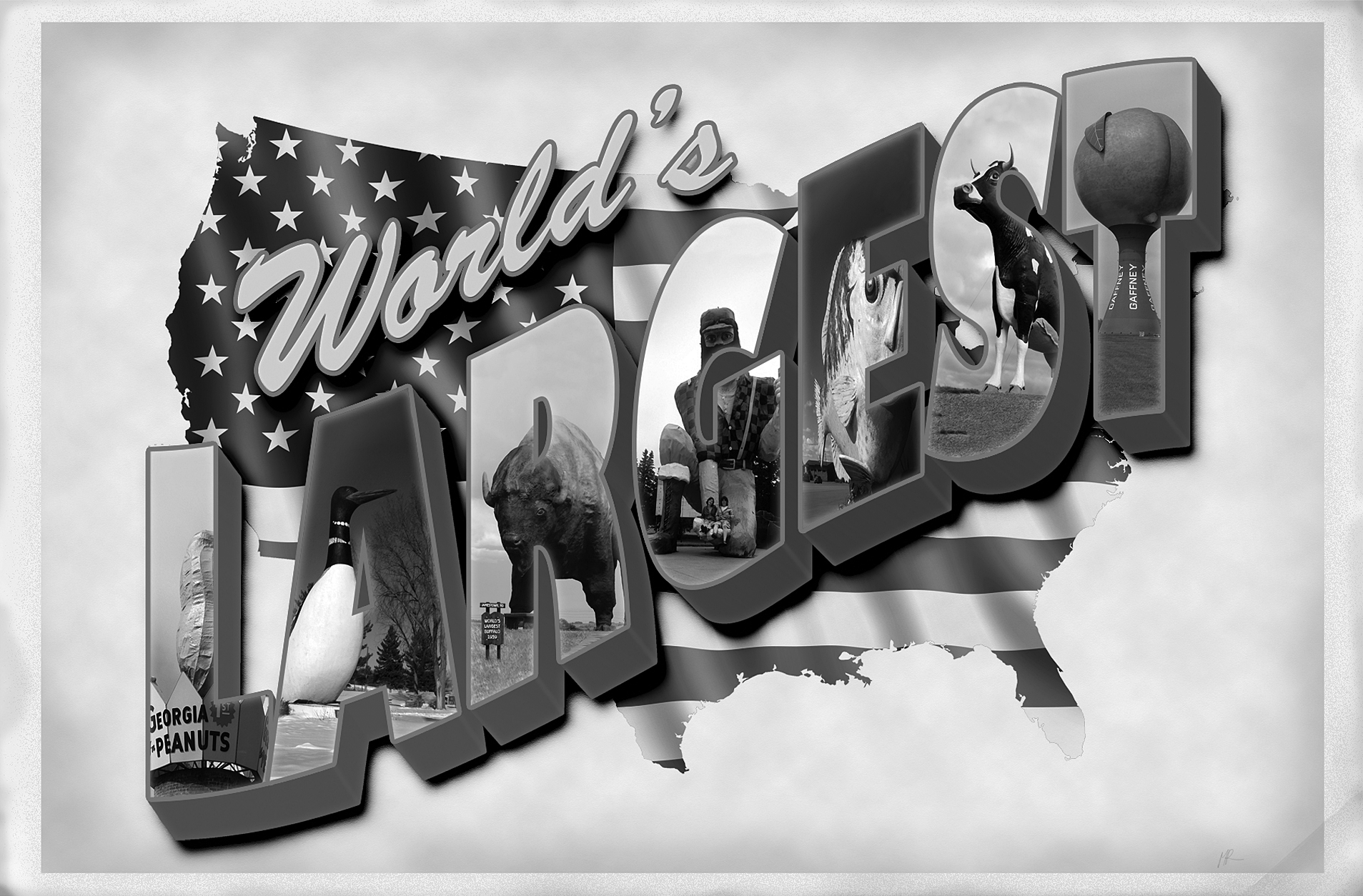
The documentary “World’s Largest” explores how dozens of small towns throughout the United States build colossal and quirky sculptures celebrating local culture and place identity. Colby King and Matthew Cazessus provide a deeper look into these shrinking communities and explain how these sculptures work to maintain a sense of community and reaffirm local place identity in the face of dramatic demographic changes and economic uncertainty.
Keywords
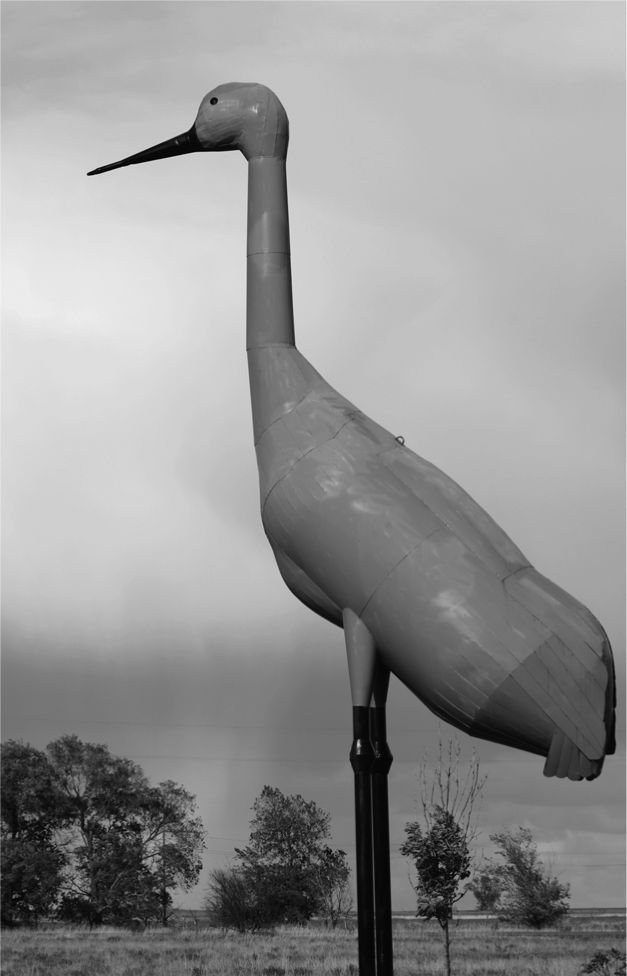
If you’ve recently traveled Interstate 94 through the long, sparse plains of North Dakota stretching between Fargo and Bismarck, you have most likely noticed the silhouette of a bird unlike any other: silent, majestic, and 38 ½ feet in height.
Erected in 1999, the “world’s largest sandhill crane” (“Sandy” to locals) stands vigil over Steele, ND from its perch beside the expressway. Comprised of rolled sheet metal and touches of paint, the sculpture inspires reactions that range from kitschy fondness to bewilderment, as well as questions about its purpose. Is this simply a piece of community art? If so, why a crane? And why so large? Intrigued travelers linger at the interstate exit long enough to snap a picture of themselves astride Sandy’s stilted metal legs. And while Sandy stands alone at her perch, her place on the map of small town America is not unique. As documented in World’s Largest, the recently released documentary film by Elizabeth Donius and Amy Elliott, Sandy is one of dozens of “world’s largest” creations dotting the interstates and byways of the nation.
These small town giants include the world’s largest killer bee, the world’s largest frying pan, and the world’s largest lutefisk. From an outsider’s perspective, it’s easy to dismiss these oversized steel icons as absurd, gimmicky tourist-traps. However, as filmmakers Elizabeth Donius and Amy Elliott reveal in World’s Largest, the motivations for these totems go far beyond a ham-handed bid for tourism dollars. In the film, residents express very genuine fear and regret that their way of life may not be passed on to the next generation and cannot envision themselves in a future apart from their community. Standing beside the World’s Largest Dairy Cow, one North Dakotan tearfully says,”I don’t know how to be anything but a farmer.”
© 2009 World’s Largest (worldslargestdoc.com)
One poignant example featured in the film is the 76-foot tall world’s largest stalk of corn in Shelby, Iowa. To passersby, a colossal corn tower is a quaint footnote to their travel along Interstate 80. What travelers may not realize is that this giant corn stalk is not the product of a lone artist, but is part of a strategic plan devised and funded by town members to celebrate the town’s economic identity. Like most rural communities, Shelby’s locally owned and operated farms have been aggressively absorbed by agribusinesses. As the need for a new generation of farmers fades, local youth have vacated their hometown in search of urban work and lifestyles. In the wake of their permanent departure, a quiet despair has settled in among the aging residents whose roots in the community are too deep for them to seriously consider relocation.
Faced with the prospect of being one generation removed from community extinction, Shelby’s faithful allotted thousands of dollars toward the manufacture of the mammoth piece of art. According to Shelby’s tourism website, the sculpture “symbolizes the importance of agriculture, and of the men and women who work the rich land to produce food for the world, and the pioneers who tamed the corn stalk.” Erected in full view of the interstate, the corn stalk is intended as a claim that this place has value. While residents hope that the tower will draw curiosity-seekers (and revenue) into the town, the giant corn stalk is also is a symbolic gesture intended to validate the experiences and identities of lifelong farmers.
“Salem Sue,” the Holstein cow of New Salem, North Dakota.
© Amy C. Elliott (worldslargestdoc.com)

Narratives of lost cultural identity are familiar to those who study recent macro-economic and demographic trends in the United States. Urbanization consistently lures residents out of decentralized areas in favor of life in or near the urban core. This migration is especially prevalent among those most able to relocate: the young, the talented, and the economically mobile.
While these migration trends benefit major metropolitan areas, how do they impact the patchwork of smaller communities from whence the “best and brightest” have fled? In Hollowing Out the Middle, sociologists Patrick Carr and Maria Kefalas offer a soulful narrative of another small town in Iowa coming to terms with a younger generation with little interest in remaining in the community. Sociologist Jennifer Hamer’s book, Abandoned in the Heartland, examines the reality of de-industrialized East St. Louis. Both books chronicle stories of residents who struggle to build up their community, only to look on helplessly as the most talented of their children’s generation leave in search of brighter economic and cultural futures.
The giant bluegill of Orr, Minnesota.
© Amy C. Elliott (worldslargestdoc.com)

This concern is also the subject of the documentary’s examination of Soap Lake, Washington, a small town with a “world’s largest” in the making: a proposed gargantuan lava lamp to be set at the town’s major intersection. The movement to create “World’s Largest Lava Lamp” is championed by an impassioned (but process-challenged) resident of the town, who hopes that the investment in the structure will ensure a meaningful future for the city. The mayor of Soap Lake entertains the proposal as he warns his neighbors, “There will be some towns that will not survive. They will turn in their charters of incorporation and become wards of the county. And this has happened, and it could happen in this county.”
No, not all residents of Soap Lake are sold on the idea of a 30-foot tall wax and oil light fixture illuminating their modest downtown. Some call the project a pipe dream, an impossible boondoggle destined to be another humiliation for an aging, and diminishing population. As tempers flare and citizens of Soap Lake exchange barbs across the lava lamp-divide, it is abundantly clear that both sides are attentive to outsiders’ impression of their community. As one Soap Lake resident declares, “It’s important for every place to have a sense of place, and things that are unique to that place. Things that are not everywhere, they are here.”
This poignant statement reveals that these giant lava lamps, corn stalks, and sandhill cranes may be functioning as community totems intended to bring recognition to towns in danger of losing their identity. Unlike religious totems, which act as mediators between the sacred and profane, these community totems are the medium through which civic pride and solidarity may be restored. Here the rituals are pancake breakfasts and place-themed parades overseen by local prom queens. In other words, when faced with the prospect of extinction, many American small towns have gambled on the hope that an oversized community icon will put them “back on the map.”
“Sandy,” the sandhill crane of Steele, North Dakota.
© Amy C. Elliott (worldslargestdoc.com)
The story of these “world’s largests” extends well beyond the borders of each small town. In every neighborhood, in towns big and small, people are drawn to places with a clear sense of identity. Although unconventional, the creation of a “world’s largest” may not be so far-fetched. After all, a 40-foot long concrete otter makes for a confident rebuttal against claims of economic insignificance and cultural irrelevance.