



Abstract
While the United States dominates the global film market, strategies are available to non-U.S. filmmakers seeking to make their mark. Sociologist Diane Barthel-Bouchier discusses how the Oscar-winning French film, The Artist, used the strategies of solving the language problem, meeting cultural expectations, building connections with Hollywood insiders, and mounting a media charm offensive to win the 2012 Best Picture Oscar award.
It’s no secret that U.S. films dominate the global market, representing between 40 and 90 percent of films shown in theaters in most countries of the world. How do other national film industries compete against the Hollywood juggernaut? This year’s Oscar awards provided evidence that certain strategies are available to non-U.S. filmmakers who, though they may lack the resources to produce a blockbuster, can nonetheless skillfully position a film to garner global attention.
In accepting the 2012 Best Picture Oscar for the film The Artist, producer Thomas Langmann dedicated it to his father, Claude Berri, the famous French film director who died in 2009. If Langmann intentionally set out to make a film with Oscar potential—perhaps as a gift to the memory of his father, who had received only one Oscar, and for a “short,” back in 1965—it would take a deliberate campaign. While top honors have gone to individuals for directing or acting, the Academy of Motion Pictures Arts and Sciences that awards the Oscars has been resistant to honoring foreign films with overall Best Picture, instead largely ghettoizing them in the special category of “Best Foreign Language Film.”
Langmann avoided the language problem by making a silent film.
By itself, the plot of The Artist doesn’t seem that remarkable. It charts the relationship between an older, silent film star (representing the decline and end of silent films) and a young actress (representing the rise of the new “talkie” Hollywood era). Against the backdrop of the stock market crash, tragic events occur, but a cute little dog saves his master and the day. After many vicissitudes, the “old” and the “new” unite and dance away in a new musical film production.
© 2011 The Weinstein Company
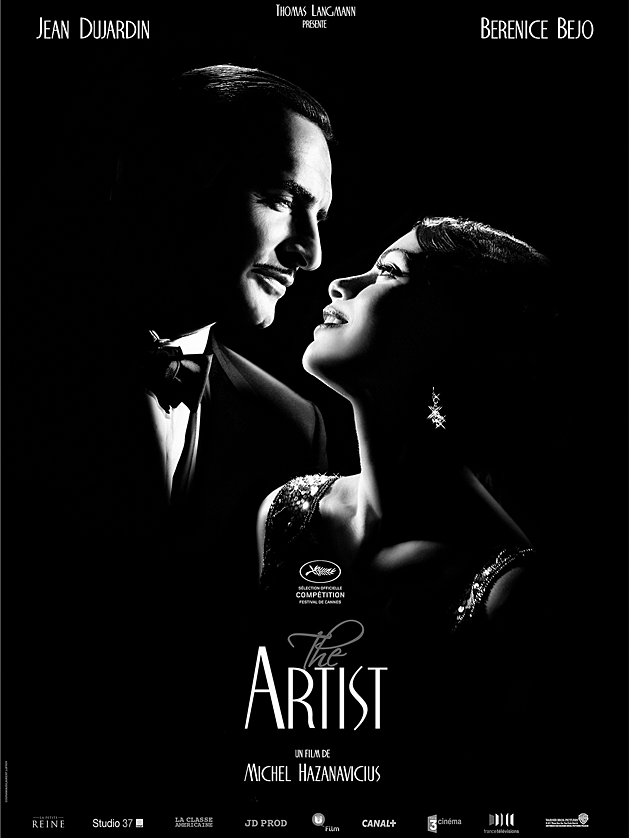
Beyond its predictable plot and happy ending, The Artist won by making cinematic choices that neutralized the Oscar bias against non-English language films and by engaging in a veritable politics of seduction. The campaign it waged incorporated four elements that solved the “problem” many Americans have with foreign films. An examination of these issues not only provides insight into the The Artist’s Oscar success, but reveals some of the social and political dynamics of the global film industry.
The Language Problem
Many industry insiders believe Americans will refuse to go to films that have subtitles or are dubbed. Foreign films produced by Anglophone nations obviously do not have this problem: Americans could easily understand The King’s Speech, even with the king’s stammer. Francophone filmmakers need to exercise other options, such as filming directly in English or making two versions, one for the Francophone, the other for the Anglophone audience. A third option has been to avoid the language issue using non-human actors. The French film March of the Penguins was a hit in the States, waddling off with the Oscar for Best Documentary, and Winged Migration also did relatively well. Voice-overs supply the narrative for different language markets, a strategy that also allows for changes in the script to suit different cultural tastes. Langmann, by contrast, used a totally new strategy: he avoided the language problem by making a silent film.
Cultural Expectations
Most French box offices hits don’t travel to the United States, largely because they don’t meet U.S. production expectations—and audiences wouldn’t understand them anyway. The vast majority of the top five French or French co-produced box office hits in France in recent years resemble slapstick comedies. How many Americans have seen Brice de Nice, Chouchou, or Les Bronzés 3? Very few. Yet these three comedies all ranked first or second among home-produced hits in recent years.
It wasn’t the predictable plot or happy ending (or even the cute dog) that won over American audiences. It was the lack of subtitles.
© 2011 The Weinstein Company

In 2011 another comedy, Intouchables, came close to taking the French box office record. This buddy film finds much of its humor in crossing class and racial barriers, but with the gimmick that one of the buddies is a quadriplegic. As an indicator of its success in France, Intouchables made more in its first weekend than The Artist did in its whole French theatre run.
U.S. comedies do export to other national markets, but big French comedies rarely travel to the U.S. Not only is there the language problem, and the fact that many comedies draw upon specifically French cultural understandings, but also that these films don’t meet typical American understandings of what a French film is, or should be. In short, if a French film is not going to be a well-made nature documentary, then Americans think it should be what the French themselves call Franco-Français. The film Amélie fit this category especially well, with its Montmartre settings, its visual inventiveness, and its romantic insouciance. La Vie en Rose, the biopic about the French singer Edith Piaf for which Marion Cotillard won her Oscar for Best Actress, also reflected American perceptions of what French culture should be.
American audiences also want their French movies to share American production values. Most French films are produced on a relative shoestring, with production budgets in the 4 million to 10 million dollar range. By comparison, top U.S. comedies usually cost 20 million to 50 million dollars, and blockbusters weigh in with budgets between 90 million and 200 million.
Regarding these expectations, The Artist managed to have its cake and eat it too. By being shot in black and white, and by being a silent film about a silent film, it conformed to U.S. stereotypes of inventive European films. But by being shot in Los Angeles rather than, as is now more common for French films, Romania, it benefited from high U.S. production values.
Insider Connections
By producing their film in Los Angeles rather than in Romania, Langmann and his team occupied enemy territory and made friends with the locals. The locals, in this case, included many members of the Academy. More than just making friends and influencing Oscar voters, The Artist attracted the attention of Harvey Weinstein, the larger-than-life movie mogul known to campaign hard for Oscar wins. The King’s Speech was a Weinstein film. So too were Shakespeare in Love (Best Picture 1999) and The English Patient (Best Picture 1996).
French comedies don’t meet U.S. expectations of what a French film should be.
Weinstein bought The Artist in mid-May 2011, right before it was to be shown in the “out of competition category” in the prestigious Cannes Film Festival. Langmann, however, managed to get it placed in the competition itself, where it went on to win the Best Actor award for Jean Dujardin, and reportedly would have also won Best Picture, if the jury hadn’t been reluctant to give two of the top awards to the same film.
Not only did The Artist feature an adorable little dog trained both to act and to mount an award podium, it also drew on the talents of an outgoing actor who was willing, like his canine counterpart, to go through his paces. Dujardin is best known in France for his leading role in two James Bond spoofs. He tapdanced his way across innumerable U.S. television talk shows as the campaign for the nomination heated up in January and February 2012. He proved himself to be a good sport and a tireless campaigner. He also has a great accent.
Of course, the odds are strong that next year’s winner will be a “talkie.” Winners take creative risks, and what works once rarely has similar success a second time. But this year’s Best Picture award winner demonstrates that while American films easily dominate global markets, foreign filmmakers use specific strategies to find their place in the sun, and also on the Oscar podium.