



Abstract
Sociologist Gary K. Perry talks with historian Michael Mizell-Nelson about digital memory banks created after Hurricane Katrina. Perry further reflects on disasters and the pedagogy of helping.
Keywords
I will never forget August 29, 2005. On that day Hurricane Katrina redefined life along the United States Gulf Coast. Katrina was the most destructive socio-natural disaster in United States history. Now, nearly seven years later, the devastation is a fleeting memory for most. But for me, and the thousands of others living in the aftermath of this destruction, Hurricane Katrina remains a haunting reality.
A week before Hurricane Katrina came onshore along the Mississippi and Louisiana Gulf Coasts, I moved to the state of Washington to begin my new job at Seattle University. I spent much of my first week exploring my new city, and savoring the near-perfect August days in the Pacific Northwest. On Saturday, August 28, my carefree existence was disrupted when I received a call from my aunt in New Orleans. She told me that a mandatory hurricane evacuation was currently underway, and informed me that she was not planning to evacuate. Just a week prior, another evacuation was ordered for a hurricane that did not affect New Orleans in the end. Like the thousands of low-income and predominantly Black residents of New Orleans, my aunt was experiencing evacuation fatigue and she had limited financial resources to sustain yet another—possibly unnecessary—evacuation.
Nearly seven years later, Hurricane Katrina remains a haunting reality for those living in the aftermath.
Throughout the evening I checked in with my aunt regularly to see how she was faring. With each subsequent call, it became evident that Hurricane Katrina was not going to be business as usual. Panic rose as I overheard the escalating winds shaking my aunt’s home and tree limbs beating against her windows. I listened as she considered the possibility that she might not survive what was to come. Around 11 pm on August 28, I lost phone contact with her.
The enormity of the destruction wrought by Hurricane Katrina was a first in United States history. The disaster prompted highly innovative ways of accessing information about the extent of the devastation and the status of loved ones. Mainstream news sources were either unable to enter the devastated areas or were compromised in their ability to get news broadcast. Because of this, I, like so many friends and family members of the people of New Orleans, turned to social networking sites for on-the-ground dispatches and to post images of my family in the hope that they would be identified. More than a week later, I was still relying on these social networking sites in my efforts to locate family members who had remained in New Orleans, and to follow the aftermath of Hurricane Katrina.
The power of new media went beyond the initial search-and-rescue process and search for updates in the aftermath. New media have been essential to the post-Hurricane Katrina recovery process. Websites such as the Hurricane Digital Memory Bank (HDMB)became a valuable resource for survivors who were displaced throughout the United States and for concerned citizens eager to help the Gulf Coast communities that had been destroyed completely. The HDMB is a virtual space that enables survivors to forge community through shared experiences of Hurricane Katrina (and later Hurricane Rita). In its mission statement, the HDMB states that it is committed to allowing survivors to narrate and document, in their own words, their experiences in the aftermath of these unprecedented socio-natural disasters. Through this documentation, the survival stories have become part of the public and the historical record.
I sat down recently with University of New Orleans public historian Michael Mizell-Nelson, who developed the HDMB. Michael is a lifelong resident of New Orleans and a survivor of Hurricane Katrina. We discussed the impact of Hurricane Katrina on his teaching and scholarship, and the role of new media in facilitating community engagement and student service learning in post-disaster communities.
The Post-Katrina Portraits Francesco di Santis drew hundreds of portraits of volunteers, whose narratives accompany the illustrations.
“For many, telling their story was a form of psychological recovery. . . . Many chose to recall, despite the emotional hardship, because they wanted the world to know. . . . I felt honored to play a part in facilitating this record.” –Francesco di Santis, Foreword, The Post-Katrina Portraits, 2007 (Hurricane Digital Memory Bank, Object #13502).
Francesco di Santis, “Portrait & Narrative: We Can Move Mountains.“ Hurricane Digital Memory Bank, Object #26756; Francesco di Santis, “Portrait & Narrative: Broken Mirror Image.” Hurricane Digital Memory Bank, Object #26734.

A Conversation with Michael Mizell-Nelson
Michael, what was your experience like during Hurricane Katrina?
Before Hurricane Katrina, my wife and I might have evacuated one or two times. But, since having children, we always thought about leaving. Since we were renting, we did not have the stress of having to protect property, which comes along with being homeowners. We were always able to leave with just having to put together a few plastic boxes with some videos and family photos and then taking off.
If I didn’t think that the evacuation notice prior to Hurricane Katrina was just another drill, there would have been a number of things I would have tried to save. We were renting a townhouse and we lost everything on the first floor and there were a few things that we lost on the second floor. So there were a lot of things that I wish I would have taken or would have moved upstairs. But, we were quite fortunate; there were a lot of one-story houses in our old neighborhood that lost everything. So that was our experience; we did not have the kind of phenomenal loss that other families had. But, I guess you’re always measuring one loss against another.
How did the Hurricane Digital Memory Bank come about?
I had tried to get funding to do some online databases in the 1990s when I worked at a local community college, but my college was not interested in funding it. In my earlier attempts at creating online databases for community histories in New Orleans, I had worked with the Roy Rosenzweig Center for History and New Media. Immediately after Hurricane Katrina, I used my connections with Roy Rosenweig to initiate an online database for Hurricane Katrina survivors. I thought that the September 11 Digital Archive, which the Center for History and New Media launched in conjunction with the American Social History Project at the City University of New York, was the model.
During the immediate aftermath of Hurricane Katrina, a lot of people were talking about doing oral histories, but how can you even conceive of doing oral histories on this scale? Hurricane Katrina was so vast. We are not talking about a couple of cities on the east coast, as with September 11, but rather an area stretching from Texas to Florida and, with the out-migration, we are talking about people affected by Hurricane Katrina who are now living in every state. Because I had worked at a community college where I started doing community oral history projects, I was used to having students get lesser known stories.
How instrumental were your students in the development of the Hurricane Digital Memory Bank?
Because the University of New Orleans offered online courses immediately after Hurricane Katrina, I started teaching an online class while still floating around and even having to live in my parents’ basement in Massachusetts. The good thing was that I had a group of students who could help test how the September 11 Database would work when collecting data objects from survivors of Hurricane Katrina. Online collecting takes a lot of effort, but we were able to get several hundred objects (that is, photos with captions, people’s stories, their narratives). We had students living all over the place who would come together, share their stories, as we worked to launch this database. I think this is one of the greatest strengths of the database from then to now. It was our ability to document stories from students who are connected to New Orleans and their family stories.
It sounds like the HDMB was able to fill a void in the news coverage of Hurricanes Katrina and Rita that went vacant by the mainstream media.
When you consider it, the mainstream media gravitates towards the extraordinary…things that grab people’s attention. The worst examples of crime; not the corporate crime necessarily; not the complicated insurance companies and how they wrote people out of their homes. When we were doing the US Coast Guard stories, the commander for the coast guard said “Please interview people doing the boat rescues; no one wants to talk to them. More than two-thirds of the rescues were done by boat, and my men and women are slogging through these horrible waters. Everyone wants to interview the helicopter pilots. Those guys were here about a week at a time and did a lot of work, but they have the dramatic video footage that the broadcast media could use. But, the people who were in the thick-of-it were not part of the national narrative.”
I’m constantly running into students who say that their stories are not worth documenting. But, once they get into my class, we talk about all the things that they had to go through. It was difficult in the beginning for some people to talk about what happened. Many of them lost photographs. So, I would have the students begin by not focusing on what they lost but, rather, share how people in other states might have helped them. I have even worked with students to develop collections; especially of photos they were taking of their neighborhoods. During this process, students began to see how their story was part of a larger narrative. It becomes another story for them: that is, the lost of their story on the national stage. These stories won’t make it into the newspaper, but they matter.
What impact has the HDMB had on your students and the interdisciplinarity of your work?
The English department at the University of New Orleans had the Katrina Narrative Project, and there was a lot of writing happening, especially at the high school level. There was a student from Norway who moved to New Orleans afterwards, and she posted her story about being in a classroom—learning English—and having to write from the perspective of a Katrina victim as part of her English practice. So, there was so much material generated but not preserved in any way. So, English teachers felt like we will have students write about these things and it might help with their grieving process, but they are not concerned about the historical aspect. Whereas, historians were saying “This isn’t history yet, this is something for sociologists or anthropologists.” I heard someone say, “I’m a historian of the 19th century; I can only provide background information. I only focus on pre-Katrina New Orleans, but this is something that needs to be documented, and it should be documented by people who know the city.”
The HDMB was part of those early efforts, following Hurricane Katrina, to democratize history. I saw the HDMB as an opportunity for my students to extend their civic engagement. As an assignment, three years after Hurricane Katrina, I had students from a historic New Orleans neighborhood that was devastated by Hurricane Katrina return to their a childhood neighborhood and document with only two photos and a caption how their community changed. Some of them would post a photo of their grandmother in front of house and now it’s an empty slab. Those sorts of stories are port of the fabric of the city; yet, most people just see devastation and they can’t fathom the human lives that were once there. I was attempting to have students re-construct some sense of how everyday people in New Orleans were affected.
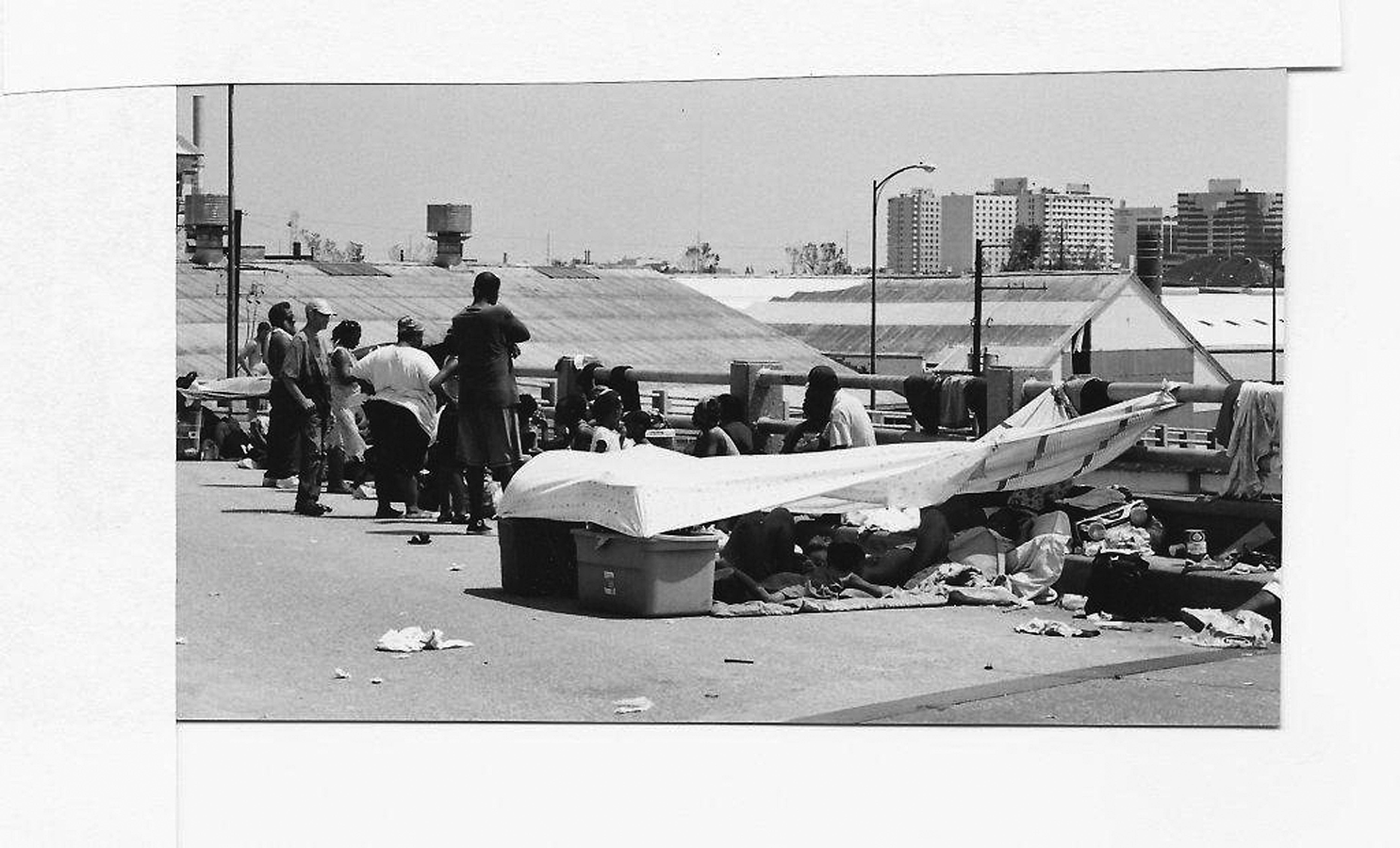
Mary Gehman: “By Wednesday, our second day on the overpass, all we could do was talk about how to survive the intense heat and total lack of food or water. Here a make shift tent from a bed sheet and blanket provides minimal shade for two infants. The N.O. downtown business district looms in the background.”
Mary Gehman, Hurricane Digital Memory Bank, Object #12540.
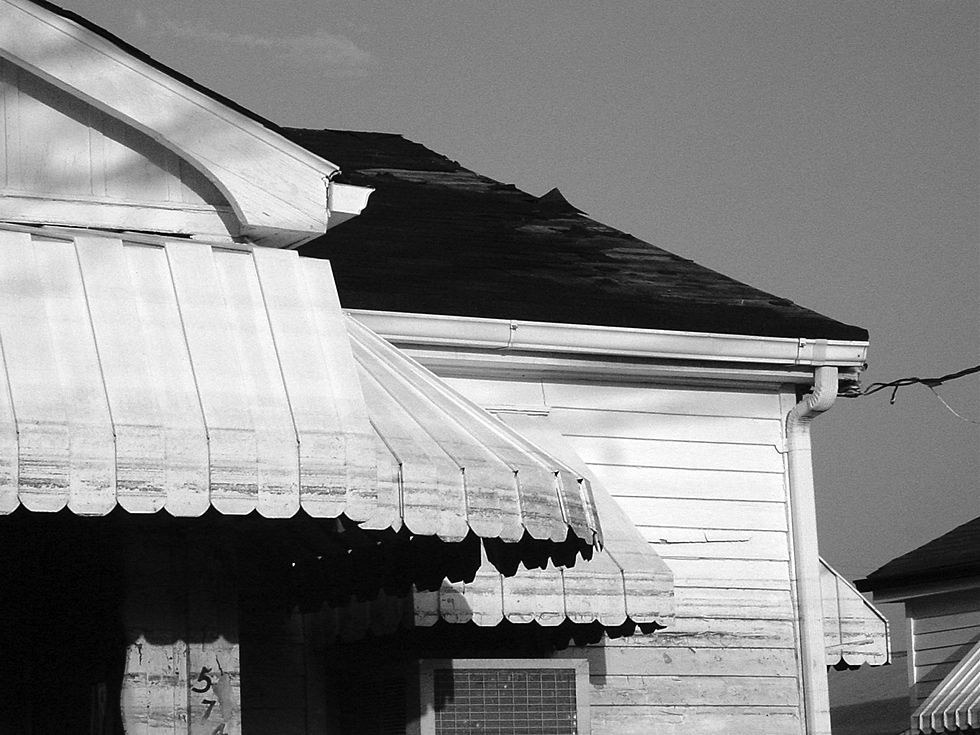
Kathleen DesHotel: “It took almost a month for the water to drain out of this Gentilly home. All was lost. All we could do was gut the home, board the windows, lock whatever we could, and return to cut the Bermuda grass that grew with reckless abandon.”
Kathleen DesHotel, Hurricane Digital Memory Bank, Object #45306.
Narrating Memories of Katrina
As the summer season draws near, college students across the United States will become involved in various community service projects. In 2006, the Corporation for National and Community Service found that the rate of community service by college students was at an all-time high. The Corporation for National and Community Service observed that this spike in college students’ rate of community service dates back to the events following September 11, 2001, and is influenced by a desire to get involved in recovery efforts following catastrophic, socio-natural disasters. The aftermath of Hurricane Katrina was no exception.
The HDMB provides a timely and novel means for facilitating college students’ community engagement. Although I am an ardent supporter of community engagement and academic service learning, I find myself constantly confronting students’ noblesse oblige orientation in their desire to help. My work with college students in post-Hurricane Katrina New Orleans has made me even more aware of this dilemma. What is often absent from students’ community service experiences is a socio-historical context for understanding the purpose of their service and for navigating the politics associated with inserting oneself into established communities and the lives of those whom they seek to help.
Because the HDMB is a virtual space that allows survivors to narrate their own experiences with Hurricanes Katrina and Rita, it can be a powerful tool when preparing college students for community engagement in post-disaster communities. The HDMB is not solely a virtual archive of survivors’ stories, as Michael shared with me; it is also a communal blog. The HDMB is a site that allows college students, many of whom are cultural outsiders to the United States Gulf Coast region, an opportunity to enter into a virtual dialogue with survivors about the complex realities of the aftermaths of Hurricanes Katrina and Rita.
A week after Katrina wreaked its havoc, I located my aunt, thanks in part to new media. As was my experience when seeking to connect with my family in the aftermath of the hurricane, digital media provide students with the opportunity to learn first-hand about the post-disaster experiences as told by the survivors.
A few of the collections hosted by the HDMB include:
Smithsonian National Museum of American History Hurricane Katrina Photos. This collection reflects the hurricane’s impact along the Gulf Coast, the rescue of survivors, and the recovery of local communities.
Louisiana State Museum Photograph Collection. 220 photographs of the destruction following hurricanes Katrina and Rita.
Katrina’s Kids Project Artwork. Started by a group of Houston-area moms to provide emotional support for young evacuees through art.
For more information
Hurricane Digital Memory Bank (hurricanearchive.org)
Roy Rosenzweig Center for History and New Media (chnm.gmu.edu)
September 11 Digital Archives (911digitalarchive.org)