



Abstract
Justin R. Goodman, Casey A. Borch, and Elizabeth Cherry discuss public attitudes toward animal testing and its growing opposition.
Opposing views on animal testing predate the scientific method. In third century Greece, physician Galen conducted experiments on monkeys and pigs, while philosopher Plotinus was a vegetarian who refused any medical treatment derived from animals. During the Renaissance, when René Descartes’s experiments on live rabbits and dogs led him to conclude animals were soulless machines, philosopher Henry More wrote a letter to Descartes decrying his theory as “deadly and murderous.”
Today, more animals are being used in experiments than ever before (around 100 million in the United States alone), and the debate about this practice has never been more visible. Dueling letters to the editor appear in major newspapers, and billboards featuring sympathetic photos of children and monkeys overlook buildings and highways in many cities. Every day, Google aggregates a list of animal testing-related news stories, blogs, petitions, message board discussions, scholastic essays, protests, and press releases. The issue has even been the plot basis on several episodes of the hit TV dramas Law & Order and Grey’s Anatomy, and in the big-screen comedy Legally Blonde 2.
Animal advocacy groups contend that the biological, emotional, and cognitive similarities between humans and other animals make the practice of using animals in experiments unethical. Some opponents to animal testing cite research such as the Food and Drug Administration finding that nine out of 10 drugs that are safe and effective in animals fail in human clinical trials, to argue that animal experiments do not reliably predict outcomes in humans, and can even be harmful.
Those in favor of animal testing use these same interspecies similarities to justify the use of animals as models for humans, and they point to Nobel Prize-winning research involving the use of animals, such as the development of in vitro fertilization, which won the award in 2010. They argue the potential benefits to human health justify the harm caused to animals, and that existing laws and guidelines adequately regulate the practice.
Shifting Attitudes
While the fundamental arguments for and against animal testing have changed little over time, public opinion data reveal that attitudes toward the issue have shifted dramatically. The first national survey on the subject was conducted in 1948 by the National Opinion Research Center, and showed that 84 percent of the public supported the use of animals in experiments, while 8 percent opposed it. Today, multiple sources suggest support rests somewhere between 40 and 60 percent, with opposition continuing to mount.
Since 2001, the Gallup Organization has conducted an annual “Values and Beliefs” survey that asks a nationally-representative sample of approximately 1,000 American adults whether they find 16 different controversial social issues, including “medical testing on animals,” “morally acceptable” or “morally wrong.” In addition to being conducted by an independent party, the Gallup rolling cross-sectional survey has several advantages over other special interest polls on animal testing. The survey is based on a representative sample of the general public, consists mainly of questions on non-animal issues, and uses the same questions each year.
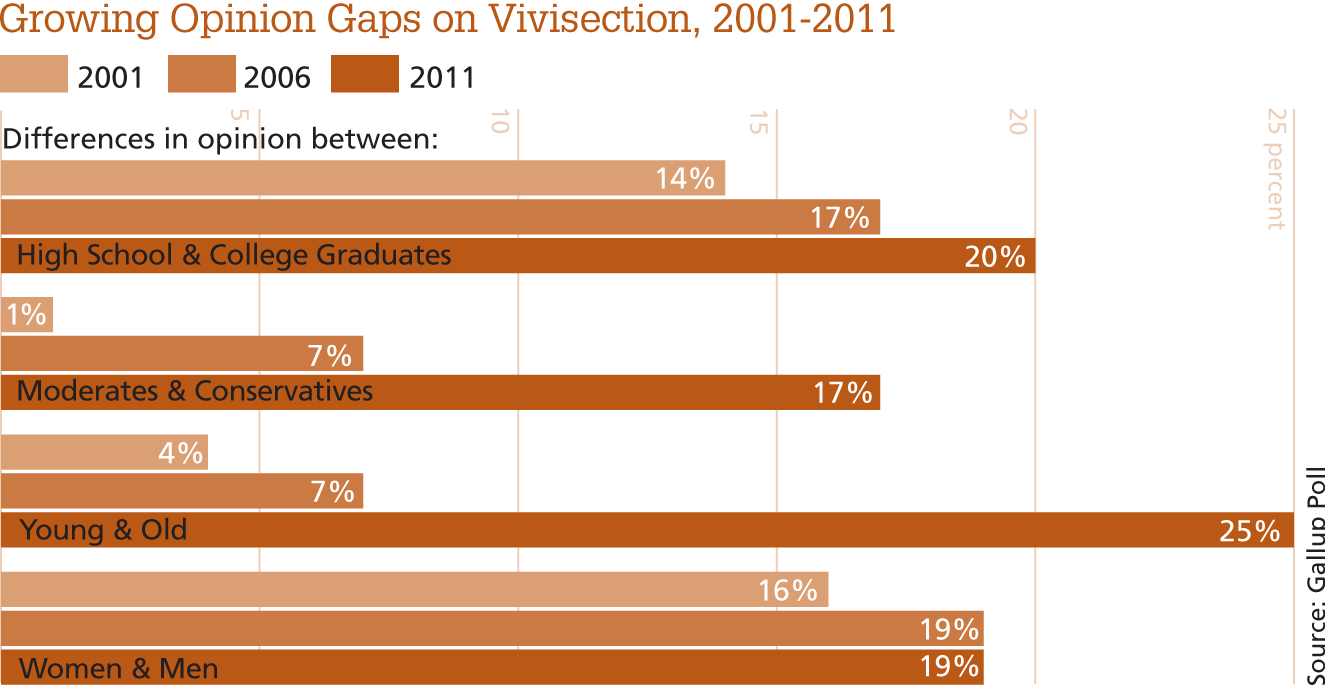
According to the Gallup poll, between 2001 and 2011, overall opposition to animal testing rose from 33 to 43 percent. In 2011, 52 percent of females and 33 percent of males opposed animal testing. Social scientists generally attribute this difference to women’s greater care and concern for animals and vulnerable populations.
Growing Opinion Gaps on Vivisection, 2001-2011
Source: Gallup Poll
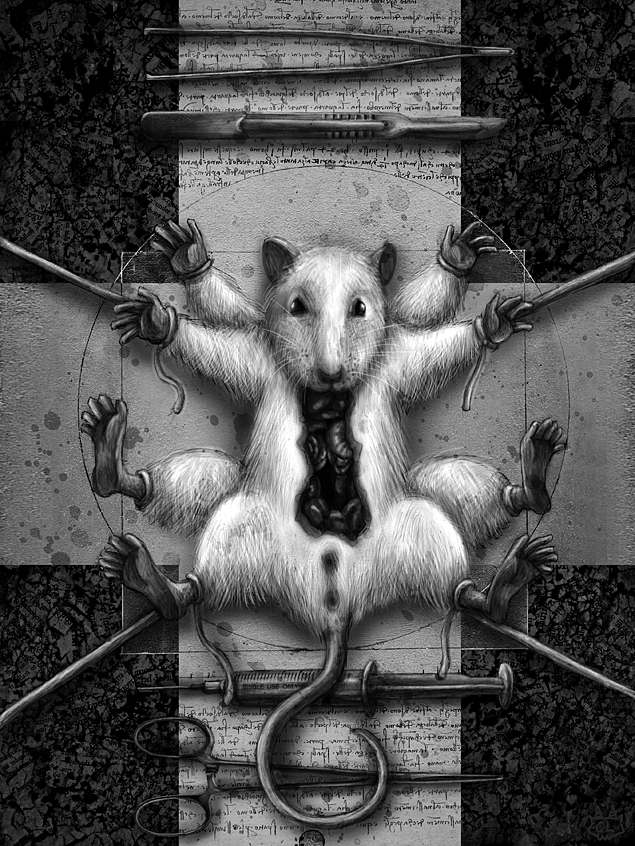
Chieh Lee (behance.net/chiehlee)
Teens and 20-somethings’ opposition to animal testing peaked at 59 percent in 2011. This increase of 25 percent since 2001 is the largest among all the demographic groups measured in the survey. Other age categories measured modest increases in opposition as well, with those 65 and up being the only group without statistically significant changes since 2001. Seniors’ opposition remains consistently at about one-third, indicating that generational differences in attitudes about animal testing may be becoming more pronounced.
People of all education levels showed significant increases in opposition to animal testing. Those with less than a high school education reported the greatest opposition (65 percent) among any demographic group measured in the 2011 survey, even when controlling for age. Conversely, only 27 percent of college graduates object to animal testing. One of the most intriguing findings from this analysis was that across all survey years, peoples’ support for the practice rose with their level of education.
These education-related differences may reflect people’s predisposition to oppose harmful animal uses. Those with more formal education may be more prone to rationalize and support animal testing because they have been exposed to information that explicitly promotes the practice (biology and psychology textbooks).
Not surprisingly, liberals have shown the greatest opposition to animal testing in almost every year of the survey, possibly because it is an issue often framed in terms of those with powerful interests exploiting and harming the weak.
Previous research shows support for animal testing depends on the nature of the tests in question, and the use of animals for “medical” purposes, which is what Gallup asks about, has historically garnered the most public support amongst all forms of animal testing (versus cosmetics testing, for example). However, our analysis shows people are growing less tolerant of this practice as well.
Recent polls conducted by Pew and other survey organizations commissioned by pro-animal testing groups reflect similar downward trends in support. Pro-animal testing groups’ concern about falling support for animal testing even prompted a series of national advertising campaigns defending the practice, including billboards across the country reading, “Ever had leprosy? Thanks to animal research you won’t.”
Oppositional Campaigns
What explains these substantial shifts in public opinion toward animal testing? While more research needs to be done to better understand the precise cause of decrease in public support for animal testing as indicated in the Gallup surveys, animal testing supporters attribute this increased opposition to animal protection groups’ effective outreach to the public. Studies show one of the primary ways people first encounter animal issues is through literature and videos produced by animal protection groups. Given the increase in Internet use since 2001, adults now have more opportunities than ever to confront information about what happens to animals in laboratories.
Animal protection organizations have become savvy about harnessing Internet technology to engage the public. A Fall 2011 analysis by Craig-Connects, a website about nonprofits run by Craigslist founder and internet entrepreneur Craig Newmark, found that animal protection issues are the most visible and discussed of all major nonprofit causes on Facebook and Twitter. Indeed, in March 2012, People for the Ethical Treatment of Animals (PETA) had more than 1.8 million followers on its two main U.S. Facebook pages, while leading pro-animal testing groups, Foundation for Biomedical Research and Speaking of Research, had less than 14,000 combined.
Research from animal industry groups shows that the public now also trusts animal advocacy groups like PETA and the Humane Society of the United States more than they trust the industry on issues of animal welfare, and that negative media coverage of animal industries not only influences attitudes, but it affects consumer behavior.
These changing public attitudes are often cited by parties on either side of the issue, but for very different reasons. The animal protection movement views the increasing opposition to animal testing as a clear sign of progress, while stakeholders who support animal testing see them as threats to the future of the practice. Regardless of where one currently falls in this debate or what accounts for these changes, it is clear that the tide of support is turning away from animal testing.