



Abstract
Using accounts from several professional Latin dancers augmented by the author’s own experience, Julia A. Ericksen traces the ways bodily perfection has become an important part of dancers’ identities. In addition, Ericksen argues that this is a more extreme form of general cultural pressure to engage in bodywork.
Keywords
U.S. and Professional Latin Champions Ricardo Cocchi and Yulia Zagoruychenko.
©2011 Jonathan S. Marion
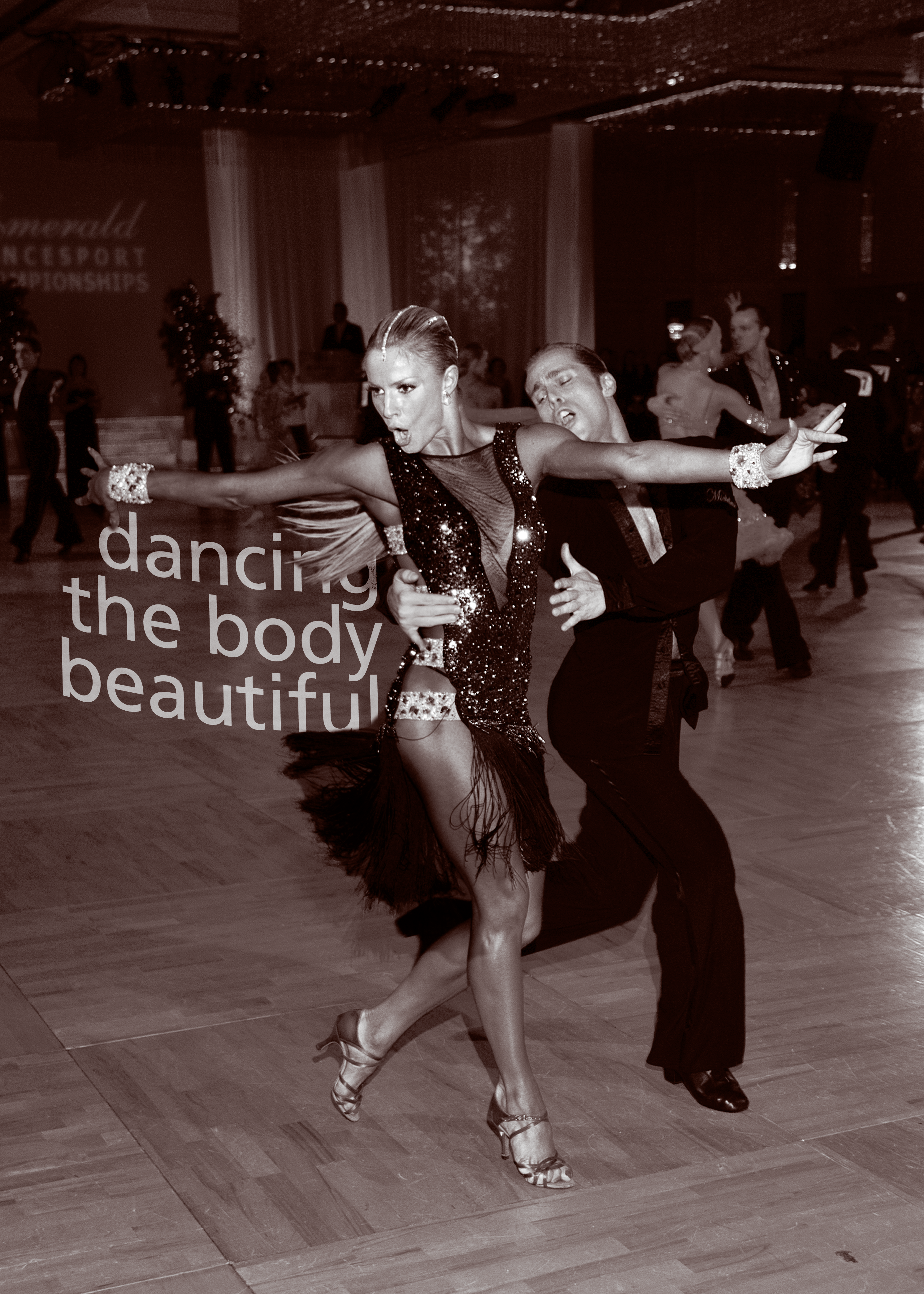
In the professional Latin event at a ballroom dance competition, men wear dance pants with tight shirts open to the waist, showing bulging chest muscles. Their hair, which must stay motionless and shiny for the entire event, is glued back with gel and blow-dried with hair spray. Faces are tanned, and matte makeup makes the skin appear translucent and blemishfree. Men’s high-heeled shoes are immaculate and usually black, as is the costume. Bodies are perfectly proportioned with no fat in sight.
Each handsome man frames an equally gorgeous woman, wearing a brightly colored skimpy dress that flares out with every move, embellished with hundreds of Swarovski crystals, glued by hand, as well as earrings, bracelets, and necklaces in matching stones. High-heeled, open-toed shoes are typically flesh-colored, to make legs look longer. Women’s backs are bare and tanned, and faces are elaborately made up. Hair is long, swept up or in a ponytail. Not only are the bodies taut and muscular, but the heights and looks of each member of the couple are purposely matched.
While looks have always been important on the dance floor, they have become increasingly important in recent years, especially in Latin dance. Clothing has become more revealing and unforgiving of imperfections, and dancers’ concern with appearance has intensified. Dancers’ identities have become intertwined with the bodywork they do, and the bodies they produce.
I became interested in studying ballroom and Latin dance after my husband and I started taking lessons about 10 years ago. I had danced as an adolescent. My parents, like many members of their post-World War I generation, met on the dance floor (in Blackpool, in the North of England), on what is now a famous competition dance floor. I abandoned ballroom when it fell out of favor in the 1960s. Recently, I became passionate about learning to dance, and also about competing.
Every weekend in America, students compete in “pro/am” (professional-amateur) dance, which means that they dance with their teachers. They compete during the day and watch professional competitions at night. Pro/am began in chain dance studios as a way for professional dancers to supplement their incomes and subsidize professional competition. It is now so popular and lucrative that professionals from all over the world come to the U.S. to teach and compete.
The over-the-top look of Latin dance used to puzzle me, but now I embrace it, along with the demands it puts on the performer. In addition to the pleasure of syncopated steps in time to sexy Latin music, I love the intimacy of the dance studio, and the permission it gives me to violate the rules about touching a man other than my husband. I like the fact that students view the professional dancers as their models for what a dancer should look like, and that well-toned older bodies in skimpy costumes are a common sight. It has made me interested in improving my body, and I am happy that at age 70 I have flexibility, balance, and strength.
As a sociologist, I became interested in how professional dancers—especially Latin—produce the bodies we see on the dance floor. My interviews and ethnographic research on top dancers suggests that bodywork has become increasingly important to Latin dance in recent years.
Tsvetanka’s Story
A dancer in her late twenties, whom I call Tsvetanka, had been dancing since age four. Off the floor, most dancers look ordinary, but Tsvetanka is stunningly beautiful. She describes her look as the result of hard work, and puts constant effort into creating and maintaining her appearance. This bodywork begins with physical exercise. Tsvetanka takes gyrotonics classes—an exercise similar to Pilates and popular among dancers—twice a week, in addition to hours of dance daily. In the beginning, she worried that she might get too bulky, but found instead, she said, that her body “became longer, more stretched.” In her late teens Tsvetanka had been “chubby, not chubby-chubby, but my thighs were bigger.” Everyone noticed the change, after she started gyrotonics, because the exercise regimen elongated her muscles and “created more elegance.” It also improved her flexibility, strength, and balance.
Dancers’ identities have increasingly become intertwined with their bodywork.
Tsvetanka was careful about diet. When she was younger, she and her partner would “eat whatever,” but now they have a nutritionist who teaches them “what is good and what is bad,” and “how to eat for energy.” They eat nothing that is not part of their prescribed regimen. This is in marked contrast to earlier years in her home country, when they survived their first overseas competition by smuggling salami, bread and ketchup across the border, using the little money they had to buy stones for her dress. Their hunger did not matter, she said, because they finally had the chance to see the all-time Latin dance greats, Donnie Burns and Gaynor Fairweather. After that, said Tsvetanka, “We were hooked, we wanted to be like them, from the makeup to the dress, to everything.”
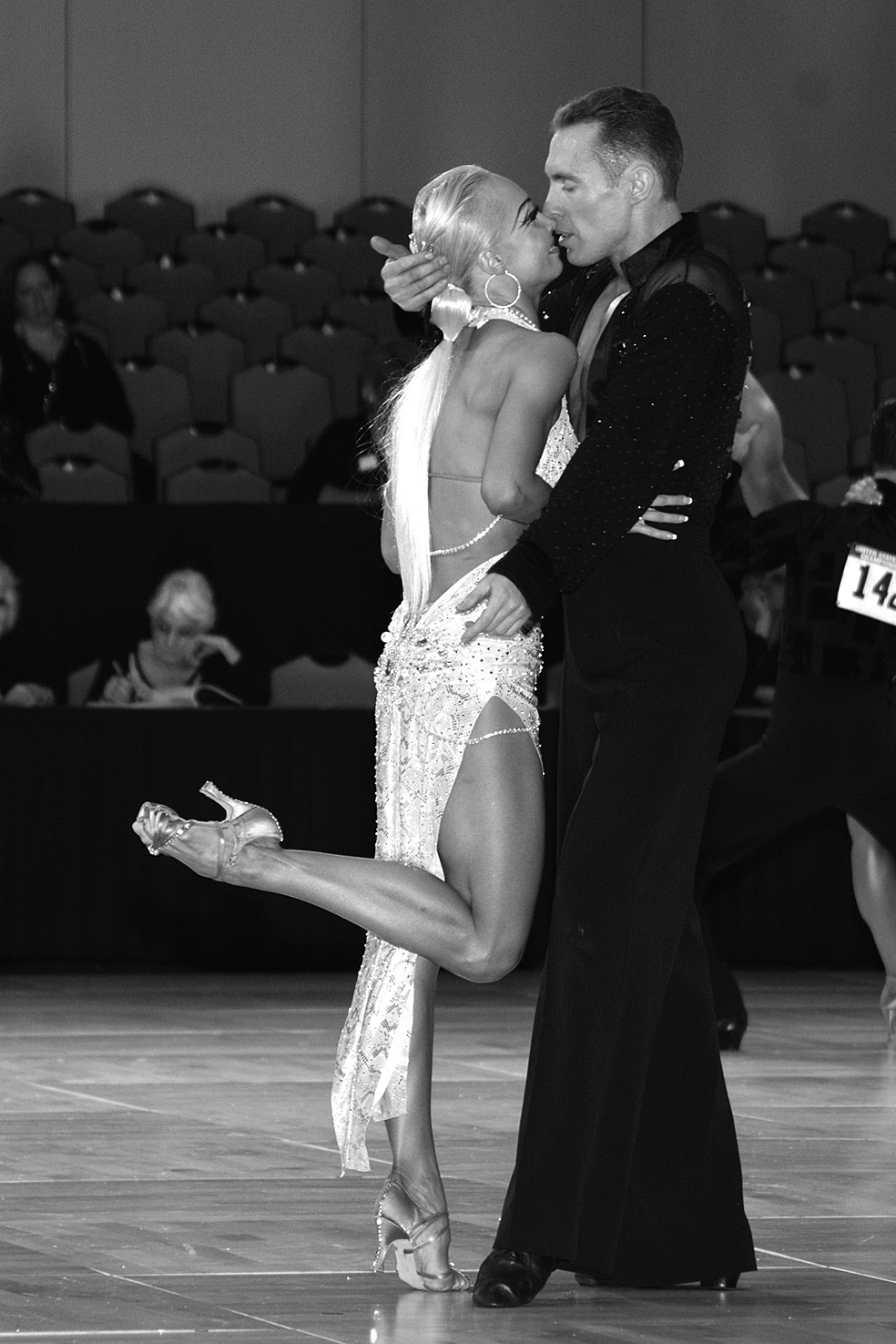
U.S. and World Professional 10-Dance Champions Gherman Mustuc and Iveta Lukosiute.
©2007 Jonathan S. Marion
In addition to creating her physical body, Tsvetanka spends countless hours planning her costumes. She keeps a “little board” beside the dining table and “everything I like, from the Oscars, from the Grammys, from the red carpet, I cut from the newspapers and magazines, and I put there.” Every day, her husband/partner adds ideas, sometimes from other competitions, creating designs for her next dress. Even at mealtime, they are absorbed in bodywork. After her dresses are made, she spends hours decorating them with stones herself, and decorating Pavel’s shirts to match hers. On the day of the competition, this appearance work intensifies. They put on their tans, and apply eyelashes and makeup. Since Tsvetanka is not particularly good with her hair, Pavel does it, as he has done so “since [they] were little kids,” she says. Sometimes she helps him with his hair and makeup as well.
This appearance work naturalizes gender, making it visible and obvious.
Tsventanka and her partner have compatible looks, which she believes is important. They are tall, dark, and slender with long legs. Tsvetanka believes that their similar shapes aid their dancing, as well as their appearance. “I’ve seen couples where both man and the lady are very, very good, but for some reason,” she says, “the body structure, it’s not as great.” Having compatible body structures is important, she says, “if you want to have a great success.” They coordinate their clothing to accentuate this similarity. (Tsvetanka’s point about the importance of matching bodies is illustrated by the images of dancers Gherman Mustic and Iveta Lukosiute, pictured left. Like Tsvetanka, Iveta’s semi-nude body reveals gleaming, tanned muscles, and her height matches that of her slender but muscular partner.)
While most professional dancers told me that the quality of the dancing should be the most important part of competition, they recognized that flawless beauty creates the appearance that they have a romantic relationship. “You have to be very well attached on the personal level,” says Tsvetanka, who believes that relationships appear more genuine and passionate when those involved are beautiful. In Latin dancing, unlike other forms of dance, audience members call out the names of their favorite couples during competitions. Dancers like Tsvetanka exert great discipline and control to achieve bodies that look “naturally” sexy.
The cultural mandate of thinness is also evident on the dance floor. While ballet dancers must be waif-like, with no perceptible curves, Latin dancers are supposed to be curvaceous but slender—not as thin as ballerinas, but without an ounce of extra fat. The appearance work Tsvetanka performs, both as part of her regular routine and before a competition, makes performances more pleasurable for the judges, the viewers, as well as for the dancer and her partner. We are conditioned to enjoy looking at what we see as desirable, and to believe in the story beautiful dancers tell. But their beautiful bodies are the products of rigorous behind-the-scenes discipline.
This appearance work also naturalizes gender, making it visible and obvious. Bodies in Latin dance are strictly gendered, and while some of the men are openly gay, the performance is always heterosexual, facilitating audiences’ fantasies of heterosexual romance. Though ballroom audiences are knowledgeable about dancing and about the work involved in creating an illusion, they respond to this romantic fantasy. Couples accentuate this by wearing matching outfits.
Gender scholar Susan Bordo, in her book Unbearable Weight, describes a culture in which slender, athletic bodies have come to represent the ideal woman in control of her appearance and destiny. Women are logically responding to the culture when they go to great lengths to monitor how they look. At the same time, fashioning their appearance also gives women power and pleasure. Historian Kathy Peiss, in her history of American beauty culture, Hope in a Jar, argues that the pursuit of beauty “has never been only a regimen of self-appraisal and surveillance.” Women use clothing and makeup for many purposes: to declare adulthood, sexual allure, and to define themselves.
Tsvetanka’s attention to her body is an extreme example of Bordo’s point, testifying to the satisfaction she achieves from looking beautiful on the dance floor. Her whole identity is bound up in dance, but also in the bodywork she undertakes. While Latin dancers like Tsvetanka take this idealization of beautiful bodies to a higher level than most Americans, now that I dance, I experience some of this, too. I take Pilates and gyrotonics and have become more flexible, and I have greater control over my core muscles. These abilities are important in dancing, but they provide an additional pleasure when one lives in a body that one has improved through hard work and discipline. These changes are not something I imagined were possible to achieve; I grew up in a world where you accepted the body you were born with.
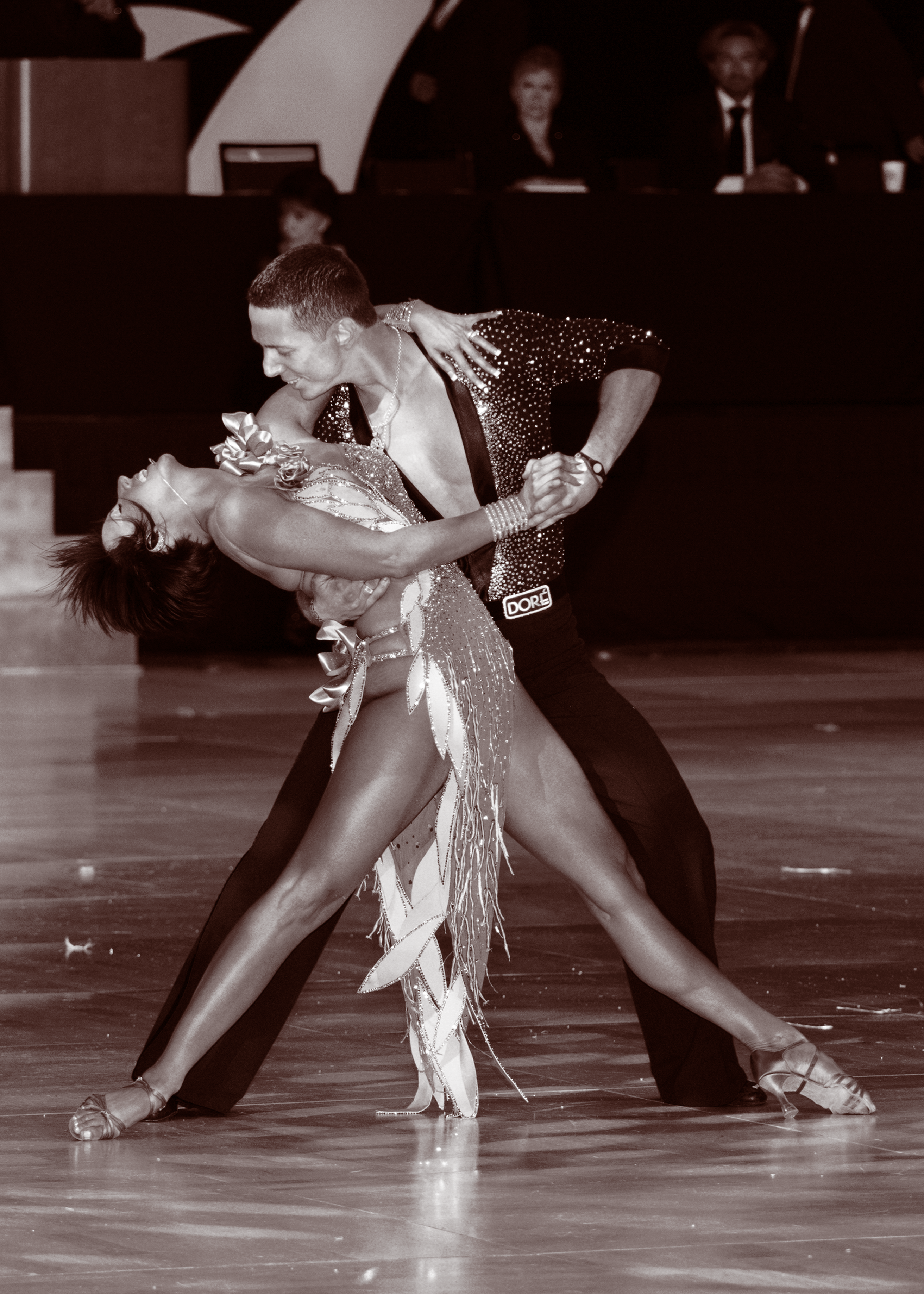
U.S. Professional Rhythm Finalists Ilya and Amanda Reyzin.
©2011 Jonathan S. Marion
No Chubbies
In the past, men were taught to make their partner the focal point of the performance, using expressions like “the man is the frame and the woman is the picture.” Today, this traditional obligation is weaker. Many men display themselves almost as much as they display their partners. For example, Pavel, Tsvetanka’s husband and partner, is as involved in appearance work as his wife. Partners, he says, “have to match well, and they have to look beautiful, and they have to match the bodies.” To accomplish this, Pavel works on every aspect of his body and its presentation. Because he does not want to be too “chubby” or too skinny, in addition to careful diet and practice and the many hours he spends coaching and teaching students, he takes gyrotonics classes, uses a Pilates machine at home, and has a personal trainer at the gym. He needs the personal trainer, he says, “because my legs are long compared with my torso.” In order to be, “connected with the center [of your body], you get tired.” He works on his upper body, and on general physical toning.
Pavel has a complicated routine before each competition. He eats, drinks coffee, and does pushups to engage his core, and then focuses on his appearance. He shaves and does his hair, as well as his partner’s. As Tsvetanka puts on her makeup, he offers her constant advice, “Do more of this. Don’t do that.” Sometimes they fix their costumes, or experiment with something new. Finally, two hours before the competition, when they are happy with their looks, they warm up together, and get into the competitive mood by listening to music and talking quietly.
The body project is not simply something dancers do; it is who they are.
Pavel believes that their meticulous attention to detail pays off. “In the beginning,” he notes, “when we didn’t know how to dance so good—because we always dress well, we always did good.” Some dancers, he adds, do not know this. “Sometimes you go to practice, and you see very good couples, and you’re like ‘Wow, damn, they’re very good.’ Then the competition starts, and they wear crap. The girl has such a gorgeous body, and, she puts so much stuff on her, she looks like a Christmas tree.” Pavel believes that it is important to impress the judges and the audience with the right appearance and look before the dancing begins. Clothing should show dancers’ best features and hide the flaws, he says.
One might contrast the story of these dancers, who are at the peak of their competitive careers, with a somewhat older dancer, Peter, who retired from professional competition at about the time that bodywork increased in importance. When asked about exercise, he pays lip service to the idea: “I should. I don’t,” he says. These days he notes, “couples coming up are doing exercise, they are going to the gym, they are getting bodies beautiful.” However, he believes that dance itself is sufficient exercise: “When you’re practicing every day, you’re dancing, you’re teaching people to do it the right way. You’re exaggerating the movements; you’re actually using a lot of resistance in your own body to show them.” Peter adds, “I could always do more exercise, and I could always be fitter, and that would help, but I don’t want to be so tired that I can’t do anything.” When asked about his diet, Peter smiles and says, “Before a competition I eat less ice cream.” When he prepares for competitions, he adds, “the weight just drops off you.” Though he might put a few pounds on afterwards, he is confident that it will come off.
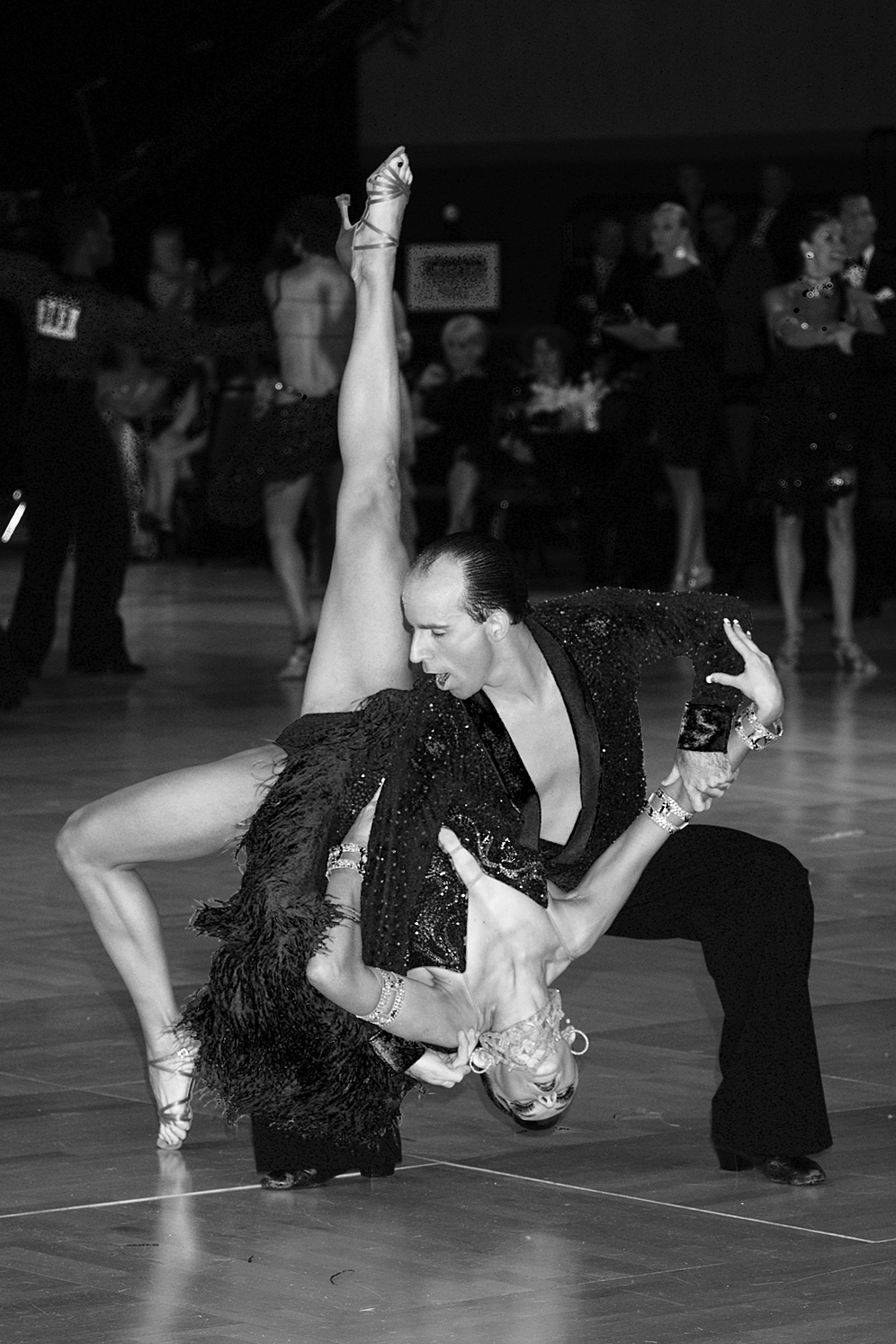
U.S. Professional Rhythm competitors Stephen Smyth and Viktoriya Kleyman.
©2011 Jonathan S. Marion
Peter’s account is typical of older dancers who put their energy into practicing and worried less about their appearance. Peter credits being “mentally strong on the competition floor” for his success. He never gives in; he describes his attitude as “a lot of sheer bloody-mindedness really.” Every now and then, he turns over a new leaf by going to the gym for a few weeks. However he adds, “then I’m travelling or I’m teaching and suddenly I don’t have the time.” Peter believes that bodies can be improved through hard work, but it is not a priority for him as it is for younger dancers. His identity as a dancer is not as dependent on looks.
Still appearances matter. “When you’re out on the floor, first impressions count,” he says. This means having “the right costume, the right hair, the right makeup.” Furthermore, he says, “it helps if you’ve got a beautiful girl; it helps if you have a handsome guy.” Still, he believes “people who are not so good-looking, or bit of a funny shape” could overcome this if they dance well. He names past champions who did not have beautiful, matching bodies, suggesting that they overcame their body limitations through the force of their personalities, and through their dancing skill. Only a few years ago, the world champion, Bryan Watson, covered his belly with a long shirt that hung over his pants. His partner, Carmen Vicenji, was slender, but she was cavalier about her appearance, and wore her hair in a short, manageable bob. For younger dancers today, appearance is increasingly important.
The Pursuit of Perfection
The body project is not simply something that dancers do. Increasingly, it is who they are. Their identities are bound up not only in what they do on the floor, but also in how they look. Why this change has occurred is not entirely clear. Perhaps perfection appears to be more attainable today. As exercise and diet are pushed by the media and absorbed by the public, bodywork has become a generalized part of our culture. Every young dancer I interviewed believes that bodies are malleable, and that it is incumbent upon them to achieve their body’s fullest potential. One Latin dancer says, “Your body is the only thing you ever truly own,” so of course you should treat it carefully and work hard to improve it. The idea of “owning” something that is part of you is a perfect illustration of the ways the body has become a “project.”
Having largely ignored the body, sociologists have recently become interested in how social systems create the bodies we inhabit, and how bodies limit and enable social forms. While our ideas about what is possible and what is beautiful arise from our culture, the physical body places limits on these expectations. Latin dancers have moved from a world where it is possible to enhance one’s body, but only to a degree, to a world where the possibilities of perfection seem limitless and where, if these limits seem insurmountable, partners must change. Younger dancers like Pavel and Tsvetanka feel a moral imperative to perfect their bodies and their appearance, and to dance with a partner whose looks enhance their own. Savvy about creating a visual image of heterosexual romance, they offer an extreme example of the pervasive ways we are all encouraged to discipline our bodies.