



Abstract
Sociologists Laleh Behbehanian and Michael Burawoy explore what it means to view the global through a distinctively sociological lens.
Keywords
From climate change and environmental destruction to drug trafficking and organ trading, from the crises of finance capital to the threat of terrorism, key challenges are facing a globalizing world. But how can sociology grasp the global?
To start, we should not confuse the “global” with the “universal.” American sociology has a long history of positing a very peculiar society as the only society, and professional sociologists in the United States have often imagined their objects of study as universal: the Chicago School saw Chicago as the universal city; structural-functionalism projected the U.S. as the modal modernity; and neo-institutionalism regards the U.S. as the lead society. Titles of books about the U.S. frequently generalize their claims without geographic specification: Habits of the Heart, The Second Shift, The Lonely Crowd, Political Man, Street Corner Society. To insure that “global sociology” doesn’t become American sociology writ large, we need to approach the global from multiple locations and perspectives.
Global Sociology, Live!
What does it mean to view the global through a distinctively sociological lens? This question motivated us to offer the course “Global Sociology, Live!” at the University of California-Berkeley in Spring 2011. The 30 students in the class, all undergraduates, came from diverse social and national origins, and, like us, they were interested in developing a sociological lens through which to understand the world beyond the US.
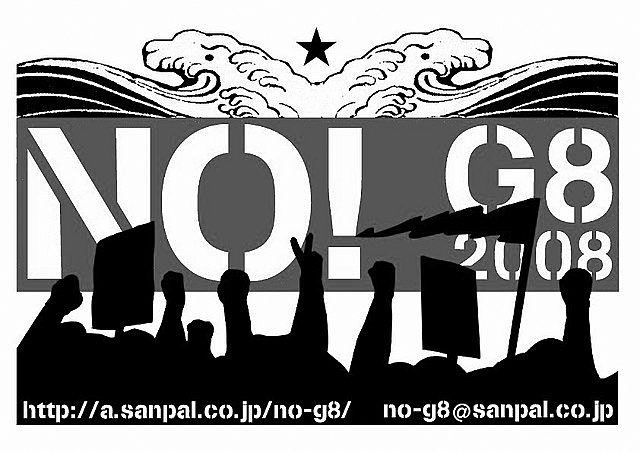
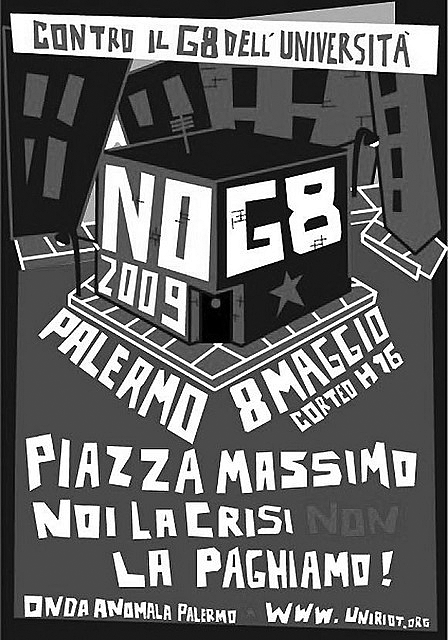
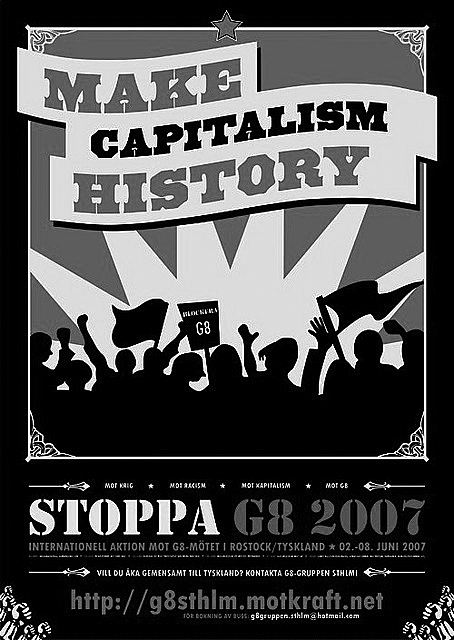
Posters announcing protests of meetings of the G8 Summit and the World Economic Forum. The protests were organized by the Global Justice Movement, which opposes “corporate globalization,” suggesting that “another world is possible.”
Posters reprinted from Sebastian Haunss’s online collection of posters from the Global Justice Movement (picasaweb.google.com/SocialMovementResearcher/GlobalJusticeMovementPosters).
Der Kampf geht weiter WEF, NATO, G8 by Antifa Bern u.a. (Basel, January 27, 2007.)

WEF Golf 1 by Plakate gegen das WEF (Davos, January 26, 2005).

Impede g8 (Japan, July 7, 2008).

The course’s pedagogical design was global in a number of ways. After a series of introductory seminars on the topic of global sociology, we devoted each week to engaging the work of a particular scholar. We focused on topics with a transnational character: the global reach of finance capital, the workings of multi-national industries, the international efforts of multi-lateral agencies, and the emergence of global social movements.
As students developed memos based on their weekly course readings, topics emerged organically through class discussions that were often virtual, integrating scholars situated throughout the world, including the Philippines, India, Colombia, Lebanon, South Africa, and the U.S. These sociologists joined our classroom through video conferencing or Skype, which enabled them to directly engage with our students. These discussions were recorded and uploaded onto the International Sociological Association’s (ISA) website so that they could also be viewed around the world. Our students even created a public blog to encourage broader dialogue around these discussions.
What is Global Sociology?
The foundational question of “what global sociology means” requires an answer to the question “what does sociology mean?” Here the danger of particularity already becomes clear. Sociology grew up in Europe at the end of the nineteenth century with the development of civil society—a sphere of institutions, movements, and publics that are neither part of the state nor of the economy. This vision of societal development can be traced to the writings of Antonio Gramsci, who focused on the relation of state and civil society, as well as Karl Polanyi, who focused on the relation between the market economy and the “active society” which emerged to contain the excesses of the market.
American sociology has a long history of positing a very peculiar society as the only society.
Sociology is not simply the investigation of civil society (though it does include that), but the study of the world from the standpoint of civil society—just as economics is the study of the world from the standpoint of the market and political science is the study of the world from the standpoint of the state or, more generally, the political order. Insofar as we are living in an era when state and market conspire to erode and destroy civil society, sociology stands in fundamental opposition to the converging projects of political science and economics. But if sociology takes as its standpoint civil society, when civil society is weak, underground, or non-existent, sociology will also be weak, underground, or non-existent. We see, therefore, the disappearance or invisibility of sociology in Stalinist Russia, Pinochet’s Chile, or Nazi Germany.
Therefore, global sociology presupposes a global civil society that emerges in the context of a global economy and global political orders. This stance provided an organizing framework for our course. We began by focusing on the increasingly global character of capital, launching the series with geographer David Harvey (New York), who presented his theory of neoliberalism as a global accumulation strategy of the capitalist class that takes various forms in different national contexts. We then proceeded with Michael Watts (Berkeley) discussing global capital’s pursuit of cheap oil in Nigeria and the social devastation it leaves in its wake, followed by Ananya Roy’s (Berkeley) analysis of how the power of finance capital extends into even the poorest of countries through the spread of micro-finance programs. We then concluded the first part of the course by focusing on the case of Chinese capitalism with Ching Kwan Lee (Los Angeles), who gave us an account of how the Chinese state has managed to tame the market, producing unprecedented rates of economic growth by relying upon a system of cheap migrant labor.
No G8 Action Japan (Japan, July 7, 2008).

No G8 2008 Japan (Japan, July 7, 2008).
Block the G8 by aarrg (Evian, June 3, 2003).

We then moved to an issue that repeatedly surfaced in our early discussions: the role of international organizations that purportedly serve as instruments for regulating global capitalism. Walden Bello (Manila) discussed the workings of multilateral agencies, specifically the World Bank, the IMF, and the World Trade Organization, offering a critical analysis from the standpoint of the Global South—frequently the target of devastating economic programs of structural adjustment. This inspired us to explore the political orders that accompany global capitalism in different countries. Sari Hanafi (Beirut) presented us with an account of how the Israeli state governs the Palestinian population through “spacio-cide”—a strategy of rendering colonized spaces uninhabitable and reducing Palestinians to “bare life.” He emphasized that such “states of exception” are not confined to Israel, but can be found all over the Arab world.
We turned our discussion to the crumbling political orders being challenged by the protest movements currently emerging in the Arab world. Laleh Behbehanian (Berkeley) then shifted our focus from the Middle East to the U.S. and its global pursuit of “terrorists.” She discussed how U.S. counter-terrorism practices are oriented around a pre-emptive logic that eludes the rule of law and relies upon extensive cooperation and collusion among the security and intelligence agencies of other states. Just as we had focused upon global capitalism in the first part of the course, we now began to see the contours of a global security apparatus in which other nations act as proxies for the U.S.
A global sociology would identify the forces that obstruct the development of a thriving global civil society.
Having explored the global character of contemporary economic and political orders, we were ready to consider the possibility of a global civil society that could serve as the foundation of a global sociology. The ever-optimistic Peter Evans (Berkeley) discussed his vision of counter-hegemonic globalization, which would require braiding together broad social movements—labor, environmental, women’s, and human rights organizations—across national boundaries. A number of scholars also offered real examples of emerging counter-movements, including Eddie Webster (Johannesburg), who discussed (largely unsuccessful) efforts at organizing labor across national boundaries and Amita Baviskar (New Delhi), who complicated our understanding of the global environmental movement by highlighting its class dynamics.
César Rodriguez-Garavito (Bogota) provided an account of how the life-and-death struggles of indigenous communities in Columbia are shaped and constrained within a vertical global field dominated by NGOs, the Columbian state, international organizations such as the UN, and the International Labor Organization (ILO)—as well as multi-national corporations seeking to expropriate indigenous lands and resources. We concluded our search for global counter-movements with Erik Olin Wright (Madison, Wisconsin) who proposed a very different approach. Rather than pursuing ephemeral transnational movements, he called on us to identify “real utopias”—actually existing institutions promoting social justice and participatory democracy. Global sociology, in this view, entails “archeological” efforts to unearth utopias and understand the conditions under which they can be sustained and spread.
Our search for a global civil society that might ground an effective counter-movement against the collusion of global capital and nation-states yielded only fragments and failed attempts. If sociology studies the world from the standpoint of civil society, and if there is, at best, only an embryonic global civil society, what then does this mean for the possibility of a global sociology? We concluded the course by identifying three possible approaches.
No G8 by Onda anomala Palermo (Palermo, May 8, 2009).
Make capitalism history. Stoppa G8 by g8sthlm (Heiligendamm, May 2, 2007).
Contre sommet du G8 by aarrg (Gênes, July 19, 2001).

The first focuses on the forces, like global capital, or states, which fragment or contain civil society. Here, a global sociology would identify the forces that obstruct the development of a thriving global civil society. A second approach might work with existing embryos, whether “real utopias” or ephemeral transnational connections, examining the conditions of their existence, perpetuation, dissemination, and expansion. The third approach calls on sociology to actively partake in the construction of a global civil society. Though sociology was initially developed with the emergence of civil society in the nineteenth century, today’s global sociology must actually strive to build a global civil society. No longer standing outside the world it studies, sociology takes on the role of participant as well as observer, creator as well examiner, and subject as well as object. In other words, global sociology is tied to public sociology.
Public Sociology, Live!
At the end of our experimental course, we engaged in collective reflection. We realized that the global conversation, regrettably, never materialized—despite the fact that our seminars were recorded and available globally, thousands of people viewed them, and students tried to establish contact with the wider world through their blog.
Even though the lecturers joined us from all over the world, they were also all trained in the West, spoke fluent English, and accepted the terms of the course to develop a global sociology. Thus, their contributions were limited by being oriented around questions raised by Polanyi, Gramsci, and Harvey. In this sense, the course didn’t adequately create a space for challenging our theoretical framework and expanding our vision for the possibilities of a global sociology.
The next version of our course, to be offered in Spring 2012, will begin where we left off, turning “Global Sociology, Live!” into “Public Sociology, Live!” We have selected colleagues from across the globe who are engaged with local and national publics and asked them to explicate how they go about “doing” public sociology. In this way, we’ll get a better sense of the distinctive sociologies that spring forth in different parts of the world and how they are organically connected to their communities. As we learned, discussions that emerge exclusively out of one location are not truly global, so now we’ll bring globally dispersed public sociologies into conversation with one another. Our colleagues around the world will organize their own courses and connect them to the seminars recorded in Berkeley. In other words, a series of parallel seminars will take place around the world, around the same issues. The students in these seminars will be connected through a website where they’ll post comments and engage with each other’s ideas.
Through these efforts, we hope to build a global community of young sociologists committed to a project of public sociology, generating novel approaches to understanding global issues through diverse local lenses. You can watch this unfold on the Digital Worlds of the ISA website, and even participate by running your own course in connection with the recorded seminars. You don’t have to be a formal class, you don’t have to be sociologists, and you don’t have to speak English. Anyone can participate in this global conversation.