



Abstract
Two books, Crisis Economics and Reckless Endangerment, are compared and reviewed to shed light on economic crises and financial scrutiny. The books both look at regulatory mechanisms and the problem of getting regulations right.
Keywords
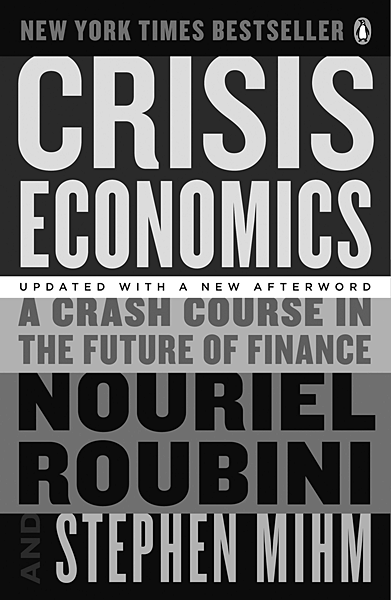
Crisis Economics: A Crash Course in the Future of Finance By Nouriel Roubini and Stephen Mihm Penguin, 2011 359 pages
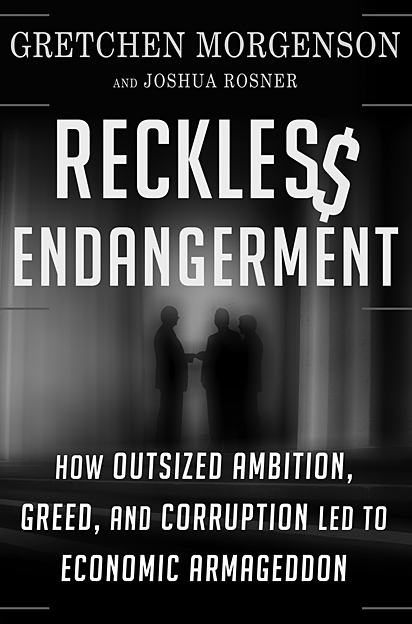
Reckless Endangerment: How Outsized Ambition, Greed, and Corruption Led to Economic Armageddon By Gretchen Morgenson and Joshua Rosner Times Books, 2011 331 pages
On Thursday evening, September 18, 2008, Ben Bernanke, Chairman of the Federal Reserve, and Henry Paulson, Secretary of the Treasury, convened a meeting in House Speaker Nancy Pelosi’s office with Congressional Leaders including Senators Charles Schumer, Chris Dodd, and Richard Shelby. During the previous 36 hours, large institutional investors and hedge fund managers had been pulling billions of dollars from leading investment houses like Goldman Sachs and Morgan Stanley. The two men with the greatest responsibility for federal financial policy had decided that the moment for the $700 billion rescue plan had arrived. Bernanke announced, “If we don’t do this, we may not have an economy on Monday.” The closed-door meeting was reported in the New York Times two weeks later, and Paulson appeared before Congress with a terse statement justifying the bailout. The initial version of the Troubled Asset Relief Program was rejected, but a second version was approved.
The lack of transparency, accountability, and responsibility that precipitated the crisis also characterized the response to it. Certainly, here was a moment begging for clarity and insight, a chance to broaden the conversation beyond the economists and journalists who brought the crisis to light and crafted its interpretive frame—but that never occurred. Though the air has been thick with concern and criticism, outrage at those who managed the crisis and benefited from the subsequent rescue has yet to alleviate suffering or rectify the 2008 calamity or mitigate its longer-term disequilibrium. The outcome of the crisis will be determined by the dialectic of social mobilization and structural change, and how the tale of troubles is told will shape the ways we imagine other possibilities.
Surely, there is a role for public sociology to play, particularly if it can find its voice in a conversation that has predominantly been taking place among economists and journalists. We need to reconsider how the narratives of crisis have been constructed around notions of immutable laws or deviant actors—with scant attention paid to how such laws achieve their force or how expunging such deviance would set the world right. While the literature on the crisis piles up, many of its underlying assumptions are left unexamined. Missing is a critical grasp of the social dynamics that flow from finance and the ways they can be subjected to public reflection. For journalists, the crisis offers an opportunity to weave a larger explanatory tale than the daily rhythms of reporting permit. For economists, it offers a public reckoning with matters that are typically treated as private. The current crisis reveals how knowledge is wrought and where its limits lie; it is a double-edged sword that cuts not only into the epistemic domain of expertise, but slices through the field of finance itself (which, after all, transforms privileged information into instruments for managing risk).
Sociology must find its voice in a conversation taking place among economists and journalists.
The journalistic account is elegantly plotted and character-driven. Gretchen Morgenson, a Pulitzer-Prize winning New York Times reporter (and author of The Capitalist Bible) and Joshua Rosner, a financial analyst, were among the first journalists to read the signs of trouble in the mortgage credit markets. In Reckless Endangerment: How Outsized Ambition, Greed, and Corruption Led to Economic Armageddon, they treat the subprime debacle as a fundamental failure of public-private partnership. Theirs is a detailed and intimate “crime story” about what happens when “unfettered risk taking, with an eye to huge personal paydays, gains the upper hand” among executives; when regulators “are captured by the institutions they are charged with regulating”; and when “Washington decides, in its infinite wisdom, that every living, breathing citizen should own a home.”
The Clinton administration’s efforts to expand home ownership in 1995, Morgenson and Rosner write, came on an economic upswing, enlisting scores of leading banks, home builders, securities firms, and realtors for its “Partners in Homeownership.” In the name of democratizing credit, the administration altered lending requirements and aided government-sponsored enterprises in their effort to bundle together mortgages in secondary markets. They believed that these securitized mortgages would provide ongoing revenue streams while home values rose—a sign of their belief in the virtue of home ownership and the government’s willingness to back it.
While actual ownership rates increased only around 5 percent—from 64 to 69 percent—its consequence was the transformation of the home from an object of security to a means for enhancing risk capacity. When the housing market imploded, risk was shifted to those with “blemished credit” and without sufficient income or assets. These recently enlisted populations (largely women, African Americans, and Latinos) were suddenly considered unworthy of home ownership—or worse—treated as the germ of contagion that sickened the entire economy.
In contrast to what has become a standard account of neoliberalism, Morgenson and Rosner focus on the role played by government attention, involvement and shaping of the market—not simply deregulation and privatization. Given the overlap of state and market, the common lament is that “too big to fail” firms undertake unsustainable risk. Governments, too, can assume more debt than they can bear, fall short on reserves, and find themselves illiquid or gridlocked in efforts to move their policy assets. The authors quote a regulator after the 2008 publicly funded salvage of Fannie Mae as saying, “Now we have created a whole new generation of government sponsored enterprises with implied federal guarantees. The cancer isn’t gone—now it has metastasized.” At the same time, government and corporations have reserves at their disposal, but are unwilling to increase revenue or invest. Though they imagine the proper balance and separation between government regulation and private enterprise can be restored, what Morgenson and Rosner so thoroughly detail suggests otherwise.
The threat of “moral hazard” and the problem of getting regulation right also looms large in Nouriel Roubini and Stephen Mihm’s lucid and comprehensive Crisis Economics: A Crash Course in the Future of Finance. The credibility of economics rests upon its powers of prediction; financial firms apply mathematical formulae to price risk. The ability to discern the truth (or transparency) is key. Indeed, as leaders around the world (from the Queen of England to Vice President Dick Cheney) have asked: Why did no one see the crisis coming?
Well, Roubini did. Now he wants to expand the economics canon to include “crisis” as a core concept—a shift that would return John Maynard Keynes to prominence, along with a wider cast of characters, such as Hyman Minsky and even Karl Marx.
According to Roubini and Mihm, the effects of crises can be ameliorated but not eliminated: “Crises are hardwired into the capitalist genome. The very things that give capitalism its vitality—its powers of innovation and its tolerance for risk—can also set the stage for asset and credit bubbles and eventually catastrophic meltdowns whose ill effects reverberate long afterward.” Crises are, in effect, business cycles writ large. While the authors understand that economic crises predate capitalism, they imagine that both will persist. If capitalism and crisis are mutually inescapable and constitutive, the most we can hope for is protection from economic storms; properly directed government oversight and intervention can cushion the blows.
Yet for Roubini and Mihm, the financial crisis of 2007-08 was different from prior boom and bust cycles because of the destabilizing effects of technological change. This meltdown was driven by a housing boom which neither improved quality nor efficiency. “The most recent boom,” they write, “was that rare creature, a boom without any change in fundamentals. It was a speculative bubble and nothing more.” Financially based innovation, then, is not the problem. In the past, the introduction of insurance and commodity options or futures have effectively managed and contained risk. But, as finance has become powerful over the past several decades, the opposite has occurred: risk has become pervasive and ungovernable. Case in point: arbitrage allows investors to take advantage of price differences in the same commodity or financial product and pocket the profit; it is considered risk-free.
While arbitrage presumes transparency, it produces opacity that can be used to evade regulations such as those requiring banks to hold minimum reserves or take liabilities off account books. Creditors, like hedge funds, who purchased these mortgages or other asset-backed securities, were unaware of their exposure to so-called “toxic assets” that could not be repaid. This led to a credit freeze by banks and other holders of capital who, “faced with so much uncertainty… curtailed credit to all of them.” Without the means to discern illiquidity from insolvency, to distinguish between investors without assets to back up debts from those who lacked the ability to draw credit on otherwise viable assets, actionable risk was transformed into inactionable uncertainty.
Both books embrace the standard crisis narrative, prescribing either a weakened or a more robust application of regulatory mechanisms—as if government could disappear or reappear at will.
Morgenson and Rosner are concerned that government overreach hastened the crisis. Roubini and Mihm, on the other hand, assume that market relations tend toward disorder, and they see regulation as a means to achieve and maintain balance and equilibrium. Both books embrace the standard crisis narrative, prescribing either a weakened or a more robust application of regulatory mechanisms—as if government could disappear or reappear at will. Both accounts suggest that a more expansive regulatory presence has been an inextricable part of the rise of finance and its attendant social disruptions. Roubini and Mihm document the increasing scale and scope of regulatory bodies at the state and federal level, as well as the increased volume of rules during years of purported deregulation. More significantly, they point to the ways in which financial instruments, like derivatives, are structured through and incorporate regulations, like capital reserve requirements and currency exchange rates.
If the regulatory reach of the state has expanded, regulatory processes once mediated through the state are now undertaken by private parties entering into contracts. Over-the-counter derivatives trades are contracts undertaken directly between parties that commingle political and economic disintermediation—that is, they remove the tempering presence of governments and financial exchanges. At the same time, such transactions merge aspects of states and markets by directly brokering relations of power and exchange—in effect establishing regulatory conditions by which prices are set and business is governed. Unsurprisingly, when such transactions manage risk and reap rewards they are called “investments.” When they fail, they are termed “speculation.” This is evident only after the fact. It turns out that the story of the ascent of finance is really the story of what rules we should be governed by and what kinds of debts and bonds we owe one another.