



Abstract
Cyber communities have facilitated new forms of identity and self-regulation for people engaging in self-harm practices. The authors explore the online worlds of self-injurers and how they offer ways for people to develop new kinds of social order.
Keywords
During the past decade, stories of self-injury have repeatedly appeared in Hollywood films like Secretary, Thirteen, and Girl, Interrupted, in books such as A Bright Red Scream and The Scarred Soul, and in myriad documentaries, television shows, and talk shows. These stories tend to feature the “same” character: a young, white, middle to upper middle class, American-born woman who takes a razor blade to herself in secret, is discovered and sent for psychiatric help. How representative is this profile of contemporary self-injurers? And how has the explosion of cyber-subcultures shaped the way we experience, interpret, and address the problem of those who choose to injure themselves?
For the past ten years we have been studying self-injury: the deliberate, non-suicidal destruction of one’s own body tissue. These acts include cutting, burning, branding, scratching, picking at skin, re-opening wounds, biting, head-banging, hair-pulling, hitting, swallowing or embedding objects, breaking bones or teeth, tearing or severely biting cuticles or nails, and chewing the inside of the mouth. Based on over 135 in-depth life history interviews with self-injurers all over the world and tens of thousands of Internet messages and emails, including those posted publicly and those written to and by us, our research offers the widest base of qualitative knowledge about this behavior.
When our book, The Tender Cut, was released in August 2011, we were asked to write blogs, articles, and posts for the websites of Psychology Today, Salon, Fox News, and CNN, among other media outlets. These pieces received hundreds of hits and immediately generated numerous postings and cross-postings. Many of these posts described personal experiences with self-injury; others asked for or offered advice. In the past, self-injurers suffered alone and in silence; today, the Internet has enabled the rise of safe subcultural spaces and helped facilitate the transformation of self-injury from a purely psychological phenomenon into something sociological.
Cyber-worlds of self-injury represent “back places” where people who share similar preferences are freed from the need to conceal their deviance.
Although self-injury has existed for centuries, prior to the mid-1990s it was practiced surreptitiously by people who tended to “invent” it themselves, accidentally discovering that scratching, hitting, or cutting themselves brought relief from emotional distress. But beginning in the late 1990s, and increasing rapidly in the early 2000s, self-injury spread to a wider population and took on a whole new meaning. Celebrities came out of the closet about it (among them Princess Diana, Johnny Depp, and Angelina Jolie) and heavy metal rock bands practiced it on stage. It spread to alternative youth subcultures, to conventional youth subcultures, and even touched the adult mainstream. Much of this expansion can be attributed to coverage of the behavior in the media; it also spread quickly by word of mouth among adolescents.
Disaffected, alternative populations seized on self-harm as a way to rebel and express their rejection of mainstream values. Structurally disadvantaged populations, such as homeless youth, minorities, the poor, and people in prisons and juvenile detention centers turned to it as a means of attaining a measure of control over their seemingly hopeless lives. “Ordinary” teenagers adopted it as a way to relieve the travails of typical adolescent development. Older people—those who started cutting both before and after it became “popular”—also used it to differentiate themselves from the “young and trendy” cutters. Young men channeled their stress, anger, and rage into injuring their bodies.
In the early 2000s, the Internet offered a way for self-injurers to express hidden sides of themselves they could not share with friends or family members. They began to post online in the United States, a trend that quickly spread to other English-speaking countries worldwide. Self-injurers posted first in solo blogs and diaries, but then reached out to interact online with others. Isolated and stigmatized as suicidal or mentally ill, they sought to find people who might tell them that they weren’t alone or crazy. The decade witnessed the rise of a host of Internet subcultures of self-injury in various sites, bulletin boards, support groups, and chat rooms.
Like other so-called “deviant” subcultures, these venues stratified themselves along a continuum of divergence from normative values—in this case, acceptance of self-injury. At one end of the spectrum lay the highly regulated groups, which were strictly recovery-oriented and often affiliated with self-injury clinics or therapists. They were moderated by a core group of members, and turned away those who saw this behavior as a way to cope with life’s problems. One moderator posted the following policy: “The reason that this group exists is to help people in recovery. All members are asked to identify the alternatives s/he tried to use to avoid using SI as a coping mechanism. For those who are not ready to embrace recovery, this is the wrong group.”
Employing firm “no trigger” policies, they had codified rules. Words such as “cutting” or “burning” were banned. They mandated the use of initials or acronyms, such as “SA” for sexual assault, “ED” for eating disorders, and “SI” for self-injury. Violators were subject to prompt expulsion. Past injurious behavior could not be mentioned, nor could people mention the implements they used to injure themselves.
Moderators and members of such highly regulated groups accepted people’s slips into self-injury as long as they discussed their feelings, did not discuss the injurious acts themselves, and remained staunchly committed to quitting. Members, who were considered fragile, were able to talk openly about their lives, their experiences, and their feelings in the confines of this relatively safe environment. When triggers or violations occurred, members communicated with moderators privately, who consulted with the list owners to adjudicate conflicts.
At the other end of the cyber-community spectrum were groups who embraced self-injury in much the same way as the pro-Ana (anorexia) and pro-Mia (bulimia) sites. These pro-SI groups were most common in the early years of self-injury in cyberspace. Often, newcomers wandered into these sites without fully realizing their nature, finding them by Googling words such as self-mutilation or self-harm. A short exchange, from 2004, illustrates this sort of misunderstanding and its correction: “Lildevil: I’m leaving… I quit… there is no one there to help me any more. FreedomFire [listowner]: Help you? This is not a help community.”
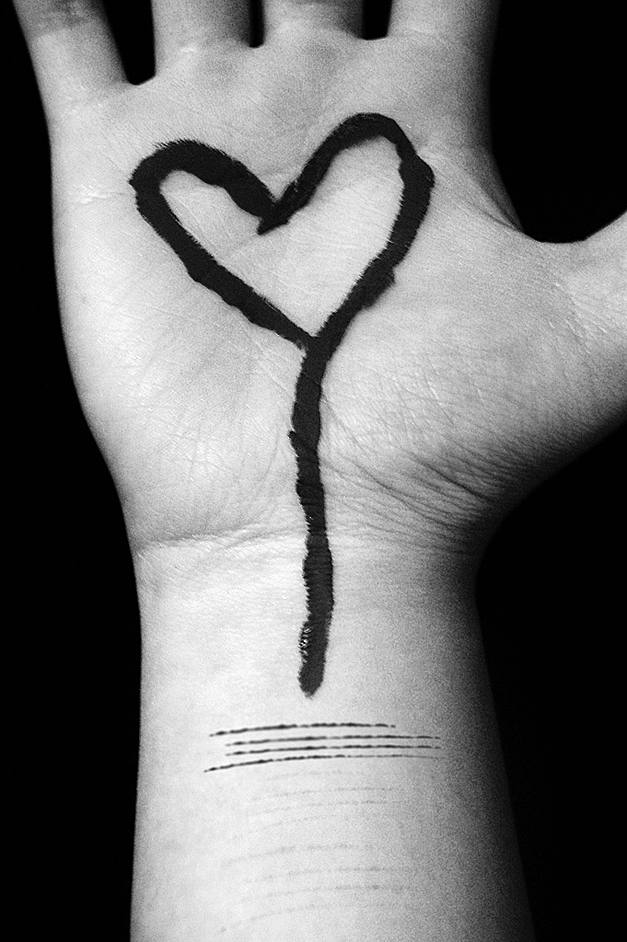
“Flame wars”—eruptions of open hostility—and tacit encouragement of self-injury eventually drove many people to seek safer havens, whittling the population in these sites to smaller, more hard-core groups. Those who remained espoused a loosely pro-SI orientation, viewing it as a lifestyle choice. They compared self-injuring to other coping mechanisms, such as the consumption of alcohol or drugs, but considered self-injury preferable to addictive and medically damaging consequences. Their bodies were their own, they reasoned, and injuring only hurt themselves, not others. Especially for those who were trapped in family, living, or socioeconomic difficulties, self-injury represented a way to escape, to assert a measure of self-control. “Cutting is the only thing that likes me right now,” one woman said, suggesting that self-injury was one of her most reliable friends. “It’s not killin’ me yet,” she said, “and definitely not killing me as bad as being anorexic is. And it’s my way out. Nobody has to know. It’s just between me and the box cutter, or the exacto knife, or the scissors.”
Pro-SIers rejected the stigma, considering it society’s problem—not theirs. Some adopted a long-term view, suggesting they would never give up the practice; others suggested that self-injury enabled them to exist in the world. By the mid-2000s, host servers began to reject pro-SI sites and participants were forced to constantly migrate to new sites, keeping each other informed about new cyber places. Like members of the pro-ED movement, they were nomadic.
Occupying the middle of the spectrum were groups and boards that served to mediate interaction but not stifle communication. By the mid-2000s, most sites fell into this category. These ranged from those that were generally recovery-oriented to those that allowed some but not too much discussion of people’s need to harm themselves. If people wanted to stop, there were those who would support them. If people wanted to continue, they could find acceptance. One member described the moderate regulation and approach to self-injury on her site as embodying the belief that self-injury was an adverse behavior that ought to stop, but which fell short of demonizing the behavior or the individuals who engaged in it. On this site, a new member made sure to initially ascertain that people could still discuss their troubles: “Hello my name is Sheila and I am not new but I’ve been in a hospital for the past 2 weeks,” she wrote. “I was trying to work up the courage to talk to people about it but I’ve already been deleted from one group and would not like to be deleted from anymore. I need people to talk to, do I still have your support?” A moderator replied: “Welcome to the group. I hope you find some comfort here in being with people who really do understand where you are coming from. We are all in different places, but have many things in common. We are not judgmental and try to be supportive.”
The cyber-world represents a new form of space that is both “out there” and “in here”—simultaneously public and social, while remaining private and solitary. It is a postmodern form, created by technology and populated by disembodied people in a virtual universe detached from physical place. These spaces are fertile locations for the rise of virtual communities that challenge traditional notions of identity and community, and, as some suggest, radically alter our conceptions of community and the nature of our communities.
Cyber-worlds of self-injury represent “back places” where people who share similar preferences are freed from the need to conceal their deviance, and can openly seek out one another for support and advice. For people who are loners in the “real world,” a range of communities are available on the Internet. As their self-injury “careers” progress, they drop out of some groups and join those that seem better suited to their evolving needs.
Cyber-subcultures are aggregations of self-interested, self-seeking individuals who join together to augment each individual’s good. They offer a context within which self-awareness about self-injury can develop. Though ephemeral and transient, they display norms, use sanctions, and offer ways for people to fashion new kinds of social order.