



Abstract
Making and selling methamphetamine is a business of personal ties. Henry H. Brownstein, Timothy M. Mulcahy, Bruce G. Taylor, Johannes Fernandes-Huessy, and Carol Hafford provide a nuanced understanding of meth markets, from mom-and-pop to import markets.
Keywords
In small town in South Carolina, a group of acquaintances meet at the home of a methamphetamine “cook,” waiting for him to prepare a batch so they can sit around and get high together. In rural Virginia, a user knocks on her neighbor’s door to borrow the equivalent of “a cup” of meth. In Oregon, a local dealer has fathered three children with three different women, each of whom is a customer.
Across the nation, meth dealers and users share personal information and secret codes, using cell phones and text messaging to arrange times and places for the exchange of drugs for money. While crack cocaine dealers sell their product on street corners to anyone who can pay for it, meth dealers prefer to do business with those they know.
The negative health and safety consequences of meth use are well known. Whether injected, snorted, or smoked, the psychostimulant has acute physiological effects: cardiovascular problems, emaciation, and brain damage, as well as psychological effects such as anxiety and paranoia. For abusers, poor personal hygiene and financial ruin are common, as is violence and the neglect of children. But we know far less about how meth markets are organized, how different kinds of markets impact their communities, and how personal relationships shape and are influenced by the kinds of markets that emerge.
Our group of researchers has been exploring these questions for the past few years. We’ve surveyed 1,367 police agencies in the United States and conducted interviews with narcotics detectives in 50 different communities. We have visited more than 28 towns and cities in five regions of the country to speak with public health and safety officials, local drug treatment providers, prevention specialists, social service workers, family service providers, meth users and dealers, and others whose lives are impacted by meth.
What we’ve learned is that methamphetamine markets are different from other illicit drug markets, and that the organization of meth markets varies wildly. We found American towns and cities in which meth is produced and distributed in small “mom-and-pop” labs that cater to personal acquaintances, others in which meth is imported by large corporate-type organizations selling to users through locals they know and trust, and areas where both types of markets operate. Perhaps the most important thing we learned is that no matter how it is organized and operated, methamphetamine distribution is personal. To understand the dynamics of meth markets, we needed to work to understand the people who comprise them.
The Rise of Meth
In his best-selling book, Methland, journalist Nick Reding described a small town in rural Iowa. Meatpacking jobs had disappeared and local family farms were replaced by agri-businesses offering low-wage jobs. As workers in these new jobs sought to find ways to boost their energy in order to work double shifts and support themselves and their families, another new industry took root in the area: methamphetamine.
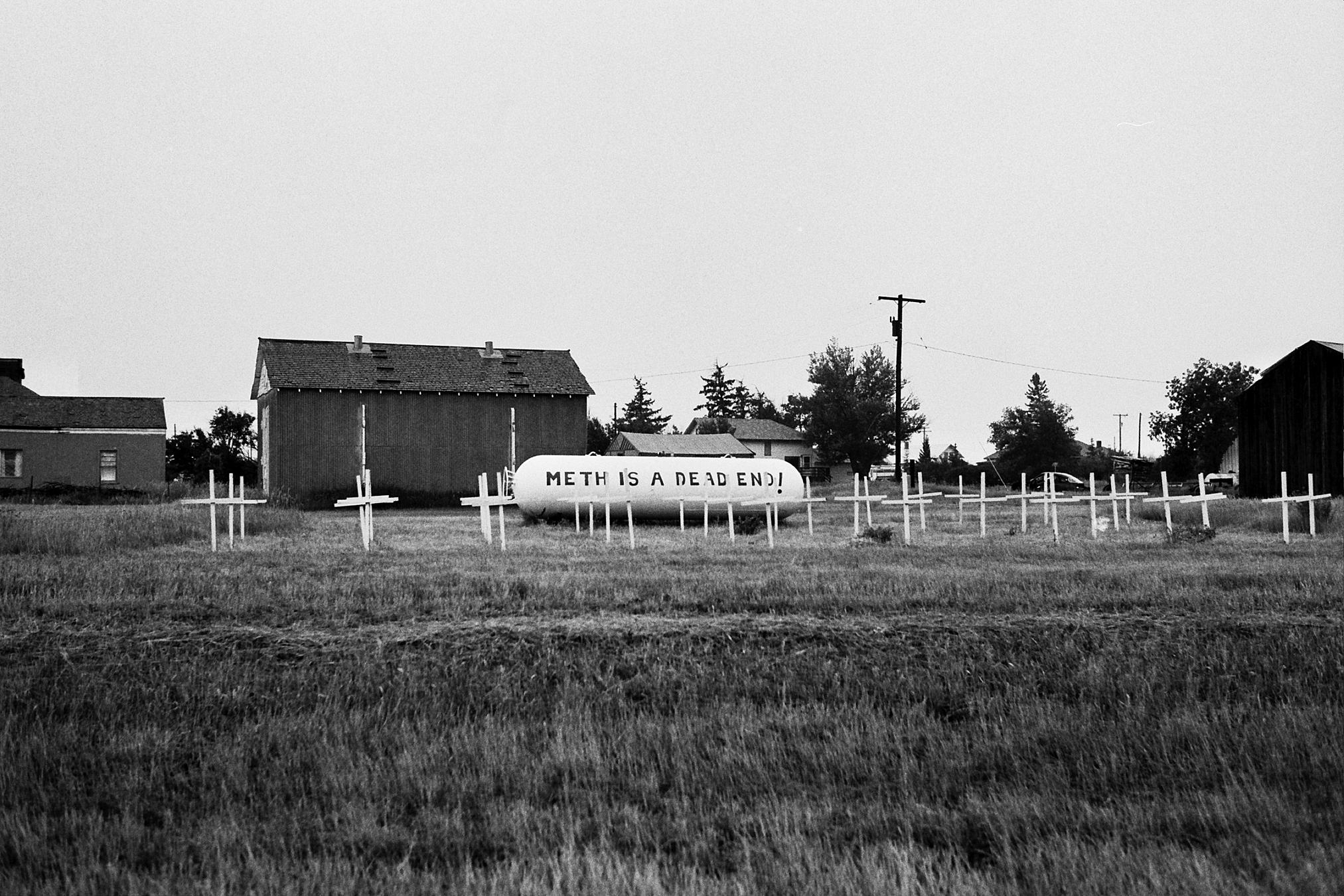
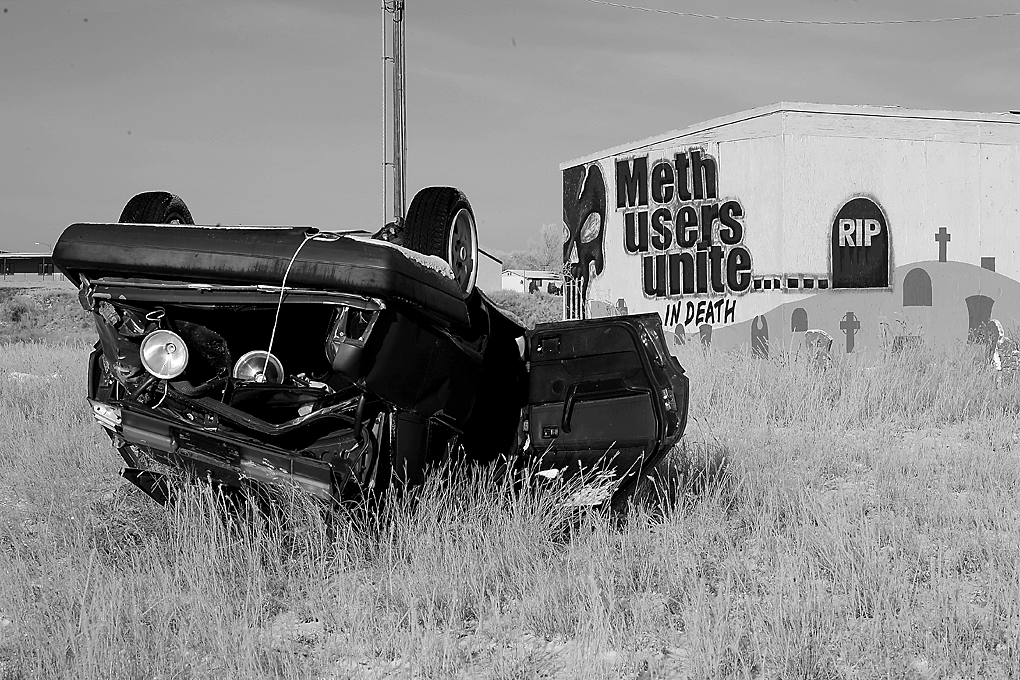
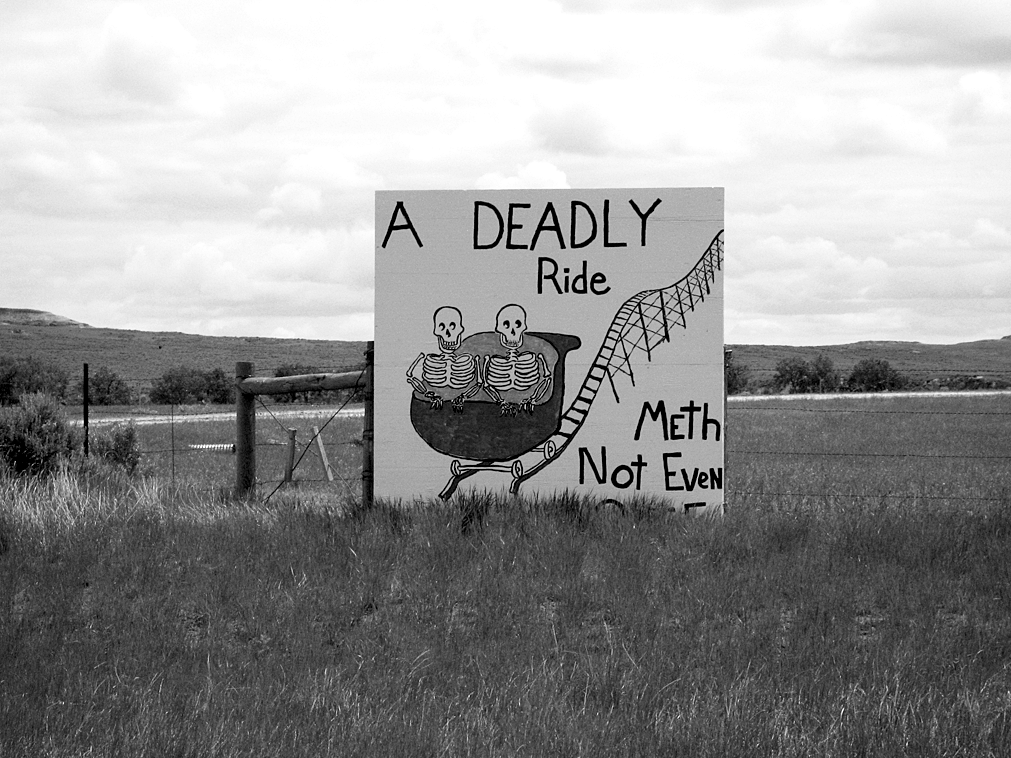
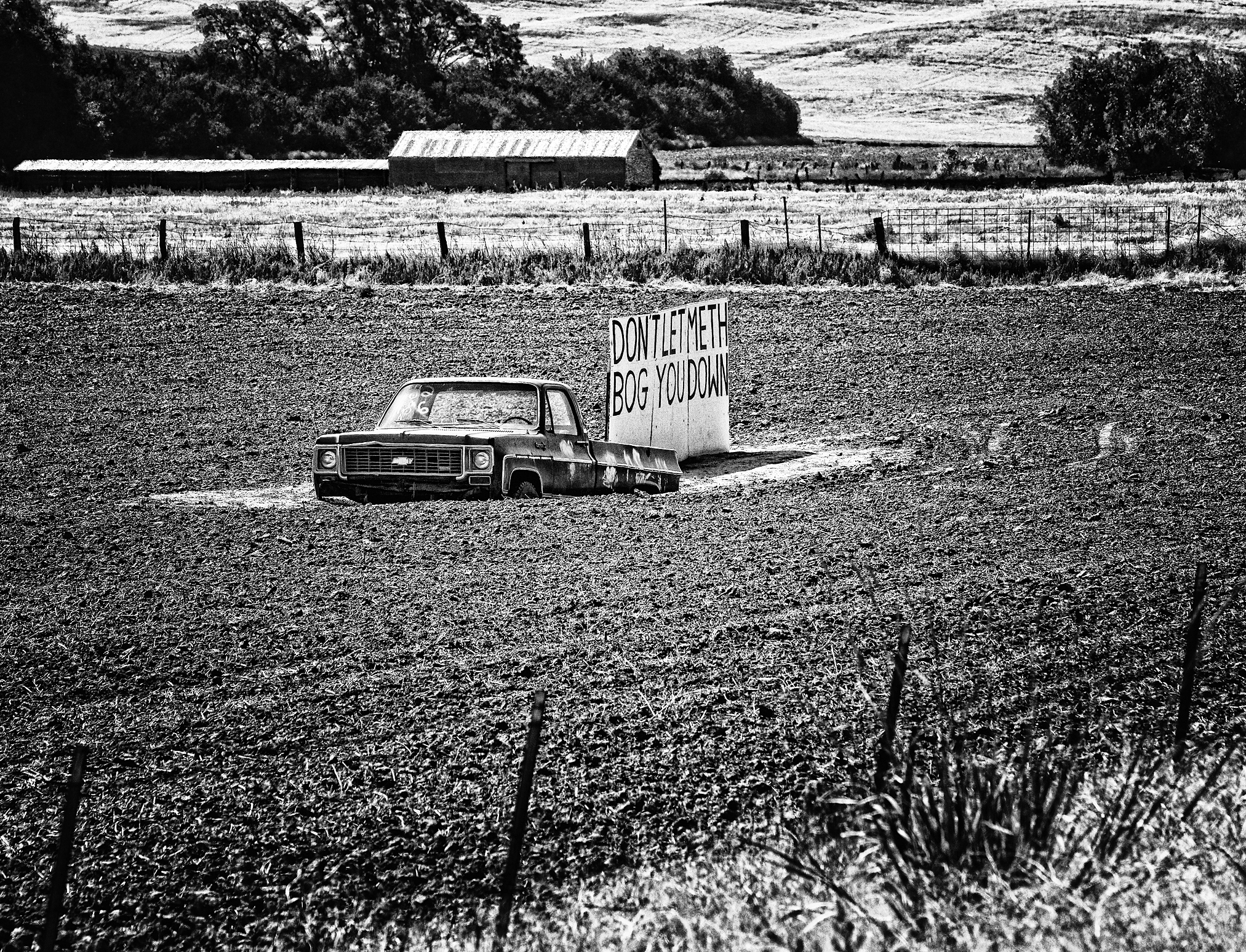
The Meth Project’s Paint the State contest emblazoned these messages throughout Montana and Idaho.
Methamphetamine is a central nervous system stimulant first synthesized in Japan in 1919 for use in treating nasal decongestion, hay fever, and even common colds. It arrived in the U.S. in the 1930s and became widely available after it was distributed to soldiers during World War II to keep them attentive. Meth became popular during the 1950s as an alertness or weight-loss aid—especially among college students, athletes, and truck drivers. Recreational use increased during the 1960s, and over time, its dangers became more apparent. In 1970, the Drug Abuse and Regulation Control Act set standards for security and recordkeeping for pharmaceuticals including meth, and use declined. But by the 1990s, the materials and methods needed for manufacturing meth in small clandestine labs became more available, especially in the western and rural U.S.
For the next decade and a half, American methamphetamine production was almost exclusively the work of local cooks who mixed batches using readily available hardware store and pharmacy chemicals. But starting in 2005, federal and state governments introduced laws limiting public access to a key ingredient in meth production: over-the-counter pseudoephedrine, the active ingredient in a number of common cold medicines. This legislation again slowed meth production in much of the U.S., but this time Mexican drug cartels responded by adding methamphetamine to their inventory. The new restrictions also prompted local cooks to collectivize meth production, leading to the formation of “mom-and-pop” labs where users pooled their limited supplies in order to produce meth for common use.
The negative health consequences of meth use are well known. We now far less about how meth markets are organized.
Mom-and-Pop Labs
In some localities, particularly in smaller communities and in the central part of the country, meth production is now dominated by “mom-and-pop” labs in which individuals produce and distribute methamphetamine for personal use, limiting sales to a trusted few friends and acquaintances. These organizations resemble social clubs: a husband and wife team and their friends, a guy and his buddies. In a rural town in Virginia, one young woman described people she knew as getting together in a “drug club kind of thing.”
In “every lab we run across,” says a narcotics detective in the rural Southeast, “there is some sort of nexus,” a division of labor in which some are responsible for shopping for pseudoephedrine, and others for cooking the meth. They all know each other: “It’s a vast, vast network of [local] individuals.” Similarly, in a small Arkansas town, a police officer told us: “It’s just one big circle,” he says, in which people “pool their resources and buy as many packs of ephedrine as they can.” And a narcotics detective from rural South Carolina described local small time labs and the people who inhabit them saying, “These people are all networked… They have something in common. They work together, they’re family members, or they’re friends. They all know each other. It’s very seldom you’ll find someone that no one knows show up and buy meth.”
In a small Southern community, local cooks recruit people to buy “precursor” chemicals, paying them in cash or with drugs. “They’ll make a loop, a daytrip, where they will drive to six or seven counties and go to all the Wal-Marts or drugstores in the area and buy two or three boxes of Sudafed or other supplies,” a detective explains. They bring the supplies back to the cooks, who mix up enough meth for them to use and sell. “It’s loosely organized, but it is organized,” he says.
In the central part of the country—in states like Illinois, Indiana, Missouri, Tennessee, and Kentucky—meth markets are centered in such small-scale, mom-and-pop operations. In contrast, in Western states—Arizona, California, Nevada, Oregon, and Washington—where meth has been around longer, the drug is more likely to be imported. In other places, particularly in the mid-Atlantic or Southeastern states such as Georgia, Virginia, and North Carolina, no one type of market predominates. A sheriff’s officer in Georgia noted that the mom-and-pop labs had been more prevalent in his community before the precursor laws (those that limited and tracked purchases of over-the-counter drugs, fertilizers, and other meth ingredients) went into effect. Now, more meth is imported “via the parcel, via the interstate, and from Mexico.” The manufacturing of meth has been outsourced.
Importing
In the West, and increasingly in small towns and villages in the southeastern and mid-Atlantic states, import markets like those that once characterized the cocaine trade now dominate: meth is manufactured in Mexico (or, sometimes, California) and distributed by locals for direct sale to their acquaintances. In a small city in the Pacific Northwest in which the Mexican community is well-established and Mexican and native whites seem relatively comfortable with one another, there is a brisk trade in meth. Here, Mexican drug cartels employ a dispatcher to work with local dealers and users. “They call him and order up what they want,” according to a detective. In areas like these, methamphetamine markets tend to be highly structured, with well-defined lines of responsibility and authority.
Though personal ties are central to the organization of meth markets, the drug often destroys the ties that bind.
Though there are very few organizations he has been able to track criminally, the detective told us, “It’s easy to figure out who’s working for who.” Locals obtain the meth from Mexican suppliers, break it down, and distribute it to their underlings. “These subordinates will go out and make the street sales, and bring the money back to the main distributors, who take a cut off it and then use the profits to buy more supplies.”
The transportation of meth through these import communities also tends to be highly organized. In one Southeastern hub for the East coast, high quality meth moves from Mexico through Texas, where it is loaded onto the trucks of drivers who pick up and drop off unscheduled packages in exchange for cash. Packages are left at designated locations, where someone collects them, and then workers divide them into smaller packages for distribution to local dealers or for further transport. On the West coast, the organization is similar, though customized cars, rather than trucks, are used to move the product.
While meth markets with product imported from Mexico are more businesslike than mom-and-pop lab markets, they are still personal, particularly when compared to traditional markets for other illicit drugs, such as crack cocaine. In a meth market located in a small mid-Atlantic city, a white dealer (who started as a user) describes the Mexican sellers as “a pretty tight group.” But local white buyers don’t trust them, he said. Because Mexican immigrants are recent arrivals to the small towns and cannot sell directly to white users, they serve as distributors of large quantities of crystal meth, typically a purer product than the powder or paste sold by local cooks. The Mexican distributors then recruit local white residents to sell smaller quantities to other local (white) users. While dealers and users in import markets do not have to be friends to do business with one another, they do have to be comfortable with one another.
Meth markets are personal—particularly compared to traditional markets for other illicit drugs, such as crack cocaine.
What makes meth’s sales network so different from those of other illicit drugs is that, in almost all areas and in all types of markets, personal relationships are key. When asked if it would be possible for a stranger to purchase meth in his area, a law enforcement officer in a Southwestern community echoed the words of police, users, and dealers across the country: “There’s a possibility you might run into one idiot or something that would sell, but not very likely. If somebody introduced you, you might get in. If you come in here cold, you’re not going to [get any meth].”
This is to say, in local mom-and-pop labs, the cooks who sell the meth and their customers are family, friends, or acquaintances. But even when meth is imported by Mexican cartels, distributed locally by recent immigrants from Mexico and sold to native white users with whom they are not personally acquainted, transactions only take place when a personal connection provides a sense of trust between seller and the buyer.
The Weakness of Strong Ties
Though personal ties are central to the organization of meth markets, the drug often destroys the ties that bind. Meth is, after all, illegal, and can harm or even kill people. Participants in illicit drug markets typically confront rapid turnover in the people they deal with, overlapping markets of buyers and sellers, huge variations in price and quality within a narrow geographic area, and lack of lawful authority governing market transactions. Because disputes over market share or product quality cannot be settled by legal means, market participants are often victimized by other dealers and users, or become victims of unsavory competitors and collaborators.
In the 1980s, when crack cocaine markets ruled rundown neighborhoods in urban America, young dealers frequently killed each other over territorial disputes, and buyers and sellers fought over the quality of the product. In meth markets, dealers and users tend to know each other, so the chance an exchange will turn violent is somewhat lower. In Utah a narcotics detective told us that “the competition isn’t great because [local cooks] just don’t have a very good product.” He expects that renewed competition will lead “people [to] battle [it] out with pricing,” as opposed to violence. Still, a narcotics detective from a town in New Mexico talked about having ”seen some violence.” Meth is “the most violent drug” because the users, he notes, are often paranoid.
“[Meth] ruins people,” says a detective who spent many years working with meth users in a Southwestern community. “I bet everybody that’s hooked on meth does not have a family anymore—mother, father, grandfather, wife, children—nobody wants anything to do with them because they can’t control them.” A woman in Virginia who used meth for many years called it “a family drug,” and explained that she’d exposed her children to other users and dealers. Eventually, they became meth users themselves. A treatment provider working at a family services center outside of a city in the Pacific Northwest agreed, telling us, “We’re treating second and third generation families here now. Over the last 15 years we’re seeing children and even grandchildren [of past clients] coming in for treatment.”
The way a particular illicit drug market is organized and operates impacts those who participate in it. It also impacts the people around them. Cooks and users in local mom-and-pop meth labs bring together family, friends, and buddies from close-knit social networks in order to get high, and in the process expose themselves and others, including children, to health and safety risks: noxious vapors, chemical explosions, filth, domestic violence, and sexual abuse and child neglect. Import markets can be a source of income in an economically depressed area, but when those who do not know or trust each other come together for an illicit meth transaction the potential for misunderstanding, conflict, and even violence is exacerbated.
Policymakers, who typically think about illicit drug markets as commercial ventures or criminal enterprises, tend to develop policies and programs that target the local economy and public safety. While this is important, in the case of methamphetamine, it doesn’t go far enough. To meaningfully address the proliferation of this home-cooked drug, we must begin with the web of personal relationships that structure its manufacture, distribution, and use.