



Abstract
How we see nature is to a large extent a reflection of ourselves. Sociologists Hillary Angelo and Colin Jerolmack use the example of New Yorkers’ fascination with two red-tailed hawks to reveal deep insights about how we represent and understand nature.
Keywords
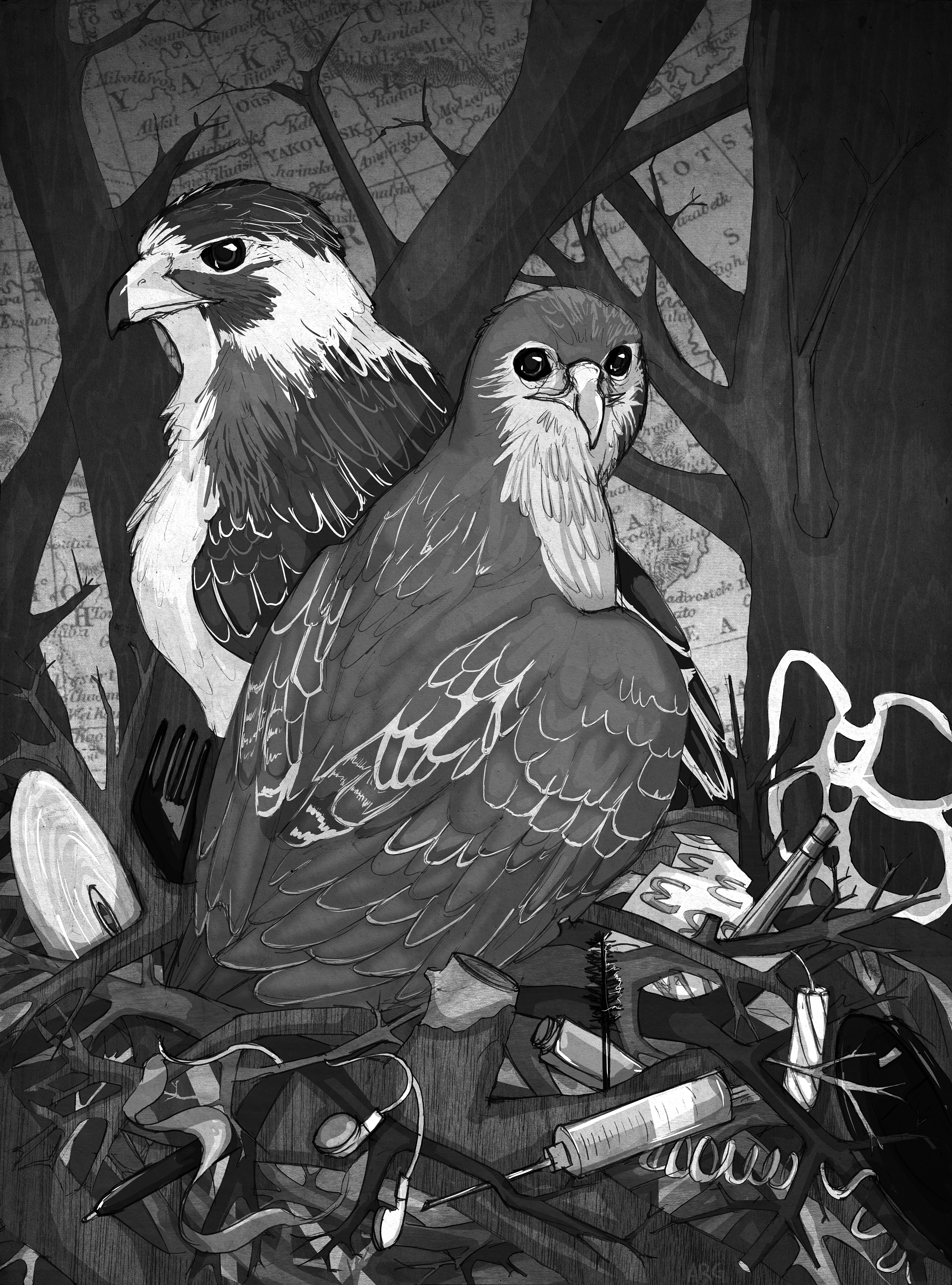
After a month of courtship and nest-building, two red-tailed hawks began patiently tending to three speckled eggs in April 2011. Given that red-tailed hawks are a common American species, the event would seem no more than a footnote in the rites of spring; but this nest happened to be on a 12th floor window ledge of NYU’s Bobst Library, overlooking Washington Square Park in Manhattan.
Within days the birds, christened “Bobby” and “Violet,” had their own Facebook page and Twitter account, and were stars of a streaming reality television show (thanks to a web camera installed by the New York Times). Building on New Yorkers’ recent infatuation with the famous 5th Avenue hawks known as Pale Male and Lola, Violet and Bobby soon gathered a devoted following who watched anxiously as the pair raised their hatchling (“Pip”) on squirrels and rats captured from the park. The public participated with “tweets,” chatroom conversations, blog posts, and face-to-face meet-ups. As articulated by the Times and reflected in statements by NYU’s president, witnessing the hawks’ efforts to start a family—up-close—enabled a rare moment of human encounter with “transcendent” nature in the city.
The environmental historian William Cronon writes that people turn to nature because it is seen as untainted by the “social ills” of civilization. He calls this the “wilderness fantasy.” Yet paradoxically, rather than facilitating a socially unspoiled nature experience in the comfort of urban homes, the “hawk cam” instead revealed its impossibility: the band around Violet’s swollen foot marked her as a raptor that had already encountered human hands; the Department of Environmental Protection opened up a case file on the hawks, declaring the state’s authority over them; hawk devotees debated online whether humans should intervene to remove Violet’s band, fortify the nest, or even help break open the eggs; and the hawks’ choices of inorganic nesting materials—a thick sheet of white plastic, a soiled hand towel, and artificial Easter grass—frustrated viewers, who criticized the hawks’ use of these “unnatural” items.
Our experience of nature is profoundly shaped by social forces.
Although some viewers embraced the hawks as “city birds” whose resourcefulness reflected an admirable adaptation to the urban environment they inhabited, fans seeking an asocial nature experience protested when signs of the social world interrupted their image of the hawks as a kind of miniature wilderness. Much as Frederick Olmsted’s design for Central Park had aimed to create an experience of nature that hid the city surrounding it, many hawk-watchers had a strong desire to maintain the myth of wild, unsullied nature.
The hawk cam, just one of hundreds of popular web cameras streaming the trials and tribulations of wild animals to a global audience, exemplifies a central paradox of our urbanized society’s relationship to the environment: on the one hand, we believe that encounters with nature allow us to transcend social life, and yet, on the other, our experience of nature is profoundly shaped by social forces. To emphasize the fact that our relationships with the environment are always socially mediated, sociologists often place quotes around “nature” or refer to socio-nature. While the idea of nature as a realm free of social interests may indeed be a fantasy, as a cultural ideal it nonetheless organizes the ways people experience the environment. The conception of asocial nature, in interaction with the reality of “social nature,” impacts how humans interpret and respond to the nonhuman world. Perhaps the incursion of the social world spoils the imagery of Bobby and Violet’s nest as a microcosm of “pure” wilderness, but the collective human response to this alleged interruption is itself a microcosm of our social struggles over how to live with nature.
Asocial Nature
Classical sociological concerns regarding modernization have centered on topics like people’s migration from rural villages to large cities, the rise of capitalism, and the reorganization of community life. More recently, though, social scientists have begun looking at how society’s relationship to the physical environment has been transformed. After all, the Industrial Revolution, as Karl Marx and Friedrich Engels observed, was founded on the “subjection of nature’s forces to man.”
New Yorker’s fascination with the red-tailed hawks comes from a desire to seek sanctuary from the concrete jungle.
Much as the rationalization of work and social life was said to produce a sort of collective malaise (what social theorist Max Weber called “disenchantment”), sociologist James Gibson tells a parallel story of contemporary society’s increasing estrangement from nature. Gibson reports that many pre-modern societies revered nature and believed it was animated by spirits, but that the rise of science promoted a mechanistic view of nature as inert matter. In turn, capitalism reduced nature to a commodity. Gibson and other environmental scholars argue that the physical defilement of the natural world and people’s increasing geographic separation from nature through urbanization have led to nature’s spiritual profanation. The art and literary critic John Berger looks to our relationships with animals as clear evidence of this estrangement: the transformation of the wolf to working farm dog and then to handbag Chihuahua simultaneously marks the retreat of wild, asocial nature and the disappearance of our respect and awe for it. Scholars like Gibson and Berger see our desecration and humanization of nature as harmful to the environment (which we are socialized to exploit as a means rather than value as an end) and to society (which is spiritually impoverished because the plants and animals around us are no longer endowed with otherworldly significance).
If the entrance of social interests into our relationship with nature despoils it conceptually and physically, then solving the ecological crisis requires that we supersede instrumentalist orientations and reinvest nature with sacred meaning. Gibson believes it’s already happening. He finds a growing number of people “who long to rediscover and embrace nature’s mystery and grandeur” and “who look to nature for psychic regeneration and renewal.” Gibson interprets New Yorkers’ fascination with the red-tailed hawks Pale Male and Lola—and, presumably, Bobby and Violet—as an expression of their desire to seek momentary sanctuary from the concrete jungle in the experience of “kinship” with nature. In his view, the hawks are ambassadors of the wild and our celebration of them is a consecration of nature, a transcendence of the social. Strands of this “culture of enchantment” are evident in the narratives of the environmental movement, which often focuses its attention on the majesty of rugged mountain peaks or charismatic fauna (rather than, say, a suburban park or snails). The implied ideal is preserving, and even reconstructing, “pristine” nature.
The enchanted nature thesis guides many preservationists’ efforts and compellingly captures the asocial wilderness ideal that many use to frame their interpretations of the nonhuman world. Yet, as Cronon has said, by reproducing “the dualism that sets humanity and nature at opposite poles,” this quixotic standard does not offer a blueprint of “what an ethical, sustainable, honorable human place in nature might look like.” As Gibson concedes, “unrealistic expectations of purity” can impede appreciation and respect for the hybrid landscapes we actually inhabit. Stories such as Grizzly Man and Into the Wild show how efforts to realize the wilderness fantasy can in fact be harmful or tragic. By threatening to pigeonhole socially mediated relations with nature—which, in reality, includes all relations with nature—as somehow less “pure” or “authentic” than nature encounters that appear to be asocial, this perspective misses an opportunity to examine how the explicit comingling of the natural and the social can be beneficial for both the environment and society.
Social Nature
A second sociological tradition, dating back to classical sociologist Emile Durkheim, highlights how the social and the natural are inextricably intertwined. In studying pre-modern aboriginal clans that practiced totemism, a belief system in which a clan adopts a particular plant or animal as its symbol and considers it sacred, Durkheim rejected the assumption that aborigines actually worshipped nature. The totem species was sacred, rather, because it stood for the clan; worshipping it was a way of expressing social solidarity. Though perhaps in different ways, our relations to the nonhuman world remain inherently social. Every landscape, sociologists Thomas Greider and Lorraine Garkovich write, is a “symbolic environment created by the human act of conferring meaning.” The meanings we ascribe to the environment reflect our self-definitions and are grounded in particular social contexts. For example, in studying an English exurban village, sociologist Michael Bell found that residents identified as “country people” who, by living close to nature, believed that they led more authentic and wholesome lives than city dwellers. Still, Bell found important differences in villagers’ relationships with nature that were patterned by their class position. Wealthier residents, for instance, prized open vistas of the countryside and sculpted their backyards to create clear sight lines, but working-class residents had a more hands-on relationship with the land and paid less attention to “the view,” even planting shrubs that impeded it. Though all of the villagers believed nature offered them an escape from the ills of society, in reality their experience of the environment still mapped onto familiar social categories.
“Social nature” analyses undermine the wilderness fantasy by exposing how the social and natural worlds are jointly constituted. They also help us understand the social motivations behind idealizing nature. Bell found that salient class tensions threatened to undermine group solidarity in the village he studied, and that grounding their sense of selves in nature was a way for villagers to overcome social divisions and rally around a shared identity—a sort of secular totemism. Historically, Cronon argues that urban elites in the U.S.—who themselves never lived close to the land—cultivated the wilderness fantasy as a national project because untamed nature was a monument to America’s heroic frontier myth and “the last bastion of rugged individualism.” Culture and context always frame our understandings of nature. The idea of asocial nature is itself a social frame.
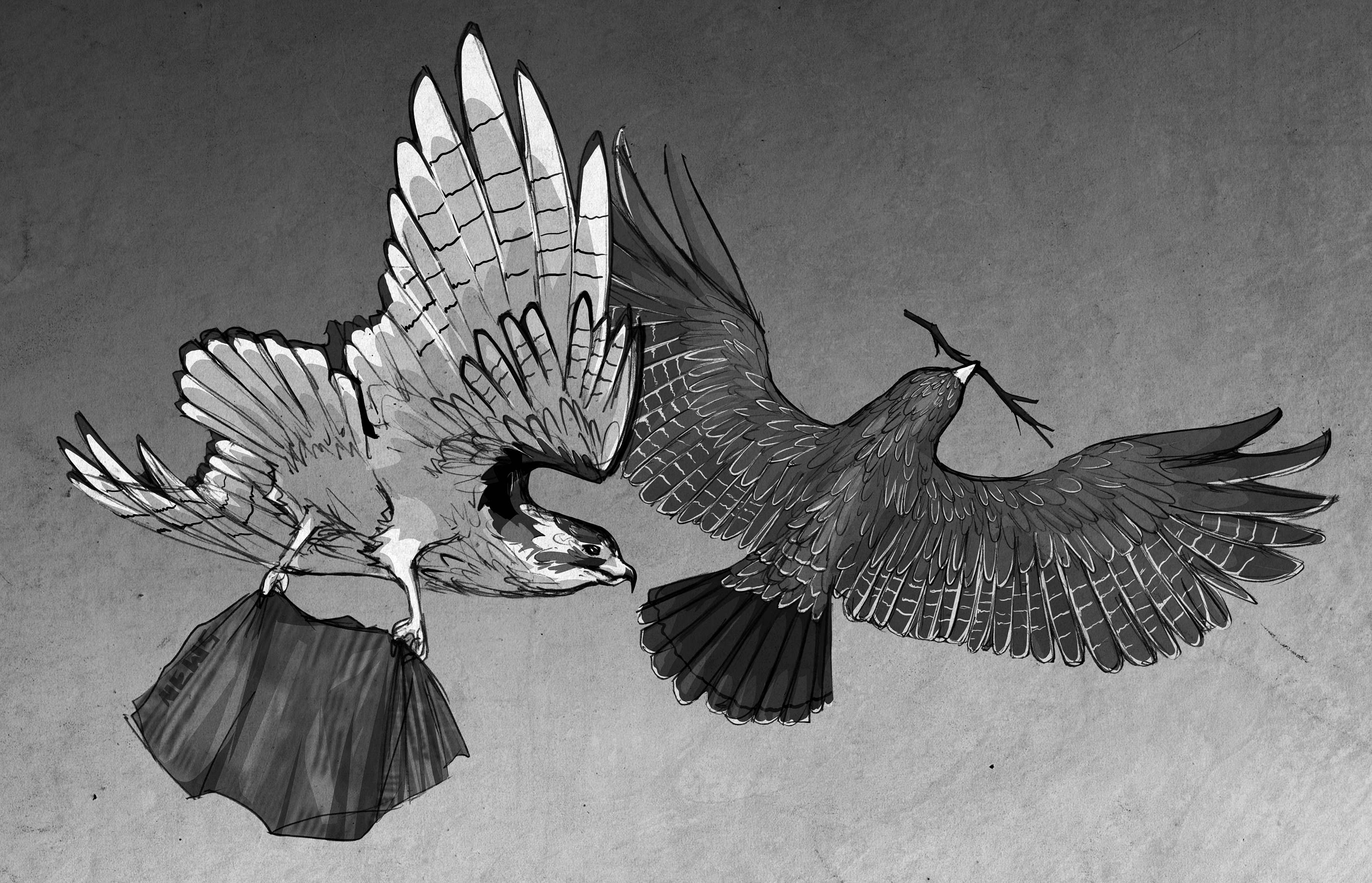
The principle that nature is just as social as race or gender challenges assumptions about environment-society relations and opens up a domain of inquiry long considered to be the realm of the natural sciences. It forces us to see the encroachment of the social world into Bobby and Violet’s nest as an inherent part of our experience of nature, not as contamination. The chatroom discussions, “expert” opinions rendered in the news, and the face-to-face meetups under the nest aren’t ancillary to the “first hand” experience of the hawks—they are the means by which the hawks become meaningful and knowable to people.
“Social nature” analyses can help us see environmental justice and social justice as inherently linked ideals.
Scholarship on the social experience of nature falls short of its potential if it simply debunks the wilderness fantasy or subjects it to an ideological critique. For while the notion that nature is always social may now be sociological commonsense, the experience of nature that people strive to create and maintain is an asocial one. Bell acknowledges that we must continue to account for the imaginative pull of this paradigmatic frame in the urbanized Western world. For most people, there is something fundamentally distinct about encountering the “wild.” We can warn hawk cam viewers that their quest for asocial nature is foolhardy, yet they will still fix their eyes on the screen hoping to capture the moment when Violet feeds her baby beak-to-beak. Interactions with superficially asocial nature in the city—a hike on Central Park’s wooded trails or a glimpse of soaring red-tailed hawks—give us an experiential analog that we reflexively connect to a grander image of the kind of nature we wish to preserve and immerse ourselves in, the rugged mountain peak or lion on the savannah we may never know. Few consider the animal-filled circus or weeds in a vacant lot “nature experiences,” and most of Violet and Bobby’s fans remain unmoved by the pigeons picking at the remains of a bagel below the hawks’ nest.
Frame Breaks
If asocial nature is an interpretive frame, then what sociologist Erving Goffman called “frame breaks”—moments when the taken-for-granted way we see the world is disrupted—are telling. Because these interruptions contain both the enchanted ideal and the social reality, they provide analytically rich data and moments for education and reflection.
Environmental educators are fluent in putting these contrasts to work. A visit to a natural history museum is unlike wilderness immersion in a wooded park because, in order to educate people about “nature,” the exhibits quite deliberately play with the tension between social and asocial nature frames. Like going to a movie, habitat dioramas (or, more recently, IMAX films) are self-conscious, short-term immersive experiences. They are explicitly designed to mimic an at-risk “natural” environment in order to show us what we would be missing if it disappeared. They are effective because the frame is visible: stepping back, you see the edges of the glass, hear the echoing cries of the children around you, and feel the wilderness recede. There is no question that this window is an illustration, that the dioramas use a clearly fabricated image of asocial nature to provoke critical reflection about humanity’s alteration of the environment. Although proponents of animal welfare decry the collision of caged animals and entertainment, zoos increasingly rely on similar visual techniques to try to educate about conservation through what might be called “living dioramas.”
When it comes to the camera that frames Bobby and Violet, however, sublime nature seekers treat it not as a manmade window that illustrates some aspect of the natural world, but as a window into “real,” asocial nature. That is why viewers are apt to complain when human hands intervene in Violet’s nest, yet watch with fascination as a zookeeper feeds peanuts to an elephant, or a museum employee exposes a diorama’s artificiality by entering to repair a perfectly rendered plant or animal form.
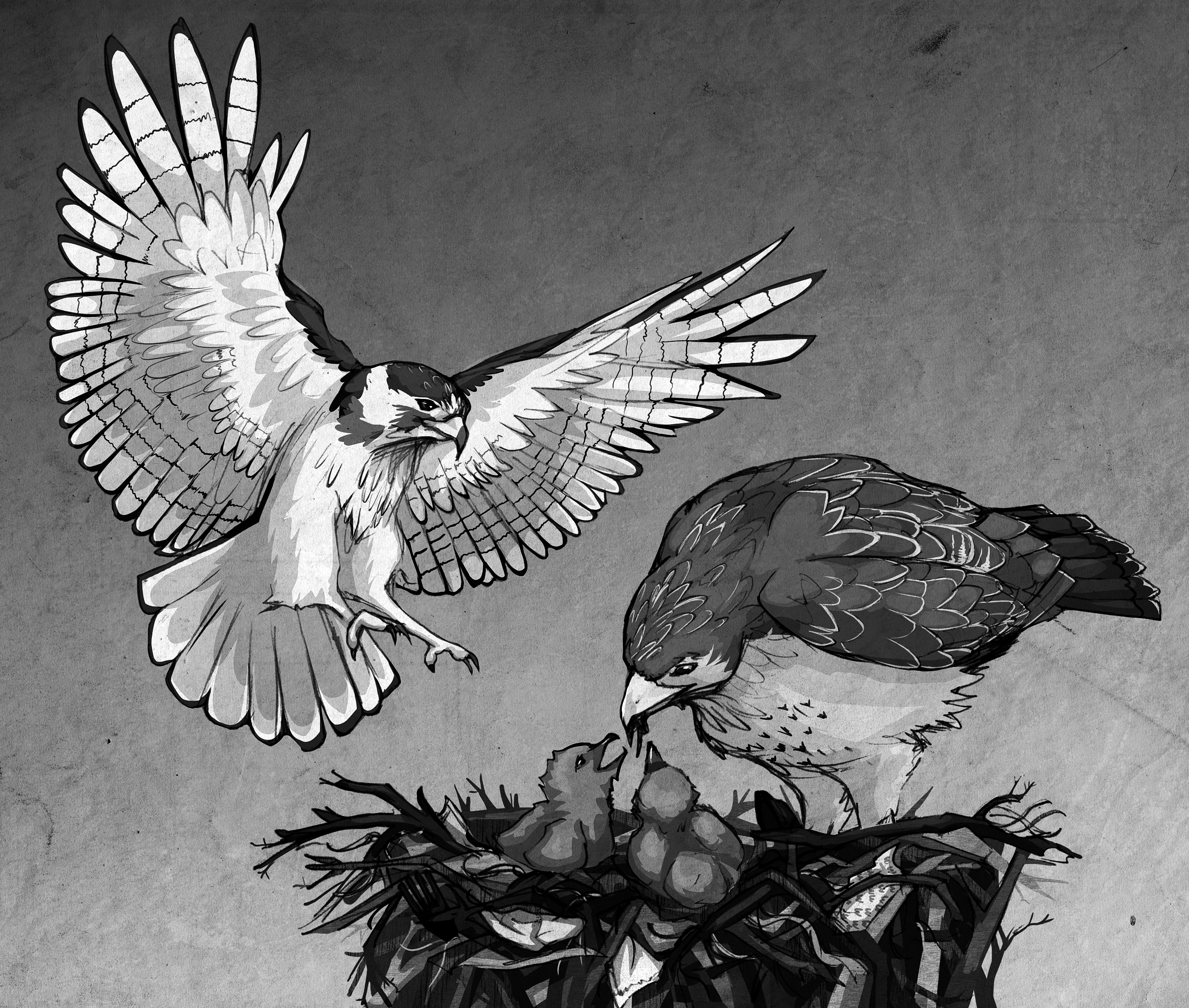
Yet the frame breaks that hawk cam viewers continually confront need not be a tragedy. Like a diorama, these moments can foster awareness and even appreciation for the ways that the natural and the social are co-constituted. The presence of a plastic bag in Violet’s nest can be a platform for discussing the adaptability of animals (and humans) to built environments and for thinking about how we can alter the cityscape to create a more sustainable habitat for “wild” species. And, rather than deploring the Department of Environmental Protection’s intervention in Bobby and Violet’s affairs as unnatural or simply holding it up as evidence that nature is always social, we can use the moment to illuminate the constellation of institutions that influence our relationship with other species in the city. Understanding this organizational ecology is more than an academic exercise; it can help environmental advocates find their bureaucratic allies and apply pressure to their opponents. It can also reveal how access to “natural goods” like clean air, safe drinking water, green spaces, and farmers’ markets is distributed in the city.
Spared the toil of the farm or the awesome but terrifying experience of taming the wilderness frontier, contemporary urbanites idealize nature as an environment uncorrupted by people. And though asocial nature is a chimera, our belief in it often serves as a prime motivator for helping the environment. It infuses our encounters with the “wild” with a sense of mystery. By the same token, seeing the social in nature need not threaten our desire to associate with it and protect it. The hawk chatroom and in-person meet-ups continued long after Pip fledged the nest. The community that sprang up around the hawks abetted people’s sense of connection to Bobby, Violet, their baby, and, in some cases, the urban ecology around them. And catching a glimpse of Pip eating her first pigeon became meaningful not only because hawk devotees bore witness to the cycle of life, but also because they could blog about it or talk about it in person with each other.
Our own research highlights how the social experience of nature can enhance our appreciation of it and how asocial and social experiences of nature are interconnected. In studying a group of Turkish male immigrants in Berlin who kept domestic pigeons, for instance, Jerolmack was able to show how the birds enabled the men to experience a connection to nature in the midst of the city. Yet the men also said they appreciated keeping pigeons in Berlin because it enabled them to experience a connection to their homeland and express their ethnicity. This social tie to nation augmented, rather than mitigated, the immigrants’ enjoyment of nature. And, in a study of two very different types of bird enthusiasts, Angelo demonstrated the interdependence of asocial and social nature experiences. While ornithologists draw the ire of birdwatchers by shooting and skinning birds to create specimens, their social practices produce the knowledge—in the form of field guides—that birdwatchers rely upon to identify avian species while imaginatively immersing themselves in “wildernesses” big and small. Socially mediated “nature,” in the form of bird specimens in a scientific collection, enables the asocial nature experience that birdwatchers enjoy through binoculars. Both practices—though very different—can be understood as driven by, and resulting in, admiration for the nonhuman world.
The journalist Robert Sullivan writes that nature is prospering in cities like New York (Queens contains more species of birds than Yellowstone and Yosemite Parks combined), but that many residents haven’t noticed because this isn’t the nature they are looking for—it is less precious, less “pure.” Yet these species, many of which have learned to adapt their behaviors to the habits of people, powerfully demonstrate the extent to which the social and the natural are intertwined. Pigeons and squirrels “beg” humans for food in Washington Square, and crows crack open nuts by dropping them into car traffic. Given the likelihood of continued ecological disruption, ecologists predict a future in which more and more species will fashion their survival strategies around human societies. Learning to appreciate and promote the biodiversity hiding in our cities expands the terrain of environmental conservation and may in fact offer clues for how to model sustainable human and nonhuman cohabitation.
Nature is prospering in cities, but many residents haven’t noticed because this isn’t the nature they’re looking for.
William Cronon writes that, while humans must be conscious of our place in the natural world in order to live mindfully within it, we must also “recognize and honor nonhuman nature as a world we did not create.” The magical experience of asocial nature is not something to blindly embrace. Nor is it something that we should—or could—rid ourselves of. Rather than conceptualizing “asocial nature” and “social nature” as moral or experiential opposites, we would do better to think of them as overlapping modes of experience that can both foster greater appreciation of, and concern for, the environment and society.