



Abstract
An interview with Tia Palermo, a professor of preventive medicine at Stony Brook University Medical Center. Palermo used population-based data to better understand the occurrence of sexual violence in Congo. Palermo talks about how the magnitude of sexual violence is higher than previous studies suggest and also offers insight on the geographic spread of such violence.
Tia Palermo is the co-author of a widely cited study of rape in the war-torn Democratic Republic of Congo, and a professor of Preventive Medicine at the State University of New York at Stony Brook. She was interviewed by Contexts editorial board member John Torpey, of the City University of New York Graduate Center, in late September 2011.
My interest in talking with you came out of a sense that Congo had been a conflict to which too little attention has been paid. There’s been a lot of attention to Darfur, because it’s a familiar story of a racial borderline across which something called genocide is taking place. But in the Congo, it’s a much more diffuse and seemingly aimless conflict with no real ideological differences at issue. There are a lot of different players, and it’s just hard for people to get a handle on. As a result, it hasn’t gotten the attention it deserves. Can you comment on that?
Every five minutes, four women are raped in Congo.
I think you’re exactly right. Most Americans don’t know the death toll in the DRC [Democratic Republic of the Congo] is the largest in a single conflict since World War II. The estimates range from 3.5 to 5 million excess deaths due to the conflict and the humanitarian crisis that it has caused. And there has definitely been less coverage of that in the media than of Darfur. The reason for that is that in Darfur we have this very simple story that there are the bad guys and there are the victims. In Congo, however, it’s a very convoluted story and there are many actors. It really goes back to the history of colonial Congo and the dictatorship that was propped up by the United States, and then the Rwandan genocide that was a catalyst for the crisis in the Congo. And it’s been going on for about 15 years. It’s very hard to tell a simple story.
Tia Palermo, Assistant Professor of Preventive Medicine at Stony Brook University Medical Center.

What you’ve studied specifically is sexual violence. Perhaps you could tell us what you found and what is significant about it?
We aimed to study the sexual violence because media reports always referred to the “tens of thousands” of women who had been raped in DRC, but always with a disclaimer that the true magnitude of the rape is unknown. What we wanted to do is to use population-based estimates, because most of the previous studies had used facility-based data or had a very narrow geographic focus—particularly on different parts of eastern Congo. We wanted to quantify the number of rapes occurring annually. [So] we used population-based data collected by the Demographic and Health Service of the DRC government. And what we found was that the amount of sexual violence was orders of magnitude higher than the “tens of thousands” that everyone had been citing. We actually found that over 400,000 women were raped in the past year.
400,000 women, in a total population of about 70 million?
400,000 women per year, so it’s a little over 1,100 per day, or 4 women raped every 5 minutes. To be sure, there are limitations to the data. We can’t identify the perpetrators, so we’re not making the conclusion that all of these are conflict-related rapes. But what we can do is compare it to nearby countries or to other countries. And the intimate partner sexual violence [IPSV] is something that stands out because nearly twice as many women report intimate partner sexual violence—by their partner, husband, or boyfriend. Twice as many report that type of sexual violence as women who report “rape” over their lifetime, either because they interpret “rape” and IPSV differently, or because IPSV is a more inclusive concept covering all forced sexual acts.
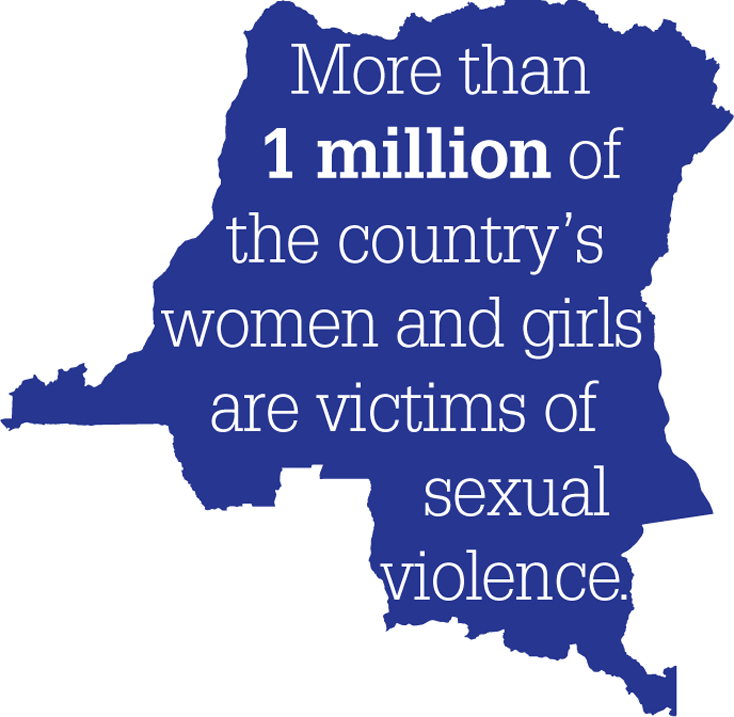
More than 1 million of the country’s women and girls are victims of sexual violence.

Another significant finding of our work is the geographic spread of the sexual violence. Everyone is generally focused on eastern Congo because that’s where the mines and the main battle lines are. But what we found was a large geographic variation in the rates of sexual violence. Actually the second highest rate of rape by province in the country was in Équateur province, which has had some ethnic violence, but is not generally thought of when we talk about the conflict in DRC.
It seems like the Hobbesian scenario—the proverbial “war of all against all.” State institutions seem to have collapsed or are non-existent…. Could you say a little—maybe extrapolating a bit from the data—about why you think this sexual violence has been going on at these enormous rates?
Part of it, as you said, is that there are very weak institutions in the Congo, and that goes back to the legacy of colonialism and afterwards. Mobutu Sese Seko’s dictatorship (1965-1997) purposefully kept institutions very weak… even today the institutions and the security sector remain very weak. The government has very little control over the militias and the rebel groups in the eastern Congo. We saw a lot of geographic variation in the sexual violence, as I mentioned, and what stood out a lot is the very high rate in Équateur: 67 per 1000 women of reproductive age [are] raped every year. A lot of experts in the region have suggested that Équateur is particularly underdeveloped, even compared to the other provinces in DRC, which is one of the poorest countries in the world. There are very few health services, infrastructure, roads. The central government has basically ignored Équateur and there’s a lack of a functioning state entity there. Perhaps that’s contributing to the high rates in Équateur, as well as eastern DRC where the central government has very little control.
Perpetrators aren’t being brought to justice—that makes women less likely to report rape.
A lot of what’s happening is rape is being perpetrated because of this general sense of impunity. Perpetrators aren’t being brought to justice and that, in turn, makes women less likely to report it, to seek help because they feel like nothing is going to happen.
For further reading, see Amber Peterman, Tia Palermo, and Caryn Bredenkamp, “Estimates and Determinants of Sexual Violence Against Women in the Democratic Republic of Congo,” American Journal of Public Health (2011) 101(6): 1060-1067. ajph.aphapublications.org/cgi/content/abstract/101/6/1060.