



Abstract
Since 2004, Hugo Chavez’s government has put resources into creating citizen support through cooperatives, councils, community media, and other participatory initiatives. But, as Sujatha Fernandes writes in Who Can Stop the Drums?, this support comes with strings attached.
Keywords
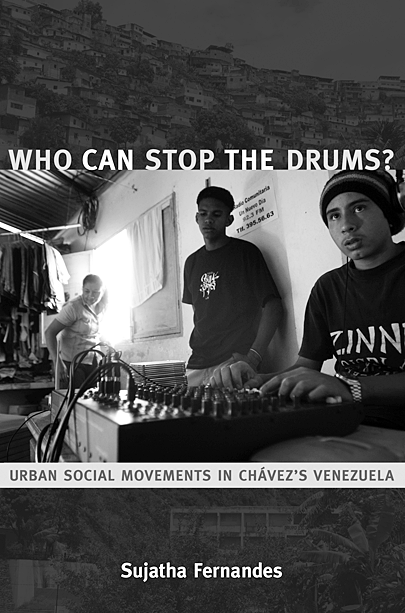
Who Can Stop the Drums? Urban Social Movements in Chávez’s Venezuela. By Sujatha Fernandes, Duke University Press, 2010 336 pages
In 2002 Venezuela’s Chávez government was on the ropes. Hugo Chávez’s popularity was in the low thirties; all major media outlets were against him, as were large parts of the public sector—most importantly, Petroleos de Venezuela, the government’s cash cow. In April a coup d’état had even removed Chávez from the presidency for thirty-six hours, but was turned back by street mobilizations—including alternative media outlets that refused to participate in a media blackout—that came to be supported by loyalist sectors of the military. Over the next two years Venezuela remained on the verge of a civil war, with Chávez opponents seeking a recall referendum to end his presidency and the government doing everything in its power to prevent it. By the time the opposition was able to get a referendum in August 2004 the Chávez government had quietly recovered its popularity through new social programs. Chávez ended up blindsiding his opposition with a landslide affirmation at the polls.
Chávez’s government learned that surviving tough times depended on supporters who could counter traditional political parties, civil society, and the private media.
The government learned two key lessons from this period. First, massive social spending was the key to its broader popularity, and second, surviving tough times would depend on mobilized supporters who could counter traditional political parties, civil society, and the private media. As a result, from 2004 on, the government poured enormous resources into cooperatives, communal councils, community media, and many other participatory initiatives.
This is the period that sociologist Sujatha Fernandes covers in Who Can Stop the Drums? Her book looks at popular social movements in several barrios of Caracas, including community media outlets, a community arts organization, and groups that carry out religious fiestas and paint murals. All of these movements in some way receive state support. Yet Fernandes looks at the difficulties they face when trying to engage state bureaucracies for permits, licensing, and funding. Organizers are invariably asked to fulfill technical requirements, provide studies demonstrating demand for and the impact of their proposed activities, and plan how they will be accountable for the resources they are given. In looking at these conflicts, Fernandes draws out a consistent pattern of opposition. On the side of state bureaucracy she finds “neoliberal governmentality”—an “extension of market rationality, based on an instrumental calculus of economic utility, to all state practices, as well as formerly noneconomic domains”—held over from the previous regime. On the side of urban social movements she finds local knowledge, historical memory, and culture valued as a spiritual, not a technical, matter. This leads Fernandes to refer to Venezuela under Chávez as a “hybrid state in a post-neoliberal era” by which she means it “has mounted certain challenges to the neoliberal paradigm,” but is still grappling with the instrumental rationality it etched into the Venezuelan state.
In the last section of her book Fernandes looks at the “new coalitional politics of social movements.” Most particularly she tells how coalitions of movements mobilized against coal mining along the Western border with Colombia. Here, argues Fernandez, the Chávez government showed the instrumental rationality it inherited from its neoliberal past by supporting foreign coal mining concessions against the wishes of local indigenous groups and despite the environmental degradation they would entail. Coalition groups, for their part, showed their potential to exercise “accountability from below that brings social pressures to bear on the Chávez government to make sure it carries out its mandate.” And this, Fernandes argues, is a much deeper sense of democracy, one that goes well beyond a focus on checks and balances, separations of power, and periodic elections.
Who Can Stop the Drums? makes only passing mention of “socialism,” which has replaced “participatory democracy” as the master metaphor of the Venezuelan revolution since Chávez’s 2006 reelection. Fernandes can hardly be blamed for this—the pace of change in Venezuela makes it hard for academic research and peer-review publishing to keep up. But I found myself wondering throughout the book if we really need the ideas of “post-neoliberalism” and the “hybrid state” to understand state-society problems that look so similar to the historical dilemmas of 20th century socialism.
A hundred years ago sociologist Max Weber took issue with socialist thought, saying instrumental rationality was not simply characteristic of capitalist enterprises. Rather it was both the scourge and opportunity of all large-scale modern organizations, economic or political. While it provides efficiency and effectiveness, instrumental rationality also treats individuals as means rather than ends and has the potential for immense destruction. Weber presciently speculated that socialism would only worsen the plight of the individual, since economic and political power would be concentrated in the same hands. Rather than being able to at least play capitalists and state authorities off of each other, the individual would be left with nowhere to turn when faced with the brutality of inhumane organizations.
From this perspective, the instrumental rationality Fernandes sees in Venezuela is not a holdover from neoliberalism, but the centerpiece of state socialism. Joseph Stalin did not use prison labor to dig the Moscow-Volga canal because he was a closet capitalist or because the Soviet Union was a “hybrid regime.” He did so because access to the sea and fresh water for Moscow was essential to the survival of a Soviet state surrounded by enemies. With Stalin controlling all institutions of the government and economy, who was going to tell him a few thousand prisoners’ lives was too high a price to pay? Likewise, the Chávez government wants to extract and export the coal in Western Venezuela not because of some neoliberal hangover, but because doing so would add to the windfall profits it already gets from oil exports and allow it to continue its massive social spending and funding of social movements.
The real tragedy of socialism comes not from its economics but its politics. Reducing social conflict to class conflict leaves socialism without the institutional mechanisms or even a vocabulary for self-criticism and mediation of conflict. Dismissing liberal institutions of accountability as bourgeois impediments to democratic participation rather than as its minimal guarantors has led to a nightmarish concentration of power in every historical case. Lenin’s original idea, for example, was to “smash the state” and give “all power to the soviets” (local worker councils). However, the destruction of existing institutions did not distribute power to the people, it resulted in the most intrusive, controlling, and unaccountable state in modern history. Thinking that popular movements sponsored by the state will somehow be able to control this dynamic overlooks past precedents in which popular political participation was encouraged… until it threatened to check government prerogatives. When, for example, the workers of Kronstadt rebelled in 1921—demanding freely-elected soviets, freedom of association, and freedom of the press—Lenin quickly labeled it a petty-bourgeois counter-revolution and repressed it.
Whether Venezuela’s democratic institutions are strong enough to withstand the centripetal forces of socialism will be made clear by the 2012 presidential elections.
When mobilized citizens do gain access to power in socialist contexts, a lack of institutionalized mechanisms and vocabulary makes their participation convulsive and destructive. When Mao Zedong recognized the bureaucratization of the communist state twenty years after the Chinese Revolution, he pushed forward with a new “cultural revolution” that aimed at revolutionizing state institutions from below. Encouraged by Mao, student and worker movements would “struggle” state officials who in some way exhibited instrumental, bureaucratic rationality—marching them through stadiums so people could jeer at them, cut their hair, and paint their faces (when they did not just slit their throats). And with no vocabulary with which to identify such state ossification, they called them “capitalist roaders” despite the fact that few of these bureaucrats had any adult experience of capitalism.
It would simply be wrong to suggest that the situation in Venezuela is anywhere as bad as it was in the former Soviet Union or China under Mao. Apart from some well-publicized violations, average Venezuelans enjoy political and civil liberties, improvements have been made in levels of poverty and inequality, and the Chávez government has been affirmed at the ballot box time and again. But clearly Venezuela is beginning to confront classic dilemmas of state-society relations under socialism: the instrumental rationality of a state that cannot be controlled and social conflict with few legitimate channels for resolution. Never in Venezuela’s fifty odd years of democracy have state finances been less transparent, never has the state apparatus been so controlled by one person, and never have the state’s resources been so crassly dedicated to partisan political ends. Mobilized citizens are faced with the choice of exercising an independent critical role and thereby being dismissed as “enemies of the people” (like much of the human rights community has been), or toeing the government line to stay in good stead. What criticism these latter groups offer can only be expressed in the impoverished vocabulary of the “legacies of capitalism.”
Whether Venezuela’s democratic institutions are strong enough to withstand the centripetal forces of socialism will be made clear by the 2012 presidential elections. The Chávez government is gearing up for a spending spree that could allow it to glide to victory—supported by a populace that feels it is finally getting the attention it deserves. If not, Chávez’s commitment to electoral democracy will be tested. He has conceded electoral defeat multiple times in the past, but in none of those cases was the continuation of the revolution really at stake. When Lenin faced defeat in the 1917 election of the constitutional assembly, he quickly dissolved that assembly saying “the working class” had learned that such bourgeois mechanisms could never bring about socialism. One can hope that Chávez will avoid such an easy dismissal of the people’s voice, but, with full control of all branches of government, it’s really up to him.