




Abstract
Author Stephen Steinberg revisits his own 1964 data to consider how and when Medicare became the “third rail of American politics.”
Keywords
Republicans were riding high after the 2010 mid-term elections restored the House of Representatives to their party’s control. GOP leaders decided to seize the moment and put forward a plan by Paul Ryan (R-WI), Chair of the House Budget Committee. The goal was to attack the deficit by drastically overhauling Medicare. One key element would replace Medicare with a system of vouchers that seniors could use to purchase health insurance in the private market. The “Ryan Plan” would essentially end Medicare as we know it—that is, as a social insurance program that covers most medical expenses for people aged 65 or over.
A firestorm of protest erupted, and Republicans found themselves on the defensive. Even before former Speaker of the House Newt Gingrich’s public repudiation of “right-wing social engineering,” it was evident that Republican leaders were quietly backing away from the Ryan Plan. They learned the hard way that calling Social Security and Medicare programs “the third rail of politics” isn’t a mere figure of speech.
This lesson was first learned back in 1964 when Barry Goldwater, the Republican nominee for President, expressed his blanket opposition to social security programs and Medicare. Two months before the November 1964 election, Goldwater flew back to Washington, D.C., to vote against Medicare legislation. But when Lyndon B. Johnson won by a landslide and Democrats gained large majorities in both houses of Congress, liberal pundits declared the death of conservatism with undisguised glee. The day after the election, James Reston, the New York Times columnist, wrote: “Barry Goldwater not only lost the presidential election yesterday, but the conservative cause as well. He has wrecked his party for a long time to come…” The lesson was not lost on Republican leaders and strategists who took Social Security and Medicare off the table for nearly half a century.
In 1964, I was a fledgling graduate student in sociology at the University of California-Berkeley, assigned to work with researcher Gertrude Jaeger Selznick on a national study of prejudice. Since our survey was launched during the three weeks preceding the November election, we decided to probe the data to see what they revealed about the burning question of the day: Did the election amount to a repudiation of conservatism? Or did Goldwater lose because otherwise conservative voters were deterred by his adamant opposition to Social Security and Medicare?
By chance, the education reporter from the San Francisco Chronicle was on campus trolling for a story. To our great surprise, on July 6, 1965, the Chronicle ran a front-page story under the headline “A Scientific Report on GOP Defeat.” It was followed the next day by an editorial titled “Computer Gives GOP Its Advice.” This was 1965, when computers were relatively new (and, in the popular imagination, assigned superhuman powers). As the editors wrote sardonically: “Nobody, not even the hardest-core, dues-paying, card-carrying Bircher is going to denounce a computer as a crypto-Communist or dupe.” An accompanying cartoon portrayed a jet plane soaring away, leaving an elephant prostrate on the ground with an unopened parachute labeled “welfare programs.”
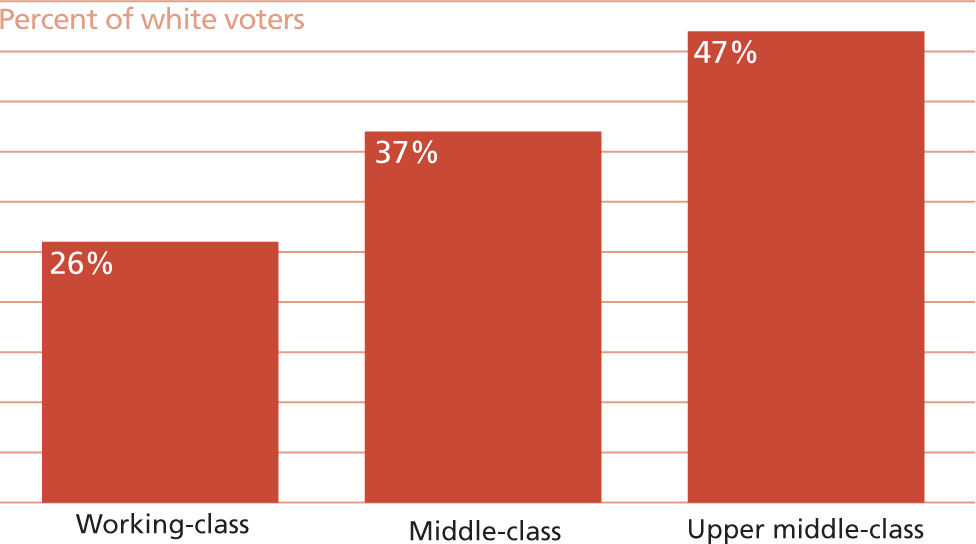
What exactly were the findings that prompted the spread in the Chronicle? We began with the familiar finding that social class was strongly related to voting behavior. As the graphic below (left) shows, among whites 47 percent of upper-middle-class voters planned to vote for Goldwater, compared to 37 percent of middle-class voters and only 26 percent of working-class voters.
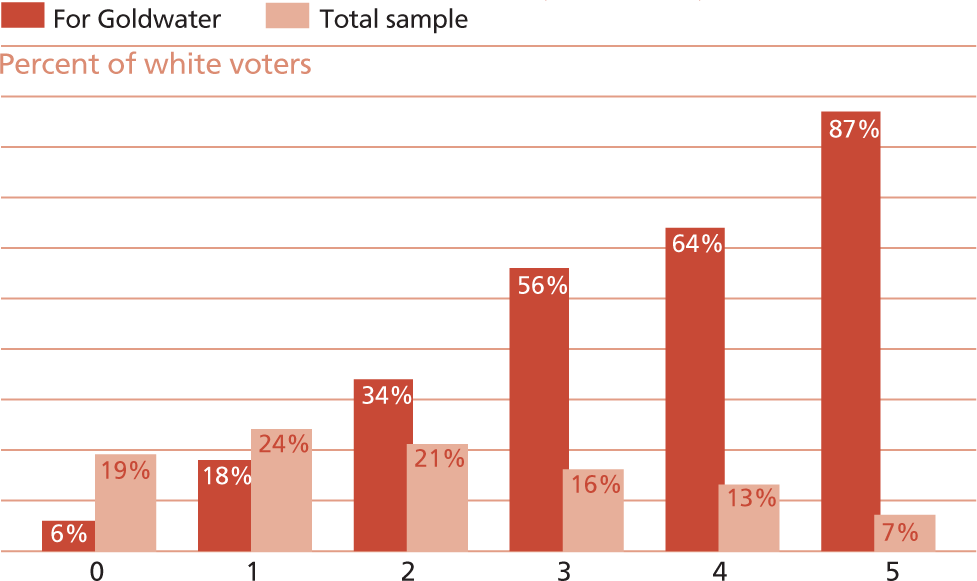
Our data also revealed widespread agreement with the ideological positions that Goldwater had advanced in the campaign: 47 percent agreed that “the Federal Government is gradually taking away our basic freedoms”; 45 percent agreed that “the country is sliding down the road to socialism”; 42 percent felt that “the nation’s morals are pretty bad and getting worse”; 41 percent concurred that “American Communists are a danger to this country”; and 30 percent felt that “the United States is losing power in the world.”
Intention to vote for Goldwater, 1964
Intention to vote for Goldwater by ideology, 1964
Index of ideological agreement
In favor of Medicare, 1964
Ideological agreement with Goldwater
Opposed to cutting Medicare and Medicaid, 2011
Source: McClatchy-Marist National Survey, April 2011.
We combined these five questions into an Index of Ideological Agreement with Goldwater. As the right-hand graphic on p. 62 shows, the higher the score on the Index, the greater likelihood one planned to vote for Goldwater. Hardly anyone with a score of 0 planned to vote for Goldwater, whereas virtually everyone with a score of 5 planned to vote for Goldwater.
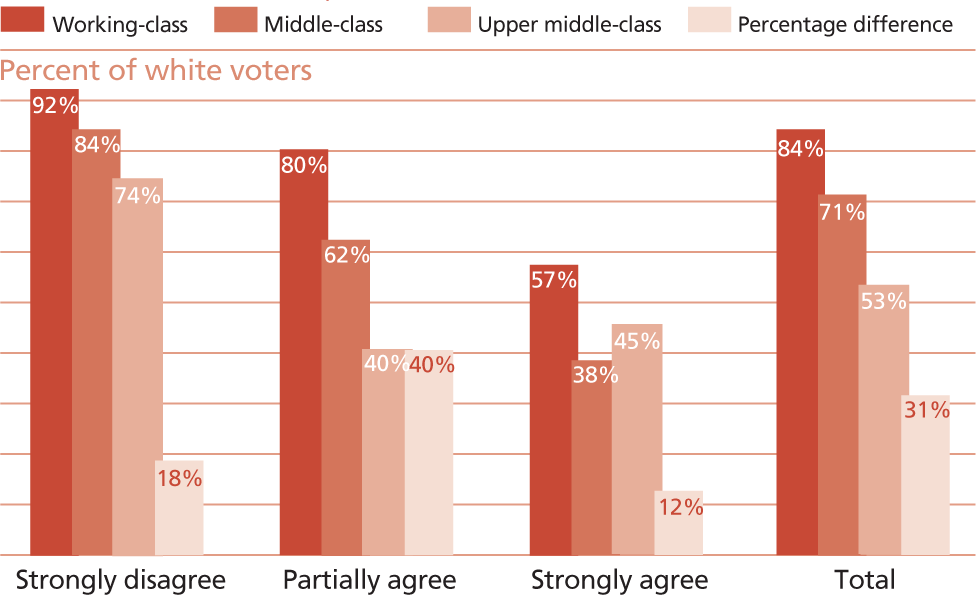
Surprising findings emerged for those on the ideological fence (the 50 percent of the sample who had scores of 2, 3, or 4 on the Index). Among these middle-of-the-road voters, social class was inversely associated with support for Medicare: 80 percent of white working-class voters who were in partial agreement with Goldwater approved of Medicare, compared to 62 percent of middle class and 40 percent of upper-middle-class persons (see above left).
Support of Medicare, in turn, had a powerful influence on whether those who were on the ideological fence planned to vote for him. Goldwater’s strong opposition to Medicare (and by implication, Social Security) clearly cost him large numbers of votes among those who otherwise shared his conservative ideology—and this was especially true among working-class voters. Fully three-quarters of working-class voters who were on the ideological fence and favored Medicare planned to vote for Johnson, compared to 62 and 60 percent of middle- and upper-middle-class voters, respectively.
Two months after the flurry of media coverage of our research, including a column in Parade Magazine, we received a polite note from Barry Goldwater, asking for a copy of our study. He wrote: “I have made a rather exhaustive study of this myself and I believe that you are correct in the social security end of it, however, I haven’t run into any amount of issue with Medicare. The second large contributing factor, in my opinion, was the widespread idea that I would go to war.”
Our study proved prophetic in one major respect: LBJ’s landslide did not signify “the death of conservatism.” Far from it. Beginning with the election of Richard Nixon in 1968, Republicans won five of the next six presidential elections and seven of the next ten. They did so by steering clear of “the third rail.” To be sure, from Ronald Reagan to Barack Obama, presidents have proposed cutbacks in Social Security and Medicare, but not until the Ryan Plan was there any attempt to challenge the basic structure of these programs.
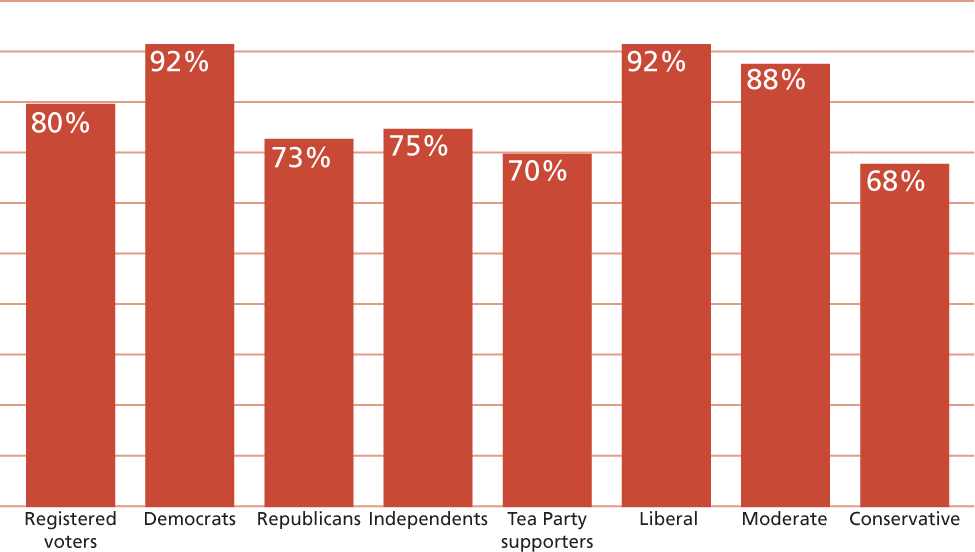
A 2011 McClatchy-Marist National Survey found that 70 percent of registered voters who support the Tea Party oppose making cuts to Medicare and Medicaid in order to cut the federal budget deficit (see above right). Moreover, 92 percent of Democrats oppose cutting Medicare and Medicaid, as do 73 percent of Republicans and 75 percent of Independents. As we found in 1964, support for Medicare is strong across the ideological spectrum: 92 percent of self-identified Liberals, 88 percent of Moderates, and 68 percent of Conservatives say they oppose cutting Medicare or Medicaid to reduce the national deficit.
Judging from the opprobrium heaped on Newt Gingrich after his salvo against “right-wing social engineering,” Republicans are going to have trouble backpedaling from their commitment to the Ryan Plan. That may change in the wake of recent Democratic victories in congressional elections in New York and Florida where Medicare was a prominent issue. However, it is already clear that the current swing of the ideological pendulum to the Right does not encompass a rejection of the social insurance programs that were part of the New Deal and the Great Society.