



Abstract
While most think of innovation’s insights coming in a flash of inspiration, Eric Dahlin uses multidisciplinary research to show that advances, big and small, more often result from collaborative, incremental efforts. To understand and spur innovation, then, scholars and practitioners must abandon the romantic notion of the lonely genius in favor of the wisdom of the collective.

Innovation, if popular conception is to be believed, comes in a flash of insight, a “Eureka!” moment, or a one-time, extraordinary event. Examples include Benjamin Franklin and his death-defying, kite-flying expedition or Isaac Newton’s apple epiphany.
Creative geniuses are often depicted as isolated, awkward, eccentric, and unkempt—think of photograph, movie, and TV personifications of Albert Einstein—and these lonely inventors inhabit poorly-lit laboratories littered with endless piles of books, half-eaten (but wholly forgotten) sandwiches, and a thin layer of scattered notes. Our socially-isolated heroes spend countless hours at lab benches, gazing into microscopes and petri dishes. These portrayals of those who accomplish legendary feats aren’t limited to scientific inventors. Henry David Thoreau famously retreated from society to better understand it by living alone for two years in a cabin on Walden Pond. Similarly, Jackson Pollack moved from New York City to the countryside where he isolated himself in a wooden shack and developed his iconic painting style. All of these tales are mythologized parts of our cultural and intellectual history.
Good stories notwithstanding, the view that innovation is tied to a solitary inventor or artist—the individual perspective—is incomplete. In reality, innovation is a social enterprise. It occurs in public spaces where people share ideas: coffee shops, work meetings, hallways, and watercoolers. Alexander Graham Bell once remarked, “Great discoveries and improvements invariably involve the cooperation of many minds.” Collaborative relationships have developed some of the greatest inventions in recent history. Thomas Edison’s laboratory at Menlo Park, which had a staff of up to thirty-five inventors, produced the light bulb. The collaborative efforts of Orville and Wilbur Wright led to the first recorded flight. Xerox Corporation’s Palo Alto Research Center (PARC) generated products in the 1970s that are still being used today: the computer mouse, laser printer, and Ethernet. The human genome was published by two different consortia in 2001. One group, The Celera Genomics Sequencing Team, consisted of 291 individuals from 14 companies, universities, institutes, and laboratories, and the other, The Human Genome Project, included 110 authors from 20 universities, research centers, institutes, and hospitals. According to a 2007 paper in Science by Stefan Wuchty, Benjamin Jones, and Brian Uzzi, coauthored scientific papers are cited more frequently than sole authored papers in almost every academic field—it seems papers written in teams are more likely to make an impact than papers written by individuals.
So, in contrast to romantic notions of lonely geniuses, innovation success depends on social contexts, processes, and activities. Innovation activities include generating, developing, and distributing new ideas or objects. Evidence for adopting a contextual view of innovation can be found by discussing the diverse activities associated with the stages of innovation, the impact of networks of people and networks of ideas on generating novelty, and the socially structured nature of innovation.
The Road to Eureka
Scholars have identified three broad stages of innovation: idea generation or invention, idea development, and diffusion. The first stage consists of creating a new idea or generating a new solution to a problem. Second, idea development involves transforming ideas into objects or practices that can be implemented. Third, diffusion refers to delivering the new objects to relevant constituencies or audiences. Of course, the activities associated with each stage can, and often do, occur simultaneously.
The stages of innovation are especially pronounced in industries where research scientists spend innumerable weeks, months, or even years brainstorming, inventing, and then developing a product in research and development labs. In the biotechnology industry invention begins with scientists examining thousands of chemical compounds in search of one viable drug candidate. The next stage, product development, continues with various phases of preclinical and clinical trials, which test drug safety and efficacy in up to thousands of human patients. Clinical trials are then followed by a lengthy application process to the Food and Drug Administration (FDA) in the United States or the European Medicines Agency (EMEA) in Europe. The final phase includes large-scale manufacturing, marketing, sales, and distribution of the new drug.
Despite romantic notions of lonely geniuses, innovation success really depends on social contexts, processes, and activities.
These stages not only apply to business, but also to artistic endeavors. In his book Art Worlds, sociologist Howard Becker argues that producing art requires many different activities and the cooperative efforts of many individuals. To create a symphony, concert, painting, book, film, building, statue, or poem requires countless hours, maybe even years, of creation. The artistic act is usually preceded by years of formal study, practice, and apprenticeship. To create art also requires many instruments, tools, physical facilities, and other materials that need to be constructed and maintained. Even once an artistic object has been invented, developed, and produced, it must be disseminated to audiences who must find the art appealing—and this dissemination may require uniquely developed skills or teams. In some cases, as in the case of a symphony, many highly-trained people are required for its delivery. For art to be noticed and embraced, marketing, distribution, and cultural preferences are no less important than the act of creation. It is no coincidence that the finished product is called “a work of art.”
Networks of People, Networks of Ideas
Refocusing our ideas of solitary genius, inventions attributed to an individual inventor are, upon closer examination, typically found to be animated by collaborative relationships and social networks. Although research uncovers many instances in which ties between individuals increase conformity (in political attitudes and behavior, happiness, and obesity, among other things), scholars also have pin-pointed the type of social networks that are most likely to generate innovation. These network structures are called “small-world” networks.
Small-world networks simultaneously generate familiarity and diversity, as they consist of small, cohesive groups or clusters within the network and a relatively small number of connections or bridges between clusters. Clusters of individuals within a network are characterized by dense connections that create familiarity and breed cohesion, while bridges or ties between people in different clusters act as conduits for transferring in information from sources outside the group. This novel knowledge leads to diversity of thought and innovation within the group. Groups, and cohesion within groups, provide the necessary coordination to adopt and implement new ideas.
Two studies published in the American Journal of Sociology show how small-world networks fuel innovation. In the first, network scholars Brian Uzzi and Jarrett Spiro consider successful Broadway musicals. These musicals are created, developed, and produced by members of a production team, and links between members of production teams emerge as they work on different musicals together. Uzzi and Spiro find that the production teams displaying small-world characteristics are more likely to achieve success on Broadway. Production teams with sufficient continuity (but not too much continuity) from one musical to the next, as well as a moderate level of connectivity across teams to promote diverse ideas and the spread of novel information, are most likely to be successful. Another study by Ronald Burt, an expert on social networks, finds similar effects. Managers of a large electronics company who served as brokers with ties between clusters in the organization were most likely to generate “good ideas” about what should be changed or improved in the company’s supply chain management.
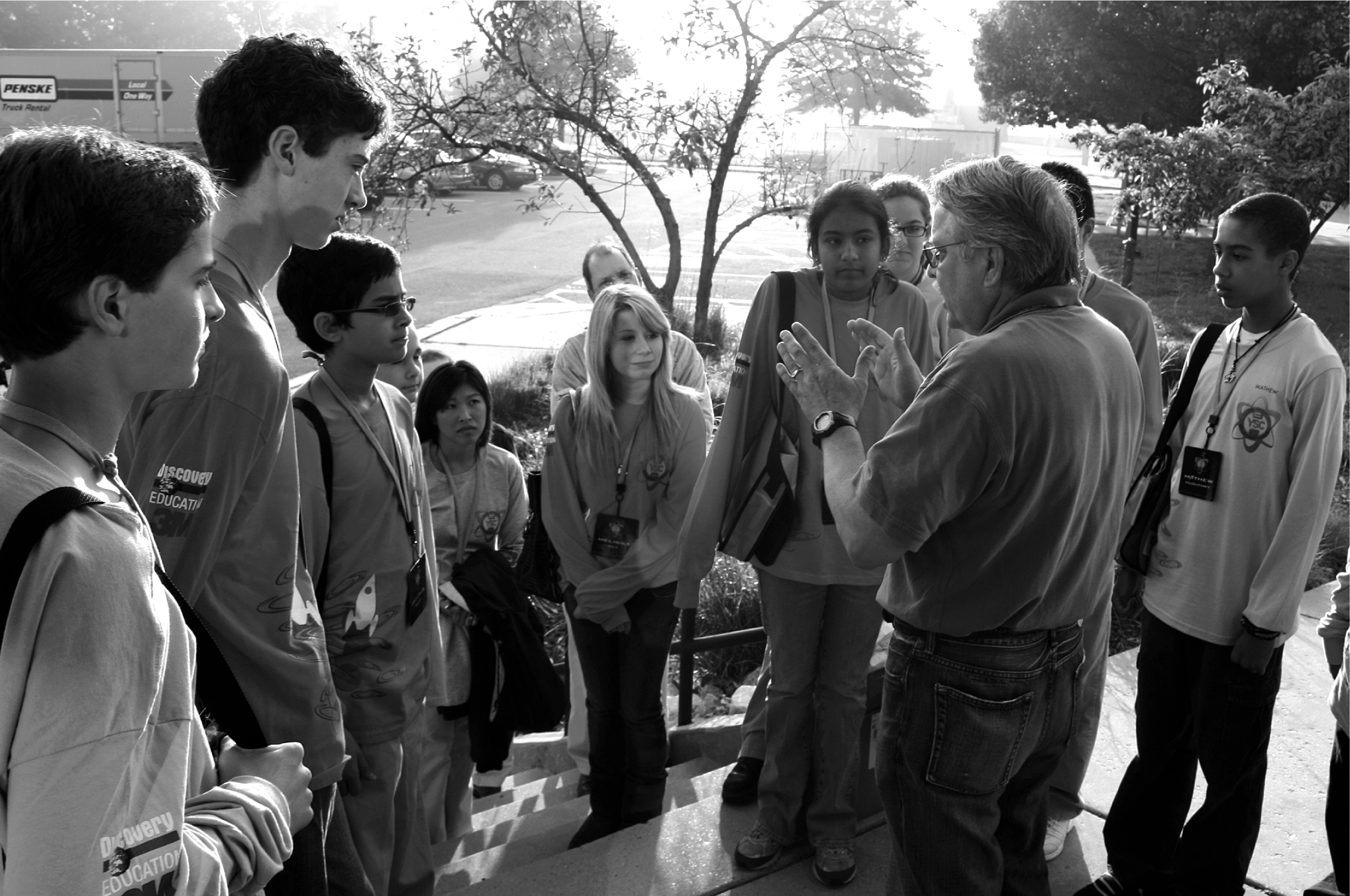
At the Discovery Education 3M Young Scientist Challenge, held annually at NASA’s Goddard Institute for Space Studies, promising young students are brought together to learn about and, more importantly, communicate about science. They’re collaborative innovators in the making.
According to the contextual perspective of innovation, new ideas are embedded within a network of existing ideas. Developing a truly unique idea is difficult, if not impossible. Even many of the most “disruptive” ideas possess an intellectual lineage or genealogy based on improvements or reconfigurations of past ideas. As mentioned above, Edison’s light bulb was influenced by the work of others. In fact, his 1879 patent application was denied because it was too similar to J.W. Star’s patent, which was approved almost 35 years earlier. Edison’s light bulb also built on Joseph Swan’s idea for using a carbon filament in an evacuated bulb, William Wallace and Moses Farmer’s device for generating power for the light bulb, and a fellow Menlo Park engineer’s idea of creating a light bulb that screwed into a socket. Edison is renowned for inventing the light bulb precisely because of his ability to recombine existing ideas. A series of studies on patenting and patent citations by Harvard Business School Professor Toby Stuart and his colleagues underscore the connections between new and old ideas. In a 1995 paper, Stuart and his coauthor Joel Podolny observed that innovations “…build on preexisting innovation and may themselves become foundations for future innovations. Thus, a given innovation is embedded in a relational context that can be defined by its connections to other innovations.”
Combining existing ideas to generate novelty is commonplace: think Reese’s Peanut Butter Cups (chocolate + peanut butter) and the iPhone (miniature computer + cell phone). Drawing from existing ideas puts extant intellectual and physical resources to work and reduces the costs associated with changing already-established routines. In 1988, Reebok hired a design firm, Design Continuum, to create a product to respond to Nike AIR technology in athletic shoes. Within six months, Design Continuum had created the Reebok Pump basketball shoe. The design was developed in a matter of weeks by two engineers, one of whom had experience designing inflatable splints and the other designing IV bags. The result was a “splint in a shoe.” The engineers’ experience with these technologies greatly accelerated the product design process and resulted in successful innovation. As innovation scholar Andrew Hargadon puts it, “Imagine what would have happened if Reebok’s engineers, or Design Continuum’s for that matter, had tried to invent the Pump from scratch.” Instead, “Design Continuum was able to recombine objects, ideas, and people of the world it knew in ways that shook Reebok and its world of athletic shoes.”
Economic sociologist David Stark identifies and explains a number of organizational practices that recombine existing ideas in his book The Sense of Dissonance (about which he was interviewed for the Fall 2010 issue of Contexts). As an illustration of recombination in organizations, Stark discusses a web development firm located in New York’s “Silicon Alley,” pseudonymously called NetKnowHow. Constant changes in technology, markets, and customer preferences put pressure on NetKnowHow to persistently innovate. To respond, Stark saw product development teams forced to reconfigure products, even as the products were still under development. The organizational practices that facilitated this recombination by product development teams included distributed decision-making authority, high levels of lateral communication between organizational units, and simultaneous engineering.
The Dvorak Simplified Keyboard has been around since the 1930s. Despite its efficiency and a small, but devoted and enduring fan base, it still never toppled the dominant QWERTY keyboard layout.

Developing a truly unique idea is difficult, if not impossible.
Social Context and Relative Innovation
Examining the context of innovation can also tell us which new objects and ideas will be successful. Even products that appear technologically superior to existing alternatives aren’t embraced if they fail to resonate with relevant constituencies or adapt to existing cultural and economic arrangements. A case in point is the Dvorak Simplified Keyboard (DSK). The DSK layout was introduced in the 1930s as an alternative to the awkward QWERTY keyboard configuration, still in use today. The DSK was designed by an educational psychologist, and placement of keys was based on frequency of use—commonly used letters were placed closest to the center row, where the fingers are at rest. The DSK holds the most world records for speed typing; U.S. Navy experiments in the 1940s showed that those using the DSK became faster typists; and advertisements for the Apple IIC (a personal computer sold in the late ‘70s and early ‘80s which utilized the DSK configuration) claimed that typists using the DSK typed 20 to 40 percent faster. Given all this, why hasn’t DSK supplanted the QWERTY layout? It lacks the social and economic arrangements that support the manufacturing, sale, and use of the QWERTY keyboard.
Sol LeWitt’s sculpture, “Four-Sided Pyramid,” at the National Gallery of Art, was not a solo effort. Like many of LeWitt’s works, it was erected by a team of engineers and stone masons working alongside the artist.

Contextual factors don’t provide the only clues about whether a new product will succeed. In fact, whether an object or idea is considered new is always relative to a particular reference point. The “relativity” of innovation became apparent in an interview I conducted with the CEO of a biotechnology company. The CEO began by stating that his company’s product portfolio is “quite innovative.” His firm focuses on “next generation” drug candidates that represent radical innovations in the biotechnology industry. But since drug development is very expensive and the firm is small with relatively few resources, all of its products coalesce around a single technology. Each new drug tested in clinical trials represents only a slight change from other drugs in its product portfolio, and the firm operates in a narrow market niche. At first blush, the product development strategy identified by the CEO is novel: his firm develops radically new products. Upon closer examination, however, each new product represents only an incremental change relative to the firm’s existing products. Therefore, whether the firm’s products are viewed as truly innovative depends on the reference point (in this case, the firm or the industry).
So, what is the implication of viewing innovation from multiple vantage points? The answer is that success is more likely when a new object or idea builds on existing competencies or knowledge of the inventor while simultaneously adapting to the social context. On the one hand, research shows that using core competencies is beneficial for innovation success, while departing from existing practices incurs costs and has deleterious effects. In organizations, the harmful effects of innovation include decreasing returns in product development and increasing costs of retraining employees or purchasing new equipment. On the other hand, adapting products or services to the social context is beneficial. It signals legitimacy and enhances chances for survival. Innovation that can leverage existing competencies while simultaneously adapting to the social context is most likely to succeed.
Ford Motor Company’s initial expansion into Britain reveals the importance of using extant capabilities while also adapting to the environment. Ford was met with remarkable and rapid success after establishing a manufacturing plant in Manchester, England in 1911. By 1913, this plant produced more cars than any other in Europe; by 1919, Ford was already producing 40 percent of all British automobiles. The British plant utilized the company’s existing capabilities with the moving production line in the manufacturing process. As a result, Ford produced and sold cars at a much lower price than its competitors. But Ford also adapted its cars to the British market, making slight design modifications like putting steering wheels on the right-hand side of the car, and giving local dealers the flexibility to make changes according to customer preferences. Ford built on existing capabilities, allowing it to sell cars at lower rates compared with competitors, and adapted its product to the new market in ways that satisfied customers. This formula added up to astounding success.
Viewing innovation as relative applies to social issues as well as commercial concerns. Every year more than four million infants die within a month of birth due to poor medical treatment. Many of these deaths could be prevented with a properly working incubator to produce heat in a clean environment. But incubators are expensive, and the incubators that are available often malfunction and require specialized knowledge or expensive replacement parts to fix. To address these issues a nonprofit firm called Design that Matters, which creates new products to help disadvantaged populations in developing countries, partnered with the Center for Integration of Medicine & Innovative Technology (CIMIT), a non-profit consortium of hospitals and universities that seeks to improve patient care. Together, they built an incubator that could be more easily distributed and maintained in developing countries. Because most regions in developing countries have cars and the expertise and parts to repair them, the incubator was made from automobile parts, with headlights to produce heat, filters to provide clean air, and a battery to generate power. Design that Matters and CIMIT leveraged their expertise and adapted it in new ways to create a much-needed technology that could be produced, used, and maintained in developing countries.
The tendency to identify the isolated inventor as the catalyst of innovation is understandable. Individuals and individual personality traits are the most convenient and visible explanations, and American society often lauds the sole hero. The easiest description is a single actor, incident, or action that immediately precedes a new idea or object. It’s unwieldy and impractical to recount every contributor to the intellectual evolution of a new object or to consider all the elements of the social structure that contributed to it. Yet, recall Alexander Graham Bell’s comment that discovery is a collective endeavor. Invoking the individual view of innovation is like seeing only the tip of the iceberg that peeks out atop the water. Failing to broaden our view of the conditions that sustain innovation provides an incomplete picture and impedes the construction of accurate (perhaps even replicable) accounts of innovation success.
The myth of the lonely inventor is slowly changing. The contextual view is gaining traction from findings in academic research that social conditions precipitate innovation, an increasing number of books written for the general public on the collective nature of innovation (see, for instance, science and technology writer Steven Johnson’s 2010 book Where Good Ideas Come From), and media accounts that provide examples of collaborative innovation. A recent article in the Wall Street Journal by Stan Sesser reports on contemporary artists who increasingly employ assistants to produce paintings on their behalf, pointing out that using apprentices to create art isn’t a recent phenomenon. After all, Michelangelo used twelve assistants to help paint the Sistine Chapel.
Novel approaches to issues such as poverty and disease may emerge from the cross-fertilization of ideas across intellectual boundaries.
Debunking the myth of the lonely inventor is essential for understanding how social context affects innovation success and for finding new solutions to pressing social problems. In fact, novel approaches to issues such as poverty and disease are perhaps most likely to emerge from the cross-fertilization of ideas across professional, political, and cultural boundaries. While individual “Eureka!” moments have given us some great stories, the social side of innovation has given us some even greater discoveries.