



Abstract
Drawing on classical sociology texts, Charles Lemert explores the necessity of a sociological examination of what he calls the Society of the Dead and how its memories impact social life.
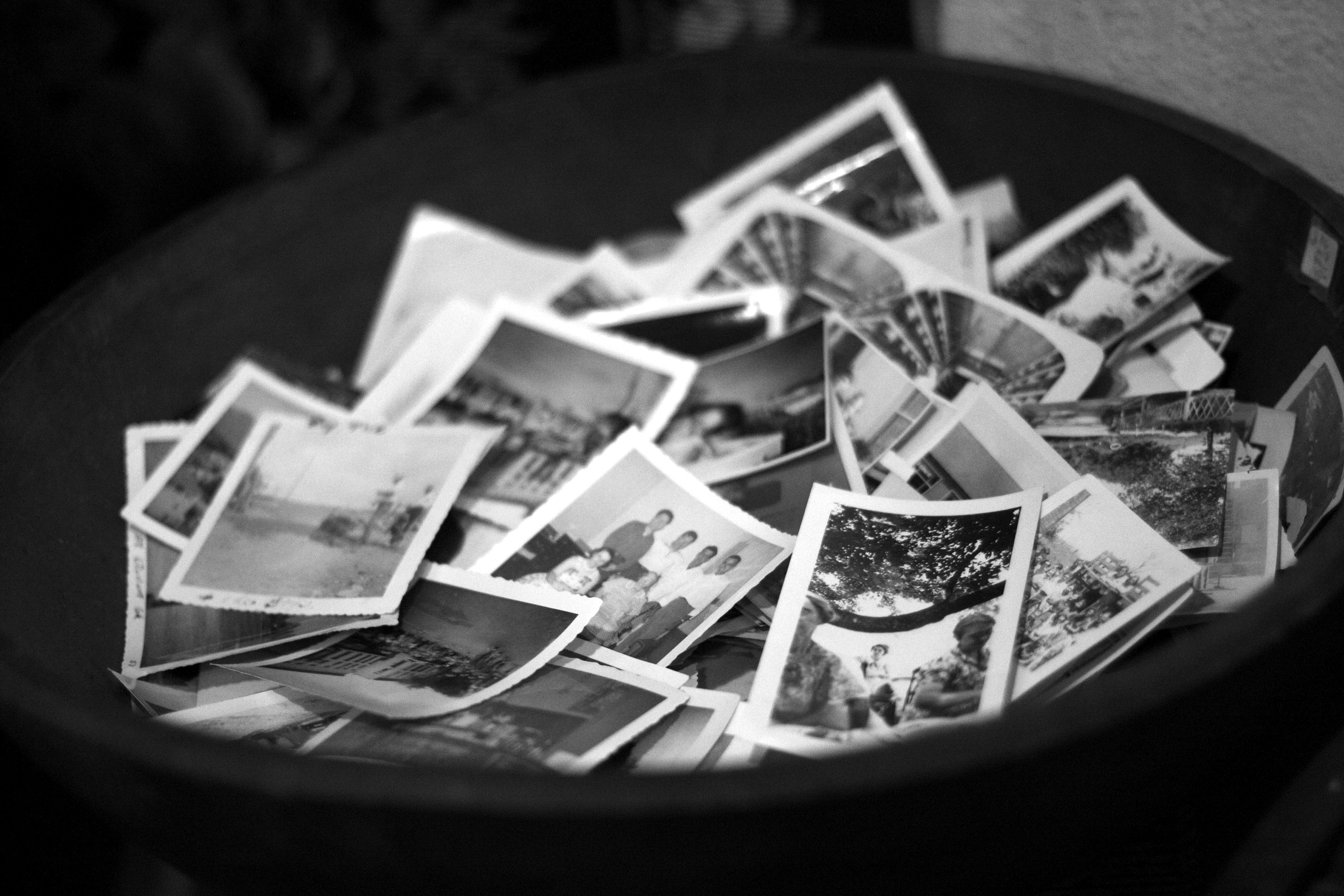
One late summer afternoon some years ago, I visited the graves of those who had brought me up.
That summer, I was of an age when one pauses before the surprising idea that he too will return to the ground of all beings. Those I visited had been thus grounded a good while. It was Florence who died most recently, about twenty years after Helen went Home (as Florence would have put it, with a capital H). That was 1975, just months after Gertrude had passed (as she would have put it, in a discreet lower case). And Grandmother Gertrude lay next to Blaine. He was grandpa; she was grandmother. I never knew why (nor thought much about it). Grandpa had purchased this family plot when World War II made burial ground a particular concern, and he bought places for four—no more. This he did in the assurance that the intended would not refuse to join him. He died in 1948. Blaine and Gertrude, parents to Charles, lay side-by-side alongside their son and Helen, his wife. Florence and Adele were elsewhere in the yard. No place had been made for them in the tight circle of family respectability. Neither had their second son, Edwin, nor my brother and I (much less our wives and children) been invited. This place wasn’t for just anyone.
The family burial place was a choice address in one of the nation’s most lovely cemeteries. When they were among the Living, these four had made a judicious show of their slight progress beyond the American postwar normal. Gertrude, whom I had never known to read a book, kept a subscription to The New Yorker until the day she died. Blaine, from small town Ohio, wanted an address in Cincinnati’s best neighborhood. He got it, but his was the smallest house on the avenue. Charles, who bought a new car every year, once bought a Jaguar. In those days, such a prize meant an hour’s drive each way for maintenance at a dealership closer to the city’s truly wealthy. The year after the Jaguar, he went back to Oldsmobiles. His wife Helen decorated our homes in expensive reproduction furniture and art, using an interior decorator, even when the interiors decorated were no more than a living room and a dining alcove. Each of these four had their way of hinting at the good luck of their inconsiderable fortunes, and they chose their final resting-place so as to perpetuate a status that outran their means. In this, they were like thousands of men and women of their times: good (or at least well-intended) people who wanted more than their circumstances would permit. In life, they had had a lot, but less than they thought they deserved. In death, their family plot was meant to close the gap.
Spring Grove Cemetery was designed in the mid-nineteenth century when landscape architecture was a new art. Its architect was the man who finished second to Fredrick Law Olmstead for the prize of landscaping New York’s Central Park—an emblematic outcome for a city like Cincinnati, so accustomed to coming second. Today, Spring Grove is as it was meant to be: an arboretum of 700 acres for about 200,000 interments since 1845. That’s about 1,200 bodies a year, 250 an acre. Like the neighborhoods in which most of the Dead here gathered had lived, Spring Grove is an exclusive address in a suburban sort of way—hard to get into, and a bit crowded, though tastefully so. No plastic flowers.
The indefinite location of the Dead in but not of our world may explain how they disturb the sober space between faith and doubt.
At my family’s perpetual address, their graveyard neighbors generally have the bigger monuments. The first rule among nouveau house hunters is that long-term profits accrue to the smallest house on a block of bigger homes. This was a rule my family had disobeyed only once, when Charles bought the biggest house in a declassed neighborhood. It made us all miserable. Today, that house is in shambles. He, like his father Blaine, may well have applied the rule to the place of their deaths as if proximity to the better-off Dead promises a perpetual gain in long-term status. But who exactly did they suppose would notice or otherwise pay the dividend? Might they have hoped that their plot, so near the road but overlooking a lovely pond amid splendid plantings, would cause strangers to tip their hats? What were they thinking, if they thought at all, about the place they would inhabit forever?
The Dead are not exactly absent from the communities of the living. Many of them lie or are scattered in special places around town. People will swear on their dead. We visit them. Huge sums are paid to manage their remains. While they remain above ground, the Living will make elaborate plans for their own burials.
Down through the ages, since at least Homer had Ulysses visit the underworld, the world of the Dead has preoccupied the Living. To write or speak of the underworld is, as novelist Margaret Atwood puts it in Negotiating with the Dead, grave digging. “Everyone can dig a hole in a cemetery, but not everyone is a grave-digger. The latter takes a good deal more stamina and persistence. It is also, because of the nature of the activity, a deeply symbolic role. As a grave-digger, you are not just a person who excavates. You carry upon your shoulders the weight of other people’s projections, of their fears and fantasies and anxieties and superstitions.” While Atwood is referring to her work as a writer, the wisdom applies just as well to the murkiness of living in the shadow of a nether world that can be explored only in the faint light of signs and symbols.
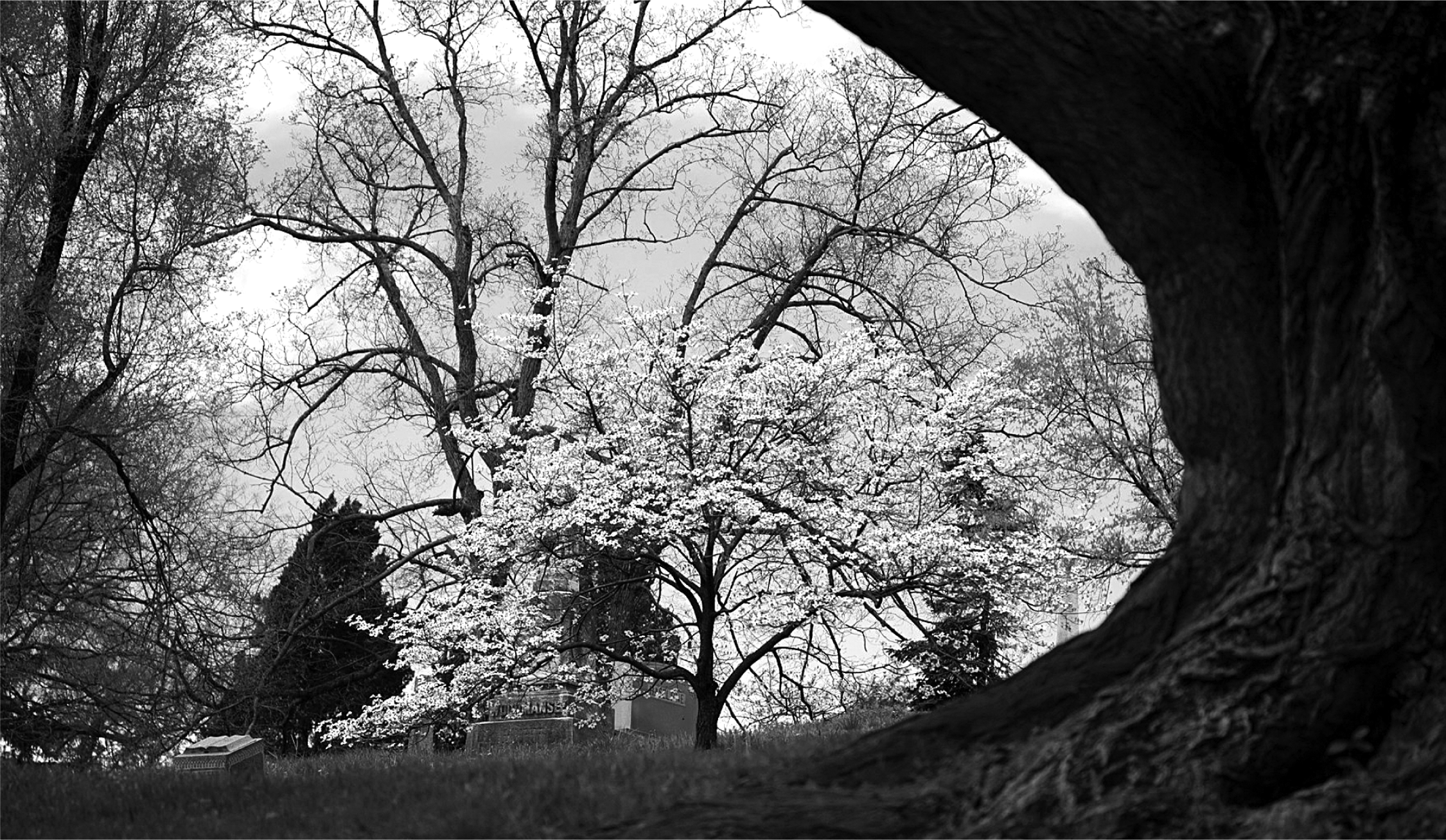
A quiet scene in Spring Grove Cemetary, Cincinnati, OH.
In The Living and the Dead, W. Lloyd Warner, one the most thoughtful of modern writers on the society of the Dead, said: “In the context of the sacred ceremonial, the funeral, and the consecrated ground of the cemetery, the name of the departed becomes the sacred symbol which helps unite the secular living with the sacred dead.” Warner went on to explain how the burial grounds of the Dead were deeply embedded in the social order of Yankee City, his pseudonym for the New England town he studied as carefully as any town has been studied.
Questions of the social worlds of the Dead may seem to entail some sort of religious sentiment. Yet, Lloyd Warner, who took religion very seriously, was quite clear that the graveyard united the secular living with the sacred dead. The society of the Dead, whatever may be its status in the order of enduring things, is not reserved either for the righteous or the religious. All die. All join the company of the Dead. Whatever may be believed about the state of their souls, the Dead are not, in themselves, religious beings (if they are beings at all). Whatever may be sacred about them is a given of their condition. They have done nothing to earn the status. The indefinite location of the Dead in but not of the worlds of the Living may explain why they disturb the sober space between faith and doubt.
Though polling evidence can be fickle, well into the twenty-first century one Harris poll reported a majority of Americans believed in ghosts (a 2009 Pew poll found that fewer did but, inexplicably, the number of those who believed had more than doubled in the first decade of the century). Even the notoriously irreligious believe in ghosts.
As long ago as 1852, in The Eighteenth Brumaire, Marx wrote of the force of ghosts in human history: “The tradition of all dead generations weighs like a nightmare on the brains of the living.” Thereafter ghosts have lurked here and there in the shadows of social theory. More recently, in Spectres of Marx, Jacques Derrida wrote an invitation: “Let us situate ourselves for a moment in that place where the values of value (between use-value and exchange-value), secret, mystique, enigma, fetish, and the ideological form a chain in Marx’s text, singularly in Capital, and let us try at least to indicate (it will be only an indicator) the spectral movement of this chain. The movement is staged there where it is a question, precisely, of forming the concept of what the stage, any stage, withdraws from our blind eyes at the moment we open them.” Why is it that the mystery of social life rests on the unfathomable fact that we cannot ever know directly the exact structural forms by which human society assigns fungible value to any given commodity least of all to the treasure of life itself? The source of value dies before our eyes at the very moment we catch a glimpse of it, then lingers as structures that haunt. What then are these ghosts, and what is their relation to the society of the Living? Simply put, they are the ghouls of the one social fact that we the Living cannot think—that we will die, all and without exception. Yet, as Marx put it, the Dead (our dead) press on us as we try to live in history.
The Dead comprise that one society all the Living must join and to which, whilst living, we are bound by the irony of the breach on both sides of the imperceptible line between. They are lost to us; we to them. The very necessity of it is the most fundamental of hauntings. We know that the Dead are waiting for us, but we know it only in that instant when we allow (or cause) that insight to disappear.
In Ghostly Matters, a modern classic in the study of ghosts, Avery Gordon sharpens the point well: “The ghost is not simply a dead or missing person, but a social figure, and investigating it can lead to that dense site where history and subjectivity make social life. The ghost or the apparition is one form by which something is lost, or barely visible, or seemingly not there to our supposedly well-trained eyes, makes itself known or apparent to us, in its own way, of course. The way of the ghost is haunting, and haunting is a very particular way of knowing what has happened or is happening.” Could there be a better adumbration of what C. Wright Mills called the “sociological imagination”?
Whether in practical or professional work we must live in the between of our subjective or personal troubles and the irreality of historical structures we can only imagine (if we will). The fact of all social matters is that we know something is happening before (and if) we come to know what it is. This is the truth of structural effects. Whatever they may be when we experience them, the deep structures of the worlds about are long dead by the time they get under our skin. Like all ghosts, they haunt the guts well before some word of them forms in mind or mouth.
The Dead comprise the one society we all must join, but they are lost to us, we to them.
To say that the Dead haunt all that we know is not the undomesticated idea it might at first appear to be. We cannot ponder the long, tragic history of race in America without a thought of the dead slaves of long before. We cannot study the modern world-system or globalization without consideration of its deep past in the ghosts of the colonial system. We cannot look into the face of inequalities without casting an eye on the flawed dream of modern equalities. Some might want to call these hauntings the necessity of history.
To live wittingly in the days we may have is hard skating on the thin evidence we garner from hints and clues found in the attics and stacks wherein history’s dusty archives languish. The first among equals of social historians was Max Weber who, in 1917 in “Science as a Vocation,” remarked that the scientist must be willing to make countless calculations for months on end before, in its own good time, an idea dawns. So it is for all. Social facts are truths buried in a past perfect. They work their way toward us and our destinies only through the hauntings of dead social structures. Some think they have earned the goods they have. Others believe that they need what they need because they did something wrong or bad. The curve that falls from the presumption of merit to the shame of poverty measures the truth of social inequalities. It counts the arrogant in and the shamed out with no sense of irony that all social measures are ghosts of the past.
The Dead weigh upon us not as nightmares, but as life itself.
An honest living accrues only to those who calculate their worth against the collective Dead who, in turn, are the only ones able to supply the facts of the structural past to an illusory social present. Could there be any subject, however slippery, more fundamental to the social study of these worlds than the hold the world of the Dead has upon our living? To be sure, that hold is the suffocating grip of denial, as the cultural anthropologist Ernest Becker put it in Denial of Death. Cultures that deny the welcoming embrace of their dead are themselves morbid—a morbidity that works its nasty charms by sneaking up in those flickering moments of awareness that we belong to the Dead. This is what an apparition is—the appearance as if it were a reality that is always somewhere in the offing. Elvis, like JFK, like all who die before their time, is out there somewhere, beckoning. These totemic figures may be perfectly content. It is we who cannot let them grow old.
In what may be the best recent essay by a sociologist on the subject, Zygmunt Bauman in Mortality, Immortality, and Other Life Strategies, joins a long lineage of thinkers going back at least to Augustine of Hippo. The single most distinctive quality of human consciousness, says Bauman, is that “we not only know but we know that we know” and this, he continues, is why death is so terrifying. Death, insofar as the living can know it, obliterates precisely this knowledge of ourselves as beings who know that they know (the very quality that makes us rational). If death is so fearsome as to be the object of a culturally induced denial and, as Bauman adds, the inspiration to creative thinking and living, then why shouldn’t the Dead be treated for what they are—as at once the symbolic shifters that return us to life and the phantoms of that life lived with others?
In the end (so to speak), to try to think of the society of the Dead is to demand a certain rigor of, if not definition, hypothesis as to what such a society might be. Ironically put, that hypothesis would be that ultimately everything social is hypothetical. It is not sheer cleverness that leads to this conclusion, but the reality of our work as we do it, or as we ought to be doing it. Everything we touch—every fact mined, every passing thought, every test of our significance, every calculus of net worth, everything—ought to be kept in the realm of the hypothetical. Yet, in the course of our practical lives, it seldom works this way. Perhaps it’s not because we long so for certainties that will resurrect us from the land of the anonymous Dead. We want to be known, remembered. The ordinary living might not stare straight on into the land of the Dead, but, whatever they think they are doing, they take Abrahamic leaps of faith in the risks of bearing children, making love, looking for work, daring to beg. To give birth, to undress, to work, to try is to live facing if not the society of the Dead, the uncertainty that our efforts will somehow endure—and they do not, at least not to a degree that warrants cutting off the land of the Dead as if it were unreal.
Still, it is a challenge to think about this society we cannot know but without which we cannot be. It may be that we must think of the Dead as they appear to us as hauntings from a nether world. In The Dominion of the Dead, Robert Pogue Harrison, the brilliant Stanford professor of Italian Literatures, ties the knot that Lloyd Warner put in place but could not bind. If there is a symbolic bond between the Living and the Dead, then how does that symbolic reality affect the work of Living itself? Harrison’s answer: “In the human realm the dead and the unborn are native allies, so much so that from their posthumous abode—wherever it be—the former hound the living with guilt, dread, and a sense of responsibility, obliging us, by whatever means necessary, to take the unborn into our care and to keep the story going, even if we never quite figure out what the story is about, what our part in it is, the end toward which it is progressing, or the moral it contains.” This contains everything necessary, if not sufficient, unto one of the social mysteries of the communion we share with the Dead. Why we, in our collective human nature, care about and for the unborn cannot be so simple as the reason the salmon swim hard against the current to reproduce their kind. Instinct may be part of it, but caring for the unborn is far more social, in the human sense, than mere species reproduction. To be sure, some among us don’t give a damn. But the human Living and our Dead are a community that cannot rely on outliers for either survival or meaning.
Societies rely on their norms, as Emile Durkheim said early in the twentieth century, even when, as Erving Goffman said much later, they do not require all members to be normal. The normal is a crypto-statistical condition. Norms are the substance of the social contract—that vast, impossible unborn ideal that is beyond historical evidence yet without which societies cannot think themselves. Collective self-knowledge is, as again Durkheim discovered, a very different thing from the psychology of self-consciousness. We may, as individuals, know that we know, but in the long run of life what matters is that those with whom we constitute a society know that together we do not know everything, least of all the truth of our relations with the Dead. Herein is where and how the Dead join us to the unborn. It’s not a formal rule, so much as an essential, affective experience that societies care for those yet to come. We cannot say exactly what the Dead feel, but we can suppose that, wherever they are, they await those as yet unborn to their realm as we await those yet to come to the land of our Living.
The norm of a social contract is, thus, tested most severely by a society’s willingness to care for its unborn. They may not come from the body of our personal relations, but they do come and they must be cared for. Hence, the society of the Dead is the social fact that in caring for what happens to our Dead, we engage them and their society in their responsibility to care for us. Otherwise, we will not keep the story going. We may not understand what it all means, but we know that we are haunted by this story that continues for however long… until whatever comes next. Where we came from and where we are going aren’t challenges to our minds but to the primordial, even pre- (or post-) verbal states of our being. Marx had it backwards. The dead weigh upon us not as nightmares but as life itself. Warner got it right. We live among the Dead, and they live among us.