



Abstract
Two analyses of welfare policy as it has played out for over a decade shows how welfare-to-work programs fail to meet the basic needs of their participants and their communities.
Keywords
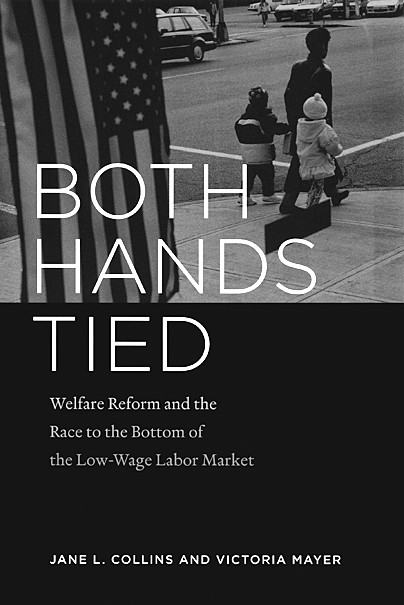
Both Hands Tied: Welfare Reform and the Race to the Bottom in the Low-Wage Labor Market
By Jane L. Collins and Victoria Mayer
University of Chicago Press, 2010, 264 pages
Selling Welfare Reform: Work-First and the New Common Sense of Employment
By Frank Ridzi
NYU Press, 2009, 336 pages

The United States’ welfare system is a punitive one, based in an ideology that believes paid work, no matter the job, is better than welfare “dependence.” This ideology has become so commonplace that it is taken for granted, or, as Frank Ridzi says in Selling Welfare Reform, it has become “common sense.” Contemporary welfare scholars seek to better understand the complexities and consequences of our current welfare programs 15 years after the creation of the Personal Responsibility and Work Opportunity Reconciliation Act (PRWORA) of 1996. PRWORA replaced the longstanding and hotly debated Aid to Families with Dependent Children (AFDC), a program that permitted eligible families to get assistance without requiring they meet other non-income conditions, such as working or looking for work.
Understanding how welfare programs in the United States operate is no small undertaking, especially because these programs can differ considerably from place to place. Past research has often failed to make the connections between national trends in welfare outcomes and more local investigations of how welfare policies are implemented. In Both Hands Tied and Selling Welfare Reform, the authors make these connections in exemplary fashion. Jane L. Collins, Victoria Mayer, and Frank Ridzi bring multidisciplinary lenses to their projects, allowing them to treat their impressive amount of data with incredible insight. While these books offer detailed investigations of the peculiarities of two different states, the authors situate them within the macro environment of national policy and show outcomes that are more similar than different. The strength of both books is the authors’ ability to connect case studies of the daily work of welfare policy implementation to broader welfare policy creation. This results in analyses that underscore the human side—and human costs—of welfare as we now know it.
In Both Hands Tied, Collins and Mayer argue that while many see welfare as the anti-thesis of work, welfare and work are actually inherently linked. In their study of programs in Milwaukee and Racine, Wisconsin, the authors show that welfare participants often work jobs that fail to provide basic benefits or a living wage. Since these jobs lack benefits, welfare participants find themselves seeking assistance to compensate for programs not offered by their employers (e.g., health care benefits, child care assistance, maternity leave, disability benefits, and family/sick leave). Welfare participants are further disadvantaged since, in exchange for government aid, they are denied the simple civil right to choose where to work. Another constraint, faced by black women in particular, is the increased pressure to be sole family breadwinners due to the disproportionately high unemployment and incarceration rates of black males in these focal areas of Wisconsin. This pressure leads women to seek welfare assistance and enter a welfare-to-work program with “both hands tied.”
Understanding how welfare programs in the U.S. operate is no small undertaking; they differ considerably from place to place.
According to Collins and Mayer, the first hand is tied for welfare participants when they face the lack of employer support for workers. With a move from a guaranteed family wage of the past, which provided enough income for a man to support a whole family, to what the authors call the “solitary wage bargain” of today, we end up with employers who want workers with no “family issues” and workers who will comply with anything a potential employer asks of them. The inherent contradiction lies in the fact that these workers only seek welfare aid in conjunction with low paying jobs because of the financial demands of their familial obligations. Most of these jobs do not offer wages high enough to free women (who are far more likely than men to be recipients of welfare) from their need for financial assistance, and the lack of medical or family leave benefits leads women to use the welfare system when faced with caring for their own or family members’ medical issues.
The other hand is tied behind the back of women in the workfare programs with the loss of their civil liberties. The women are treated as second-class citizens. For instance, unlike most workers who can choose where they work, welfare recipients are not allowed to select their workfare site: instead, they are often placed in low-skill and low-wage work regardless of their skill set or career aspirations. Most welfare programs do not provide any form of job training, much less the specific job training the welfare participant desires. Furthermore, welfare recipients are not provided with clear guidelines for filing grievances (even less rarely are they provided with legal assistance.) This presents barriers to disputing sanctions by the welfare agency or unfair treatment by agency or employer.
One of the best aspects of Both Hands Tied is the authors’ ability to draw connections between the macro and the micro level of the welfare dilemma through the intermediaries of unionization, service sector jobs, and changing welfare policy. They show readers how current welfare policy is driven by a market philosophy meant to benefit employers and disadvantage (and disempower) all workers by driving down wages and making employees vulnerable to replacement. Workers directly interacting with the welfare program through workfare are especially affected. Being forced into an occupation that offers no benefits, no safety nets, and no hope of escaping poverty isn’t a choice most people would make without the coercion of the welfare system. The clear message from welfare program administrators and politicians is that recipients’ choices do not matter. Any job is considered better than welfare without work.
This point is also emphasized in Ridzi’s Selling Welfare Reform. The study, set in New York, is a critical analysis of the so-called “common sense” that led to the welfare reform of 1996 and generalized acceptance of the new welfare-to-work mentality. Through insightful interviews, Ridzi finds that the work-first program is helping capitalists more than anyone else. In multiple chapters, he discusses corporate lobbyists’ influence on politicians to pass PRWORA, which created this work-first program. There is a widely-held belief that welfare recipients are lazy, but being forced to work in even the lowest paying of jobs will teach them the value of hard work. Through that hard work they will be able to move up in their jobs and eventually be freed from welfare “dependence.” Like Collins and Mayer, Ridzi points out, however, that these jobs lack basic employee benefits and offer no opportunity for career advancement. Ridzi provides numerous examples of women who work every day just to make enough to still be poor and still need assistance from the government. Ridzi questions exactly how much common sense is actually implemented in the current welfare-to-work system.
Both books connect case studies to broader policy creation, underscoring the human side—and human costs—of welfare as we know it.
If the goal of the welfare program is to help individuals become self-sufficient, then the current system isn’t very effective. It seems to emphasize punishing and disciplining welfare participants in an effort to prepare them for the so-called “real world.” Ironically, defrauding the welfare system was found to be one of the only ways for women to escape poverty and become financially self-sufficient. By lying to caseworkers and using the system to go to school or train for the jobs they wanted, not just the jobs they were forced into, they were able to find gainful employment and free themselves from government assistance.
Welfare scholars often undertake research with an eye toward making the system more just for the poor. These authors are no exception–in many ways, they exemplify this trend. The authors capitalize on their extensive observations, in-depth interviews, and expansive policy analysis to illustrate how the current system is built to serve the needs of low-wage employers. If we desire better conditions for low-wage workers, serving the needs of welfare participants must become the new common sense. According to these authors, this would mean restoring participants’ civil rights and requiring employers to pay a living wage and provide benefits. This would not only help welfare participants, it helps, the authors argue, all low-wage workers. After all, the United States has a staggering number of people who are poor and yet work full-time jobs.
Ridzi is even more specific in his closing chapters, suggesting a number of changes to welfare programs. Among them, Ridzi argues that welfare providers could use the massive amounts of paperwork they collect to provide services to clients instead of using them only for surveillance of clients. In other words, caseworkers could easily collect (and in some cases are already collecting) data that could be analyzed for ways to improve the lives of people seeking assistance. Researchers and administrators could track what works and does not work to better inform policy change. This would require minimal structural change.
For all of these innovative suggestions, the question remains whether we can have a more just system with our existing welfare policy. As long as people see welfare participants as different from (and less than) themselves, things are not likely to change. We see the humanizing of welfare recipients as one of the strongest contributions made by the authors; it lessens the distance between recipients of welfare and the readers of these books. The possibility of these books reaching a broad audience allows us to remain hopeful that change is coming.