



Abstract
The successful, three-decade-long campaign to free the Soviet Jewry, found its strength in effectively blurring the boundaries among secular and religious acts, symbols, and space.
This year marks the twentieth anniversary of the fall of the Soviet Union. For activists around the world who spent the Cold War fighting against the special persecutions the Kremlin reserved for its Jewish citizens, the anniversary is also a moment to recall long years of struggle. Their commemorations add to a growing wave of memorialization that includes the Museum of the Jewish Diaspora’s 2007 exhibition in Tel Aviv, The Jews of Struggle; filmmaker Laura Bialis’ 2009 documentary, Refusenik; and journalist Gal Beckerman’s 2010 award-winning history, When They Come for Us We’ll Be Gone.
Scholars, too, are looking back at the campaign to free Soviet Jewry, which from 1963 to 1991 united millions of people in North America, Israel, Western Europe, and the USSR in common cause. What we find is not a Cold War–era relic, but a social movement whose mobilization of religion in the name of human rights can help us think more dispassionately about the decidedly more contentious and illiberal religious politics of today.
A sign of support hangs outside the Lincolnwood Jewish Congregation in the San Francisco area.
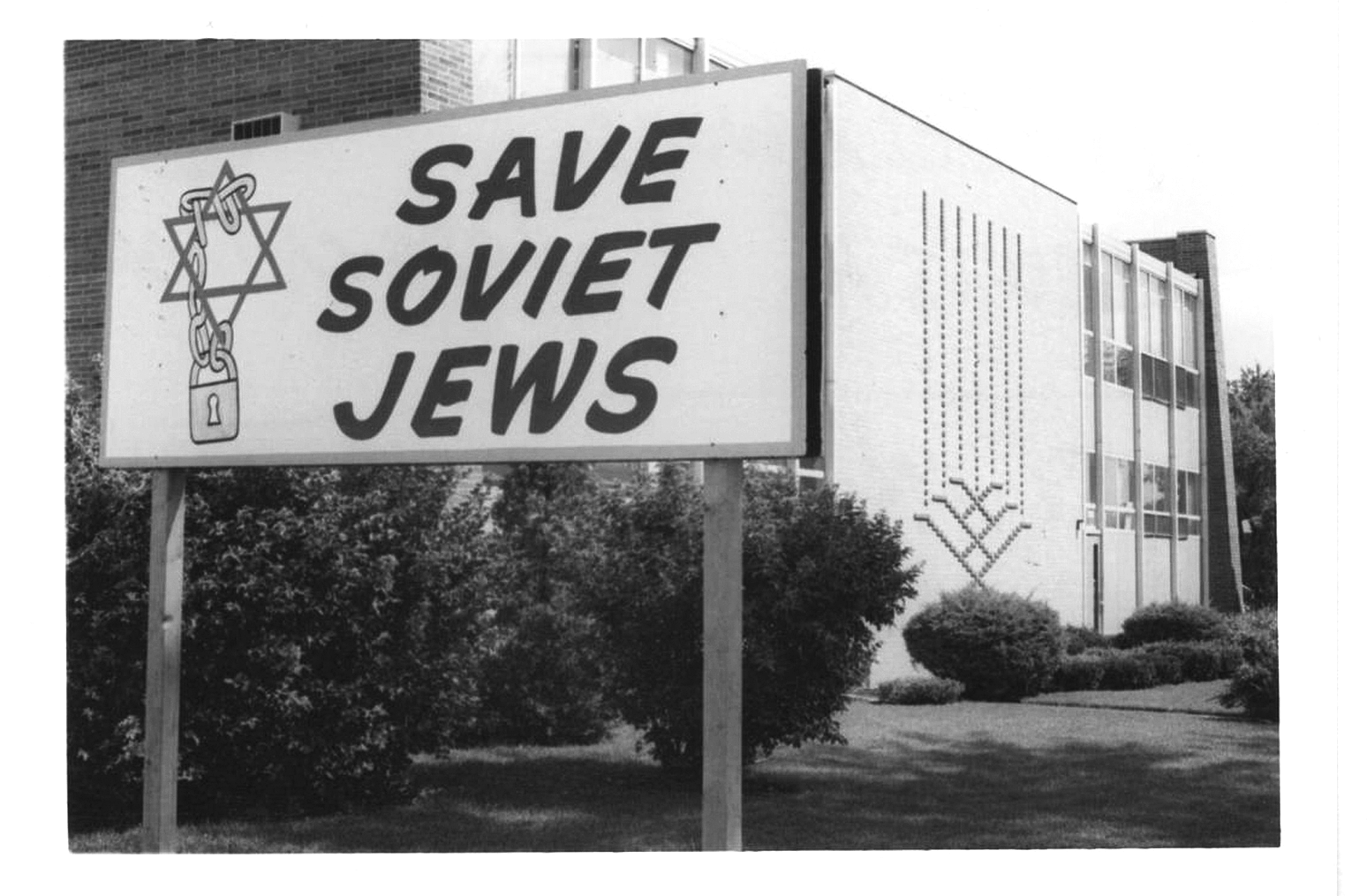
For much of the previous century, Jews in the USSR were singled out for vilification by state media, forced to endure barriers to social and economic mobility, and denied the cultural rights granted to other ethnic groups. Refused the right to emigrate, they could not escape their second-class status. As word of their plight filtered out from behind the Iron Curtain in the early 1960s, a worldwide protest movement arose.
The mobilization to free Soviet Jews was among the largest Jewish social movements of the twentieth century. Under slogans like “I am my brother’s keeper,” and “Let them live as Jews or let them leave,” the movement brought hundreds of thousands of demonstrators into American streets in the 1970s and 80s, singing movement songs like “Am Yisroel Chai” (“The Jewish Nation Lives”) and wearing movement jewelry such as metal bracelets inscribed with the names of Soviet Jewish “refuseniks.”
By the time it drew to a close, the Soviet Jewry movement had amassed an impressive list of accomplishments. It demonstrated the Kremlin’s susceptibility to pressure from citizens’ groups in the West. It placed the issue of Soviet Jewry on the agenda of superpower relations. Its flagship legislative effort, the 1975 Jackson-Vanik amendment, linked American trade policy to international respect for human rights for the first time in history. And of course, in securing the release of tens of thousands of Soviet Jews in the 1970s and in preparing the legal and logistical groundwork for their mass exodus when the USSR collapsed, the movement helped a million and a half people to freedom.
In the United States, Soviet Jewry activism was shaped by the shifting relationship of Jewish Americans to the civil rights movement. With the rise of Black Power and the waning of the Black-Jewish alliance of the early 1960s, many Jewish American civil rights activists found that the cause of Soviet Jewry enabled them to combine universalistic commitments to social justice with unapologetic assertions of ethnic pride.
In form and content, the mobilization in America was a product of its era’s social movement field. Drawing explicit contrasts with the quiet—some said quiescent—Jewish politics of their parents’ generation, young baby boomers took Jewish symbols and rituals out of the synagogues and into the streets, transforming them into tools of political theater.
At the Student Struggle for Soviet Jewry’s 1965 “Jericho March” to bring down the walls of oppression, prayer shawl-clad rabbis carrying Torah scrolls led a procession of 3,000 protesters, encircling the Soviet Mission to the United Nations seven times and sounding blasts on the shofar, or ceremonial ram’s horn, at the completion of each circuit.
Four years later, SSSJ held its first of many “freedom seders” outside the USSR’s diplomatic offices in New York. Analogizing the oppression of Soviet Jews to the enslavement of Israelites, they raised the unleavened matzah and declared, “This is the bread of affliction which our ancestors ate in the land of Egypt and cannot eat in the land of Russia.”
How might the Jericho Marches and freedom seders help us think about religion and social movements more generally? For one, studies of Soviet Jewry activism suggest that we should be wary of interpreting the use of religious language and symbols as simply a “natural” expression of the “inherently” religious character of a movement. Activists make choices about how to frame their causes. Here, the choice to deploy the trappings of the Jewish religion was partially a strategic choice, developed to mobilize an initially apathetic Jewish American populace by convincing them that this was no mere matter of secular politics but a sacred obligation of transcendent significance.
Refuseniks demonstrate on Arbat Street in San Francisco.
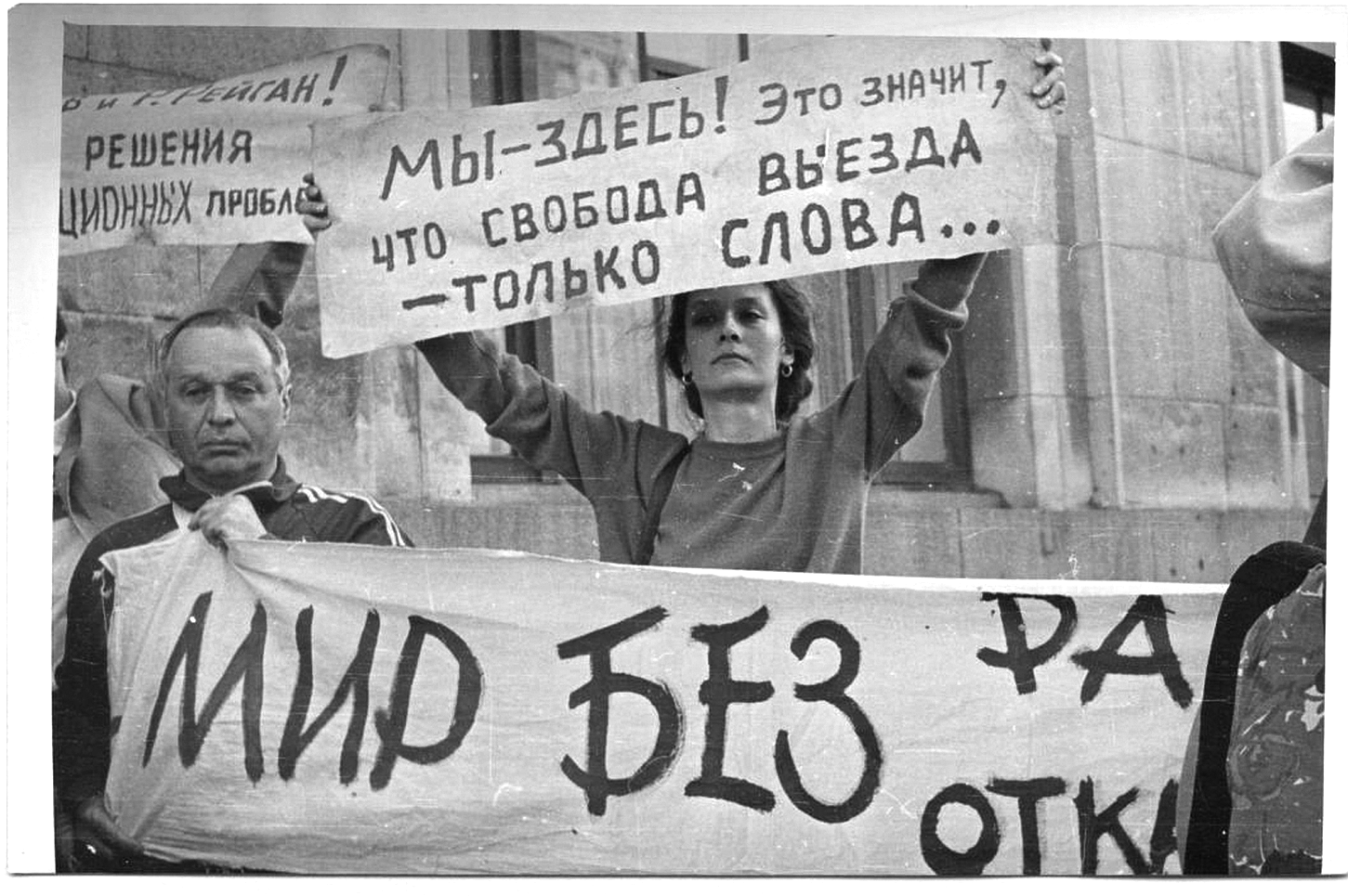
Framing politics as sacred is not easily accomplished. Declaring something religious does not necessarily make it so in the minds of those one is trying to convince. The reason words alone hardly suffice is that religion is never solely about disembodied beliefs and abstract doctrines. Religions do not compel allegiance unless they are lived in real behaviors.
Intuiting this, activists not only preached—they practiced. To frame support for Soviet Jewry as a religious obligation incumbent on Jewish Americans, they infused movement content into traditional Jewish rituals such as Passover seders, Chanukah candle lightings and Tisha B’Av fasts. This linked the movement to concrete religious acts. Participants in these ritualized protests would first perform the message of the cause’s sacredness. Whether they actually believed it or not, they had publicly committed themselves through their behavior. Belief, perhaps, would follow.
In addition to showing the importance of behavior in framing politics as religious, the ritualization of protest in the Soviet Jewry movement also points to the importance of time and space.
At first, the movement was using Jewish symbolism on an ad hoc basis. Why invoke the battle of Jericho in an April rally? There is no commanding logic linking that particular metaphor to that particular moment. By the end of the movement’s first decade, activists shifted to focus on seasonally appropriate rituals, symbols and themes, pegged to the Jewish holiday cycle.
This offered practical advantages. It mobilized Jews at times when they were already focused on Jewish things. It was also efficient. A year-long mobilization calendar could be planned in advance, reused year after year. More deeply, it integrated the movement into the sacred rhythms of the Jewish year, associating the cause with sacred time.
As for space, the movement tried to blur the line between the religious and the secular by placing religious behaviors in secular spaces and secular politics in religious spaces. The freedom seders brought Passover rituals out of the home and into the streets. Conversely, having Jewish American teens “twin” their Bar and Bat Mitzvahs with absent Soviet Jewish youth brought the movement out of the streets and into the synagogue.
In these ways and more, the movement staked a claim that an authentic Jewish politics expressed itself religiously and that an authentic Jewish religion had to be politically engaged. “How can you experience Passover and not speak out for those in the Egypt of today?” SSSJ’s leader, Rabbi Avraham Weiss, asked at a 1988 freedom seder.
All this raises a question: If social movements have to actively work to frame their causes as religious, what obstacles do they face? The main danger is the charge of sacrilege. Activists’ efforts to sanctify the profane may be instead perceived by their coreligionists as profaning the sacred. The movement to free Soviet Jews largely avoided this charge. The fundamentalist political movements of today, however, may not be so lucky.