



Abstract
Today's tabloids, and their messages, are remarkably similar to the first glossies that appeared in Hollywood's "Golden Age." Even the first female film stars were caught between celebration and condemnation as they navigated traditional notions of femininity.
Keywords
A 2007 Newsweek article, “Girls Gone Bad,” focused on the exploits of Britney Spears, Paris Hilton, Nicole Richie, and Lindsay Lohan, arguing that they were “oversexed.” Sex, drugs, and body size are all subjects of heightened focus for female celebrities, each used as evidence of lack of virtue and self-control. While Spears, Hilton, and Lohan have remained tabloid staples, Richie’s foray into motherhood and marriage seems to have allowed her to rehabilitate her image, reflecting historian Alice Kessler-Harris’s observation that family is equated with virtue for women. Wedding rites, baby bumps, and motherhood are all central facets of covering female stars today. Ambivalence about women’s proper roles in public life lingers in these glossy pages and beyond.
Celebrity has long held the potential to be both liberating and constraining; women who capitalize financially on their renown might create their own production companies and parlay fame into numerous business ventures. However, celebrity status is often rooted in regressive definitions of gender. There are notable exceptions—Madonna and Lady Gaga have famously played with these contradictions in their acts—but young women drawn to the allure of fame today will find much in common with the experiences of young women decades ago, walking a tightrope between celebration and condemnation.
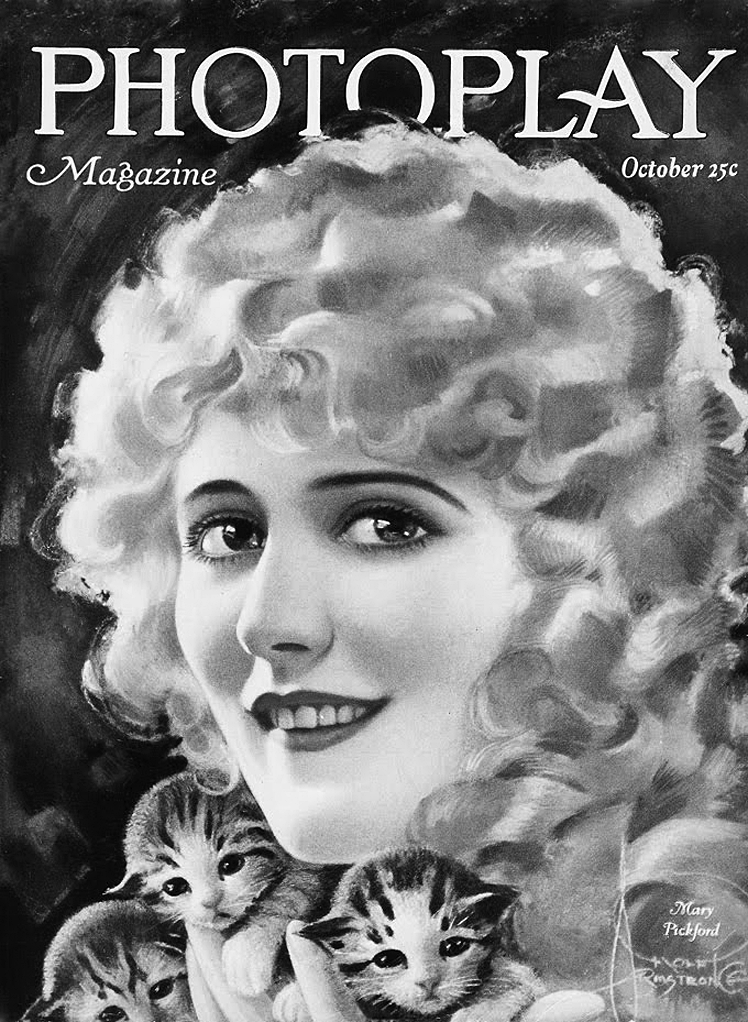
During the silent era, when movie fan magazines were first published, Motion Picture Story Magazine (1911-1977), Photoplay (1911-1980), Picture Play (1915-1941), and others were subsidized by the studios as industry boosters. Unlike today’s glossies, which reveal every detail of the lives of the rich and famous, these magazines initially offered little information about silent screen performers, known as “picture players.” This was by design: early films carried no credits, since producers wanted the films themselves to capture the public’s attention, and actors’ anonymity protected their potential careers in the legitimate theater.
That all changed as readers—often women—began to write in requesting information, mostly about the female players. What is her name? How does she keep her hair so lovely? Is she married? A Christian? Movie mavens soon realized that selling its performers, particularly its female performers, could also help sell the fledgling industry.
As cultural sociologist Joshua Gamson notes in his study of fame, women had historically been excluded from positions of public renown, but gained ground as they increasingly became primary consumers of mass produced goods at the start of the twentieth century. Advertisers picked up on this trend and used silent screen stars in their ads for beauty products. Features soon provided details of players’ personal backgrounds (albeit often fabricated) and burgeoning careers. Most fan magazine writers were women, and issues with women on the covers tended to sell better too.
Clara Bow may star on the cover, but the top headline for this 1923 issue of Movie Weekly is still “Why Betty Compson is Going to Marry.”
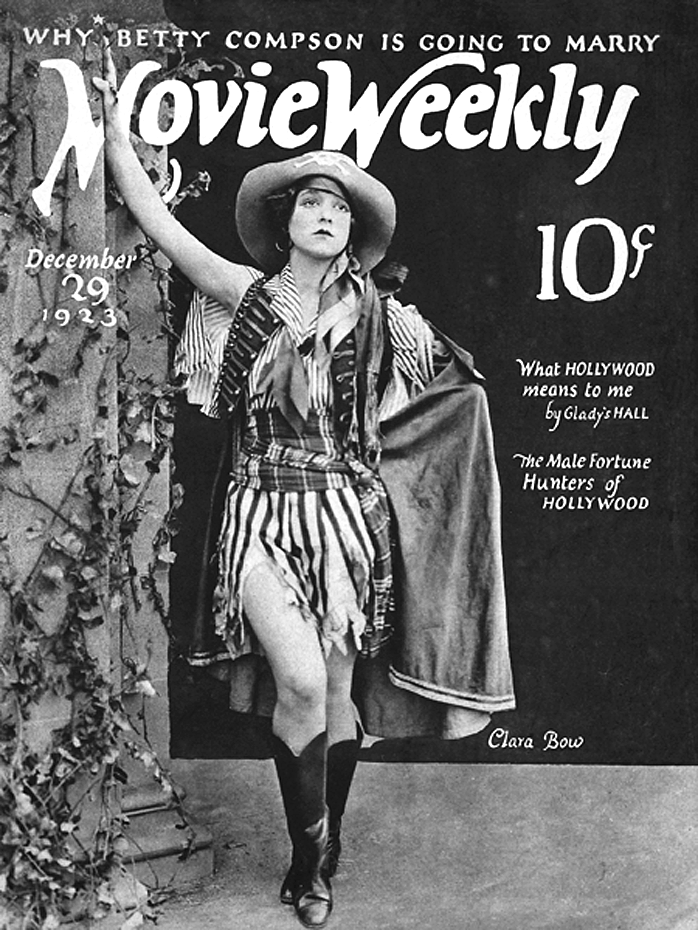
Thus, fan magazines reflected women’s ambivalence about the change in their identities as they took on greater importance outside the milieu of home and family. As I found in my examination of nearly 600 issues of 8 different magazines for my latest book, Celebrity Culture and the American Dream, the articles and photos that made up coverage of female celebrities at once challenged and reinforced traditional notions of femininity in the Golden Age of Hollywood and beyond.
Women’s Work
Not coincidentally, fan magazines first appeared at a time when women began entering the labor force in larger numbers, seeking a higher status in public life. As historian Alice Kessler-Harris observes, “Women are used in the workforce in ways that relate the ideological justifications of a whole society to its immediate labor needs.” Leo Braudy, author of Frenzy of Renown: Fame and Its History further explains, “The history of fame is also the history of the shifting definition of achievement in the social world.” Women would have more opportunity for public recognition at the start of the twentieth century than perhaps ever before. “The dream of fame in Western society has been inseparable from the ideal of personal freedom,” Braudy notes. If fame connotes a degree of public admiration, increasing opportunities to achieve public acclaim reflect women’s shifting status in society. At a time when women’s involvement in the paid labor force would increase for all American women, female movie stars would be on the vanguard.
Film scholar Marjorie Rosen argues that “the birth of movies coincided with—and hastened—the genesis of modern woman.” The growth of the movie industry in the early 1900s coincided with both rapid urbanization and women’s suffrage; for young women seeking independence, moving into cities provided new possibilities, although mostly in low wage occupations.
According to the 1910 Census, three-quarters of employed women worked in agricultural, manufacturing, or domestic jobs. While many men experienced upward mobility within growing corporations, high-paying corporate positions were mostly out of reach for women until the end of the century. The movie industry held the promise of less physically demanding work.
In her 1977 book Men and Women of the Corporation, sociologist Rosabeth Moss Kanter observed how corporate executives assumed women were too emotional for managerial positions. In the company she studied, women were pigeonholed into the roles of mother, seductress, non-threatening “pet,” or “iron maiden.” While these stereotypical images would limit women’s advancement in midcentury corporations, actresses could parlay them into on and off-screen identities—and big paydays.
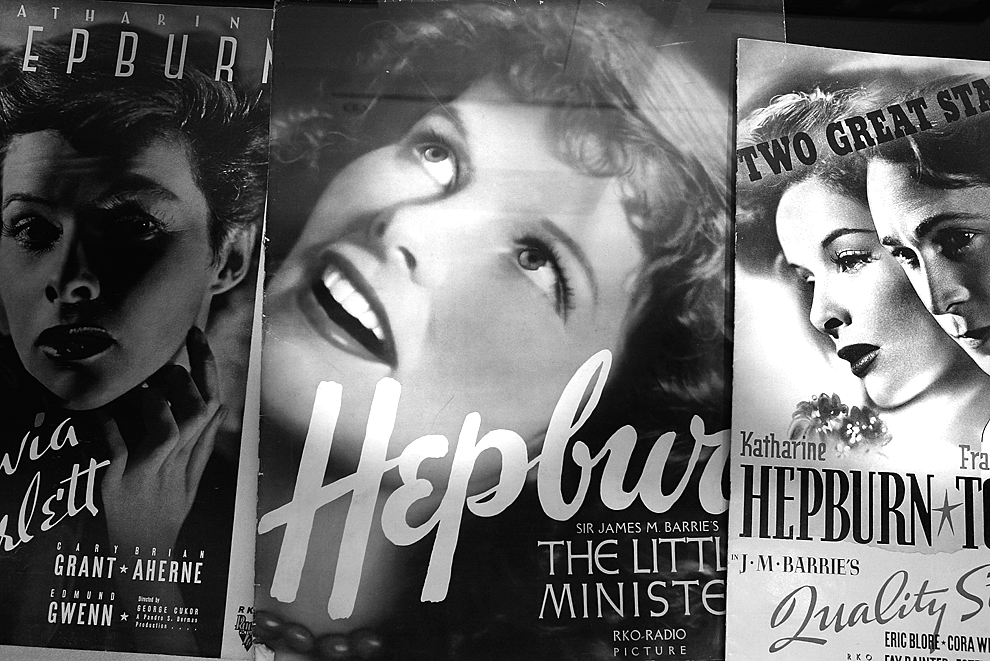
The indomitable Katharine Hepburn, whose independence once left her labeled “box office poison.”
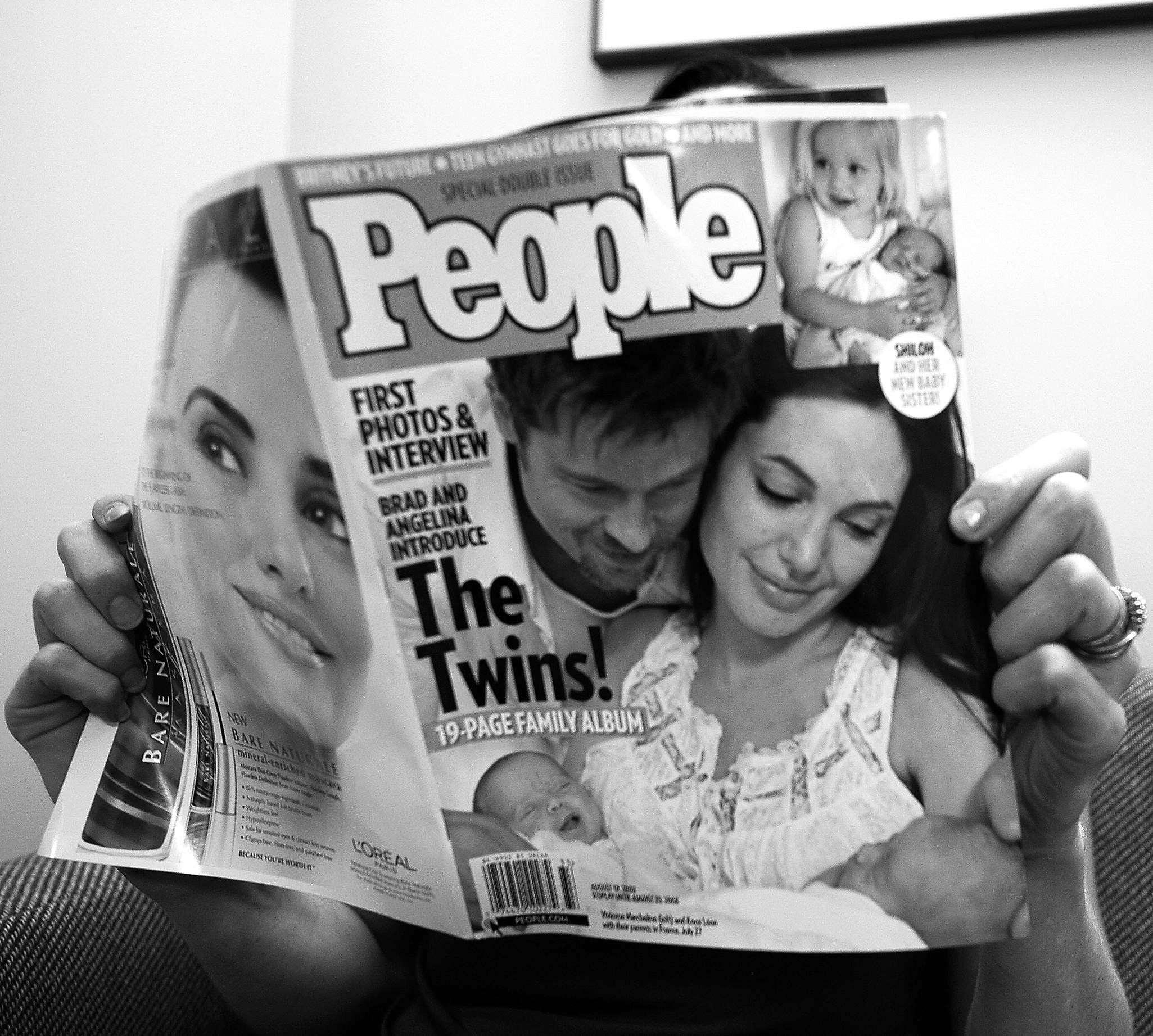
An accomplished actress and humanitarian, Angelina Jolie nevertheless lands most magazine covers as either a doting mother or a dangerous, man-stealing “fallen woman.”
Of course not all actresses would get rich, but many did find careers. Movies offered only a lucky few on-screen roles, but other women found work writing scripts or writing for fan magazines, among other behind-the-scenes jobs. Lacking the prestige of the theater and thus initially less appealing to men, the early film industry provided women opportunities as creative workers.
According to Denise D. Bielby and William T. Bielby’s study of Hollywood writers, women comprised about half of all screen writers during the silent era; when the industry gained clout and male-led studios dominated the production process that percentage dropped dramatically. (Female writers remain in the minority in Hollywood and earn about 20 percent less than their male counterparts today.)
In Hollywood’s Golden Age, the promise of upward mobility was at once liberating and constraining.
In this Golden Age, the promise of upward mobility was at once liberating and constraining. A select group of women did achieve economic independence and public acclaim, but they also typically embodied traditional notions of femininity and a narrow definition of beauty. Like today’s stars, their success likely lured thousands of women to the industry—and to the fabled casting couch—even as men continued to control production, financing, and the very nature of the work.
Famous Yet Feminine
Beginning in the 1910s, fan magazines celebrated women’s opportunities to rise from rags to riches in the movie industry, often highlighting women’s working class backgrounds and “girl next door” virtue. Freedom from toil seemed possible for more women than ever in these articles that so effectively mirrored Horatio Alger’s inspirational tales of the nineteenth century.
A February 1918 Photoplay article, “From Stenography to Stardom,” for example, describes Virginia Valli’s rags-to-riches story. The article vividly recalls how she walked past rotting food and animal carcasses to get to her stenography job in Chicago before making it big: “She would climb a long pair of dingy half-lighted stairs, go into a dingy, half-lighted office.” The city was threatening, and every day Valli passed by the “voluble sons of Italy,” unable to “keep herself neat and dainty, and she had to endure being ogled by express drivers and roustabouts.” But persistent Valli visited a local movie studio, applied for a position, and went back three times until the director would see her. Her career apparently a reward for virtue and doggedness, Valli could now lead the “limousine life,” no longer enduring the indecency of city life, framed as unfit for young women.
Plenty of other stories, too, gushed over women’s newfound career success. A 1915 issue of Motion Picture Classic trumpeted “Women’s Conquest in Filmdom,” and a Picture Play piece from the same year detailed how the new movie industry had become an increasingly respectable outlet for “ambitious girls.” Written by Kathlyn Williams, known then as the “Jungle Actress,” the story described the bravery needed to work with animals in movies. The next year, the same magazine profiled “Girls Who Play with Death,” the women performing risky stunts on film sets.
Even outside the movie industry, women were entering the workforce in larger numbers in this period. According to Census data, women’s participation in the paid labor force more than doubled between 1890 and 1910. Many worked in expanding “female occupations” as sales clerks, telephone operators, stenographers, typists, and in other relatively new positions. World War I further hastened women’s entry into the labor force; America’s brief involvement threatened to create a male labor shortage. “The war has caused a tremendous shortage of salesmen—women must be trained to take their places,” a 1919 Photoplay ad for traveling saleswomen beckoned. Also during the war, Motion Picture featured a photo spread of silent movie actress Gladys Brockwell doing “men’s work,” appearing behind a movie camera, climbing a telephone pole, and driving a horse-drawn cart.
Profiles like these still revealed an underlying discomfort with shifts in the gender order in the years leading up to women’s suffrage in 1920. Brockwell’s foray into “men’s work” was, to be sure, temporary: “It is the present crisis that inspired Miss Brockwell to discover just how many of the purely masculine jobs a woman could perform if it became absolutely necessary for men to leave for duty ‘somewhere in France.’” The title of the article, “Gladys Brockwell Does ‘His’ Bit,” reinforced the idea that she was crossing a gender boundary for the photo shoot, but it was fully expected that she’d cross back once the camera was gone. Still, the female reporter recognized the changes that had taken place for her generation: “It is a far cry from the simpering, languishing lady of Victoria’s day,” she observed.
The earliest fan magazines clearly celebrated women’s opportunities to have exciting new careers, but even as they challenged Victorian notions of femininity and domesticity, the magazines reminded readers that the “new woman” was non-threatening. Historian Alice Kessler-Harris describes how independence and virtue were often viewed as incompatible in the first decades of the century; women who defined their public roles as tied to home and family were perceived as more virtuous. A 1918 photo spread in Motion Picture, for instance, featured silent screen performers doing household chores. Despite their high-profile careers, these women supposedly enjoyed scrubbing floors, doing laundry, cooking, and washing cars in their spare time. Perhaps the first true movie star, Mary Pickford—called “Little Mary”—embodied this nonthreatening femininity, playing a young girl in films even after she turned thirty.
The Threat of Upwardly Mobile Women
Some women responded to the promise of upward mobility by seeking their own acting career. As Marjorie Rosen notes, Census data indicate that the number of women listed as “actresses” rose between 1910 and 1920 (and was nearly as high as those who had earned bachelor’s degrees), while the number of male actors declined.
While the aspiration rose, the celebration of these career opportunities was short lived. As women gained professional ground in Hollywood and got the right to vote, fan magazines more frequently framed independent women as fallen or morally bankrupt, heartless schemers threatening unsuspecting men. In the era of flappers, women’s on-screen sexuality became more overt—and seemingly more dangerous. Fan magazine articles reflected this backlash against women’s growing independence, suggesting that the shifts in the gender order had left men impotent. Ads for body-building products chided men as weaklings.
A handful of famous women symbolized the threat reflected by women’s gains in an age of uncertainty.
Photoplay ran a story in 1929 about female celebrities, rife with hand-wringing over the prediction that men might one day be little more than “excess baggage” on a woman’s quest for fame—especially if they were less famous or less well-paid than their wives, as was increasingly likely after the start of the Great Depression.
During and after the Depression, women still slowly gained ground in the labor force: in 1920, 23 percent of all women age fourteen and over were working for wages, and by 1940, that proportion was up to a full quarter. Kessler-Harris observes, “It is noteworthy not that women gained few jobs in the 1930s, but that they lost so little.” Also, marriage was less likely to signal a retreat from the labor force. In 1920, 23 percent of married women worked for wages, compared with 36 percent in 1940. Since women’s labor was cheaper than men’s, their employment prospects were sometimes better, shifting the gendered balance of power within their families.
In “Hollywood is a Woman’s Town,” a 1932 article, Photoplay claims “women decide how men shall spend their money and their leisure hours,” and Motion Picture’s “The Women Who Made them Famous” from the same year credits women with the success of stars like Clark Gable and Maurice Chevalier. These women emasculate men, according to the magazine, by pursuing men romantically, a “reversal of the age-old formula of boy seeks girl.”
Some of the men in question spoke up. Actor Douglas Fairbanks, Jr., for one, expressed his displeasure about the growing status of female stars in a 1934 Photoplay article. He claimed he was quitting the Hollywood life because leading ladies got too much attention. “The best that any [male actor] can look forward to is the ignominy of finding himself cast opposite the woman star who is momentarily in the ascendant. And to submit to that sort of thing is too stultifying for most men.” A handful of famous women symbolized the threat reflected by women’s gains in an age of uncertainty.
Fairbanks had recently divorced Joan Crawford, whose celebrity was a direct creation of the fan magazine—her very name was the result of a 1925 Photoplay contest to replace her given name, Lucille LeSueur. Crawford embodied the good-time flapper before transitioning into the quintessential powerful woman, broad shoulders and all. But by the end of the 1930s, she and fellow actress Katharine Hepburn had been labeled “box office poison.” Hepburn’s independent image (both on and off-screen) directly challenged traditional ideas. RKO canceled her contract in 1938, and she did not appear in films for two years. Crawford had to take a pay cut to have her contract renewed.
Magazines came to offer morality tales about women who focused too much on their careers and alienated men. Stories like “Is the Devil a Woman?” (Motion Picture Classic, 1930) and “Are Women Stars the Home Wreckers of Hollywood?” (Motion Picture, 1932) warned that women who out-earned and outshone the men in their lives might find themselves permanently single. “The minute a male star weds a film beauty he finds himself in a subordinate role,” according to a March 1939 Motion Picture story. A 1935 Photoplay cover teased the article, “Why Male Stars Marry Plain Girls.” Apparently even beautiful women could be undesirable if they threatened the gender order. If even rich and famous women had to maintain a delicate balancing act, the magazines’ everyday readers must have been overwhelmed.
Hollywood Wants You
In another shift, independent women soon became invaluable as the U.S. entered World War II. Hollywood fan magazines no longer portrayed strong women as devils; instead, articles and ads reminded female readers of their important role as workers in the war effort.
“Your Country needs you in a vital job!” an Ipana toothpaste ad beckoned, encouraging women “to release more men for wartime duties.” A Beautyrest mattress ad bore the caption, “She’ll do a man-sized job tomorrow!” and will be well rested for her “full-time regular job, (and) her after-hours war work.” “Every woman is a war worker today!” a feminine hygiene ad proclaimed. A tampon ad pictured a woman changing a tire. Female pilots could be powerful yet feminine, according to an ad for nail polish. “America’s Smart Flying Women Choose Favorite Cutex Shades” pictures women in uniform wearing shades named “On Duty,” “Alert,” and “Off Duty.”
Features now characterized actors like Rosalind Russell as advocates for their own careers; a 1942 Photoplay story called “Don’t Be a Doormat!” detailed confrontations with male studio bosses to get prized roles. “Who said Women aren’t Men’s Equals?” asked Photoplay. Both Joan Crawford and Katharine Hepburn saw their careers rebound in the war years. Strong women were back in vogue, but not for long.
When the war ended, the independent woman disappeared from fan magazine coverage again. Now (presumably suffering from whiplash) she could only serve as a warning to female readers that they might lose the men in their lives. Coverage of elaborate weddings became more frequent, and as the baby boom began, celebrity stories came to feature the now-omnipresent photos of nurseries, newborns, and baby showers, as well as features about how stars got their figures back after giving birth. Women’s virtue was once again linked primarily with home and family.
Female celebrities who put child rearing and their husband’s careers first gained high praise in these pages. Just as the fictional Lucy Ricardo schemed to get into her husband’s shows to launch her own career (and create sitcom mayhem), celebrity stories emphasized how women who refused to put their husbands and children before their ambition were sure to face marital failure.
A 1948 Photoplay story accused “ambitious Aphrodites” of marrying as a career move. “Hollywood’s Biggest Headaches” were wives who tried to become as successful as their movie star husbands, according to a 1953 Motion Picture article: “Happiness is only possible with his wife at home.” “Till Work do us Part,” a 1947 Photoplay story, suggests Judy Garland and Vincente Minnelli’s marriage troubles were largely due to her work schedule.
If a good wife wanted a career, she could work to support her husband’s. Alan Ladd’s wife Carol Sue Ladd, for instance, served as his agent. Stars who “made him her life’s work,” as Lauren Bacall allegedly did with Humphrey Bogart, would give husbands “the kind of push a man needs to send him soaring,” according to a 1952 Photoplay story. “The husband couldn’t possibly be where he is today… if the little woman hadn’t been right behind him,” the article concludes. World War II pinup Betty Grable wrote “Rules for Wives” for Photoplay in 1949, recommending that women learn to accept their husband’s criticism.
“We Applaud Mrs. Robert Taylor,” a 1957 Photoplay story announced, citing her decision to make “his career more important than hers” and “for giving up ‘sophistication’ to be a housewife and mother.” “Behind every top actor you’ll find a woman—living in the shadows of success and giving freely of courage, love, and devotion,” wrote Hedda Hopper in a 1949 Modern Screen article.
According to the Bureau of Labor Statistics, in 1950 about a third of women sixteen and over were part of the paid labor force. Although part of postwar lore, the domesticity celebrated in movie fan magazines did not necessarily reflect the realities of their readers—or even of the celebrities they featured. Instead, celebrity stories reflected an ever-shifting ideology and the fact that women were simply less necessary (or even a hindrance for men returning from war and looking for work) in the paid labor force of the postwar economic boom.
For nearly a century now, movie stardom has offered women financial opportunities rarely available elsewhere. From their first publication, fan magazines touted women’s upward mobility via movies, reflecting celebration and concern about women’s increasing numbers in the paid labor force. And now, while celebrity stories no longer routinely blame women’s ambition for relationships that don’t work out, young women’s morality is still a major source of gossip and judgment. Male celebrities’ behavior isn’t, of course, immune from disparaging gossip—Charlie Sheen’s springs to mind—but an emphasis on young women’s virtue echoes coverage from a hundred years ago, and has expanded well beyond fan magazines. If the pressures to be successful screen actors, doting wives and mothers, and sufficiently virtuous examples of femininity continue to bedevil even the most famous and privileged among us, one wonders how the rest of us are to manage such a thing.