



Abstract
Wisconsin's Governor Scott Walker's "Budget Repair Bill" prompted shock—and a large, coordinated response. The authors offer an insider's perspective of a social movement for democratic rights, "Wisconsin-style."
Keywords
As the first state to allow collective bargaining for public employees, Wisconsin has had strong, active public sector unions since 1959. But in November 2010, Republican Scott Walker was elected governor, and union members like us began to nervously anticipate what his budget plan might mean for our community. The attack finally came in February 2011 with Governor Walker’s announcement of a Budget Repair Bill (BRB). Walker’s proposal went far beyond cuts in benefits and compensation; it cancelled virtually all public-sector employee contracts, severely limited collective bargaining rights for everyone but firefighters and most police, and required annual union re-certification.
Editors’ note: In early 2011, much of the nation’s attention focused on an unlikely place: Madison, WI. When Governor Scott Walker moved to severely curtail the bargaining rights and compensation of public sector workers in the name of budget repair, union activists and concerned citizens descended upon the state capitol in protest. Here, University of Wisconsin sociology graduate students who are also members of the Teaching Assistants Association (the TAA, which is the oldest graduate student union in the country), share their experiences motivating, sustaining, and experiencing a movement—what they called “creating community and making waves.”
Walker announced the bill on a Friday (a traditional tactic to minimize news coverage) and planned an expedited debate so that the bill might pass within a week. Thanks, though, to some advance planning by union activists, it didn’t quite work out that way.
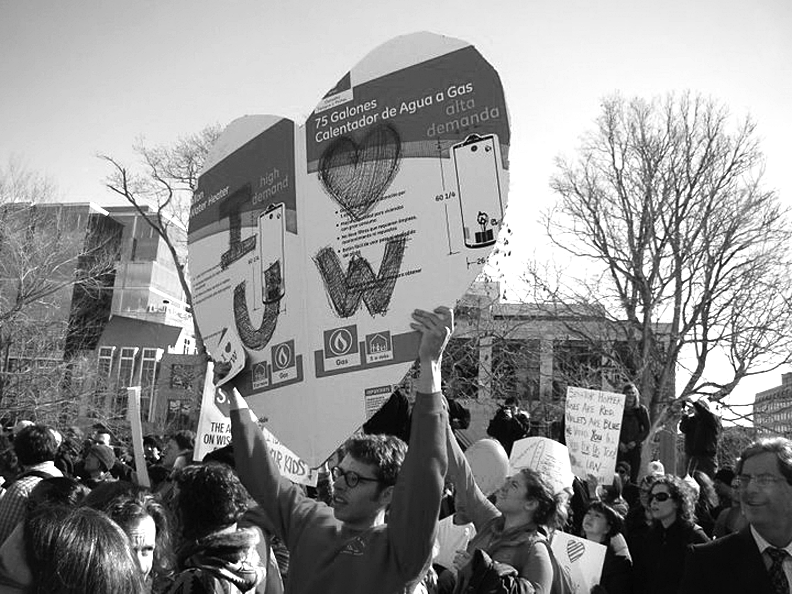
Back in December 2010, our union, the TAA, was anxious about the upcoming budget and possible cuts to university funding. We sent Facebook invitations encouraging students to deliver Valentine’s Day cards to the governor that read, “I ♥ UW: Governor Walker, don’t break my ♥.” On February 14th, we met at the University of Wisconsin’s Memorial Union prepared to march to the Capitol and drop off our valentines, but news of the BRB, announced three days earlier, had energized us all. What we expected to be a modest protest turned into 1,000 people filling the Capitol rotunda. We stood in our state’s Capitol building, some of us for the very first time, chanting “Kill the Bill!”
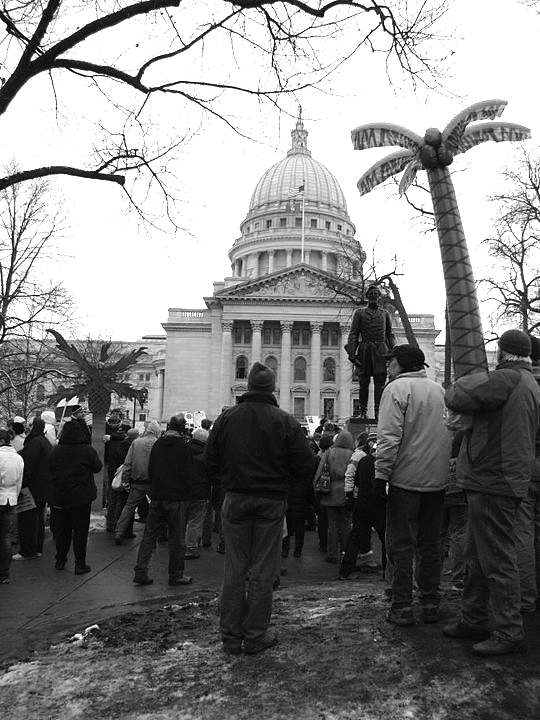
Even in the blustery Wisconsin winter, tens of thousands rallied outside the state Capitol.
The next day, Wisconsin’s Joint Finance Committee began public BRB hearings inside the state capitol. The hearings were supposed to continue as long as there were people to testify, but each person was only allowed to speak for two minutes. We wanted to keep the hearings going for as long as possible, so the TAA organized a “citizen filibuster.” Along with union members from around the state and supportive members of the Madison community, we stayed up late, made phone calls, sent text messages, and posted on Facebook to encourage our friends to come down to testify. They did.
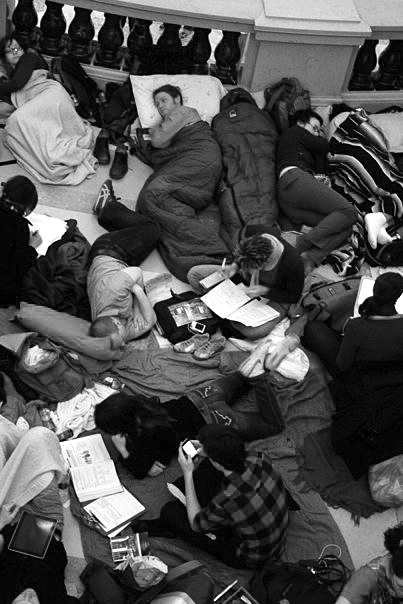
After 17 hours of straight testimony, despite several hundred people still waiting for their chance to testify, the Republican co-chairs of the Joint Finance Committee terminated the hearing at 3:30am. Our crowd erupted in response, and we began to chant “Let us speak!” Many of us were prepared to stay the night. Again, text messages, tweets, and Facebook posts went out, this time announcing that the TAA had decided to hold a public “sleep-in.” We invited our friends to bring their sleeping bags to the Capitol. It was pretty fun, actually; we were excited and driven as a community to make a difference in the outcome of our state’s politics. The public occupation of the Wisconsin state Capitol was born.
During the sleep-in and for the rest of the occupation, many of us kept our laptops and smart-phones cued to local news sites. We discovered that, outside the Capitol, other unions and campuses were also mobilizing crowds of protesters. It was especially shocking when, after calls from the state teachers union, so many protesting teachers called in sick that schools were forced to close in Madison on February 16th and in at least 20 other districts in the following days. In solidarity, our union organized “teach-ins” for our students, holding discussion sections in and around the Capitol. Every day, local high school and college students marched to the Capitol in support of their teachers, and other workers (even non-union workers) took time off to come to the Capitol, many bringing their children with them. Even in the blustery Wisconsin winter, tens of thousands rallied outside the Capitol. The crowds grew steadily from Tuesday through Saturday in the first week of protests.
Tired after days of almost constant rallies, running on little sleep and taking shifts to run home and shower, we protesters gained hope on Thursday, February 17th. The legislature was scheduled to vote on the BRB. We worried that all of our efforts would turn out to have been in vain, but at 4pm, when we expected the verdict, we learned instead that the Democratic senators had fled the state. The shock was tremendous—we were thrilled! By leaving the state, the “Fab 14,” as they are now known, denied Republicans the constitutionally required quorum to vote on fiscal bills. They also bought us protestors time to further plan our movement and express our fury over the bill (and how it was being pushed through). The day after the Fab 14 left, Assembly Republicans told Assembly Democrats that they would reconvene at 5pm to vote, but they met and called a vote at 4:56 instead. Democratic Assembly members and protesters were outraged, and YouTube videos capturing the event in its entirety spread widely. Local media helped get out the news, and Republicans rescinded the vote. A recess was called, and the rallies continued.
From this point on, we watched the protests grow larger and larger, especially on Saturdays when more people were free to travel to Madison. As a result, there were more demands on police to maintain order and safety. We TAA members began working with the officers, who were following the principles of “negotiated management” by talking with us and other protesters rather than simply enforcing top-down rules. These discussions led us to become marshals: members of the TAA and other supporters took turns donning neon orange vests and walking around the Capitol at all hours of the day and night making sure that everyone was safe and peaceful and that both the protesters and the police were comfortable with the flow of events. Many of us had pleasant, friendly interactions with Capitol Police and other Madison officers, and we appreciated that they, too, supported the protest.
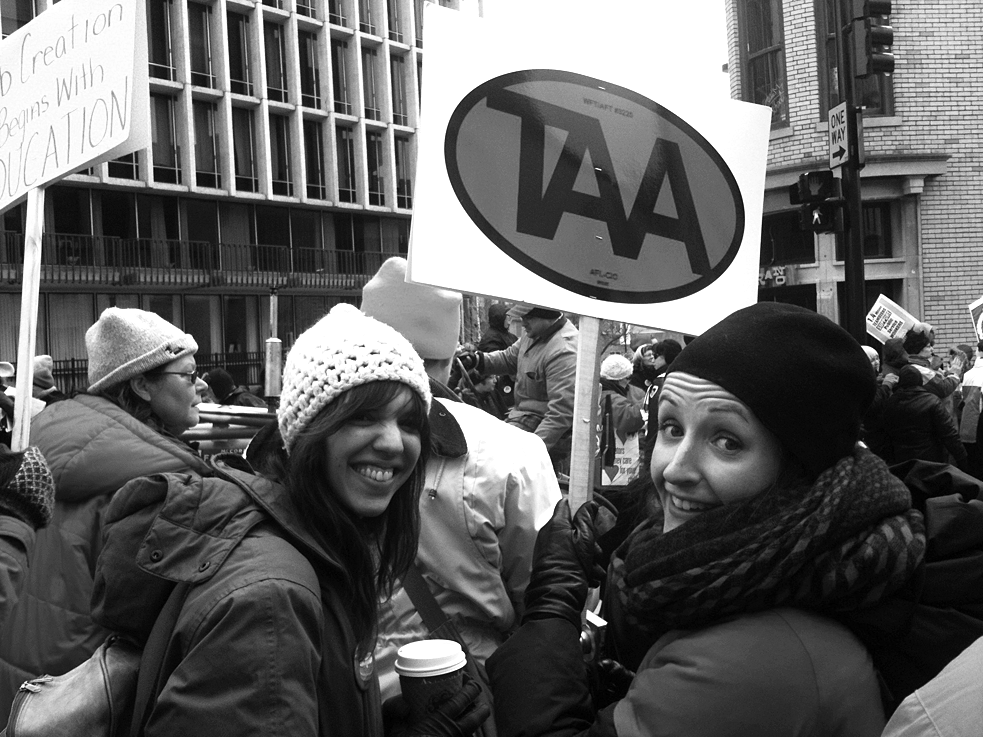
Nevertheless, Republicans, the Department of Administration, and the conservative-led State Troopers gradually changed the rules in the Capitol. First, because none of us were legislators, our use of legislative space was restricted. The TAA was ordered to vacate the conference room that had served as our central coordination point, and, beginning Sunday, February 27th, State Troopers and Department of Natural Resources officers began patrolling the entrance to the Capitol and searching belongings. Now we couldn’t bring in sleeping gear, noise makers, or food. Many restrooms were locked. Worse, during the last four days of the occupation, virtually no one was allowed to enter the building anymore. On Thursday, March 3rd, the Chief of Police announced that the Capitol was closed and anyone who refused to leave would be considered in contempt of court. No one who stayed behind was arrested, but the occupation was officially over. Our protests moved to the street.
On March 9th, a parliamentary maneuver allowed the Senate to vote even though the Democrats were still out of the state. While many of us had started slowly trying to get back to our regular lives, word of this move spread instantly via Twitter, Facebook, and text messages, and within an hour, hundreds had gathered outside the Capitol. Some of us even made it inside before police locked the doors. Alongside hundreds of other protesters, our group of TAA members chanted angrily: “Whose house? Our house!” From inside the Capitol, some of us distracted the police so that hundreds more could swarm inside. When the Senate voted to support parts of the bill, we had tears in our eyes, but we called an emergency TAA meeting and met inside the Capitol to strategize. A number of us stayed overnight again in protest, but the following morning we were removed by the police, and the Assembly took the final vote.
Since then, our protest efforts have moved toward recall elections, court challenges, and long-term mobilization. There are still protesters outside the state Capitol, and on April 4th, in commemoration of Rev. Dr. Martin Luther King, Jr.’s assassination, a coordinated rally was held in many locations to unite the past civil and labor rights movements with our workers movement. A lawsuit claiming that the BRB was passed illegally has led to an injunction against its implementation that is still in place at the time of this writing.
Co-ccupation
For 17 days, many of us essentially lived in the state Capitol; it became our unique social world. To us, the Capitol was transformed into “Capitol City”—a newly defined space with its own rules, language, symbols, rituals, and meanings. Anyone could come and live in the Capitol, and hundreds of people, including students, members of various unions, environmental groups, disability rights organizations, police, firefighters, and others, did. We slept on marble floors with our fellow TAA members and friends, but also with others with whom we normally wouldn’t share such intimate space. These experiences in our new city helped us develop a sense of common identity despite our diverse backgrounds. We were protesters, living in Capitol City, taking care of our common home.
Of course, this home required basic necessities. Plenty of food was provided by restaurants and individual donors within Madison, but it was also delivered compliments of backers from every state in the U.S. and many countries around the world (including Egypt, which was just experiencing its own massive social movement). A medic station distributed sanitary and over-the-counter healthcare supplies free of charge. The generosity was truly astounding.
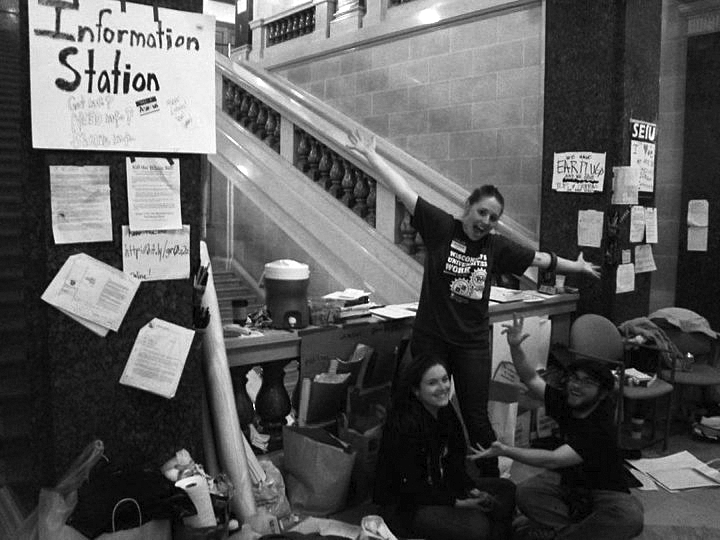
One wing of the building was cordoned off as a “family center” so that protestors’ children could play together, and we helped set up an information center on the ground floor of the Capitol where daily schedules, fliers, petitions, and a “low-tech Twitter” poster were available for all to see. Other information was communicated via Facebook, Twitter, and other digital media to occupiers inside and protesters outside the Capitol building. We always felt “in the loop” with one another, and it was easy for people who might never meet otherwise to begin conversations about the new world we were living in. Firefighters, off-duty police officers, teachers, nurses, corrections officers, and many others joined together day after day, night after night, in a completely unique environment wherein everybody had a voice. Singing, chanting, and speaking on the “people’s mic” contributed to our sense of common cause and community.
We were excited and driven as a community to make a difference.
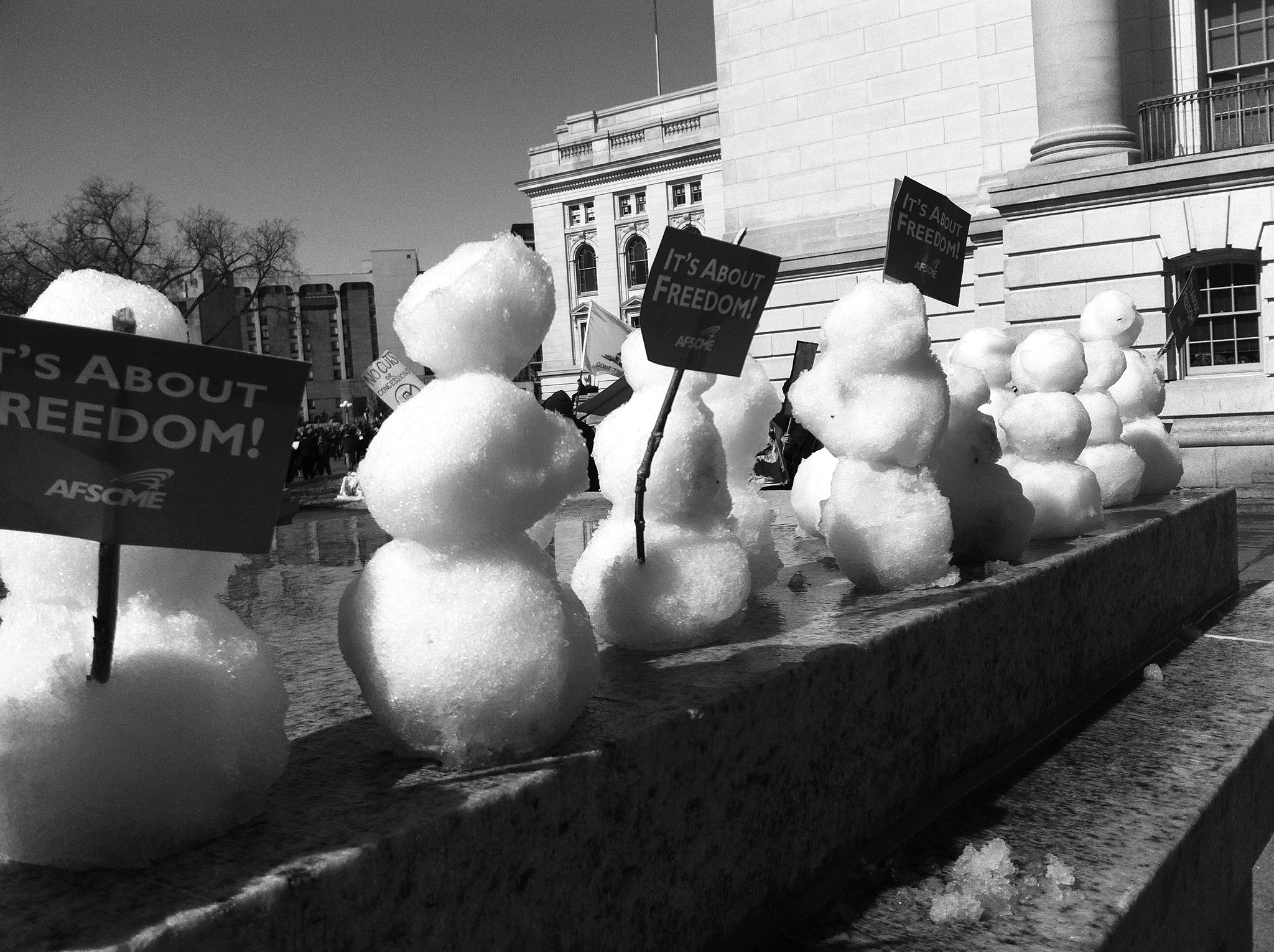
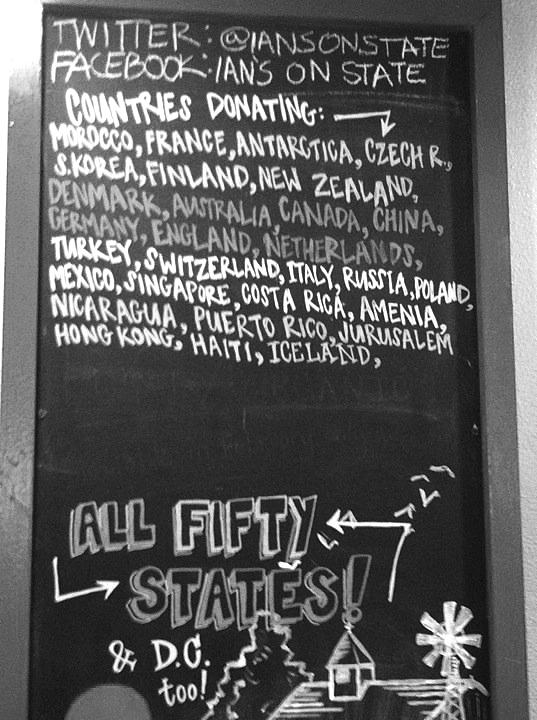
Despite having to make some difficult decisions, especially at critical junctures (like the passage of a portion of the BRB or sudden limitations on Capitol occupancy hours), we kept ourselves on the same page by emphasizing respect, communication, and cooperation. For instance, we knew it was important to take care of the Capitol building itself. In group cleanings, teams armed with garbage bags, rubber gloves, and catchy chants swept through the Capitol building and grounds picking up loose trash and encouraging others to do the same. Everyone made a special effort to recycle and we requested extra bins from janitors that we differentiated with signs or distinctive bags. Lots of us posted signs not only with political messages, but also listing “Rules for Our House” with quiet hours that occupants respected.
Capitol City was a newly defined space with its own rules, language, symbols, rituals, and meanings.
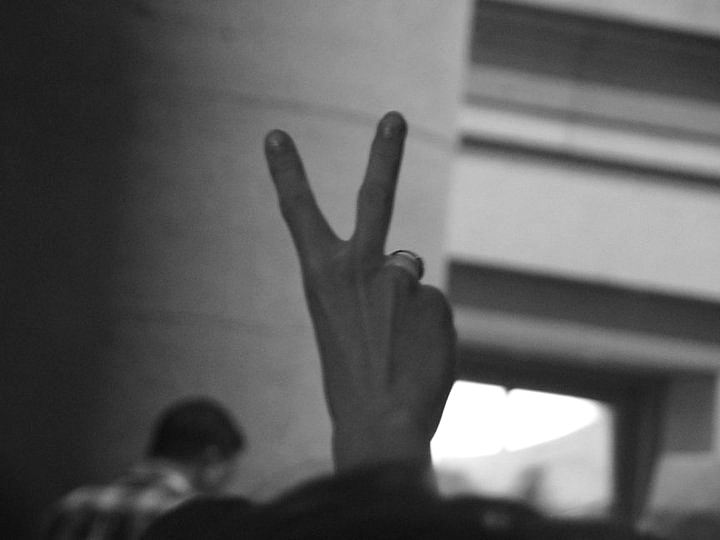
Over time in Capitol City, the hand gesture for “peace” took on new meaning. It started as a plea for calm, when individuals or groups would become agitated, and it was often accompanied with a shouted reminder that “This is a peaceful protest!” After a while, those words became unnecessary: occupants now used the symbol often to silence masses, both inside the building and at demonstrations outside, so that announcements could be heard. It seemed as if we were all vested with a common interest in displaying midwestern niceties and demonstrating to everyone that we were not a violent crowd.
This may sound idyllic, but not everything was rosy all the time. Gendered political roles were glaringly apparent. Many of us noticed a clear division between who held the microphone versus handed out food or who carried the drum versus who played with children in the family center. Organizers often discussed gender and power, and, at times, we made special efforts to ensure that everyone was given a fair chance to occupy all of the roles needed for continued successful protests. Perhaps because the occupation lasted so long, we had the time to negotiate how things would unfold and to make collective decisions that attempted to include everyone’s voices.
Framing a Movement
Sociologists know that all movements must explicitly or implicitly confront the issue of how to employ frames to draw in support and define the movement’s boundaries and goals. With the Budget Repair Bill protests, union leaders who initially mobilized our communities saw the BRB as an assault on collective bargaining rights and the very existence of public employee unions. One of our first chants was simply “What’s Disgusting? Union Busting!” We saw how the national media picked up on this frame and how well it resonated with the national public. As a result of this initial success and in the spirit of compromise, several unions announced they would make concessions on compensation so long as their collective bargaining rights were preserved. Now the media was able to describe public sector unions as reasonable and willing to compromise.
Still, many Wisconsinites did not share the concerns of union leaders. For some public workers, the protest was about more than collective bargaining rights. In fact, on our first night occupying the Capitol, dozens who testified in front of the Joint Finance Committee broke down in tears as they described their concerns about how the BRB could ruin their lives. Teachers, home care workers, bus drivers, and other public employees repeatedly emphasized how increased benefit contributions would drastically cut their take-home pay and cutbacks in state-subsidized health care for the near-poor would leave them unprotected. Many of these workers eventually developed an alternative anti-BRB frame centered on not making cuts or concessions, and some of us shifted stances in support of their anti-austerity protests. Our signs now proclaimed “Stop the attack on Wisconsin families,” and National Nurses United organized a “funeral march” with posters reading “Blame Wall Street: No concessions.” The goal was to turn attention to the non-bargaining provisions of the BRB, and through various strategies, the “No cuts, no concessions” frame eventually led to a sub-movement within the larger protest against the BRB.
Others who felt left out of the larger collective bargaining rights movement were particularly upset by a BRB provision giving the administration the power to circumvent the legislative process for funding public health programs. Instead, it handed authority to an agency director known to oppose Medicaid. Molly Cisco, director of the mental illness advocacy group Grassroots Empowerment, voiced her frustrations about the lack of media outcry over these issues in The Capitol Times: “Everybody who is controlling the message is only controlling it to be about the unions.… I have been screaming about this. I’ve been sending letters to the editor and calling the Democratic Party every hour. It’s been so frustrating. I don’t want us to be pitted against the unions, but they’ve been so loud we haven’t been able to find our niche or get our voices heard.”
Another upsetting provision granted the governor the right to sell the state’s power plants on no-bid contracts. It seemed to put the governor’s close relationship with wealthy donors like the Koch brothers (both long-interested in buying such plants) into stark relief. Creative signs highlighted such conflicts—”Walker is a Koch-head” and “Walker: hands off my walker”—but this framing, too, initially received only minimal attention.
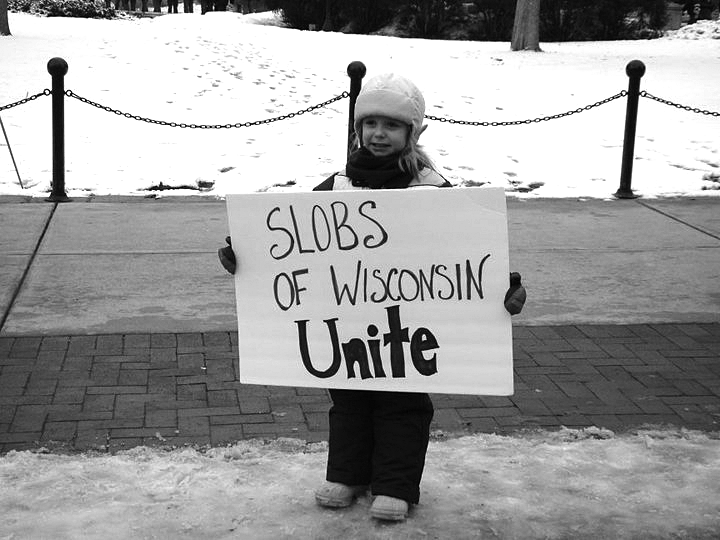
For their part, Republicans established a counter-framing: the Capitol occupation and absence of the Democratic senators were anti-democratic actions. The Fab 14 were called “shirkers” in the media and accused of not doing their job as representatives. Union workers and Capitol occupiers were called “thugs” and “slobs.” Folks who identified with the Tea Party movement showed up to protest the protests, but their presence was minor; what could have been a nasty encounter was surprisingly benign. A Fox News broadcast of a fight, used to support the claim of violence amongst the unruly protestors, became a punchline when palm trees were spotted in the background of the news clip. Wisconsinites reacted with their typical, good-natured humor, dragging inflatable palm trees through the snow to future demonstrations and giving their children signs that read “Union Thug in Training.”
Ripple Effects
The events described above are just a sample of what is now Wisconsin history. They’ve created ripples far beyond the state, giving this protest its broader meaning.
For many of us, this time has been an opportunity to genuinely participate in a mass social movement and put our sociology training into practice. But these events have also demonstrated the potential of both unions and the Democratic Party to mobilize working people. The Democratic senators who fled Wisconsin to prevent a vote on the BRB were welcomed home on March 12th by a crowd of over 100,000. We protesters are now voters, focused on recalling eligible Republicans and maintaining our mobilization so that we can work to recall Governor Walker, too. Though time has passed, every weekend is now a new adventure in our ongoing protest: we’ve had “Tractorcades,” motorcycle rallies, and “zombie marches” against the bill, and in future elections, we’ll learn how well movement politics and our various mobilization tactics translate into electoral politics. For now, it seems our main task is to keep this energy and drive that propelled us in February going. It’s not time to let our hopes slip into political history.
This has been an opportunity to genuinely participate in a mass social movement and put our sociology training into practice.
We realize that the events in Capitol City and around the state are now recognized as part of a larger struggle. Battles are being waged across the country as “Wisconsin-style” attacks on collective bargaining are brought in the name of austerity politics. Wisconsin may be the first domino in a broader effort to break public sector unions in the U.S., and protests like ours may spring up in response. We hope so. As members of the TAA and the sociology department, many of us feel a profound and important connection between our academic work and our public service to the community in which we live. We’ve held countless teach-ins, we’ve organized lectures with speakers from across the department, the university, and even the country, and we aim to continue our fight until it is clear that our democratic rights are secured.