




Abstract
For over half a century, magazines aimed at teens have been teaching girls how to inhabit stereotypical gender roles. Surprisingly, though the celebrities on the covers have changed, the messages have remained the same.
Many women, even those of us now in our twenties, thirties, forties, and beyond, remember the thrill of coming home from school to the fresh, crisp pages of the latest issue of Seventeen (now in it’s 66th year), hoping for guidance as we struggled to navigate the perils of adolescence. Today’s girls consume an even wider range of “teen ‘zines,” both in print and online, and at increasingly younger ages. Their pages are filled with how-to pieces—how to style your hair in the latest fashion, give your lips an enticing shine, even how to kiss correctly. But beyond beauty tips, teen magazines also teach girls, at a basic level, what it means to be a girl today.
While we might have hoped traditional ideas about femininity had been relegated to the past along with typewriters and Burma shave, teen magazines are still saturated with them. In their pages, girls should focus on being pretty, pleasing men, and decorating men’s spaces. Without the colorful modern layouts and contemporary actresses splayed across their shiny covers, one might mistake the glossies for dusty relics left on the shelf since the 1950s.
Without the modern layouts and contemporary actresses, these glossies might be relics from the 1950s.
Indeed, recent covers offer little more than provocative teases about boys and beauty, such as “Where will you meet your next boyfriend?” or “Is school secretly making you fat?” Pieces that focus on substantive issues—drunk driving, careers, or politics—are rare. The overall message a girl receives, journalist Kate Pierce found in her study of Seventeen over time, is that “how she looks is more important than what she thinks, that her main goal in life is to find a man who will take care of her… and that her place will be home with the kids and the cooking and the housework.”
Sociologist Kelly Massoni also studied Seventeen, finding that men held 70 percent of the jobs represented in its pages. Women were disproportionately shown either not working or working in traditionally feminine jobs, with a particular emphasis on modeling and acting careers. Advice on sexuality hasn’t evolved much either. Sociologist Laura Carpenter explored the presentation of (almost exclusively hetero-) sexuality in Seventeen across the decades, and though she saw greater inclusion of sexual diversity and increased openness to women’s sexual agency in recent years, these progressive messages were often presented alongside more traditional ones, with the author or editors emphasizing the latter. Girls might now learn they can “make the first move” or dress in clothing as risqué as fashion demands, but the subtext is clear: a hip young woman is more concerned with lipstick, boyfriends, and belly-button rings than books, politics, or careers.
So beside how-to features on hair styling, body shaping, and make-up application, there are explicit instructions for interacting with men and boys. While beauticians, personal trainers, actresses, or other women offer advice on beauty, fashion, and exercise, men (often adult men in their twenties) advise girls on how to support, entertain, and excite their boyfriends by cheering them on from the sidelines, doing personal favors, making them laugh, and “talking dirty.” Despite a new millennium, much remains unchanged.
What has changed is the packaging: many of these messages are now couched in feminist language. Advertisers must convince young women that they are in need of constant improvement—largely to get and keep boys’ attention—without threatening young women’s views of themselves as intelligent, self-directed, and equal. Buzz words like “empowerment,” “self-determination,” and “independence” are sprinkled liberally across their pages. But this seemingly progressive rhetoric is used to sell products and ideas that keep girls doing gender in appropriately feminine ways, leading them to reproduce, rather than challenge, gender hierarchies. An ad for a depilatory cream, for instance, tells girls that they are “unique, determined, and unstoppable,” so they should not “settle… for sandpaper skin.” Feminist demands for political and economic equality—and the refusal to settle for low-wages, violence, and second-class citizenship—morph into a refusal to settle for less than silky skin. Pseudo-feminist language allows young women to believe that they can “empower” themselves at the checkout counter by buying the accoutrements of traditional femininity. Girls’ potential choice to shun make-up or hair-removal disappears, replaced by their choice of an array of beauty products promising to moisturize, soften, and smooth their troubles away.
Everywhere, girls are flooded with messages urging them to see success, as achieved through beauty, just a purchase away. By some estimates, a ten-year-old is likely to spend $300,000 on her hair and face before she reaches fifty. In Beauty and Misogyny, Sheila Jeffreys catalogs the damage these beauty products, cosmetic treatments, and surgical procedures do to female bodies. Jeffreys argues that beauty practices normalized in Western culture—wearing high heels, for example—can injure women physically and socially. These practices are seductive, because we learn to take pleasure in them, but they also reinforce the underlying ideology that women’s bodies are unattractive when unadorned and must be carefully groomed simply to be presentable.
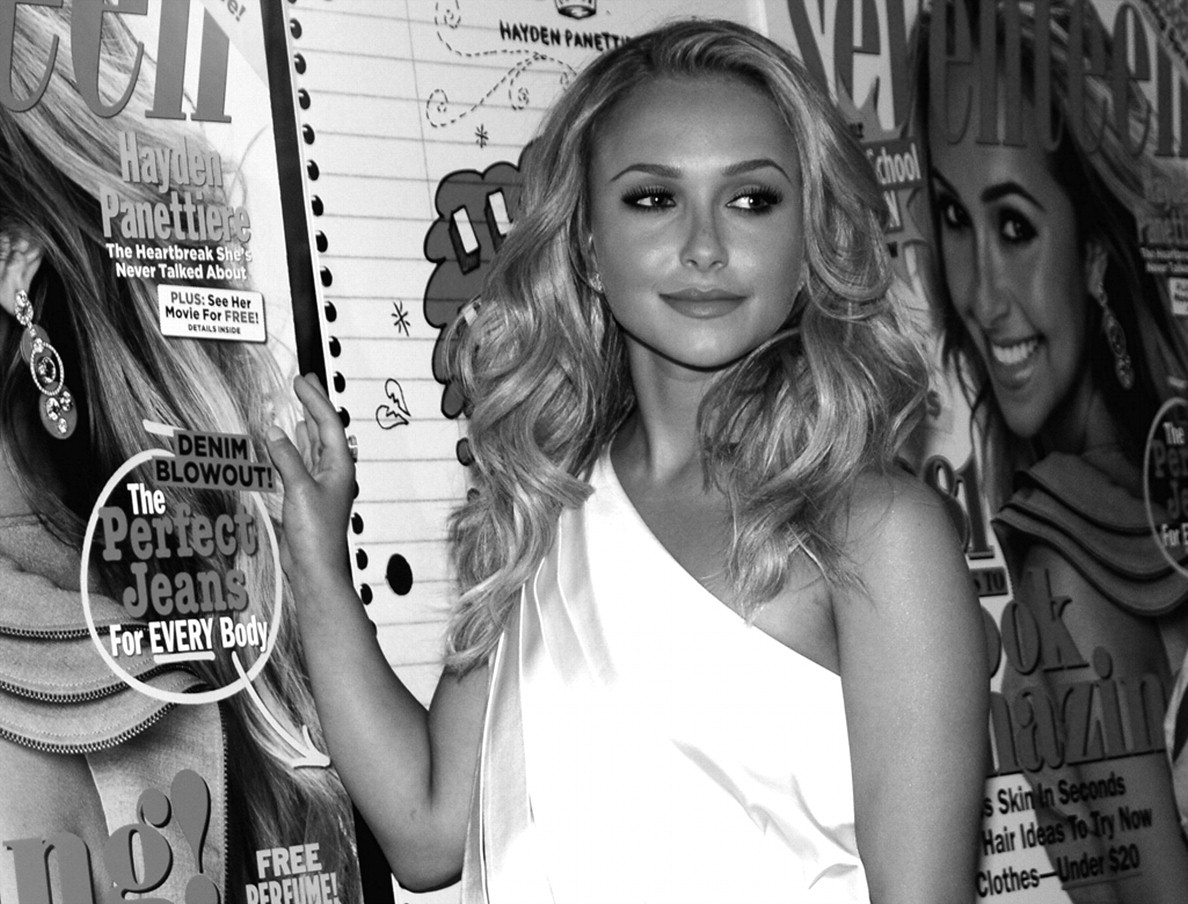
Hayden Panettiere poses with her cover of Seventeen. The cover lines promise “1,081Ways to Look Amazing,” “The Perfect Jeans for Every Body,” and, of course, this accomplished actress dishing up “The Heartbreak She’s Never Talked About.”
On top of the advertising that accounts for around half of these texts’ content, many articles that appear to be editorial—pieces comparing the merits of accessories, fingernail polishes, or facial cleansers, for example—are advertisements in disguise, conveniently including brand names, retail locations, and prices. In her ethnography of teen ‘zine consumption in a junior high, Margaret Finders noted that girls often failed to recognize these as marketing, interpreting them as valuable, neutral information instead.
This is not to say that all girls consume teen ‘zines uncritically. Interviews by sociologists have shown that girls are often critical of airbrushed models and claim to ignore advertisements. Melissa Milkie, for example, found that girls of color were especially skeptical, viewing teen magazines as oriented primarily to white girls and including girls and women of color only when they fit white beauty ideals. For the most part, however, girls’ critiques stop at body image, failing to question these texts’ nearly exclusive focus on beauty and heterosexual romance. Dawn Curie found that 70 percent of her interviewees were “avid” readers, for whom the reading and sharing of these texts was a significant pastime. These girls spent hours devouring their content, and admitted that they turned to the magazines’ “real life” pieces for “practical advice,” and used the girls in the magazines as yardsticks by which to measure their own lives and experiences.
Teen girl magazines breathe new life into some very old ideas. Today’s successful woman, they proclaim, orients her life around looking beautiful and snagging a man. Seemingly esteem-boosting “grrl power” rhetoric makes this message seem fresh, and provides marketers an appealing way to sell even independent-minded girls old-fashioned deference and subordination as “empowerment.” Those of us who grew up with these texts can’t deny that consuming them, along with the products they push, was often a lot of fun, even a rite of passage. But if feminist goals of equality are to be realized, girls need better options (New Moon, newmoon.org, is one attempt to offer an alternative to traditional girls’ magazines). We can also teach girls to question the basic assumptions embedded in popular media and to become critical consumers (or non-consumers) of these texts and the culture of beauty and romance they peddle. We might even offer girls the more radical message, learned and lived by earlier generations of feminists, that true empowerment comes not through consumption, but solidarity, critical-consciousness, and collective action.