




Abstract
While boasting a golden age of arts and culture, New York City's cultural institutions continue to be concentrated in privileged, predominantly white Manhattan. This spatial isolation limits access for many other Big Apple residents.
Many New Yorkers are living in a golden age of arts and culture. Under Bloomberg's “arts administration,” a diverse set of institutions has spread across the five boroughs. In the past decade, the number of such institutions has increased by more than one third. Museums are springing up in neighborhoods that are not traditionally home to wealthy New Yorkers, such as the Bowery and Long Island City. And, while New York's most famous cultural district, “Museum Mile,” is nestled in an elite enclave on Fifth Avenue, it now includes El Museo del Barrio and the soon-to-open Museum of African Art.
The rise in the quantity and diversity of institutions has also seen a symbolic shift toward inclusivity and representation. Policymakers and arts administrators have touted a new “cultural democracy,” which has emerged in part because of significant increases in public funding for arts institutions. Taxpayer money brings pressures to create institutions that are accessible and enjoyable to a city's entire constituency. The Big Apple now boasts myriad forms of programming, including exhibitions targeted at underrepresented populations, incentivized by fee reductions.
But as we walk into Lincoln Center on a Saturday night or view the newest public art on the High Line, we notice that the people who attend these spaces still look and act a lot like the ones who built New York's first cultural institutions. These institutions, which once helped elites distinguish themselves through implicit and explicit exclusion, are now meant to be democratic public goods enjoyed by all. And yet social science work confirms our impressions: there are still enormous economic and racial disparities in attendance to cultural institutions. What happened to our golden age?
While we've looked at New York, there is more at stake than simply the life of one city. Our dilemma is at the heart of teasing out why, how, and when people form the cultural and artistic tastes that induce them to go to a gallery, or see a Broadway play, or take a dance class. Cultural tastes are resources that give advantages to certain members of society; better understanding how they are formed brings us closer to understanding inequality. Education, family background, and income alone cannot make sense of our current reality. America's openness, diversity, and democratic ethos have simply not produced a more representative interest and participation in cultural institutions.
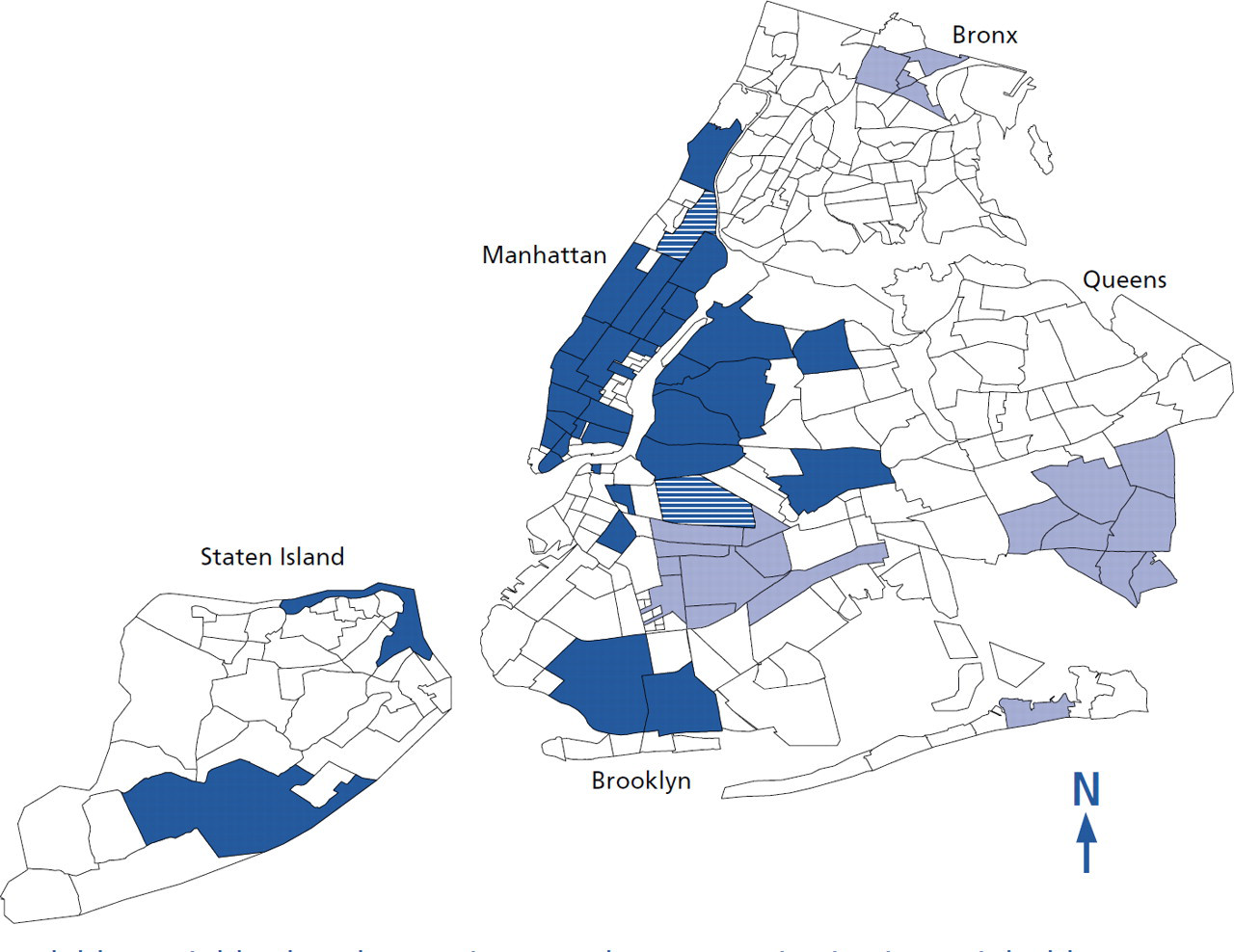
Arts institution concentration in New York: Dark blue neighborhoods contain more than 15 arts institutions. Light blue neighborhoods are majority Black/African. The striped neighborhoods, Bedford-Stuyvesant and Harlem, contain more than 15 institutions and are predominantly Black/African. Neighborhood boundaries are based on data from the NYC Department of City Planning.
Map created by Jennifer Kondo using Census data and an original dataset of arts institutions
The answer rests upon one of the oldest and most quintessentially American sociological concepts: space. Space affects the formation of cultural tastes and practices, and it helps explain disparities in institutional attendance.
Let's return to New York City, where by our count there are about 3,500 places you can walk into off the street to consume or participate in the arts. About half of those institutions are small art galleries, most of which are concentrated in downtown Manhattan. Larger institutions, like museums and live theaters, are similarly clustered in several Manhattan neighborhoods. When we look to the outer boroughs, it's clear that Manhattan is the heart of New York's arts scene, pumping out satellites through the arteres of major roads and subway routes.
Beyond Manhattan, in Brooklyn, Queens, Staten Island, and the Bronx (where over 80 percent of the population lives but where only about 25 percent of art institutions are located), we can see a familiar and disheartening story of segregation. White, wealthy New Yorkers have the lion's share of in-neighborhood arts and culture, and middle and upper class black New Yorkers experience a shocking absence of such institutions in their neighborhoods.
Take, for example, Cambria Heights in Queens. The average family makes $62,000 a year and their home costs $450,000. This middle class neighborhood is 92 percent black, and like many other black neighborhoods it is a cultural desert, absent of the kinds of cultural institutions that middle class whites in New York enjoy. When we compare Cambria Heights to the far whiter Forest Hills, a similarly-sized Queens neighborhood a bit to the west, where the average family makes $65,000 and lives in a home valued at $413,000, we find that the neighborhood boasts more than ten cultural institutions. And to the north in Jackson Heights, a predominantly Latino neighborhood known for its ethnic and economic diversity, there are fifteen cultural institutions.
There is added social “know-how” in learning to experience cultural institutions—not just the development of social ties.
The black experience of residential segregation, then, is also one of institutional and cultural segregation. Such cultural apartheids can go far in explaining disparities in attendance at cultural institutions and differences in the acquisition of cultural capital. They also help us draw connections and comparisons between the continued isolation of black Americans, both spatially and culturally, in contrast to the so-called “successful” assimilation and acculturation of other minority groups.
It has led us to develop what we call “the institutional exposure hypothesis”: Spatial exposure to cultural institutions creates capacities for neighborhoods and their residents. While all neighborhoods have culture, when institutionalized, such culture generates additional cognitive and social benefits.
The idea here is not that some neighborhoods are “cultured” and others are not. But some cultural experiences are institutionalized: they are either endorsed by or experienced in “legitimate” cultural spaces. This institutionalization matters, and it's highly segregated.
It is a very different experience to live where a number of galleries and a museum are within a couple minutes walk than to live on a street where the closest institution is a subway ride away. Even though residents may not attend all of their neighborhood institutions on a frequent basis, there is something about knowing they are there and that they are part of one's cityscape. There is an acquired ease and a comfort—a cognitive benefit—when these institutions are at your doorstop and a part of the daily rhythms of your life. And there is an added social “know-how” in learning to experience, negotiate, and even expect access to these institutions.
Social benefits include all of the possible relationships, interactions, and information sharing that can be done at arts and cultural institutions. Just as in community or daycare centers, essential socializing and network formation is done at arts institutions, particularly those that are neighborhood-focused. As people spend more time at arts institutions, they begin to show an embodied ease which conveys their “belonging” to certain groups of people (and their right to the social advantages that go along with them). This isn't just the development of social ties, but also the development of skills that show you belong.
Research on neighborhood effects often focuses on differential exposure to crime, negative role models (or the absence of positive ones), and violence, but we're finding that exposure to arts and cultural institutions is integral to explaining both privilege and disadvantage. The institutional exposure hypothesis also touches on other questions that have occupied social scientists.
For instance, those interested in how neighborhoods affect social position, behavior, and relationships will find cultural institutions central to understanding the life of a neighborhood and how that life influences a resident's life chances. And for those interested in cultural capital, we argue that culture happens in space. Without understanding spatial context in the formation of social and cognitive resources, we will misunderstand how culture works and how we might intervene to help the disadvantaged.
For New York's “golden age” to become a truly transformative moment in the experience of the arts, the arts must be disentangled from the lives and neighborhoods of the already advantaged. Until the arts experience is spatially available to all, today's “cultural democracy” will remain little more than a myth that places this inequality on the shoulders of those already disadvantaged.