




Abstract
Stereotypes and media mischaracterizations prohibit conversations between Muslims and non-Muslims that could otherwise counteract false assumptions.
For twenty-five years before the “Ground Zero Mosque” became a national preoccupation, two mosques were quietly serving Muslim worshippers in the Lower Manhattan neighborhood of New York City. Masjid Manhattan, established in 1970, lies four blocks from the site of the former World Trade Center. Masjid al-Farah, started in 1985, is 12 blocks away. Both mosques are small, and have struggled to accommodate their growing congregations over the years. Beginning in fall of 2009, Masjid al-Farah moved its weekly religious services to a larger space—an abandoned Burlington Coat Factory building located about two blocks from the World Trade Center site. Within a few months, the New York Times and FOX News' “O'Reilly Factor” reported that the leaders of the mosque had purchased the building and were planning to build a large Islamic Center, if they could raise the money. This coverage of the proposed project was generally positive, prompted little controversy, and marked the last media mention on this issue for some months.
Stereotypes about Muslims and terrorism are impediments to open dialogue and deeper social relations between Muslims and non-Muslims.
By the summer of 2010, however, the issue of the “Ground Zero Mosque” had become a focus of public attention. There was a frenzy of media coverage, local and national protests were held, and statements and speeches were made by dozens of public figures, many of whom were candidates for the rapidly approaching mid-term primaries and elections.
How did the Islamic Center proposal grow from a relatively benign matter of mostly local concern to a full-blown national “controversy” and public referendum on the place of Muslims and Islam in American society? Several factors contributed to this shift. These include the intense and unsettled emotions that surround the World Trade Center site, the approaching (and hotly contested) midterm elections, the institutional strength and reach of politically conservative media outlets, and widespread popular economic anxiety resulting from a recession with no relief in sight. But even with these factors encouraging focus on the downtown mosque, the political potency of this issue would not have been possible without the existence and availability of a handful of widespread and durable misconceptions about Islam and Muslims within American society. The most deeply embedded and prevalent myth is that there is a natural and abiding association between religious Islam and terrorist extremism. The active dismantling of this presumed link is crucial for our ability to work constructively towards a shared future.
The assumption that Muslims are more prone to support terrorism than others persists despite evidence to the contrary. In fact, Muslims in both the U.S. and in most large, Muslim-majority nations are more likely to unequivocally condemn terrorist tactics than other members of the American public. According to the Program on International Policy Attitudes' 2006 survey and Pew's 2007 results, only 46 percent of all Americans believe that “bombing and other attacks on civilians are never justified,” while this belief is much more prevalent among American Muslims (78 percent) and respondents in Iran (80 percent), Pakistan (86 percent), Bangladesh (81 percent), and Indonesia (74 percent). Along the same lines, most Muslims worldwide have the same concerns about terrorist violence as many non-Muslims. When asked in a 2007 Gallup poll what they least admire about their own societies, Muslims' top concerns included extremism and terrorism.
There is also evidence disproving the common assumption that Muslims with higher levels of religious commitment are more likely to hold extremist views. In fact, empirical data demonstrate that, within the United States, the opposite seems to be true. Our detailed analysis of the 2007 Pew survey of American Muslims confirms that regular engagement with groups of other Muslims, such as mosque attendance, actually decreases support for violent extremism; it also demonstrates that orthodoxy of religious belief has no relationship with violent extremism. Similarly, a recent Duke University study of terrorism by David Schanzer, Charles Kurzman, and Ebrahim Moosa found that Muslim American communities in the U.S. actually discourage radicalization by “confronting individuals who express radical ideology or support for terrorism, preventing extremist ideologues from preaching in mosques, communicating concerns about radical individuals to law enforcement officials, and purging radical extremists from membership in local mosques.” Gallup's 2007 international survey of Muslims demonstrates that religious piety is also not an accurate predictor of more radical views among Muslims worldwide. Taken together, these studies debunk the notion that there is a natural or timeless link between religious Islam and terrorist violence.
A sign at the 9/11/2010 “Rally of Remembrance/Yes to Freedom, No to Ground Zero Mosque” in New York City.
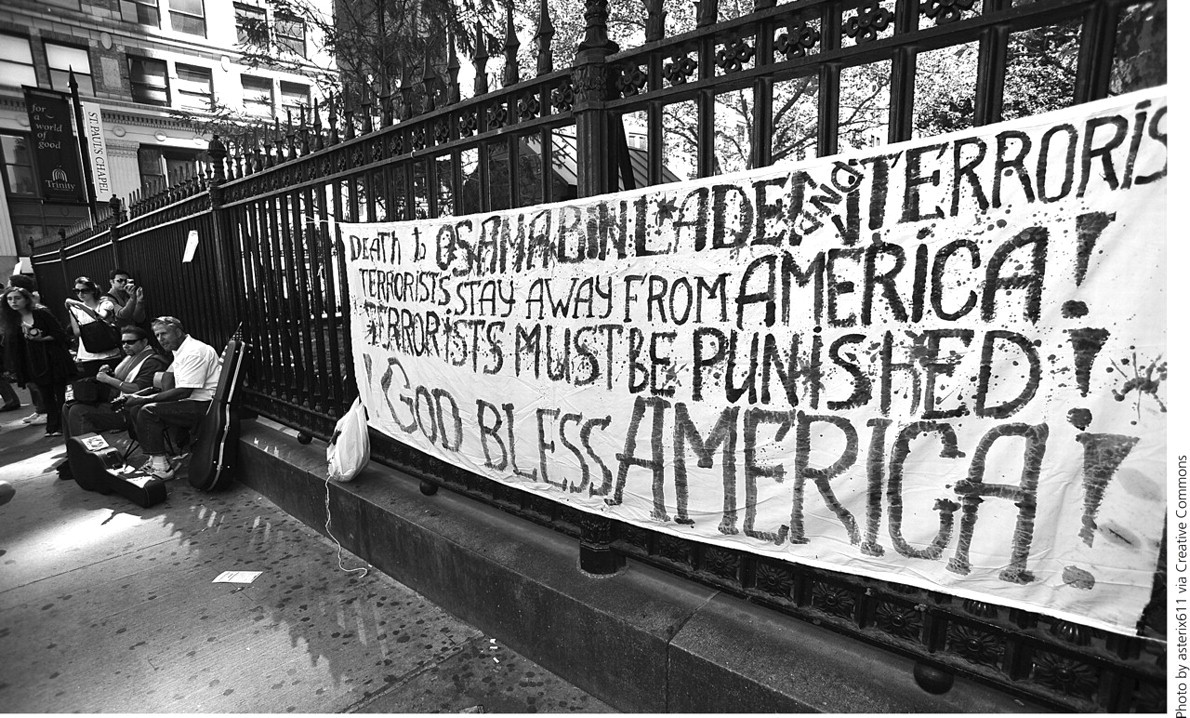
While within certain social and political contexts around the world a connection between Muslim religious devotion and extremist ideology may exist, overall—particularly in the United States—it definitely does not.
Given that these assumptions about the links between Muslims and support of terrorism lack empirical backing, the persistent misconceptions should be corrected. One mechanism through which stereotypes about Muslims might be countered is increased social interaction and conversations between Muslims and non-Muslims. Social psychologists, from Gordon Allport (writing in the '50s) to contemporary scholars like Thomas Pettigrew and Ulrich Wagner, have found that contact between members of different groups, and especially long-term relationships, can decrease negative stereotyping. Similarly, research has demonstrated that non-Muslim Americans who personally know Muslims and are familiar with Islam are less likely to automatically associate Islam with terrorism. However, our own qualitative research on American Muslims complicates this picture by demonstrating that the stereotypes themselves often act as impediments to open dialogue and deeper social relations between Muslims and non-Muslims.
Members of a Muslim youth group in one major American city told us they generally avoid conversations about Islam with non-Muslims for fear that non-Muslims will be predisposed to a negative view of Islam and perceive them as potential terrorists or terrorist sympathizers. Eighteen-year-old Muhammad said that when classmates in his high school spoke about Islam as a violent religion, he “had to just lay low and keep it cool, you know, try not to get worked up about it… And definitely not say anything about it because they would just talk over me, and twist everything I said.” This same sense of the futility in the face of prevalent stereotyping was expressed by seventeen-year-old Abdul. When he saw a pair of college students with notebooks entering his mosque, Abdul walked the other way, saying, “I don't want to talk to those people… They probably have an assignment to learn about the mosque or something, to learn about Muslims. To understand us.” When asked why he thought they wanted to understand Muslims, Abdul replied, “Because we're the world's biggest terrorists, supposedly. We're in the news all the time.” Abdul and Muhammad's experiences demonstrate how the perceived presence of negative stereotypes linking Muslims to terrorism can obstruct the social interactions that have the potential to invalidate such assumptions.
Even when American Muslims actively reach out to non-Muslims, the anticipation of stereotyping can constrain the depth of the dialogue. Yasmeen, an Egyptian American woman in her 40s, regularly tries to explain her religion to her non-Muslim colleagues and acquaintances, often finding them interested and respectful. Nevertheless, she feels that a powerful social dynamic works to shape these conversations even before they have begun:
“There is a subtext that people are always reacting to. So what would the subtext be if I am a Muslim engaged in a discourse with a non-Muslim in America? …Right now, in America, being a Muslim you're kind of on the defensive ever since 9/11 and maybe even before that.”
Unlike Muhammad and Abdul, Yasmeen openly engages with non-Muslims on topics related to Islam and Muslims. Yet she must still take into account the pervasive Muslim-terrorist association even as she works to debunk it. In each interaction, the prevalent assumptions linking Muslims and terrorism serve to constrain intergroup communication.
Despite this powerful social dynamic, constructive conversations between Muslims and non-Muslims about religion, culture, and politics do take place. They're initiated both by frustrated Muslims like Yasmeen and concerned non-Muslim individuals, and they're supported by the efforts of some public figures to openly defend religious freedom and encourage tolerance. In addition, such conversations are encouraged by organizations such as the Interfaith Youth CORE, IMAN, and the New Ground project, which work to initiate and forge ongoing relationships between American Muslims and non-Muslims.
The proposed site of the “Ground Zero Mosque.”

Unfortunately, the narrow focus by some media entities and politicians (from across the ideological spectrum) on the terrorist acts of a small minority of Muslims simultaneously reinforces Muslim stereotypes and discourages substantive intergroup conversations. These stifled dialogues and lost opportunities then leave the prevalent Islam-terrorism association unchallenged. Without personal direct knowledge of Islam and Muslims, many people have no effective way to counter the skewed perspective. It is this continuing cycle of broad, stereotypical representation and hindered local intergroup contact that allows an association between Muslims and terrorism to become taken for granted in American public life. And it is within this particular social and cultural context that a proposal to develop an Islamic community center near the World Trade Center site can balloon into a nationwide controversy and be met by significant and vocal popular opposition.
How might we transform this social and cultural climate? These are complex issues, but one immediate way to challenge the cycle of misinformation and missed opportunities is for more Muslims and non-Muslims to actively speak out. By addressing the assumptions that associate Islam and Muslims with terrorism wherever they arise—in newspapers, classrooms, or dining rooms—we can all play a small part in working to replace potent and prevalent misconceptions with more accurate and multi-faceted representations of Muslims and Islam.