




Abstract
Healthcare models and the finances associated with such models are complex. Patients with epilepsy (PWE) receive care in a variety of settings, and each is associated with differing reimbursement, financial levers, as well as unique strengths and weaknesses. As the financial climate of healthcare system changes rapidly in the setting of an aging population, physician shortages, and increasing costs of healthcare delivery, it is important for clinicians to understand the financial aspects of caring for PWE. In this review, we examine basic concepts in healthcare economics and then review the financial aspects of care in an academic context, a private practice, a capitated healthcare system, and in tele-electroencephalography services.
Introduction and Definitions
Early physician compensation models included cash payments to physicians (Chicago, 1892) and the creation of prepaid hospital plans by Blue Cross et al in the 1920s. The passage of the Social Security Act of 1965 created both Medicare and Medicaid, which have become large drivers of healthcare reimbursement to providers and institutions in the United States. In 1983, Diagnosis Related Group payments were introduced to bundle payments to control costs and incentivize hospital efficiency and resource management. In 1992, the resource-based Relative Value Unit (RVU) model of reimbursement was created to give a monetary value to physician services and procedures based on intensity, time, skill, and overhead expenses. The term value-based care was coined in 2006. Currently, the typical payment models in the United States include “fee-for-service” where payment is for each service that is provided, value-based care where reimbursement is based on quality of care, capitation where payment is per patient over a period of time, and bundled payments where a single payment covers an entire episode of care. 1
It is crucial for clinicians to understand basic health economics to sustain ongoing patient care. Familiarity with common financial terms can improve alignment between providers and healthcare administration. Fixed costs are defined regardless of patient volume (such as salaried labor and rent), whereas variable costs are dependent on volumes (Electroencephalography or EEG electrodes, EEG technologist overtime). Capital represents funds designated for further investment in assets. Operating expenses are the recurrent costs incurred to provide patient care. Operating margin is the revenue accrued after deducting operating expenses, and contribution margin represents the difference between revenue and variable costs; both serving as a measure of operational efficiency and opportunity for cost savings.2,3
Epilepsy Practice Economics
According to the US Bureau of Labor Statistics, the Consumer Price Index for healthcare is rising at a much higher rate than that of other sectors such as housing and gasoline. 4 Further, hospital expense growth is over double that of Medicare reimbursement. 5 These data points become especially alarming when looking at the projected growth in the Medicare population in coming years, with lower associated reimbursement for clinical services compared to commercial payors. As of 1960, there were 6 working adults per older adult, with a projection of a 2:1 ratio by 2060. 6 These factors underscore the importance of financial sustainability to continue providing patient care. Healthcare providers can optimize productivity and increase revenue, while also reducing the risk for burnout. Patient access can be improved by clinical template optimization, such as standardized appointment lengths by specialty and monitoring for unfilled appointments. Leveraging telehealth and artificial intelligence (such as ambient listening options) can improve efficiency. An ideal compensation model should align fair market value salary with bonus incentives or call pay.7–9
Epilepsy practices have the unique opportunity to maximize revenue with the combination of complex patient care and diverse procedures. Optimizing E/M billing via time-based codes, the use of the G2211 longitudinal care code, and utilizing epilepsy specialty taxonomy codes can maximize reimbursement. Rapid EEG can reduce unnecessary transfers, preserving revenue for rural hospitals. In-home video EEG can supplement Epilepsy Monitoring Unit services and bridge care gaps for patients unable to travel. Downstream revenue provides a strong financial contribution for neurology patients, particularly epilepsy. 10
Amidst a rapidly changing healthcare landscape, “intangible” financial inputs should not be overlooked. Strong workplace culture and morale promote a better work ethic.11,12 Physician retention is essential to avoid costly recruitment.13,14 While daunting, an understanding of the financial healthcare landscape will align providers and administration, optimizing resource allocation and quality of patient care in coming years.
Financial Implications Supporting the Academic Epileptologist
Within the broader landscape of epilepsy financial models, academic medicine represents a unique case study where the full scope of an epileptologist's work is essential to the academic mission, yet often inadequately captured by compensation frameworks. Academic epileptologists balance highly specialized clinical care with essential educational, scholarly, and institutional responsibilities. The challenge is not a lack of value but rather how that value is recognized, funded, and operationalized within academic financial models.
Across U.S. academic medical centers, epileptologists are employed under a variety of structures, including direct university or hospital employment, faculty practice plans, contracted or affiliated groups, and hybrid systems. While these models differ in governance and revenue flow, the underlying funding sources are remarkably consistent. Faculty support is derived from combinations of federal graduate medical education funds, medical school tuition and state support, clinical revenue, philanthropy, grants, and in some institutions, Veterans Health Administration partnerships. 15
A persistent challenge is the underfunding of the educational mission. National surveys of neurology department chairs demonstrate wide variability in protected or compensated time for educators. 15 While clerkship and residency program directors often receive defined support, time allocated for core educators, neuroscience course directors, and faculty mentorship is inconsistent and frequently uncompensated. Departments have responded with local solutions such as teaching or academic RVU equivalents and nonmonetary incentives, yet these approaches lack standardization and reproducibility across institutions.
Faculty full-time equivalent (FTE) definitions further complicate resource allocation. Although clinical FTE in academic medicine is commonly anchored to a standard full-time workload of approximately 40 h per week, or roughly 1920 annual hours when leave is accounted for, 16 this framework is difficult to apply across epilepsy practices. National survey data from NAEC Level 4 centers demonstrate substantial heterogeneity in EEG service coverage, with wide variation in the number of weeks faculty spend on EEG service annually, reflecting center-specific structural differences rather than individual practice patterns. 17 These inconsistencies are compounded by stark differences in how after-hours call is attributed, which can range from applying billable RVUs, to providing an extra stipend, to inclusion within fixed clinical expectations, or not counted at all.
Importantly, narrow reliance on work RVUs fails to capture the broader financial contribution of epileptologists to health systems. Claims-based analyses demonstrate that neurologist involvement in epilepsy care is associated with substantially higher downstream revenue compared with non-neurologist care, driven largely by inpatient services, procedures, and imaging rather than professional fees alone. 10 These data reinforce that epileptologists function as clinical and financial multipliers, even when their individual compensation does not reflect that impact.
Ultimately, supporting the academic epileptologist requires intentional alignment between mission and funding. Transparent FTE definitions, acknowledgment of undercounted work, and strategic reinvestment of downstream value are essential to sustaining excellence in epilepsy care, education, and research within academic medicine.
Tele EEG Services
Tele-EEG integration in hospital settings is a pivotal advancement in epilepsy care, enabling timely EEG interpretation and expanding access to subspecialty expertise. This review outlines best practices and operational strategies for successful implementation, balancing clinical rigor with business alignment.
Two dominant service models exist: Direct-to-Facility, where independent practitioners’ contract directly with hospitals, and Networked Models (see Figure 1), which leverage group scalability and shared resources.18,19 Clinical best practices include defining service scope—such as routine and continuous EEG interpretation—adhering to standardized protocols, ensuring HIPAA compliance, and implementing robust technology safeguards such as audit trails and disaster recovery planning. Operational protocols, including service-level agreements, escalation pathways, and credentialing requirements, underpin reliability, and quality assurance. 20
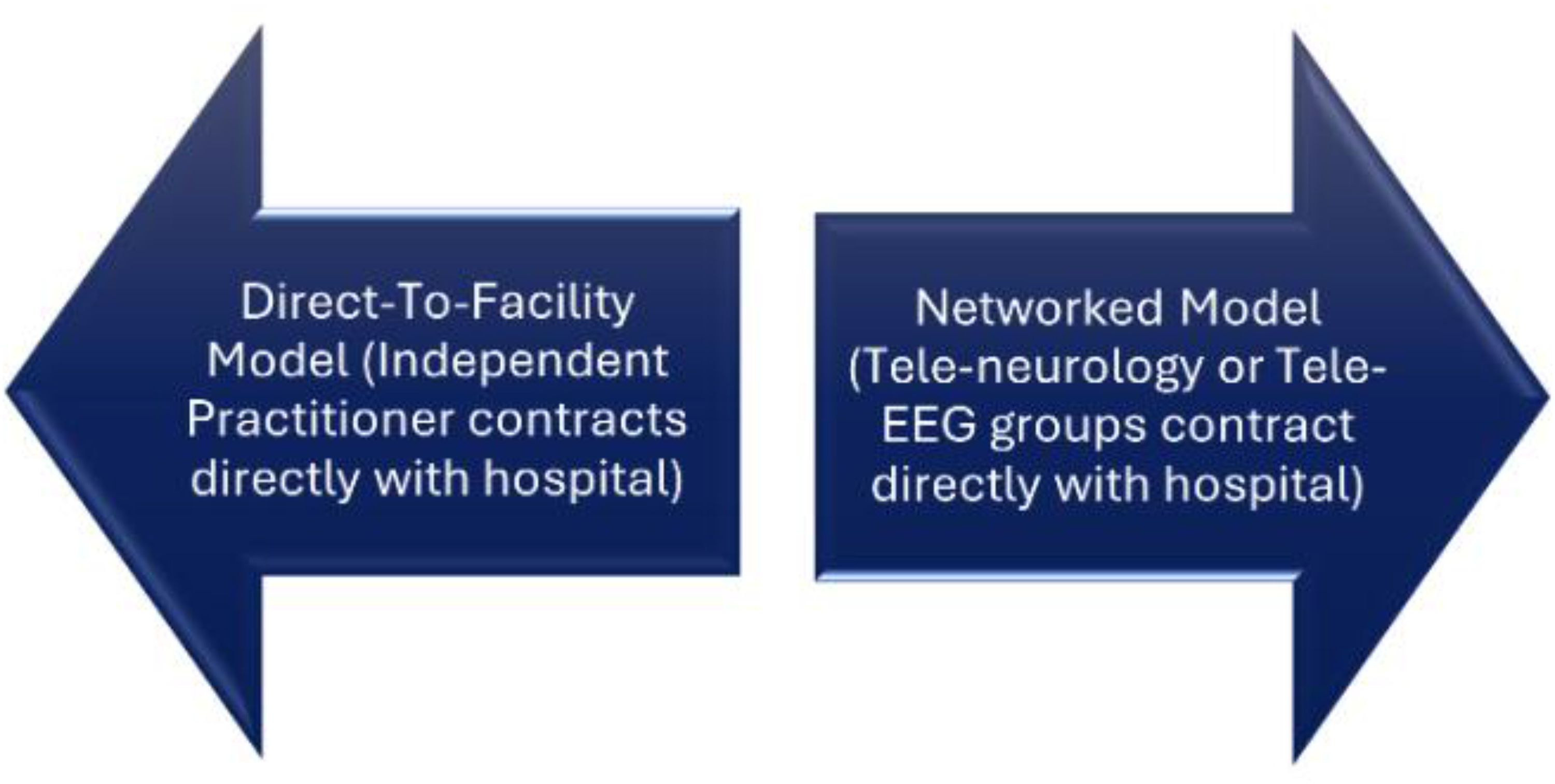
Service models for tele-electroencephalography (EEG) in the hospital setting.
Business considerations are equally critical for sustainability. Pricing structures range from per-study fees to monthly retainers, with contracts addressing liability, licensure costs, and turnaround expectations. A Decision Matrix Framework evaluates partnership models across 3 weighted dimensions: organizational culture (35%), working model fit (30%), and payment model (35%) (see Figure 2). For example, hospitals prioritizing workflow integration and rapid STAT response (<1 h) may favor models offering 24/7 IT support and flexible scheduling, resulting in weighted totals that objectively rank options.

Partnership fit decision matrix framework.
The synergy of clinical and operational excellence drives measurable patient care benefits. Hospitals adopting well-aligned Tele-EEG models report improved access for underserved populations, reduced patient transfers, and enhanced provider satisfaction. Rural facilities such as critical access hospitals in underserved areas and specialized facilities serving vulnerable populations—such as Neonatal ICU patients within Women's Hospitals—benefit significantly from continuity of care through nurse-led EEG setups, guided in real time by remote technologists (R. EEG T.), who provide monitoring and escalate to epileptologists for interpretation.21,22
Ultimately, integrating evidence-based standards with strategic business planning creates a scalable, high-value solution that advances equity and quality in epilepsy care delivery.
Thriving as an Independent Physician: Competing Through Value, Not Volume
The landscape of epilepsy care in the United States is changing rapidly. Physician ownership continues its steady decline as hospital employment expands, private equity enters the field, and payer-driven reimbursement creates new pressures. Medicare payment cuts, the growth of Medicare Advantage plans, and an increasing shift toward value-based contracts have squeezed all specialties. For epilepsy programs specifically, the heavy dependence on inpatient video-EEG monitoring adds another layer of financial and regulatory vulnerability. These forces make a compelling case for more diversified, resilient care models.23–25
Despite these challenges, independent practice remains not just viable but often advantageous—when it's built on a clear value proposition. The fundamental advantage of independent practice is the clinician can guarantee the quality of care given to the patient. The independent practitioner controls visit length, scheduling, and care coordination. Independent groups can also negotiate directly with payers, which allow epilepsy-specific services to be valued more accurately without distortion from intermediary administrative layers. 26
Several models support high-quality independent epilepsy care, each with distinct trade-offs. Community-based general neurology practices with epilepsy expertise provide broad access and often serve as an effective entry point for patients, though they typically have limited negotiating leverage and may lack access to advanced diagnostics. Hospital-integrated partnerships bring infrastructure, staffing support, and reliable referral streams, but usually at the expense of autonomy. Multicenter epilepsy groups can extend their reach across hospital systems, gaining better leverage and resilience, albeit with greater administrative demands. Fully independent ambulatory epilepsy centers offer maximum clinical and operational control, along with the ability to capture both professional and technical revenue, but they require significant capital and face substantial regulatory oversight. 26
Regardless of which structure is chosen, successful independent practices differentiate themselves through value rather than volume. In concrete terms, this means offering accessibility, short wait times, responsive communication, and flexibility in diagnostic options. This includes everything from in-hospital monitoring to ambulatory and home-based EEG. Independence also preserves the freedom to refer patients to the most appropriate specialist or institution without being constrained by institutional politics. The goal is to deliver care where it's most efficient and most effective, not where it's most profitable for a health system.
Building a distinctive clinical focus strengthens an independent practice further. Comprehensive epilepsy programs that weave together medical management with neuropsychology, nutrition, psychiatry, and surgical evaluation improve both patient outcomes and the program's reputation. Subspecialty niches including women's epilepsy, autoimmune epilepsy, functional neurological disorders (psychogenic nonepileptic seizures), allow physicians to deepen their expertise, and strengthen referral networks. Partnerships with primary care, psychiatry, sleep medicine, dietetics, and palliative care enable more holistic patient management. Participating in regional epilepsy coalitions increases both visibility and opportunities for shared learning. 27
There are also opportunities to expand beyond traditional clinical care. Clinical research can provide both financial support and professional relevance, and independent settings often enable faster study initiation and more predictable enrollment, with strong patient retention as an added benefit. Ancillary services, ambulatory EEG, infusion programs, coordinated genetic testing can improve the patient experience while supporting financial sustainability. Teaching, consulting, and hospital-based roles represent additional avenues for expanding access to specialized epilepsy care, provided these activities are pursued with appropriate ethical and regulatory guardrails. 26
Ultimately, thriving in this evolving healthcare environment depends less on scale than on strategic focus. Independent epilepsy practices that prioritize quality, patient experience, collaboration, and thoughtful diversification can remain both clinically excellent and financially viable. Success isn't measured by volume, it's defined by consistently delivering the care that matters most to patients and their families.
Integrated Health Systems: Optimizing Resources to Serve Populations
An integrated health system is one that combines insurance coverage with inpatient and outpatient care as well as diagnostics and pharmaceutical services. The VA and Kaiser Permanente are examples of integrated health systems. In this section we will focus on the VA which provides services in the form of Veterans Integrated Service Networks (VISN) that span the nation, which are composed of medical centers (facilities) and community-based outreach clinics. There are approximately 18 million living US veterans (13.3 M urban) of whom 9.3 million (6.3 M urban) are enrolled in the VA for healthcare. 28 With such a geographically distributed population, the VA must ensure even the most rural Veterans receive comparable general and specialty care,
The VA's budget is divided into general purpose and specific purpose funds. 29 The VA uses the Veterans Equitable Resource Allocation (VERA) model to distribute general purpose funds to VISNs with over 90% of funds allocated to patient care using a capitated pricing model, not a fee for service model. For patients receiving care in more than one VISN, VERA employs a prorated patient model to divide their allocation among the VISNs proportional to the total cost of care delivered.
In 2008, the US Congress passed legislation allocating specific-purpose funds to support the creation of a hub and spoke network of Epilepsy Centers of Excellence (ECOE) within the VA. These centers streamline care coordination, address access for rural Veterans and incorporate novel care delivery methods including virtual care, electronic consults, provider-to-provider on demand consults, and digital technologies. All ECOE sites provide epilepsy outpatient care, routine and continuous EEG, and elective video EEG telemetry admissions. Select ECOE sites also provide comprehensive surgical care. The ECOE sites must maintain minimum volumes for each service, including outreach to other facilities within their VISNs, to maintain their site designation and funding level. 30
Patients that are ideal for ECOE care are those with drug-resistant epilepsy, psychogenic nonepileptic seizures, special populations (elderly, capable of pregnancy), and those with complex comorbidities and drug–drug interactions. Pugh et al evaluated ECOE care and found that the number of veterans with epilepsy approaches 130,000, but only 20% of them receive any specialty care for epilepsy at the VA and only 5% receive VA-authorized specialty care outside the VA. 30 Haneef and colleagues within ECOE performed a quality evaluation to validate an administrative algorithm identifying Veterans with drug-resistant epilepsy. The ECOEs are now tasked with leveraging that data to improve utilization of VA epilepsy care. 31
Integrated health systems are able to support complex epilepsy care through a combination of capitated and supplemental funding. Hub and spoke networks like the VA ECOE system can be leveraged to efficiently deliver care across a widely distributed geographical area when the infrastructure exists to support telehealth and patient travel. Focused outreach efforts can target patients who benefit most from tertiary care, maximizing the value of centralized hubs.
Conclusion
The care of patients with epilepsy (PWE) and delivery of healthcare services occurs in a variety of settings in the United States. In this review, we examine care systems including academic hospitals, private practices, capitated systems and tele EEG services while making it clear that understanding the financial and economic aspects of epilepsy care is vital for clinicians. In the future a variety of trends including the growth of artificial intelligence in interpreting imaging and neurophysiological studies, the rise of rapid EEG services which will bring continuous EEG services to remote locations, and the continuing presence of telehealth have the scope of transforming clinical practice. These trends as well as the challenges of rising healthcare expenditures vis-à-vis incomes, shortages of epilepsy care personnel32,33 and “deserts” of care in many areas of the rural United States 34 are important challenges to address to ensure equitable care and access for PWE. Finally as Levine points out, while Francis Peabody famously stated the secret for caring for a patient is to care about the patient, it is also now about caring for the physician who can face the pressures of burnout. 35 The glass half full perspective of coming changes in healthcare is that they will help physicians care for patients and about themselves and therefore understanding financial models is vitally important.
Footnotes
Funding
The author(s) received no financial support for the research, authorship, and/or publication of this article.
Declaration of Conflicting Interests
The author(s) declared no potential conflicts of interest with respect to the research, authorship, and/or publication of this article.
