



Abstract
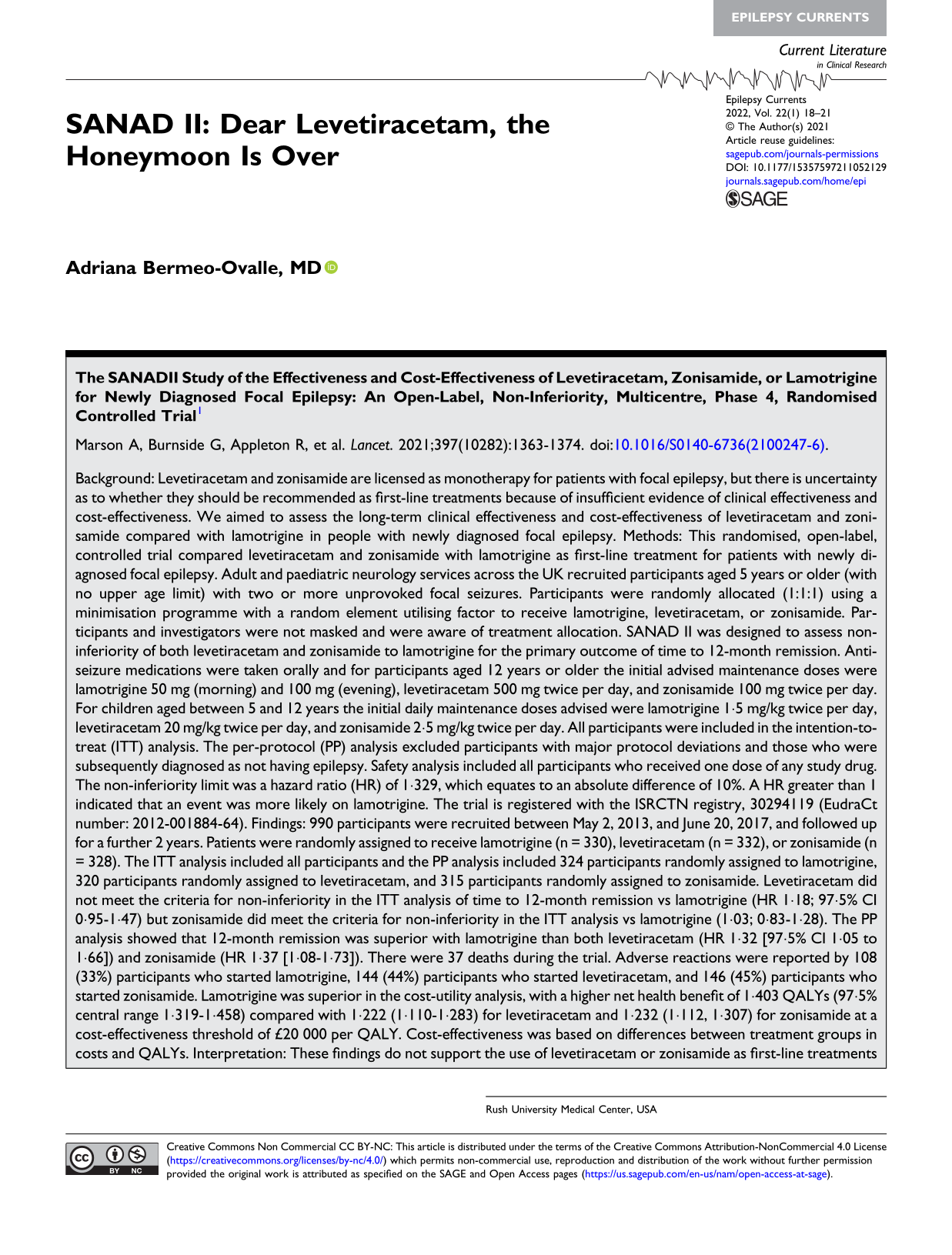
Marson A, Burnside G, Appleton R, et al. Lancet. 2021;397(10282):1363-1374. doi:10.1016/S0140-6736(2100247-6). Levetiracetam and zonisamide are licensed as monotherapy for patients with focal epilepsy, but there is uncertainty as to whether they should be recommended as first-line treatments because of insufficient evidence of clinical effectiveness and cost-effectiveness. We aimed to assess the long-term clinical effectiveness and cost-effectiveness of levetiracetam and zonisamide compared with lamotrigine in people with newly diagnosed focal epilepsy. This randomised, open-label, controlled trial compared levetiracetam and zonisamide with lamotrigine as first-line treatment for patients with newly diagnosed focal epilepsy. Adult and paediatric neurology services across the UK recruited participants aged 5 years or older (with no upper age limit) with two or more unprovoked focal seizures. Participants were randomly allocated (1:1:1) using a minimisation programme with a random element utilising factor to receive lamotrigine, levetiracetam, or zonisamide. Participants and investigators were not masked and were aware of treatment allocation. SANAD II was designed to assess non-inferiority of both levetiracetam and zonisamide to lamotrigine for the primary outcome of time to 12-month remission. Anti-seizure medications were taken orally and for participants aged 12 years or older the initial advised maintenance doses were lamotrigine 50 mg (morning) and 100 mg (evening), levetiracetam 500 mg twice per day, and zonisamide 100 mg twice per day. For children aged between 5 and 12 years the initial daily maintenance doses advised were lamotrigine 1·5 mg/kg twice per day, levetiracetam 20 mg/kg twice per day, and zonisamide 2·5 mg/kg twice per day. All participants were included in the intention-to-treat (ITT) analysis. The per-protocol (PP) analysis excluded participants with major protocol deviations and those who were subsequently diagnosed as not having epilepsy. Safety analysis included all participants who received one dose of any study drug. The non-inferiority limit was a hazard ratio (HR) of 1·329, which equates to an absolute difference of 10%. A HR greater than 1 indicated that an event was more likely on lamotrigine. The trial is registered with the ISRCTN registry, 30294119 (EudraCt number: 2012-001884-64). 990 participants were recruited between May 2, 2013, and June 20, 2017, and followed up for a further 2 years. Patients were randomly assigned to receive lamotrigine (n = 330), levetiracetam (n = 332), or zonisamide (n = 328). The ITT analysis included all participants and the PP analysis included 324 participants randomly assigned to lamotrigine, 320 participants randomly assigned to levetiracetam, and 315 participants randomly assigned to zonisamide. Levetiracetam did not meet the criteria for non-inferiority in the ITT analysis of time to 12-month remission vs lamotrigine (HR 1·18; 97·5% CI 0·95-1·47) but zonisamide did meet the criteria for non-inferiority in the ITT analysis vs lamotrigine (1·03; 0·83-1·28). The PP analysis showed that 12-month remission was superior with lamotrigine than both levetiracetam (HR 1·32 [97·5% CI 1·05 to 1·66]) and zonisamide (HR 1·37 [1·08-1·73]). There were 37 deaths during the trial. Adverse reactions were reported by 108 (33%) participants who started lamotrigine, 144 (44%) participants who started levetiracetam, and 146 (45%) participants who started zonisamide. Lamotrigine was superior in the cost-utility analysis, with a higher net health benefit of 1·403 QALYs (97·5% central range 1·319-1·458) compared with 1·222 (1·110-1·283) for levetiracetam and 1·232 (1·112, 1·307) for zonisamide at a cost-effectiveness threshold of £20 000 per QALY. Cost-effectiveness was based on differences between treatment groups in costs and QALYs. These findings do not support the use of levetiracetam or zonisamide as first-line treatments for patients with focal epilepsy. Lamotrigine should remain a first-line treatment for patients with focal epilepsy and should be the standard treatment in future trials. National Institute for Health Research Health Technology Assessment programme.
Marson A, Burnside G, Appleton R, et al. Lancet. 2021;397(10282):1375-1386 doi:10.1016/S0140-6736(2100246-4) Valproate is a first-line treatment for patients with newly diagnosed idiopathic generalised or difficult to classify epilepsy, but not for women of child-bearing potential because of teratogenicity. Levetiracetam is increasingly prescribed for these patient populations despite scarcity of evidence of clinical effectiveness or cost-effectiveness. We aimed to compare the long-term clinical effectiveness and cost-effectiveness of levetiracetam compared with valproate in participants with newly diagnosed generalised or unclassifiable epilepsy. We did an open-label, randomised controlled trial to compare levetiracetam with valproate as first-line treatment for patients with generalised or unclassified epilepsy. Adult and paediatric neurology services (69 centres overall) across the UK recruited participants aged 5 years or older (with no upper age limit) with two or more unprovoked generalised or unclassifiable seizures. Participants were randomly allocated (1:1) to receive either levetiracetam or valproate, using a minimisation programme with a random element utilising factors. Participants and investigators were aware of treatment allocation. For participants aged 12 years or older, the initial advised maintenance doses were 500 mg twice per day for levetiracetam and valproate, and for children aged 5-12 years, the initial daily maintenance doses advised were 25 mg/kg for valproate and 40 mg/kg for levetiracetam. All drugs were administered orally. SANAD II was designed to assess the non-inferiority of levetiracetam compared with valproate for the primary outcome time to 12-month remission. The non-inferiority limit was a hazard ratio (HR) of 1·314, which equates to an absolute difference of 10%. A HR greater than 1 indicated that an event was more likely on valproate. All participants were included in the intention-to-treat (ITT) analysis. Per-protocol (PP) analyses excluded participants with major protocol deviations and those who were subsequently diagnosed as not having epilepsy. Safety analyses included all participants who received one dose of any study drug. This trial is registered with the ISRCTN registry, 30294119 (EudraCt number: 2012-001884-64). 520 participants were recruited between April 30, 2013, and Aug 2, 2016, and followed up for a further 2 years. 260 participants were randomly allocated to receive levetiracetam and 260 participants to receive valproate. The ITT analysis included all participants and the PP analysis included 255 participants randomly allocated to valproate and 254 randomly allocated to levetiracetam. Median age of participants was 13·9 years (range 5·0-94·4), 65% were male and 35% were female, 397 participants had generalised epilepsy, and 123 unclassified epilepsy. Levetiracetam did not meet the criteria for non-inferiority in the ITT analysis of time to 12-month remission (HR 1·19 [95% CI 0·96-1·47]); non-inferiority margin 1·314. The PP analysis showed that the 12-month remission was superior with valproate than with levetiracetam. There were two deaths, one in each group, that were unrelated to trial treatments. Adverse reactions were reported by 96 (37%) participants randomly assigned to valproate and 107 (42%) participants randomly assigned to levetiracetam. Levetiracetam was dominated by valproate in the cost-utility analysis, with a negative incremental net health benefit of −0·040 (95% central range −0·175 to 0·037) and a probability of 0·17 of being cost-effectiveness at a threshold of £20 000 per quality-adjusted life-year. Cost-effectiveness was based on differences between treatment groups in costs and quality-adjusted life-years. Compared with valproate, levetiracetam was found to be neither clinically effective nor cost-effective. For girls and women of child-bearing potential, these results inform discussions about benefit and harm of avoiding valproate. National Institute for Health Research Health Technology Assessment Programme.Background
Methods
Findings
Interpretation
Funding
Background
Methods
Findings
Interpretation
Funding
Commentary
Since its approval and introduction to the market in 1999 as adjuvant therapy for the treatment of focal epilepsy and its following expanded indications for the treatment of generalized epilepsy, myoclonus, pediatric population and ultimately as monotherapy for the treatment of focal epilepsy, levetiracetam (LEV) resulted a very attractive therapeutic alternative for the treatment of different types of epilepsy in multiple clinical scenarios. It was love at first sight.
The draw towards LEV is easy to understand. It is approved for treatment in a broad spectrum of epilepsy types. It is easy to administer and to titrate in a short period of time. It is available in multiple presentations including tablets, oral solution and IV preparations. It is conveniently dosed, well tolerated and has a good safety profile with few medication interactions. It quickly became a medication of choice in the emergency room, 3 the outpatient clinic and the intensive care unit alike.3,4 Additionally, it has proven to be a safe alternative for women in childbearing age as it is safe during pregnancy in regards to rate of major fetal malformations and long term neuro-cognitive outcomes. 5 Our relation with LEV seemed to be a long and stable one.
Now, all good relationships have their up and downs. Just as we collectively became more aware of the high prevalence of psychiatric co-morbidities among patients with epilepsy 6 and their association with lower quality of life, it also became apparent that, while generally well tolerated, LEV is associated with an increased risk of behavioral side effects and neuropsychiatric symptoms in up to 13% of adults. These side effects include mood disorders, irritability, agitation, hostility, suicidal ideations and psychosis. 7 These symptoms are more frequently seen in patients with baseline psychiatric symptoms and are reversible with the discontinuation of medication. In my practice, a history of personal or familiar psychiatric illness is the most frequent reason to avoid or closely monitor the use of LEV.
The recent publication of the results of the SANAD II1,2 (Study of Standard and New Antiepileptic Drugs II) trial, seems to rock our relationship with LEV to its core, but, is this a breakup? Is the honeymoon over?
The trial evaluated the response to first line treatment in newly diagnosed focal, generalized or unclassifiable epilepsy and aimed to assess the long term-effectiveness of newer and older anti-seizure medications as well as the cost-effectiveness of such therapies. The trial was a randomized, controlled and un-blinded study in patients ages 5 and older and included a 2 year follow up.
In focal epilepsy, lamotrigine (LTG) was chosen as the medication to beat as it had been identified in the first SANAD trial 8 as the medication of choice for focal epilepsy: more effective, better tolerated and more cost effective than carbamazepine, oxcarbazepine, gabapentin or topiramate (TPM). LEV and Zonisamide (ZNS) were put to the test. LEV was found to be inferior to LTG and ZNS regarding the time to achieve long term (one and two year) seizure remission and time to first breakthrough seizure. LEV and ZNS were found more likely to fail than LTG due to poor seizure control and adverse reactions. Adverse reactions were more frequent in the LEV (44%) and ZNS (45%) groups as compared to LTG (33%). There were 37 deaths in the trial but not in relation to one particular medication.
A prior randomized trial 9 and a Cochrane 10 review had already had found LEV to be inferior to Carbamazepine and Lamotrigine in the treatment of focal epilepsy and to Valproic aicd (VPA) in the treatment of generalized epilepsy 9 regarding time to achieve 12 month seizure remission.
In the group with generalized or unclassifiable epilepsy VPA was chosen as the standard treatment as it had outperformed TPM and LTG in the first SANAD trial 11 regarding time to achieve one year remission, tolerability, time to treatment failure and cost-effectiveness. In SANAD II LEV was shown to be inferior to VPA in the time to achieve long term (one and two year) seizure remission. A smaller proportion of patients in LEV (24%) achieved immediate 12 month seizure freedom as compared to VPA (33%). LEV was also more likely to fail due to poor seizure control than VPA. Interestingly, there was no difference in treatment failure due to side effects or adverse events. These findings lead the authors to recommend VPA as the first line medication for newly diagnosed epilepsy within this group. However, a significant consideration should be taken when treating women of childbearing age as VPA has shown to be associated with an increased risk for major fetal malformations.12,13
Choosing the first line anti-seizure medication in newly diagnosed epilepsy is an important decision that should be taken carefully. It not only defines the safety and outcome of the patient, it may define the therapeutic relation with the provider, the adherence to medical treatment and the prognosis in the long term. About half of the patients who fail the first treatment also fail the second one. 14 Multiple factors influence this decision including the type of epilepsy, frequency of seizures, age, gender and co-morbid conditions of the patient, pharmacological interactions with other medications, family plans and others.
The versatility of LEV has probably obviated the careful consideration of these multiple variables when starting first line management for many clinicians including non-epilepsy specialists and non-neurologists. It is sobering to realize through the SANAD II study that while LEV may be a “user friendly” choice, it is not the proven most effective choice in the long term. For LEV as the one and only “go to” medication for all seizures, the honeymoon bliss is over, but likely not the relationship altogether. Its ease of use, quick therapeutic effect, safety for women in childbearing age and predictable side effect profile still make it a good enough choice for many patients to try, although not necessarily the best long term choice we can offer.
Footnotes
Declaration of Conflicting Interests
The author(s) declared no potential conflicts of interest with respect to the research, authorship, and/or publication of this article.
Funding
The author(s) received no financial support for the research, authorship, and/or publication of this article.
