



Abstract

Keywords
The 2021 AES/NINDS Epilepsy Research Benchmarks.
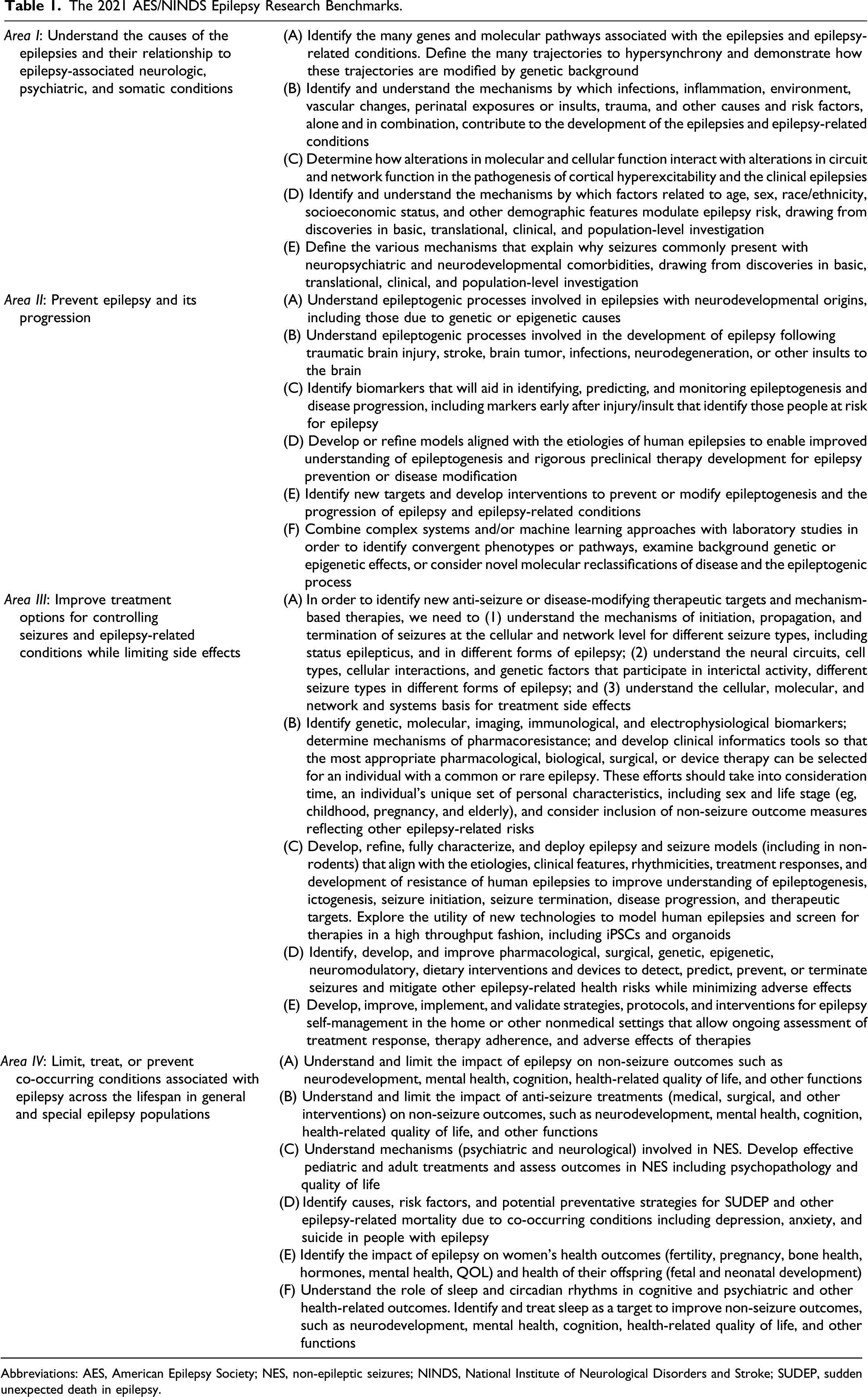
Abbreviations: AES, American Epilepsy Society; NES, non-epileptic seizures; NINDS, National Institute of Neurological Disorders and Stroke; SUDEP, sudden unexpected death in epilepsy.
Between 2014 and the present, the Benchmarks Committee reviewed progress in each of the 4 benchmarks areas, noting remarkable discoveries across basic epilepsy research, highlighting the major gains in understanding the causes of epilepsy, but also noting many continued gaps in all areas.9-13 We have experienced a cultural shift through which the voices of patients and advocates are not only acknowledged but included in the discussions of the AES, including with the Benchmarks Committee, through the work of Epilepsy Leadership Council members, whose working group and leadership provided input into the Benchmarks process (and whose commentary accompanies this one). To further invite community input into the Benchmarks, in 2020 the NINDS published a Request for Information and launched a crowdsourcing campaign using the ninds.ideascale.gov platform. What was different about the most recent process of revision to the Benchmarks is that we relied less heavily on in-person discussion and debate. The Benchmarks Committee and ELC members last met in person at the December 2019 AES annual meeting, and our discussions and deliberations have since relied on the technology of the digital age for virtual meetings and shared documents to continue this important conversation about research priorities in the epilepsies.
The 2021 Epilepsy Research Benchmarks are presented in detail in Table 1. We have maintained the structure of the 4 areas, modifying some areas where progress has been made, and emphasizing the need for continued and new research in several aspects: for Area I, to deepen our understanding of the many causes of the epilepsies and their comorbidities and their mechanisms; for Area II, to employ models, biomarkers, and novel methodologies to understand epileptogenesis with a goal of preventing seizures, acknowledging emerging newly discovered causes; for Area III, to develop new treatments and new modalities of treatment for the epilepsies and associated conditions; and for Area IV, to focus attention on epilepsy-related developmental and psychiatric comorbidities, risk of sudden death, and associated conditions (eg, non-epileptic seizures) for individuals across the lifespan and for populations historically not well studied, including women with epilepsy.
We recognized that there are many themes running through all 4 benchmarks areas. Collectively, we acknowledged the importance of affirming these core research priorities that continue to reflect basic, unanswered questions in the field. In addition, now 20+ years after the original framing of the benchmarks, we felt the need to outline specific areas in which transformative research could move the field forward. The 2021 Curing the Epilepsies conference launched a conversation around transformative research priorities that will likely shape the Benchmarks in years to come.
Review of Curing the Epilepsies Meeting
The NINDS convened the Curing the Epilepsies: Setting Research Priorities conference virtually via Zoom on January 4-6, 2021. This conference, originally scheduled as an in-person conference in April 2020, was postponed due to the SARS-CoV-2 pandemic. The January 2021 Curing the Epilepsies conference was focused on considering priorities for future efforts, by bringing together stakeholders—including researchers, healthcare providers, individuals with epilepsy, families, and advocates—to identify gaps and opportunities in epilepsy research. Although significant progress has been made in epilepsy research in recent decades, the personal stories shared by advocates at this conference underscore the need to transform progress so that research advances reach individuals with epilepsy faster. As such, participants were asked to focus on transformative research priorities for the field, including (1) accelerating the development of new treatments that can be translated to individuals with epilepsy, (2) increasing data sharing and collaboration, and (3) addressing the challenges faced by all stakeholders.
Over the course of this 3-day conference, attendees shared their perspectives on the following topics: (1) expediting targeted treatments for the epilepsies, (2) modeling human epilepsies, (3) establishing biomarkers for human epilepsies, (4) harnessing big data to drive epilepsy research and clinical care, (5) emerging research priorities in the epilepsies, and (6) translating research into clinical care. Sessions focused on these topics included panel discussions and breakout groups to allow participants to suggest and refine transformative research priorities that will drive epilepsy research forward.
The transformative research priorities discussed at this conference have the potential to accelerate progress and make a meaningful difference in the lives of individuals with epilepsy and their families. Several recurring themes were discussed throughout the conference and will continue to be the topics of ongoing discussions: Progress in the field will be accelerated by increased collaboration and breaking down of the ‘silos’ that traditionally have separated researchers, healthcare providers, and advocacy groups. Concerted efforts are needed to foster and support large-scale collaborations that will expedite the discovery of the mechanisms of disease, the development of new therapies, and the translation of these therapies to clinical care. Enormous amounts of data are being collected on individuals with epilepsy, including in the course of routine healthcare delivery, that could be shared and utilized in large multimodal datasets that could be integrated with extant datasets. This would require infrastructure and resources for data sharing and the use of new analytic strategies to mine high-quality data in order to improve research and clinical care. The epilepsy community would benefit from learning from successful models for research and clinical care that have been implemented for other diseases. More specifically, there is a need to understand the mechanisms that underlie the epilepsies in order to develop targeted and more precise therapies; develop and validate an array of biomarkers for the epilepsies to identify those most at risk for developing epilepsy and SUDEP, measure progression of disease, and response to treatment; improve preclinical models of epilepsies so that they better recapitulate the human condition; expand epilepsy research and clinical care to underserved communities and diversify the workforce in both areas; and create and utilize innovative new tools and measures, such as those being developed in the BRAIN Initiative
14
that expand the capabilities of basic and clinical research on the epilepsies.
Challenges and Barriers to Transformation in Epilepsy Research
The Curing the Epilepsies conference shifted from reviewing benchmarks to seeking transformation because the fundamental scientific understanding of human epilepsy and of single genes, circuit dysfunction, and emerging cellular and animal models that aim to reflect human epilepsy has critically advanced in the last 7 years. While these advances are real, during the Curing the Epilepsies conference there was much discussion through formal talks, informal discussion in the “chat” feature of the teleconference platform, and in the moderated breakout groups about impediments to further transformation in epilepsy research. From this discussion, it was clear that there are barriers to collaboration and sharing in science, which appear to be consequential in epilepsy research. While there are structural and cultural aspects of academia and industry that encourage a “go-it-alone” spirit, there are examples of effective collaboration, most recently with rapid and effective convergence of science in the face of the SARS-CoV-2 pandemic, but more consistently within pediatric oncology clinical research. While a major barrier to sharing is an existing lack of shared databases, the crowdsourcing campaigns portion of the Curing the Epilepsies/Benchmark revision 2020 process did not generate widespread responses. There are many potential explanations for the relatively small number of responses to the IdeaScale campaign, but the absence of novel ideas that emerged through this platform suggests a need for the community to further embrace a culture of publicly sharing ideas in order to maximize data sharing and collaborative work.
The goal of the conference was to generate transformative scientific ideas, as the key core epilepsy research questions have been outlined in the updated Benchmarks. There was excellent discussion about how to advance the current questions, but there was a lack of transformative research ideas discussed. This may either reflect that recent advancements in epilepsy science are on the cusp of solving the fundamental problems in epilepsy or it may mean that researchers are in a collective “idea valley.” The current nature and pace of epilepsy research requires acceleration in technologies to truly understand the complexities of the brain. With the BRAIN Initiative and novel techniques and tools emerging, the field could quickly move forward in bigger steps, instead of the modest increments with which we currently advance. Another reason for lack of discussion of specific transformative ideas could be that academic and personal incentives are primarily centered around individual success reducing the motivation to publicly discuss transformative ideas. A final reason could be that we need more fresh ideas, new minds, to ask new questions, speaking to the need to engage and encourage young scientists and new researchers in epilepsy research.
Some potential solutions to these impediments that were discussed included formal mechanisms to advance sharing and collaboration, such as a greater use of “center-without-walls” and other team science models, harnessing the potential of the many available National Institutes of Health (NIH) grant mechanisms and resources, not just those geared to epilepsy, and partnering with non-NIH funding agencies. Finally, the need to reach out to leaders at academic institutions to rethink and change the incentives for success in our field was oft repeated throughout the conference.
What Will Benchmarks Process Look Like in the Future?
The 2021 Curing the Epilepsies conference sought to drive a more forward-looking approach to epilepsy research. We emerged from this conference with momentum building about ways to ask big questions, to build more multisite collaborations, to engage scientifically with people that we have not previously met, and to share large datasets. To keep this momentum going forward, we envision a more active role for the Benchmark Stewards Committee, including working with the NINDS to extend and deepen the conversations on specific topics and areas from the 2021 conference through workshops or other platforms. These discussions could reach an even broader audience through presentations at annual AES meetings. Future Curing the Epilepsies conferences and revisiting of the Benchmarks should occur more frequently than every 7-8 years to keep pressure on the research community to drive transformative research and to adapt priorities to evolving times. Learning from the 2021 Curing the Epilepsies Conference, future conferences can implement some aspects of the virtual meeting format, such as random assignment of participants in discussion breakout groups and allowing people to participate remotely, that pushed some of the discussion in new directions and allowed broad participation, including from junior investigators, patient advocates, and others who might not always be able to travel to in-person meetings. An achievable goal for the next conference is to have inclusive representation at all discussion groups from trainees to senior investigators and from basic and clinical researchers to clinicians and patient advocates.
The revised 2021 benchmarks will serve an important need to continue to foster a breadth of research on the epilepsies across all 4 benchmark areas, including identifying causes and risk factors, understanding mechanisms of epileptogenesis, identifying biomarkers and new targeted treatments, with overall goals of improved understanding of the causes and consequences of the epilepsies, and limiting the presence and consequences of seizures, comorbidities, and treatment side effects. With a focus not only on what the epilepsy research community has achieved but also on what we as a community aspire and challenge ourselves to achieve, we hope that the 2021 Curing the Epilepsies conference inspires a new era of epilepsy research. Future Curing the Epilepsies conferences should be able to review major advancements, not just incremental ones, and generate even greater transformative research goals in an accelerated pace toward new treatments and cures that will impact every person with epilepsy.
Footnotes
Declaration of Conflicting Interests
The author(s) declared no potential conflicts of interest with respect to the research, authorship, and/or publication of this article.
Funding
The author(s) received no financial support for the research, authorship, and/or publication of this article.
