



Abstract

Workshop Summary
Epileptic seizures, sleep, and circadian timing share bilateral interactions, but concerted work to characterize these interactions and to leverage them to the advantage of patients with epilepsy remains in beginning stages. In May 2019, the American Epilepsy Society, funded by the Band Foundation, organized an expert multidisciplinary panel to discuss these interactions in terms of review, identification of gaps of knowledge, and beginning the process of identifying benchmarks for concentrated research in the basic, translational, and clinical sciences.
The most important organizing feature of this workshop, dubbed the Sleep and Epilepsy Workgroup (SEW), was the thesis that benchmarks for research should stay firmly focused on questions that will most likely lead to improvements in quality of life, morbidities, and mortality in patients with epilepsy. To that aim, participants not only included basic science researchers and physicians but also patient advocates.
Survey of Important Topics in Sleep and Epilepsy
These participants were surveyed prior to the meeting to determine areas of particular research interest (Figure 1). Mechanisms of sleep pertaining to SUDEP arose as the topic of most common interest. Sleep quality in epilepsy and investigations in leveraging sleep to reduce seizures tied as second. Basic mechanisms of clock function (not necessarily tied to epilepsy) and basic mechanisms of sleep tied as third. Finally, cognition as consequence of sleep problems or treatment side effects on sleep tied as fourth.
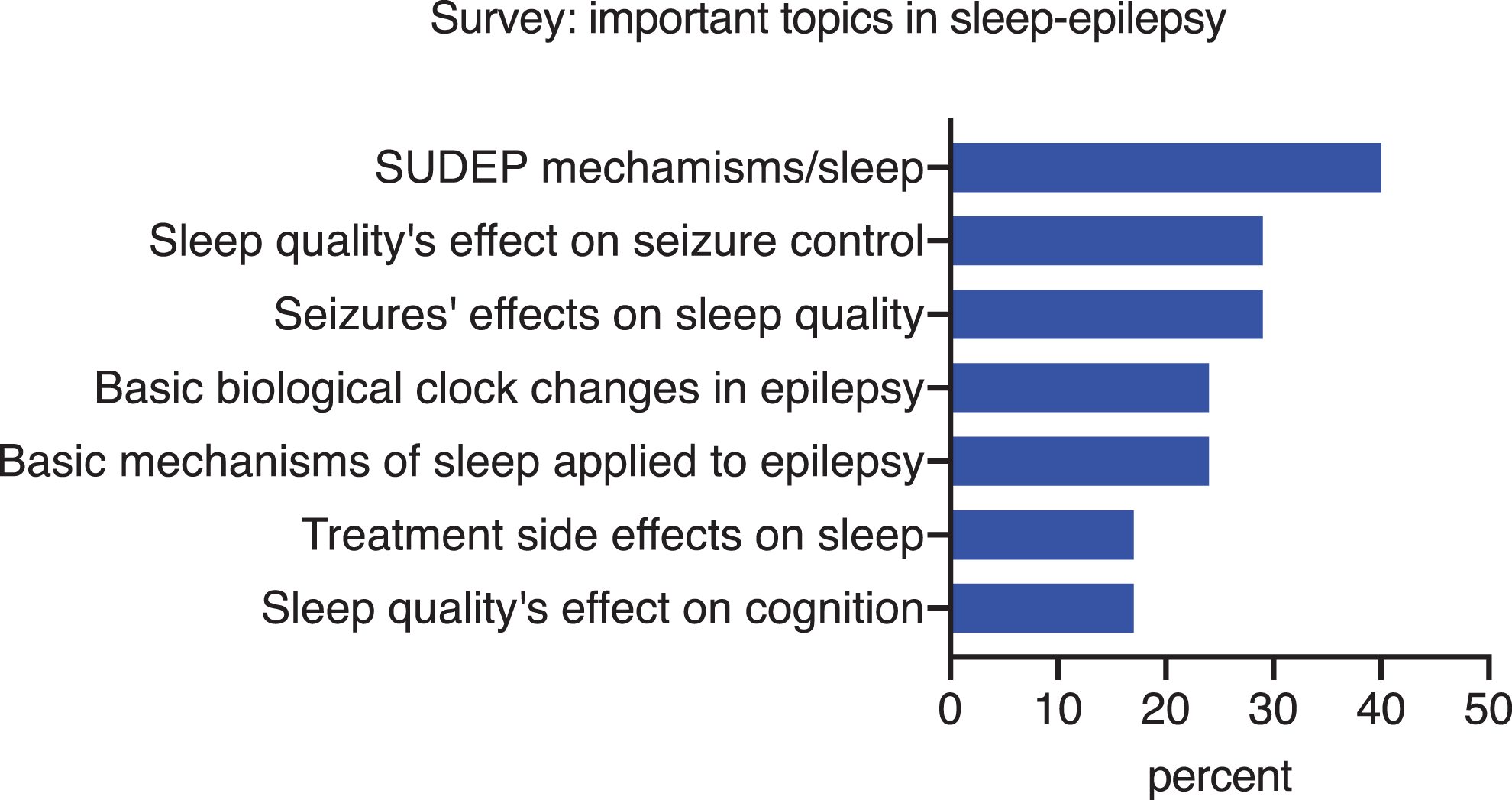
Results of expert panel survey on the “the most two important questions in interactions of sleep, circadian rhythms, and epilepsy.”
Furthermore, the panel indicated that interactions between sleep, biological timing, and epilepsy have 3 major questions of clinical relevance summarized below. These areas of potential major impact on patients with epilepsy formed the bulk of the discussion and will be featured in these series of proceedings. In short, the draft benchmarks of future research are summarized below: Can improvements in sleep or more consistent alignment with circadian rhythms decrease seizure frequency? Can improvements in sleep directly improve the lives of patients and their caregivers by addressing important comorbidities of epilepsy? Can the mechanisms inherent in sleep be leveraged to decrease mortality in epilepsy, particularly SUDEP? In addition to these areas, the participants noted that education about sleep was lacking in among patients, their families, and physicians, and that focus on education was an extremely important “low hanging fruit” to harvest to patients’ advantages.
The proceedings, detailed in our series of articles, will focus on each of these areas of clinical relevance.
Decreasing Seizures
The first topics reviewed the timing of seizures with respect to sleep and circadian rhythms, outlined possible mediators of sleep’s potentiating effect on seizures, and the alterations of homeostatic systems in epilepsy. Technologies of measuring sleep, rhythms, and seizures were discussed. Presenters included Carl Bazil, Melanie Boly, Erik St. Louis, Judy Lui, Louis Ptacek, Bruce Gluckman, and Jay Pathamanathan.
Comorbidities of Sleep and Epilepsy
The purpose of this section was to review current advances in the field of sleep and circadian disorders in relation to cerebral health and identify how treatment of these disorders can help patients with epilepsy. Milena Pavlova and Phyllis Zee provided an overview of circadian rhythm function and circadian rhythm sleep disorders. Subsequently, we had a review of the impact of sleep and circadian disorders on metabolism by Gail Adler, and subsequent to that, Rebecca Allen reviewed the effect of sleep disorders on neuropsychiatric disease. Sanjeev Kothare reviewed the effect of sleep loss on the developing brain.
Improving Mortality in Epilepsy
The purpose of this portion of the workshop was to review associations between SUDEP and sleep, to identify gaps in knowledge, and determine pathways forward for research and prevention. We first heard from Rama Maganti, MD, about clinical perspectives. We then heard from Kristina Simeone, PhD, Franck Kalume, PhD, and Bruce Gluckman, PhD, regarding basic science perspectives, and finally we heard about lessons from the National Institutes of Health sponsored Center for SUDEP Research from Jeff Noebels, MD, PhD, and Sam Lhatoo, MD.
Education
In addition to these areas of focus, the participants noted that education about sleep was lacking among patients, their families, and physicians, and that focus on education was an extremely important “low hanging fruit” to harvest to the advantage of patients and their families. Articles of this series will address whether improvements in sleep can promote seizure reduction, outline sleep-epilepsy comorbidities, and associations between sleep and SUDEP.
Future Plans
During the meeting debriefing, panelists were asked about steps forward. An important conclusion reached was that a more permanent organization would facilitate the gathering of the “critical mass” of the various disciplines required to evaluate these interrelated—but professionally separated—aspects of neurobiology. In the winter of 2020, the American Epilepsy Society approved the formation of the SEW. Accordingly, this taskforce within the aegis of the AES is dedicated to bringing together the diverse, multidisciplinary group of specialists in sleep, epilepsy, circadian rhythms, and patient advocates, who will aim to address the important interactions among these systems to evaluate basic pathophysiology of epilepsy and improve treatment outcomes.
Footnotes
Declaration of Conflicting Interests
The author(s) declared no potential conflicts of interest with respect to the research, authorship, and/or publication of this article.
Funding
The author(s) disclosed receipt of the following financial support for the research, authorship, and/or publication of this article: The Sleep and Epilepsy Workshop was supported in part by a grant from the BAND Foundation.