




Abstract
Participatory planning has faced challenges engaging predominantly Spanish-speaking immigrants beyond the bottom rungs of Arnstein’s ladder of citizen participation. Participating at any level of the ladder requires individual civic skills, or capacities, that are integral to participatory processes. However, the specific skills necessary for collective action are less certain, due in part to a lack of clear definitions and a lack of clarity about how these capacities work in practice. Drawing on two years of data from a participatory budgeting process in an immigrant community in Chicago, Illinois, the authors identify key civic capacities that Spanish-speaking immigrants activated while engaging in civic discourse, and they explore the role these capacities played in moving ideas toward collective decision making. The authors present an organizational schema that aligns the study’s findings of 17 unique civic capacities with capacities identified in the literature as helping participants engage more meaningfully in decision-making processes.
Identifying and characterizing individual civic skills, or capacities, necessary for collective decision making is important for advancing community-building strategies that support democratic participation, particularly in diverse neighborhoods (DeSipio 2006; Ebert and Okamoto 2013; Morenoff, Sampson, and Raudenbush 2001). Community-based civic groups often complain about the lack of engagement of immigrants and English-language learners in diverse neighborhoods without examining these groups’ norms around engaging in civic practices or the skills diverse residents need to participate in more meaningful ways (Hoekstra and Gerteis 2019). Such an examination of civic practices must include an expanded notion of what constitutes civic engagement, given that the ways immigrants engage in the civic sphere may not be readily evident in normative participatory processes (Bloemraad 2018; Han 2016; Karner et al. 2019).
Moreover, studies on civic participation have failed to differentiate between civic capacities at the individual level and those activated as a community resource for collective efficacy (Sampson, Morenoff, and Earls 1999). As a first step toward understanding this distinction, this study identified and defined individual civic capacities activated by predominantly Spanish-speaking Latino immigrant residents engaged in a participatory budgeting (PB) process in a diverse neighborhood in Chicago, Illinois. Generally, PB processes aim to include members of the public in some type of decision making regarding the allocations of public funds in their neighborhoods. Using an ethnographic approach and employing data from videotaped PB meetings, we present evidence of the role these capacities played in moving participants’ individual ideas into collective decision making. Through a discourse analysis of multiple speech events (Wortham and Reyes 2015) at community meetings, specific individual civic skills became evident. Distinctively, our analysis of transcripts revealed 17 unique civic capacities that fit the definition of civic skills we conceptualized as necessary to participate in Arnstein’s (1969) hypothetical levels of decision making. We chose Arnstein’s “ladder” as the organizing scheme because of its clear relevance to PB in fostering political engagement, with the goal of achieving “significant reform which enables [the have-nots] to share in the benefits of the affluent society” (Arnstein 1969:216). The identified capacities aligned with Arnstein’s eight rungs, allowing for specificity in recognizing those complex skills that have the potential to lead to transformational outcomes for communities (e.g., Brady, Verba, and Schlozman 1995; Kirlin 2005) and collective decision making. To explore the role of these individual civic skills in fostering community action, we highlight five civic capacities from our findings, providing examples of their activation and interplay as Latino immigrant participants engaged others in collective decision making.
Finally, we argue that the activation of such civic capacities is impacted by context and by the engagement of participants who have prior experience in the civic sphere. These capacities are engaged by participants in a complex interplay that can foster Arnstein’s (1969) more expansive forms of public participation such as partnership, delegated power, and citizen control, as evidenced through Latino immigrants’ claims-making abilities (Abrego 2011; Karner et al. 2019; Meléndez 2020). Our analysis also suggests that creating safe spaces for residents from underserved communities to express their needs, “including their feelings of injustice and oppression” (Forester 1998:221), help them build social relations and gain a sense of belonging that can impact engagement (Bloemraad 2018).
PB as Engagement Practice
PB began in Brazil in 1989 as an initiative of the Partido dos Trabalhadores (PT). This democratic innovation expanded democratic participation through a process that gave the public a more direct say in how to spend public funds in their communities (Cabannes 2004). In the Porto Alegre design of PB, one of the goals was to engage underserved and underrepresented community members as decision-making authorities in resource allocation within their neighborhoods (Avritzer 2006; Cabannes 2004; Fung 2015). As PB began spreading to the Global North in the late 1990s and early 2000s, however, it lost the equity aspect of both its implementation and outcomes, emerging as another participatory process for increasing public engagement writ large and enhancing the legitimacy of decision-making processes (Fung 2015; Ganuza and Baiocchi 2012).
With the global expansion of PB, questions arose about which aspects of the process “travel” from place to place. Ganuza and Baiocchi (2012) argued that the aspect of PB that is most transferrable is “an attractive and politically malleable . . . set of procedures for the democratization of demand-making” (p. 1). Indeed, as Baiocchi and Lerner (2007) wrote two years before, the first PB process in the United States was implemented in Chicago, all PB processes share a “common foundation and sequence: a deliberative process (that includes diagnosis, discussion, and decision-making), execution, and monitoring” (p. 9). Historically, PB spread in two distinct phases. The first occurred between the late 1980s and late 1990s as a direct democracy initiative to push for administrative reforms and to tackle structural inequity. The second phase, beginning in the 2000s, moved away from the direct democracy design to position PB as a political tool for gaining support for policies, decisions, or governance in general (Ganuza and Baiocchi 2012; Meléndez 2020), with “social justice . . . espoused as a key goal, but . . . not institutionalized” (Meléndez 2018:96).
In 2009, during this second phase, a Chicago alderman—seeking a political turnaround—decided to implement PB in his ward, the 49th, which comprises the Rogers Park neighborhood in the northernmost part of the city. A Leadership Committee was formed, which developed a five-step process and timetable culminating in a ward-wide vote on infrastructure projects totaling one million dollars. 1 To obtain funding for their projects, resident participants were expected to learn the norms and rules of the PB process. As emphasized in the Participatory Budgeting Chicago Rulebook (Great Cities Institute 2012), participants should propose project ideas; encourage others to participate; discuss and prioritize ideas; and prepare proposals and presentations, among other roles and responsibilities.
The 49th Ward reflects the changing demographics of the United States: 40 percent of residents are white, 28 percent are black, and 23 percent are Hispanic; nearly 21 percent speak Spanish at home; and 30 percent are foreign-born (Statistical Atlas 2018). The relationship between the implementation of PB and the alderman’s success—he was comfortably reelected in 2011 (NBC Chicago 2015) 2 —illustrates the potential of PB to be used as a “top-down” political tool to cultivate the public (Ganuza, Baiocchi, and Summers 2016).
Challenges of the PB49 Process
Studies of PB49 have revealed a complex picture of both the potential and limitations of PB. For example, “unlike in the PB method originally deployed in [Brazil], the 49th Ward’s process does not include a quality of life index or needs-based assessment prior to residents’ proposing ideas for improvements” (Stewart et al. 2014:202). Rather, in PB49, all resident-proposed projects that meet the funding criteria have the potential for consideration, given that the process prioritizes arguments supported by “objective” quantifiable data (Young 2010). However, the discourse used can accentuate power differentials among participants since the value of decision making is largely determined by the arguments and evidence provided by participants. Those who are adept at using language and practices that align with dominant expectations of civic participation are often advantaged in the process (Meléndez 2020; Meléndez and Martinez-Cosio 2019; Smith 2009). This points to a clear limitation of PB49: although it took place in a relatively small geographic area, few residents actively engaged in the process, and those who did were “largely white, college-educated, middle-aged . . . homeowners” (Stewart et al. 2014:203). Not surprisingly, one of the most pressing and persistent challenges of PB49 is developing strategies to attract a more diverse range of participants who fully represent the demographics of the community (Knutson 2016; Stewart et al. 2014). During data collection for this study, the PB49 alderman and his staff took on this challenge by making a major push to increase the number of Spanish-speaking residents participating in the process.
Challenges of Defining Civic Capacities
Key for building civic engagement is identifying capacities that facilitate individuals’ engagement and determining how those abilities are actualized, particularly for non-English-language speakers (Arnstein 1969; Briggs 2008; Meléndez 2016; Meléndez 2018; Meléndez and Parker 2019; Saegert 2004). However, there is little clarity around the specific capacities needed to engage successfully in civic spaces. Using insights from political science, education, and developmental psychology, we define individual civic capacity as the individual skills that facilitate collective decision making (Brady et al. 1995; Brown and Brown 2003; Forester 1998; Gatsil 2004; Kirlin 2003, 2005; Saegert 2004; Stone 2001).
Reference to civic capacities in the literature related to urban planning and deliberative democracy has failed to differentiate between civic capacity at the individual level and community level civic capacity that holds promise for collective efficacy (Sampson et al. 1999). At the community level, Briggs (2008:13) maintained that civic capacity involves engaging different sectors of a community that are “capable of collective action . . . and choose to apply such capability” to engage in problem solving. Stone (2001) defined civic capacity as collective action focused on the reshaping of community resources through coalition building—a context in which “extraordinary problem solving can occur” (p. 615).
Adding to these definitional challenges, Saegert (2004) highlighted the conflation of community capacity, community building, civic capacity, and civic engagement, suggesting that both individual and community capacities are needed to effect change. She argued that civic capacity involves “a variety of disparate components including the formation of goals achievable through civic engagement, knowledge and skills required for civic action, relationships of both solidarity and power, and other social and economic resources needed to achieve goals” (p. 5). She also identified elements of “individual civic capacity,” including human capital, motivations, information, media access/reputation, access to resources or influence, relationships, and social position, but also included other elements that, while not skills per se, may impact one’s engagement such as participation costs and perceived incentives for civic engagement. Clearly, civic capacity “has not developed units of analysis” (Shinn 1999:114).
Meanwhile, at the individual level, Brady et al. (1995) framed civic capacity as the knowledge, skills, and dispositions necessary for engagement in the civic sphere (Kirlin 2005). Their list of individual civic skills, still relevant to today’s participatory dynamics, includes competency in English, writing letters, attending meetings, participating in decision making, planning or chairing meetings, and delivering speeches or presentations (Brady et al. 1995). These skills also require additional resources, including civic knowledge (e.g., of American government), participatory skills (e.g., speaking and responding appropriately to questions and debates), and civic dispositions (e.g., respect for the law and attentiveness to politics; Patrick 2003; Westheimer and Kahne 2004).
Kirlin’s (2003) literature review of essential civic skills offered us a solid starting point for identifying the role of these skills in collective decision making and action. She grouped her extensive list into four broad categories—communicating, organizing, collective decision making, and critical thinking/cognitive skills—and then synthesized them into civic skills for collective action and civic skills for collective decision making. She argued that the civic skills for collective decision making are essential for a democracy and represent “the highest end of the skills acquisition sequence” (p. 310). These higher end skills include writing and speaking; understanding, explaining, and taking positions; learning to express one’s own preferences and understanding others’ preferences; and learning to compromise for the collective good. They require that individual actors understand others’ perspectives and develop “a respect for a process that considers the common or collective good to be greater than individual preferences” (Kirlin 2003:312).
We found Kirlin’s (2003) conceptual model instrumental for thinking about individual civic capacities needed for collective decision making and those needed for collective action. We then sought to clarify the definition of individual civic capacities by identifying skills across the literature and relating them to the rungs of Arnstein’s (1969) ladder which conceptualizes citizen participation as ascending from nonparticipation at the bottom rungs of the ladders, which includes manipulation and therapy; tokenism, which occupies the middle three levels of the ladder; to citizen power at the top of the ladder, which includes partnership, delegated power, and ultimately, citizen control. Our interpretation of the ladder suggested that we would only find collective decision making—and the corresponding civic capacities needed to achieve this goal—at the citizen power rung. It was difficult for us to envision collective decision making taking place at the lower rungs since, by definition, these are not meant to engage participants in decision making or cogovernance. As Arnstein attested, “Instead of genuine citizen participation, the bottom rung of the ladder signifies the distortion of participation into a public relations vehicle by powerholders” (p. 218). We argue that, of our identified civic capacities, most would be observed at the higher rungs, where both parties achieve a more balanced partnership or delegated power.
As we detail in our findings, even though individual participants in our study enacted civic capacities, collective action necessitates that these capacities distributed across individuals become organized for collective action. We saw this collective action take place as individual capacities materialized through dynamic exchanges across multiple participants around a common idea, creating the basis for the civic capacities of collaborating, strategizing, and historicizing.
With this model of individual civic capacities in place, we then turned to the literature on communicative planning to help frame the role of identified civic skills in developing a theoretically ideal democratic process. In this article, we highlight five critical skills that arose from our data and represent variables in “ideal speech situations” (Healey 1997:265): introducing ideas, providing reasons to support ideas, collaborating, strategizing, and historicizing. Communicative planning provides for the reduction of systemic distortions that lead to the exclusion of “others” by adopting a Habermasian analytical view that places ideal speech situations at the core of deliberative processes (Dryzek 1993; Healey 1997). These ideal speech situations should engage individuals’ civic capacities in collective decision making; allowing for and supporting effective communication, including understanding and taking positions, making claims while recognizing others’ preferences, and compromising for the public good. Finally, ideal speech situations must include instances of claims-making by all involved in the communicative planning ideal; otherwise, it is ideal only for a certain subset of the participants. It is in ideal coditions that “. . . emancipatory knowledge can be achieved through dialogue that enagages all those with differing interests around a task or problem” (Innes and Booher 1999:418). Given our analysis of a communicative planning process, our organizational schema of civic capacities aligns our civic capacities with collective decision making and action.
Forester (1998) argued that “transforming diverse and plural voices into concerted democratic action” (p. 17) is a challenge that can be addressed by pushing for this latter communicative planning ideal. Challenges arise when deliberative democratic processes, which typically cater to the normatizing influence of dominant communities, exclude behaviors, practices, values, and ways of speaking of nondominant communities (Meléndez 2020). Forester shared three examples of planning and environmental mediators that engage civic capacities encompassing many of the skills we identified and present in the findings section. In each of the examples, Forester observed that the mediators allowed each participant to voice their grievance and to fully share their story, including those framed by oppression, and facilitated the recognition of others’ views, while creating a safe space for democratic discourse to occur. This was central to our case study since we observed immigrant participants engaging in historicizing, a civic capacity that possesses elements of narrative and shared experiences.
While foregrounding the ideals of communicative planning theory, it is important to highlight the role of context and the spaces in which decisions are made (Hillier 1998; Martens 2013). Brooks (1996) argued that planning can create structural constraints that limit communicative action, including “codes of behavior, . . . dominant discursive frames for problem shaping [and] loyalties to specific actors in the planning arena” (p. 118). Yet, these constraints are nonstatic design elements (Meléndez 2020; Meléndez and Martinez-Cosio 2019; Bryson et al. 2013). Participatory spaces are flexible and can be designed to allow participants to move closer to the ideals of communicative planning, in which storytelling is appropriate for communicating and “emotion and passion have a place in discourse” (Forester 1998:10). Creating opportunities for these “relational conditions” allows participants to engage actively and to “recognize a shared past and implied future” (Han 2016:300; see also Cialdini and Goldstein 2004; Clark and Lemay 2010).
For low-income residents and English-language learners in communities targeted for change and possible displacement, the acquisition of civic capacities that are often the norms of deliberative democratic participatory processes is important since decisions are made through such normative practices—ostensibly in the name of community development, redevelopment, or community improvement (Arreola 2009; Newman and Wyly 2006). In a study of migrant-led membership organizations and community organizations, Fox and Bada (2009) argued that immigrants tend to organize around their identities, which often provide culturally appropriate opportunities to not only learn, practice, and develop the normative civic skills of said processes but also tap into the cultural skills, knowledge, and dispositions that support Latino immigrants’ engagement in the civic life of their communities (Brown and Brown 2003; DeSipio 2006; Tran et al. 2013). Notably, the context and design of the participatory space, one that “supports immigrant integration and public expression,” may also play a role in the acquisition and activation of individual civic capacities (Ebert and Okamoto 2013:1273).
Data Corpus and Methodology
Although the analysis is part of a larger three-year case study (Meléndez 2016) using data gathered from three PB49 committees, only data from two committees are presented in this article. Primary data were analyzed for four Traffic and Public Safety Committee (TPSC) meetings (2011–2012), two of which captured the participation of Latino immigrant community members who had joined the committee but stopped attending after the second meeting, and five of the Spanish-Language Committee 3 (SLC) meetings (2012–2013), capturing Latino participants’ engagement in a language-based committee 4 (2012–2013).
Streets and Public Safety Committee 2011–2012
The TPSC dealt specifically with public safety projects. During the 2011–2012 PB49 cycle, 15 members joined the TPSC. Including the lead author, there were seven additional Latino immigrant participants as well as two African American females, two African immigrants, and four Caucasian males, as shown in Table 1.
Traffic and Public Safety Committee.
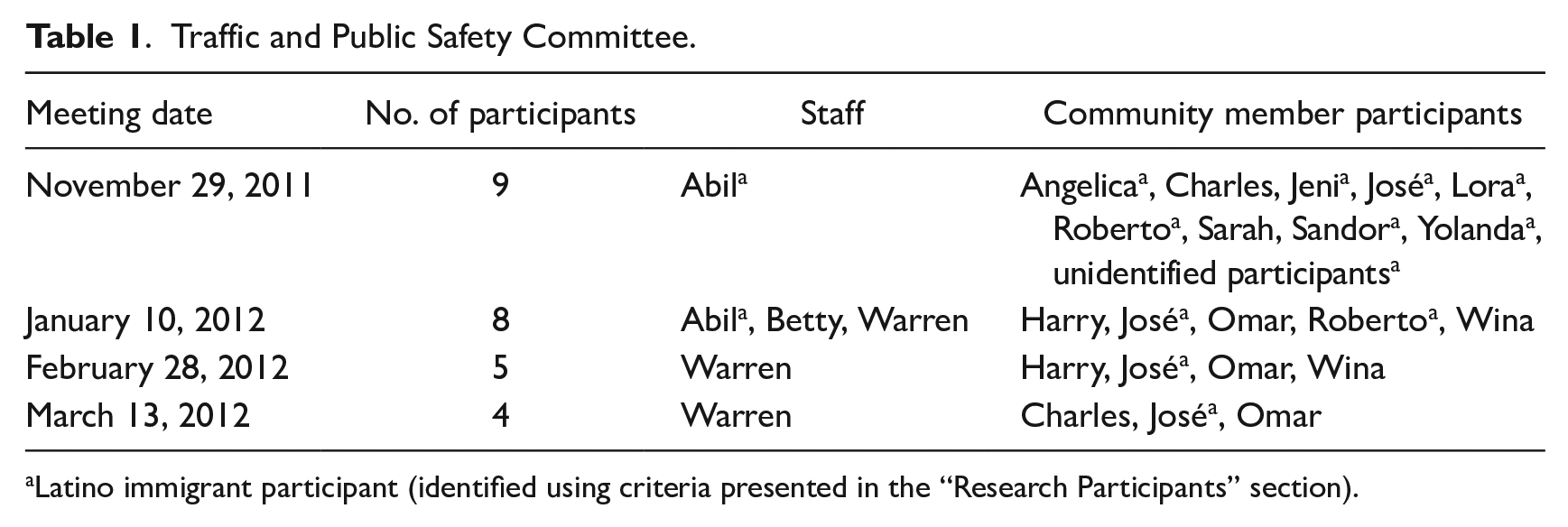
Latino immigrant participant (identified using criteria presented in the “Research Participants” section).
The committee met regularly beginning in the late November 2011 to April 2012. Each meeting was about two-hour long and was held at various locations throughout the ward.
SLC
We present data gathered from the first year of the SLC during the 2012–2013 PB49 cycle. During this first year, participants explored a variety of project ideas, which ranged from a community garden to improved safety lighting at a variety of locations. However, the committee settled eventually on two park projects, which, after being developed into proposals, were the projects the SLC placed on the ballot for that PB49 cycle. One of the park projects was elected by community residents to receive funding for implementation.
During this first year, 10 Latino participants served on the committee. Of the community participants, four were female and four were male, and one was the first author. Members of the committee (see Table 2) decided collectively to host meetings closer to the area where the majority of the ward’s Latino immigrant community reside. This differed from all other committees, which tended to hold their meetings either at the alderman’s office or at a community health facility that had meeting space. This move was an important design decision made by the SLC members for a variety of reasons, but especially since most Latino community participants walked to meetings.
Spanish-Language Committee, Data Corpus for Analysis.
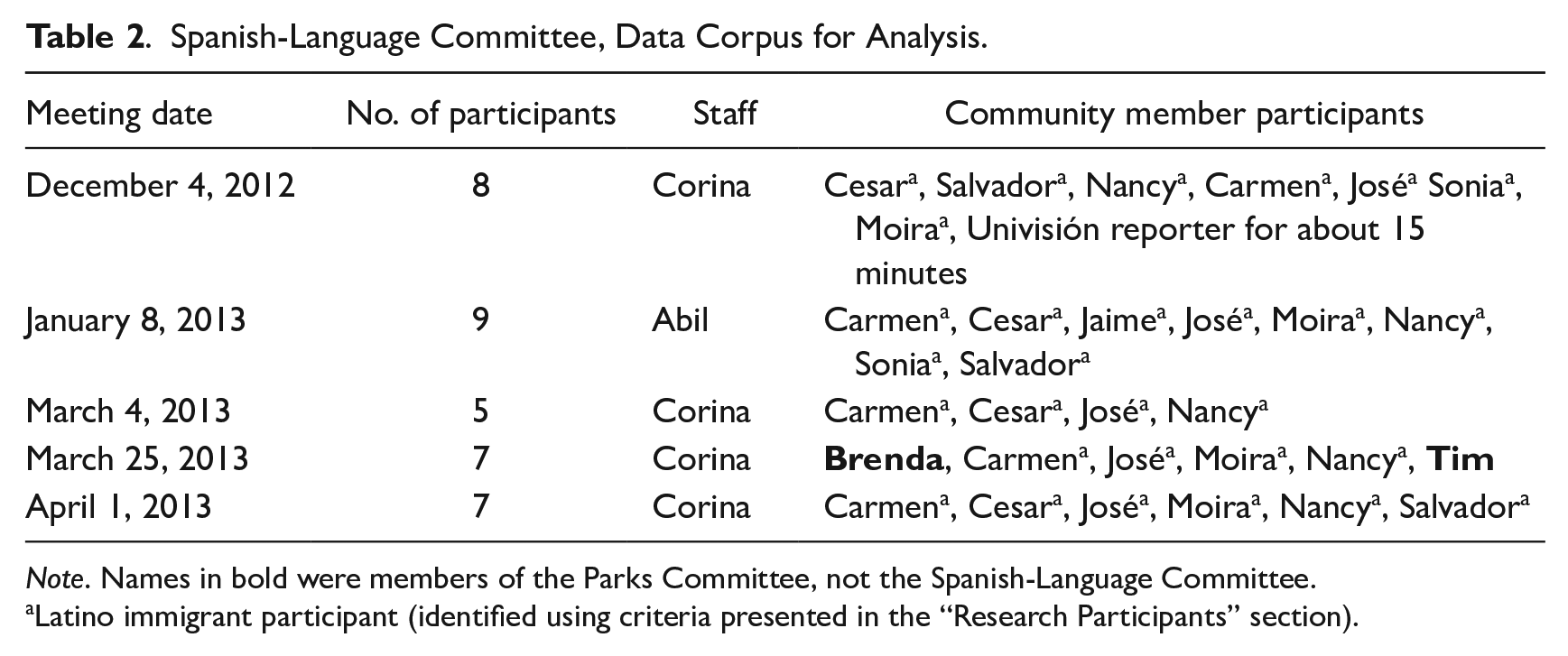
Note. Names in bold were members of the Parks Committee, not the Spanish-Language Committee.
Latino immigrant participant (identified using criteria presented in the “Research Participants” section).
Analytical Approach and Context
This study drew heavily from practice-based theory and the lead researcher’s deep involvement with the PB49 process, which was crucial for documenting and theorizing the “development, stagnation, or regression of the activities under scrutiny” (Sannino, Engeström, and Lemos 2016:3). Situating participation in PB49 as occurring in a system governed by relationships, we acknowledged the importance of the first author’s relationship within the study context. During the study, he came to be seen as a boundary crosser (Wenger 1998) among the multiple communities in the process, allowing him to build trust across participants and identities over time. Among the Latino participants, he accomplished this in the TPSC by volunteering to cochair the committee since he was the only bilingual participant. Additionally, he attended events and engaged with Latino participants in Spanish, helping to translate in the moment, volunteering for PB49 positions or activities that facilitated their involvement (e.g., delivering information through texts, making home visits, canvasing throughout the neighborhood). He also met with the alderman and his staff, strategizing about different approaches, providing information on research, challenges, and opportunities, and volunteering and taking on leadership roles to help facilitate the engagement of Latinos. Within the Leadership Committee, he took the lead on formulating the SLC and volunteered as a mentor to Latino participants. Overall, through direct participation in the activities of PB49, the first author observed the lived-in social worlds of participants in the process (e.g., Lave 1988). Arguably, his access to the PB49 process was facilitated in part by his identifying as a bicultural, bilingual immigrant participant who was also a resident and homeowner in the 49th Ward.
The first author’s positionality was only possible through his active participant-researcher approach in the study. As a result of the trust he gained over time as a bridge builder, he engaged in flexible collaboration among the various stakeholders (Meléndez et al. 2018; Radinsky et al. 2017) and constituents in an effort to refine the implementation of the PB49 process to make it more accessible to underrepresented groups, in particular, predominantly Spanish-speaking immigrants. This approach was grounded in the belief that researcher participation does not threaten a study’s validity or findings. In fact, the researcher’s boundary crossing afforded systemic clarity in the research as he aimed continuously to conceptualize his work as a bridge between theory and practice—a conceptualization strengthened by its connection to participatory action research (PAR; Collins 2011; Freire 1972) and systemic action research (Burns 2007). Such a “bridged” analytical approach allows all stakeholders affected by the phenomenon under study—residents, practitioners, politicians, researchers, and so on—to determine collaboratively how to intervene for the sake of the community.
This analytical approach and clarity grounded the aims of this study: to decipher how individual capacities were activated over time, to examine their dynamics, and to determine their role in the collective decision making of PB49. Additionally, we sought to gain further insights into the design features of the participatory spaces in which participants activated civic capacities.
The limitations resulting from the first author’s role as an active research participant were real. For example, his ability to capture observational data was impacted when he engaged in discussions, facilitated meetings, or helped Latino immigrant participants engage. However, his role also afforded certain access and trust since he gained insights into conversations and activities that he would have missed had he observed meetings from an “objective” distance. Although the findings of this study are limited in their scope and generalizability, we suggest that the results provide points of departure for greater reflection in and on action (Schön 1983) by practitioners and researchers across disciplines.
Research Participants
Study participants were selected based on the following criteria: (1) They were aged 18 years or older; (2) they had engaged in PB49 as a result of attending any of the assemblies and/or committees associated with the process; (3) they were predominantly Spanish speaking; and/or (4) they referred to themselves as Latino, Hispanic, or immigrant, or identified with a specific Latin American nationality. Participants’ racial/ethnic identity was inferred based on data gathered from their discourse and social interactions, a common practice in research on democratic processes.
Due to the nature of public meetings and the particular community studied, a brief assent script was read in English and Spanish at the beginning of each meeting where data were collected and whenever a new participant joined. With the exception of the alderman and the first author, pseudonyms are used for all participants in this study.
Methods for Capturing Individual Civic Capacities
In his examination of three ethnographic accounts of interaction in a participatory planning process, Briggs (1998) demonstrated the types of insights a sociolinguistic analysis could provide on how power and culture interact with one another. Along with Forester (1989), few other planning researchers have focused their attention on what we refer to as atypical social science methods applied in planning research. Methods reveal the role power and culture play in speech acts and social interaction in planning contexts. Some revealing exceptions include interdisciplinary research between planning and other fields (Radinsky et al. 2017; Taylor 2020), where discourse analysis has been used to examine talk over longer time scales that describes and explains change in a range of variables, that can include knowledge, behaviors, or the focus of this study: participants’ civic skills/capacities. Given how few, if any, planning activities take place in one speech event, different time scales are needed to study how participants learn the norms and practices of participatory processes, or more specifically the “interactions that occur between citizens and government officials participating in the official work of the city” (Farkas 2013:24).
This methodological gap (Forester 2015) represents an opportunity for us to expand the use of discourse analysis in planning processes from one public speech event (e.g., a meeting) to multiple speech events over time. The micro-level analysis we used to identify the civic capacities participants used during engagement is one that is still missing in much of the literature on decision making from planning, political science, and other related social science literature, which focuses more on strategies or courses of action (Karner et al. 2019; Slotterback, Schively, and Lauria 2019).
Data were collected using a video camera set up in the back of the room where committee meetings took place, with a SmartPen audio recorder serving as a backup. During meetings, the researcher took observational notes while also participating in the discussions; as such, only one camera captured data related to PB49 enactments. The video and audio recordings of the PB49 meetings were subsequently transcribed, cataloged, and then imported into NVivo for analysis (see Appendix for transcription conventions).
Adopting Wortham and Reyes’ (2015) discourse analysis method for learning over time and speech events, the transcripts from two committees were coded for general topics and the types of practices in which participants were engaged. Topics focused on interactions and discourse, within which there might be smaller but no less important subtopics (e.g., talk about safety within a larger conversation about improvements at a park). Generally, the organization and actions that occur within events contextualize participation in the moment, even when the participants are not necessarily aware of it. The initial round of coding sought to identify the various foci of participant interactions in PB49. This coding continued until no new variations of topics emerged (Charmaz 2006; Saldaña 2009). In total, over 100 topics were coded before saturation was reached.
Within the topics, we then coded for either instances of Latino participation or talk about Latino participation since we were interested in analyzing either topics that included Latino participants or situations where their participation was being discussed. The identified segments of topical talk satisfying the preceding criteria were then mapped to determine their trajectories (Wortham and Reyes 2015); this meant connecting parts of talk across various scales, including time, meetings, and cycle years of PB49 (i.e., speech events over time such as conversations on a particular park project over several months). These connections allowed us to determine the length and trajectory of the focal topics of conversation and make claims about when the civic capacities were being engaged in a given topic of conversation. With these connections made, we outlined the beginning and end of each topic for the two committees analyzed across two cycles of PB49: traffic light at an intersection and a park improvement idea.
In our view, civic capacities are skills demonstrated through participation and thus evident in participants’ speaking turns (Duranti 1997). By conceptualizing civic capacities as evident through linguistic turns, we can more clearly identify them, describe them, and theorize about their specific characteristics and utility for collective change (Vygotsky 1978).
Therefore, the two topic trajectories were subsequently coded for linguistic cues signifying civic capacities—verbs and gerunds 5 —that indicated actions within the discourse observed that included what are referred to as indexicals. Indexicals are linguistic markers that refer to different focal points across a conversation. We coded for references between events, that included time, person, or other discourse (e.g., you, I, here, yesterday, tomorrow, it, that).
In so doing, the identified civic capacities shed light on the importance of understanding participants’ shared tools for problem solving, which cannot be underestimated since this recognition impacts “everything from collaborative activities with shared goals to human-style cooperative communication” (Tomasello and Carpenter 2007:121–22). We conducted this iterative process systematically to avoid making single interpretations or missing counter-explanations, refining codes throughout the process (Wortham and Reyes 2015). The iterative and systematic approach to coding generally increases reliability of codes and interpretation of findings.
This analytical approach identified the discourse tools that were actualized during conversations and that either moved topics of conversation forward or kept them from developing. The identification of discursive tools was both inductive, using a grounded theory approach (Charmaz 2006), and framed by the reviewed literature, which included descriptions of civic capacities by political scientists and civic educators (e.g., Kirlin 2003, 2005; Verba, Schlozman, and Brady 1995). In total, four rounds of coding and analysis were performed on the transcripts—for topics discussed, topics related to the research focus, verbs and gerunds signifying civic capacities, and discursive indexicals that contextualized the emerging civic capacities.
Findings: Identifying Civic Capacities
Table 3 presents the findings of our analysis of conversations within the PB49 process which produced 17 unique capacities that fit the definition of civic skills. We argue that these civic capacities are necessary for participating at the higher rungs of Arnstein’s (1969) ladder, and that they comprise “civic skills for decision-making” (Kirlin 2005:308), which are more complex and focused on collective decision making.
Findings: Civic Capacities for Effective Public Participation in PB49.
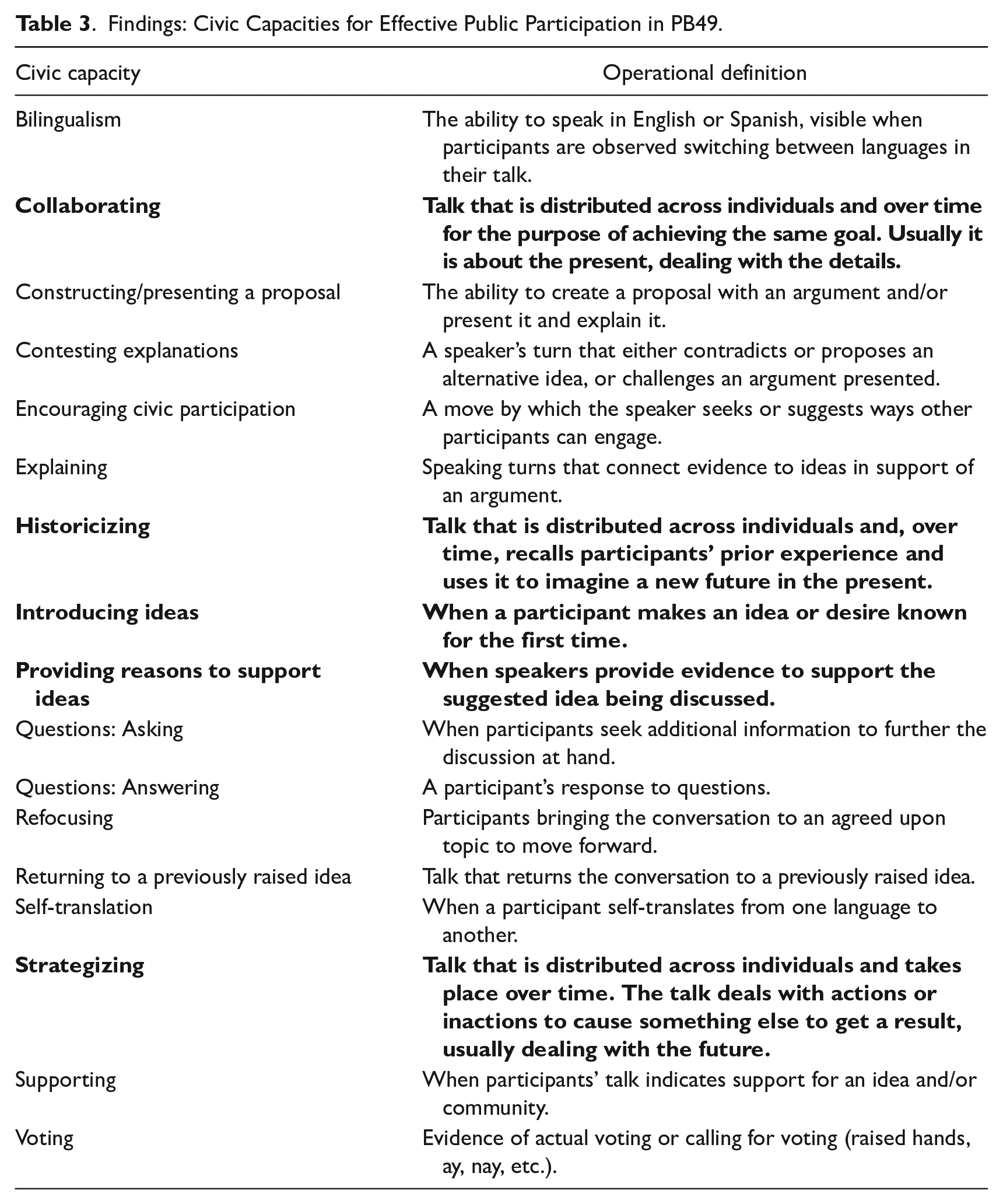
In the following section, we highlight five civic capacities 6 bolded in Table 3 that proved instrumental to generating civic action. Although most of these civic capacities appeared multiple times across the two conversation topics (regarding the need for a traffic light and improvements to a park), three of them—collaborating, strategizing, and historicizing—were only present in the second topic. These later three civic capacities were distributed across individuals in the social interactions that supported a joint purpose (Hutchins 1991).
Introducing Ideas and Providing Reasons to Support Ideas
Introducing ideas was evident when participants verbalized an idea, inviting others to engage. The act of verbalizing an idea for others to consider through deliberation is a basic norm of the PB49 process and ideal democratic processes. We therefore frame this civic capacity as the most basic.
The manner in which participants proposed an idea could take on more than one form, the first of which is evident in the following excerpt: My name is Sandor. {I live in district 50 not 49 ~} I am interested . . . to the traffic lights. It is the most important part for me. And the other one is for the traffic lights at schools. Some other people think . . . {~} It is very dangerous, very important.
Sandor was the first to introduce the idea of the traffic light at the TPSC orientation (the first identified subtopic of discussion). At the end of his speaking turn, he provided reasons supporting his suggestion, related namely to safety. The ability to provide reasons in support of ideas can potentially strengthen one’s ideas, especially if the reasons align with the norms of the process in which participants are engaged. 7
In our analysis of the TPSC meetings, we noticed that all the coded speaking turns by Latino immigrant participants followed a similar pattern: idea + evidence. We also observed that all Latino immigrant participants used an additional civic capacity—returning to a previously raised idea—to reiterate the importance of a particular idea. Additionally, two Latino immigrant participants, Roberto and Sandor, were bilingual, which we coded as a civic capacity, given that competency in English has been described as a key civic skill (Verba et al. 1995).
A second variation of introducing an idea involved providing a line of reasoning (explaining) that eventually led to the verbalization of an idea, elicited support, and subsequently provided evidence. We saw this variation in the SLC meeting at which Cesar, in a series of speaking turns, argued that Latinos were being excluded from the decision-making process:
Thus, I saw it as: one the Latino newspaper and then the other one, the American. And since the reporters where there, possible about three with their laptops and honestly I don’t think I saw at this meeting—at this park where I would say those that live here—let’s say about 55% or 60% of the people who use that park are Latinos, what I noticed at that meeting was how the rest were making decisions without including us—nor include the complaints that we had.
In the preceding turn, Cesar lines up the evidence supporting his conclusion that decisions about park improvements were being made without the input of Latino immigrants. Carmen followed up by introducing the idea of the park as their concern, a topic she returned to later in the meeting:
In Touhy Park. Yes, that is {~} our concern/
I think that {there} in Touhy Park—again, returning to Touhy Park
Once the idea of the park was put forward as their concern, other participants agreed (supported) and followed up by introducing multiple ideas to improve the park, accompanied by evidence. For example, Moira suggested the following:
I think also that there is a need for much more lighting at that park. At night it is too dark and that {it is a long, how do you say long section} for me to cross, it is quite dark there.
Here, the specificity of Moira’s ideas aligns with the initial idea introduced but also builds on it by providing additional evidence that may elicit support from others. It is important to note the distinction between providing evidence in support of an idea, which names a list of items (objective and subjective) related to an idea, and explaining, which seeks to create a rationale linking the idea and the evidence. In Moira’s turn, we can identify the objective items or data (e.g., “it is too dark,” “it is a long section to cross in the dark”) that begin to form the basis of a project proposal. Besides the additional lighting, Latino immigrant participants at this meeting also introduced other ideas for improving the community park, including adding water features and community gardens. Notice in the above framing of the second variation (explaining + introducing an idea + supported + providing evidence in support of an idea), as different individuals enact civic capacities, they are, in fact, collaborating on the development of a shared idea.
Collaborating
We identified collaborating with other participants as a civic capacity for achieving collective decision making. Collaborating occurs when people engage with one another in a joint endeavor. Our data revealed that this capacity usually related to focusing jointly on transforming present conditions. Collaboration, by nature, is distributed; thus, we could not limit our analysis to simply searching for linguistic cues in one individual’s speaking turns. Instead, our analysis focused on multiple turns, across multiple participants, gerunds, and verbs (indicating potential action needed to change the present). For example, over a period of two-and-a-half minutes during a meeting, Cesar introduced the idea of planting cherry blossom trees in the community park. Once this idea was introduced, multiple participants engaged jointly in exploring what this might mean for the park:
Another is to possibly place
(Nods in agreement) Right now it does look like that.
Right now, yes.
But the
To relax/
/Everyone can go.
No, I know (Laughter). But the
But in reality, in the summer I have seen it, without offending anyone because we are members of the community, right. It seems to me like a
/Wasteland (giggles)/
/Forgotten, neglected, and really like ((makes gesture to mean don’t care and to throw)) have it there. Things should be to makes one feel proud to be human and to say that, I feel proud to live in Rogers Park. How pretty, how beautiful. Personally, I think the gang members would be thrown off to know
In these preceding speaking turns, one can follow Cesar, Carmen, Corina, and, by reference, Natalia engaging jointly with an idea as it evolves through several phases in which participants’ collaboration centers on changing the present condition of the park. The phases in these latter turns included the following: (1) the park’s current condition (abandoned), which quickly transitioned to (2) what the park could become with the planting of the cherry blossom trees (peaceful), returning to (3) the type of activity currently taking place at the park (loitering), to (4) what the park could support in the future (relaxation), returning to (5) its current condition (neglected), and finally to (6) what it could become (a place of pride). These six phases involved a variety of civic capacities, including providing evidence in support of the idea, explaining, and supporting someone else’s ideas—all activated within the collaborative turns, suggesting that collective decision making, as represented through collaboration, requires joint activation of various civic capacities across several individuals.
Strategizing
The civic capacity of strategizing focuses on devising a course of action (or inaction) and is signaled by the formation of a plan to achieve a goal. In our study, linguistic cues for identifying strategizing included present and/or future action verbs, with the actions distributed across multiple individuals’ speaking turns. One example of strategizing took place near the end of a spring meeting in which participants spent two hours engaging with multiple ideas they had introduced. The following exchange not only provides evidence of strategizing and other civic capacities but also reveals other dynamics that may have influenced collective decision making. Note in the speaking turns that four individuals are involved. Additionally, two (José and Corina) verbalized points that support the other individuals’ organizing around how to accomplish the action items needed for the project idea to be finalized. As such, the actions required coordination between the various individuals and were time sensitive (deadlines). Only when the actions were met by those involved could they move on to the next deadline and set of steps. It might be obvious to state, but in the exchange everything is future orientated, which distinguishes strategizing from collaborating (when the focus is on actions in the present).
Then, for, I know
And
You meet with him. Well, I know that you are very busy. (Referring to Carmen). But if you want to go with me,
With the stuff for Langdon park? Oh.
So, you can let me know
And you will notice that, in
In three weeks {what’s the date}?
It’s the 25th of March, Monday, 25th of March.
Supposedly, for the 29th of March, yes for the 20th of March I have to have the PowerPoint.
And well, what I was thinking is that if
And
These turns between four individuals articulate steps needed to meet a series of goals and deadlines (i.e., the decision about what projects to advance by March 25 and about gathering details for a PowerPoint presentation by April 1). To meet the first goal, two steps were articulated using future-oriented action verbs; the actions included meeting with park supervisors (for two distinct parks), submitting information to the city agency, and obtaining price quotes for the proposed projects. If the first deadline was met, the members of the SLC would need to meet to decide which projects to propose, including filling out the PB49 paperwork required for committee decisions. If the group achieved these goals, the committee was more likely to achieve the second articulated goal.
The turns indicate that strategizing and collaborating comprised group activities distributed across participants as they moved toward collective decision making. Participants activated additional civic capacities across these strategizing turns, including encouraging civic participation (José to Cesar and Nancy, and José to Carmen); introducing new ideas (extra meetings and deadlines); returning to a previously raised idea (PowerPoint deadline and the Latino population); and explaining, as suggested by the use of the conjunction “then” in support of an additional meeting.
Though we discuss this dynamic later in the article, it is important to note that José and Corina were returning participants and were familiar with the steps needed to advance projects and with the civic capacities needed to achieve collective decision making.
Historicizing
The civic capacity of historicizing helps organize participants around a common experience that has the potential to facilitate collective decision making. This skill centers on using “resources and understandings of the past into the future” which support new forms of collective learning and action (Gutiérrez and Jurow 2016:7). Historicizing occurs when participants recall prior experiences and use that recollection to imagine a new future in the present. In the example of Latino immigrants collaborating around ideas to improve a community park, our analysis suggests that the impetus for collective action began when Cesar initiated a collective recollection of how participants felt when they attended a park planning meeting:
So then, I say—but who made that decision in the first place? I don’t think it was a Latino.
{~} Without
They are not
I think that
{No} I saw that—what I felt more was how the rest of them kept turning around to look at
In the preceding historicizing of the event, participants used collective past-tense pronouns (e.g., “tomarnos/no nos estand tomando” {us}) recalling a common memory. This suggests that historicizing has collective organizing qualities similar to collaborating and strategizing. As described earlier in the explanation of the second variation of introducing an idea, other civic capacities by Cesar and Carmen were also activated in this sequence of turns as they raised the issue of the apparent exclusion of Spanish-speaking immigrants in the decision-making process. Notably, historicizing included narrative elements through which speakers’ reasoning was revealed; as such, identifying this civic capacity may represent a step toward identifying nondominant civic capacities in practice.
At the end of the preceding historicizing turns, when Carmen claimed the community park as “nuestro problema” (“our problem”), the park became an organizing focus of the SLC. Not only did Carmen’s claims-making statement introduce the idea of the park as the Latino participants’ concern, but it also moved the Latino participants’ civic interaction to a more agentic form of engagement that was not evident in the TPSC.
Connecting Civic Capacities and Their Role in Collective Decision Making
As shown in the data collected from in situ participation, PB49 provided an opportunity to observe, identify, and more clearly define the enactment of civic capacities as individual skills that moved ideas toward collective decision making. One goal of PB is to open spaces for participation by creating fields of deliberation in which “people become more like citizens and the government becomes the people” (Holdo 2016:390). Yet, to achieve the goals of PB in the 49th Ward, participants needed particular skills to fully engage—the interplay of which provided an ideal “laboratory” for understanding the activation of civic capacities among a group of Latino immigrant residents.
We developed an organizational schema to determine whether relationships existed between the civic skills that were present in our dataset, and those that were identified from a cross-disciplinary review of the political science, public policy, and planning literature we cited earlier. We grouped Arnstein’s (1969) rungs in her ladder of participation as an organizing typology, using her definitions to focus on those rungs that “correspond to the extent of citizens’ power in determining the plan and/or program” (p. 126). Table 4, Organizational Schema of Civic Capacities across the Literature and Findings, presents this approach from theoretical to practical within the context of immigrant participation, thus categorizing the civic capacities that, we argue, are essential for effective participation in the public sphere.
Organizational Schema of Civic Capacities across the Literature and Findings.
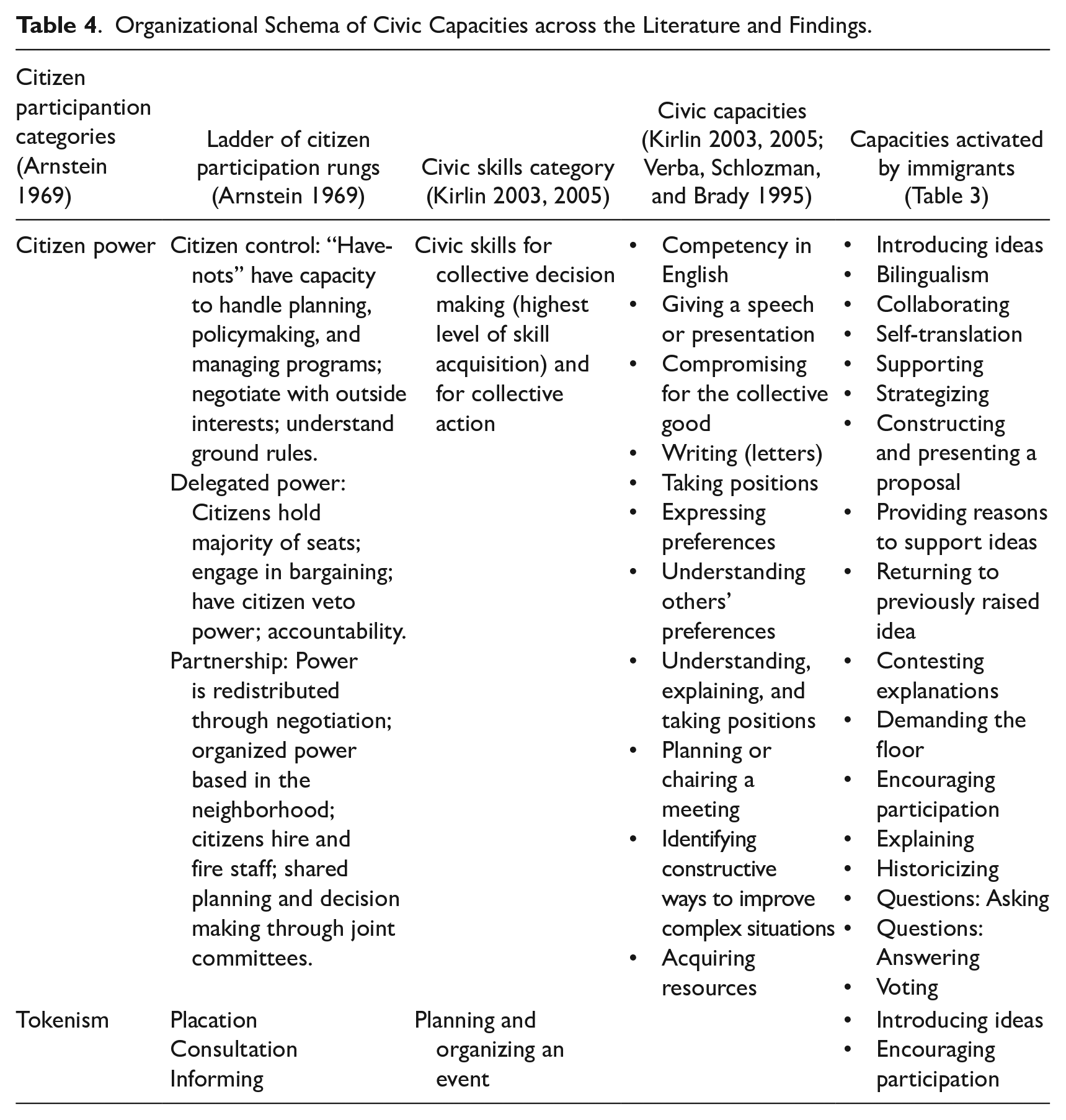
Given that the rungs relate to the type of decision making that the public is invited into, they suggest the skills participants need to achieve specific levels of participation. These align with what the alderman reiterated as the goals of PB49 during assemblies, “Residents in our community are {proactive}, they are engaged, . . . they demand to have a voice in the decisions . . . made that affect their lives.” Our organizational schema seeks to operationalize the civic capacities required that Kirlin (2003) described as more complex and that are aligned with the top rungs of Arnstein’s ladder. We argue that making visible the capacities activated by immigrants allows us to engage with the existing literature to better discern the specific actions required for meaningful access and potential for impact in the civic sphere (Bloemraad 2018).
The following is an example of the ways that the schema provided can support thinking about civic capacities: moving from left to right of Table 4, we make the case that to negotiate with outside interests, which is at the citizen power rung (Arnstein 1969), individuals are engaging in a form of collective decision making which requires the skills to understand others’ perspectives and to explain their positions (Kirlin 2003, 2005; Verba et al. 1995). These skills were operationalized by immigrant participants through specific civic capacities we observed: collaborate, strategize, and contest explanations. In the above example, we use the schema to move from the general to the specific, thus providing a tool that practitioners and others can use when asking questions about the kinds of civic engagement skills they would like to see across different types of decision-making practices. The schema could also be used in the reverse order, from the particular to the general—where practitioners can identify specific civic capacities as evident in meetings engaging Spanish-speaking immigrants, and determine strategies for supporting this emerging engagement. Using this tool to align intent with practice could inform design decisions moving forward (Meléndez 2020; Meléndez and Martinez-Cosio 2019; Meléndez and Parker 2019).
The organizational schema places our 17 civic capacities in conversation with those in the literature and aligns them with collective decision making envisioned in Arntein’s rungs (1969). First, several civic capacities—namely collaborating, strategizing, and historicizing—were critical in moving ideas forward and were activated by a variety of participants over time. These more complex capacities were employed within various turns, suggesting that collective decision making in PB49 required the construction of ideas over time, engaged new and returning participants in their native language, and reflected those skills identified in the literature as occupying the top rungs of the ladder. Additionally, although we identified the participant who introduced a particular idea or who asked a follow-up question, we would be hard-pressed to assign single ownership to the back-and-forth that was evident in the activation of these complex civic capacities and that resulted in concrete collective actions (e.g., presenting proposals). Han (2016) highlighted the importance of examining participation as dynamic social interaction as well as the role of organizational contexts that provide opportunities for social relationships to develop.
We were careful not to reduce the role of particular civic capacities to a cause-and-effect paradigm since we cannot claim that any of our civic capacities led directly to a particular outcome or action. Yet, we do maintain that there was a difference in participation by Latino immigrants between the first cycle of the data analyzed in the TPSC and the second cycle in the SLC, and that the presence of more complex civic capacities among Latino participants in the second cycle yielded different outcomes. To us, this serves as a caution against equating any list of civic capacities with best practices; rather, it should be treated as a holistic rubric that researchers and practitioners can use to observe and reflect on whether a variety of civic capacities are being activated in specific types of participatory spaces.
Our research also suggested that the role of returning participants is important in the activation of civic capacities for collective decision making. The roles played by José and Corina during the staretgizing exchange presented were illustrative of returning participants who had more specialized knowledge regarding, for instance, how the PB process works. Returning participants, at least in the PB49 process, provide the technical support Arnstein (1969) argued as necessary for deepening forms of civic engagement within citizen control.
Unlike in the SLC, we did not observe an organization of civic capacities by the Latino participants in the TPSC that could be characterized as collaborating, strategizing, or historicizing. This may be due to a number of factors, including the design of the participatory space. Participants’ talk in this committee engaged both English and Spanish monolingual speakers, requiring the use of translation. Waiting for translation precluded multiple turns across participating Spanish speakers, and it impeded the required organization. English speakers did engage in the second variation sequence of talk described earlier of “ideas + explaining”, since they were able to have multiple turns of talk across participants that appeared to provide the organizational space for engaging more complex civic capacities. The point here is not that Latino participants were less capable of enacting the more complex civic capacities, since we see clear evidence of activation in the SLC, but that the participatory spaces did not support the ideal speech situation for Latino participants to develop these skills.
Yet, the SLC did act as a space where Latino immigrant participants engaged in collective decision making and where they could bring “painful histories to the table” (Forester 1998:18). Opportunities to share common experiences and to listen to and learn from each other in their own language, without “conventional ground rules of meetings [that] can be exclusive, dismissive and humiliating” (p. 15), allowed for historicizing to occur. As we observed immigrant participants engage in historicizing in their native language, we also sought to identify other civic capacities activated within their historicizing narratives that may have been less obvious in rational or deliberate talk (Silver, Scott, and Kazepov 2010).
Examining the narratives in which historicizing occurred highlighted differences in participants’ claims-making abilities. Claims-making is tied to one’s sense of belonging and “their ability or inability to voice their concerns and demand rights” (Abrego 2011:340). Whether because of the environment created by the SLC or the activation of the more complex civic capacities, during the second cycle in the SLC we observed Carmen and other Latino participants making claims—a different discursive practice than observed in the first cycle. “For a community, individuals’ claims-making suggests an awakened sense of belonging that could be transferred to other parts of the public sphere as civic identities are reimagined” (see Meléndez 2020:22 for further explanation). Bloemraad (2018) argued that “behaving in citizen-like ways can generate feelings of personal and collective empowerment” (p. 51) that may make it easier to engage in claims-making. This distinction is important when considering Arnsteins’s (1969) rungs of participation. We can assume that in a designed participatory space aimed at engaging the public at the highest rungs of Arnstein’s ladder, participants would make claims about outcomes. We would not expect the same to be true of designed spaces where participants are engaged at the tokenistic or nonparticipation rungs of decision making. Yet, even when participants engaged at the highest citizen power rungs, we observed the critical role that the designed environment played in supporting members of the underserved community to activate their capacities.
Defining Outcomes
The outcomes of the two years of the PB49 process presented here are layered and complex, requiring us to resist the urge to place more value on outcomes of the process than on process outcomes, since each is constitutive of the other. In addition, in describing the outcomes of the process, we must also differentiate between immediate (i.e., within the time of the study) and long-term outcomes.
As a result of the challenges Latino participants faced in the TPSC, all but one of the Spanish-speaking participants decided to stop attending by the second meeting, and none attended by the third meeting. Additionally, none of the ideas initially proposed by the Latino residents were developed into projects to be voted on. The engagement of the Latino participants in the TPSC could not be sustained, despite the alderman’s major push to increase the number of Spanish-speaking attendees—efforts that included hiring two Latina staff members. This is an important observation since it aligns with findings in the literature on decision making showing that underserved communities are typically involved at the input phase, due to outreach efforts, but oftentimes are missing at the decision-making table (Smith 2009). As a result of this process outcome, other participants in the TPSC, aldermanic staff, and members of the Leadership Committee (LC), along with the first author, reflected on what went wrong. As a result, the SLC was proposed and developed as an intervention (Meléndez 2020) to move away from only outreach to redesigning aspects of the process aimed at more strategic and sustained engagement with a focus on the decision phase.
The design of the SLC supported Latino participants’ use of more complex civic capacities, even engaging their claims-making abilities. These capacities related to their ability to focus on projects of their own choosing (just like any other committee) and to develop two projects to appear on the ballot for a community vote. The Latino participants prioritized projects, conducted site visits, and met with city agency officials. They used their social identity to engage in mobilization and empowerment, gaining recognition as “as . . . legitimate claimant[s]” (Bloemraad 2018:6). As a result of these process outcomes, one of the two park projects on the ballot was chosen by the community for funding and implementation. Additionally, as a result of their sustained engagement through an entire PB49 budget cycle, two members of the SLC became eligible for and joined the LC. This was the first time in what was then four cycles of PB49 that predominantly Spanish-speaking participants had been eligible for LC membership. Subsequently, the SLC became a design norm of PB49, sustaining the engagement of Latino participants and ensuring that Latinos are represented on the LC. Additionally, the SLC was seen as a jumping-off point for the creation of a Youth Committee, one year after the data for this study were collected. Finally, given the impact that the SLC’s differentiated opportunity to participate had on Latino participants, PB49 materials were translated into other languages spoken by community residents.
Investigating Design Decisions that Support Differentiated Participation
Considering the importance of arriving at a refined unit of analysis, pushing analytical approaches to capture and analyze the complexity of participation in the public sphere is instrumental to achieving more equity-orientated decision-making processes. A variety of stakeholders can use this additional knowledge to reflect on how their designed processes support the engagement of predominantly Spanish-speaking residents, as well as others from underserved populations (Bryson et al. 2013; Fung 2003). Analysis of the PB49 process suggests that the activation of individual civic capacities may be influenced by the type of participatory space created, but the specific factors that impact this design require careful long-term observation that we invite further research on.
In an effort to bridge Verba et al.’s (1995) work with Arnstein’s (1969), we invite civic capacity researchers and practitioners to continue operationalizing skills evident in their interactions with residents from underserved communities, and to examine their alignment with the eight rungs of Arnstein’s ladder. By refining their observational skills, planners, educators, and researchers can develop a deeper understanding of the complexity of civic skills, knowledge, and dispositions needed to include traditionally underrepresented groups in democratic practices. Our analysis did not code for knowledge and dispostions. Further research around defining dispositions within the context of diverse participants would help identify their emergence in processes like PB and how they may change over time, providing insights into the lasting changes experienced by participants.
Researchers have demonstrated that increasing the diversity of participants also increases the difficulty of establishing deliberative spaces (Baiocchi and Lerner 2007). We argue that linguistic diversity, beyond just ethnicity and class, adds another layer of complexity that could interfere with learning the “unspoken rules of these social contexts” (Baiocchi 2003:59), that is, the norms for participating. This challenge is heightened for non-English speakers as they engage in participatory processes, since prior experience with normative civic practices in the United States may not be as readily accessible, particularly for new immigrants (Avritzer 2006). Hence, the importance of encouraging more experienced participants to work alongside new individuals over time is an effective way for practitioners to structure participatory processes. This combination of new and returning participants may afford new individuals more time to learn the specific civic engagement practices of democratic activity and opportunities to be mentored in the activation of these skills. As this case study suggests, linguistic diversity does not have to be an impediment to innovative strategies for engaging underrepresented communities in decision-making practices.
Conclusion
Arnstein’s (1969) ladder of civic participation provided an ideal type, which, at its core, is about power sharing. As Bloemraad (2018) argued, “The implicit mechanism by which citizenship has value is through the power of access” (p. 9). Yet, we first must identify the civic capacities that allow for the creation of corresponding rights to access the civic sphere. Given how Arnstein’s levels direct our attention to think about what civic skills are needed by individuals to engage at the higher rungs, we provide an initial organizational schema that aligns the study’s findings of 17 unique civic capacities with those identified in the literature as helping participants engage more meaningfully in collective decision making and action. We present our schema as a heuristic that can be used to support practitioners and others as they reflect on their own designed decision-making processes, and assist in the identification of civic engagement tools used by underrepresented participants. In light of the role that civic capacities play in both process outcomes and outcomes of the process, we encourage others—using similar atypical planning methods—to contribute to our schema by continuing to refine the unit of analysis of civic capacities.
