



Abstract
Nanotechnology is predicted to be a transformative technology and lead to improvements in many aspects of human life. Accumulating scientific evidence from experimental animal studies indicates that exposure to some engineered nanomaterials may cause adverse health effects. Despite efforts to move away from using animals for toxicity and biological testing, the use of animals in nanomaterial testing raises the potential for harmful occupational exposure to researchers, laboratory technicians, and custodial personnel. The risks to workers from such unintentional exposures can be reduced or eliminated through identification of the hazards arising from the use nanomaterials in animals, assessment of all potential worker exposures, and implementation of effective exposure control measures. Proactive guidelines for safe handling of nanomaterials in laboratories are available from both public and private sector bodies and should be consulted regularly to ensure awareness of the newest, actionable nanomaterial risk prevention information.
Nanotechnology—the manipulation of matter at the nanometer scale (typically between 1 and 100 nanometers in at least 1 dimension) for a commercial applications—is predicted to be a transformative technology and lead to improvements in many aspects of human life. 1 The ability to engineer nanoscale structures made from elemental carbon and various metal oxides has already resulted in their use in a broad range of research and commercial applications.
In 2000, the US government formed a research and development initiative across multiple federal agencies called the National Nanotechnology Initiative (NNI). The NNI aims to foster the transfer of new nanotechnologies into commercial products to benefit the public, develop a skilled workforce, and support the responsible development of nanotechnology. 2 In 2001, concerns about potential adverse health implications resulting from occupational, environmental, and consumer exposure to nanomaterials resulted in environmental health and safety being included as an NNI focus. 3
Accumulating scientific evidence from experimental animal studies indicates that exposure to some engineered nanomaterials may cause adverse health effects. 4 The toxicity of ultrafine or nanoparticles have been shown to be greater than that of the same mass of larger particles of similar composition. 5 Studies indicate potential respiratory health risks from exposure to carbon nanotubes.6,7 Multiwalled carbon nanotubes have been shown to have asbestos-like pathogenicity. 8 Other studies have investigated possible DNA damage from nanosized metals and metal oxides.9,10
Despite efforts to move away from animal testing to alternative in vitro, ex vivo, and in silico toxicity testing methods, 11 nanotoxicology studies involve researchers using an inhalational exposure design to dose laboratory animals with various concentrations of nanomaterials. The majority of animal testing involving nanomaterials in health care involves its use for targeted drug, vaccine, or gene delivery, tissue engineering for regenerative treatments, and magnetic tumor thermotherapy. 12 These laboratory experiments using animals raise the potential for occupational exposure to nanomaterials by researchers, laboratory technicians, and custodial personnel.
Animal testing of nanomaterials to satisfy regulatory requirements of the US Food and Drug Administration 13 and the US Environmental Protection Agency 14 has also increased concerns about how best to assess and control the risks to laboratory workers from the use of nanomaterials in animal testing. On the international level, the Organization for Economic Cooperation and Development (OECD) has developed specific testing guidelines. 15 The International Organization for Standardization (ISO) has also published several standards focusing on nanomaterial toxicity testing, including those testing methods utilizing animals. 16
In a proactive effort to eliminate the potential risks of using animals in testing of nanomaterials, government agencies and private sector research and academic centers, have developed risk management guidance. Risk management guidance is meant to inform the research community about how to identify the hazards associated with nanomaterial testing experiments using animals, how best to assess specific exposures in the laboratory, and how to implement effective exposure mitigation strategies.
Risk Management Guidance
In 2008, the ISO was the first international body to publish general risk management guidance for working with nanomaterials. 17 The ISO guidance was based on occupational safety and health recommendations published by the US National Institute for Occupational Safety and Health. 18 In 2012, NIOSH developed recommended safe practices for working with engineered nanomaterials focused on research laboratories. 19
The NIOSH guidance for working with nanomaterials in research laboratories recommends that exposures to nanomaterials be controlled in such settings through a flexible and adaptive risk management program. An effective program provides a framework to (1) anticipate the emergence of nanotechnology into laboratory settings, (2) recognize the potential hazards, (3) evaluate the exposure to the nanomaterial, (4) develop controls to prevent or minimize exposure, and (5) confirm the effectiveness of those controls. 19
In 2017, the World Health Organization (WHO) published guidelines on protecting workers from the potential risks of manufactured nanomaterials based on 10 systematic reviews covering a broad range of topics relevant for risk assessment and risk management of nanomaterials including hazard characterization, exposure assessment and risk mitigation. 20 The WHO systematic reviews analyzed all published research up to 2017. The WHO reviews provide an excellent reference source for information about risks of nanomaterials including those used in animal testing laboratories. 20 All of the currently available guidance documents for the protection of laboratory workers from the risks of using nanomaterials in animal testing experiments have 3 elements in common: (1) hazard identification, (2) exposure assessment, and (3) exposure control.
Hazard Identification
The safety and health toxicity hazards presented by nanomaterials arise from their unique physico-chemical properties, such as particle size and shape, surface area, chemical composition, solubility, and surface activity. For example, inhalation toxicity of poorly soluble, low toxicity nanomaterials is proportional to the total surface area of the nanomaterial. Other toxicity mechanisms include the following: (1) release of ions into solution; (2) generation of oxidative stress by facilitating the generation of electron-hole pairs to create reactive oxygen species in the microenvironment; (3) semiconductive properties causing ejection of excited electrons to create superoxides, directly catalyzing electron transport in redox regulators; and (4) fiber-induced biological responses. 21
The WHO guidelines suggest grouping nanomaterials into 3 categories: (1) nanomaterials with specific toxicity, such as nanoscale silver; (2) nanomaterials that are fibers, such as carbon nanofibers; and (3) nanomaterials that are granular, bio-persistent particles, such as nanoscale titania. 20 As part of hazard assessment of nanomaterials, the WHO guidelines recommend assigning hazard classes to nanomaterials according to the Globally Harmonized System (GHS) of Classification and Labelling of Chemicals for use in safety data sheets. In addition, WHO recommends updating safety data sheets with nanomaterial-specific hazard information or to indicate which toxicological end-points do not have adequate testing available. The WHO further recommends using the available classification of nanomaterials provided in the WHO guidelines, and derived from the OECD toxicity testing data, for the provisional classification of nanomaterials in the same group for 2 categories of nanomaterials, the respirable fibers and granular, bio-persistent particles. 20
Finally, safety hazard identification is an important aspect of working with nanomaterials in the laboratory setting. Fire and explosion hazards of nanomaterials could be more pronounced than those for larger particles or bulk materials. This is particularly true if the larger particle of the same chemical composition are combustible dusts. 22
Exposure Assessment
The toxic effects of nanomaterials can manifest themselves after nanomaterials are absorbed by the body through 3 major exposure routes—inhalation, ingestion, and dermal or ocular contact. The most significant exposure route for workers in any setting, including laboratories, is through airborne exposure. 19 Studies in mice have shown that deposited nanomaterials can interfere with the lung’s gas exchange function through development of granulomas. 23 Recent evidence shows that workers exposed to multiwalled carbon nanotubes in a manufacturing facility can manifest changes in the biomarkers of immunological effects and in their lung health. 24
Nanomaterials can translocate to other organs in the body following inhalation exposure. 25 Inhalation exposure may also be accompanied by ingestion because nanomaterials that are cleared from the respiratory tract via the mucociliary escalator may be swallowed. In addition, nanomaterials can enter digestive tract by ingestion of contaminated food or water and by hand-to-mouth transfer from contaminated surfaces. Ingested nanomaterials have the potential to cross the digestive tract lining and translocate to systemic organs such the liver, spleen, lung and peritoneal tissues. The third important exposure route is through skin and eye contact. Some nanomaterials can penetrate an intact skin barrier and cause local or systemic effects. 26 Lacerations and punctures of the skin can also be a pathway to introduce nanomaterials into the body.
Nanomaterial toxicokinetics—the absorption, distributions, metabolism, and excretion of a nanomaterial—differs from the macroscale chemical from which the nanoscale material is derived. The toxicokinetic mechanisms of nanomaterials involve opsonization, cellular recognition and internalization, and physical and enzymatic degradation, while the toxicokinetics of chemicals is driven by diffusion, active transport and enzymatic metabolism. 27
Metabolism of nanomaterials is minimal or absent although some metal-containing, and metal oxide, nanomaterials may degrade and disappear slowly by dissolving into ions. Nanomaterials are rapidly removed from the circulation by cells of the mononuclear phagocytic systems as indicated by a major fraction of an injected dose into spleen and liver. 28 And, after oral administration, nonabsorbed nanomaterials are excreted from the gastrointestinal tract via the feces. Some polymer-based nanomaterials can be excreted via urine. 29 Other nanomaterials can translocate through biological barriers such as blood-brain barrier. Migration of nanomaterials into the placenta and to animal offspring has been demonstrated. 30
Nanomaterials designed for medical applications could require special exposure assessment of their hazard potential. This type of exposure assessment should be considered while planning the experimental protocol. 31 Nanomaterials could be designed to penetrate biological barriers and to avoid detection and clearance by biological systems through coatings capable of avoiding immune system. 32 For example, intact, biologically active insulin and pancreatic ribonuclease—both are nanoscale biological molecules and could be considered natural/biological nanomaterials—can be delivered into the blood circulation through oral administration in the presence of a bile acid and a protease enzyme inhibitor. 33 Phage peptide chaperones can enable transdermal delivery of intact, biologically active protein medications such as insulin via the transfollicular route. 34
Exposure considerations for nanomaterials in animal testing laboratories are similar to exposure considerations for traditional chemicals. As described in Occupational Health and Safety in the Care and Use of Research Animals, the extent of potential exposure to a traditional test chemical that a worker receives while participating in an experiment is determined by the complexity and type of an experimental operation. 35 Similar considerations would apply in nanomaterial animal testing situations.
Exposure assessment should identify tasks that can contribute to nanomaterial exposure and workers conducting those tasks. For example, during incorporation of a test nanomaterial into feed 36 for ingestion studies, a contaminated dust created during milling and mixing and during transfer of the diet could result in inhalation and dermal exposures. Test nanomaterial applied to the skin of experimental animals might be disseminated to workers by handling of animals, clipping of hair, changing of bedding, and sweeping of the animal room floor. Aerosolized nanomaterials could be a source of exposure during the application of test material to the skin. Exposing an animal to an agent by injection will create a risk of accidental self-inoculation. Inhalation experiments carry a particular high risk of worker exposure and require appropriate containment equipment and investigators with appropriate experience and training. 35
Every laboratory using nanomaterials in animal testing situations should conduct a detailed assessment of exposure that may occur in the laboratory. Assessment should include an inventory of specific job tasks that may result in exposure to workers. The inventory should include information on the duration and frequency of the tasks, the physical form, particle size and quantity of the material being handled, and “dustiness,” or risk of the nanomaterial becoming airborne in the laboratory. Knowledge of the exposure potential will inform exposure measurements, which in turn determine the type of control measures required for adequate exposure control.
Exposure Control
In the United States, the safety and health of workers in research laboratories, including those utilizing animals in experimental protocols, is regulated by the Occupational Safety and Health Administration (OSHA). A number of OSHA regulatory standards may be applicable to laboratory situations where employees may be exposed to nanomaterials. Chief among these are (1) Occupational Exposure to Hazardous Chemicals in Laboratories (29 Code of Federal Regulations (CFR) Section 1910.1450); (2) Hazard Communication (29 CFR Section 1910.1200); (3) Respiratory Protection (29 CFR Section 1910.134); and (4) certain substance-specific standards such as Cadmium (29 CFR Section 1910.1027).
OSHA also has developed a Fact Sheet highlighting a number of measures—engineering controls, administrative controls, and personal protective equipment (PPE)—to reduce or eliminate exposure to nanomaterials in the workplace. 37 Engineering controls include ventilated enclosures (eg, glove box, laboratory hood, process chamber), and local exhaust ventilation (capture hood, enclosing hood). NIOSH guidance for laboratories handling nanomaterials also describes recommended minimum controls for nanomaterials handled in the liquid formulation, minimum recommended exposure controls include (1) laboratory chemical hood (with high efficiency particulate air (HEPA) filtered exhaust), (2) HEPA-filtered exhaustive enclosure (glovebox), and (3) a biological safety cabinet class II type A1, A2, vented via thimble connection, or B1 or B2. 37
Administrative controls include providing handwashing facilities, implementing procedures for cleanup and decontamination of spills, including wet wiping and vacuum cleaners equipped with HEPA filters, and prohibiting dry sweeping or use of compressed air for cleanup of dusts containing nanomaterials. 37 Guidance for PPE involves providing workers with appropriate PPE such as respirators, gloves and protective clothing. Finally, medical screening and surveillance for workers exposure to nanomaterials is recommended. 37
In Occupational Health and Safety in the Care and Use of Research Animals, general approaches and measures to mitigate worker exposures from traditional chemicals in animal facilities are recommended. 35 For example, it has been shown that control measures developed to minimize worker exposures to traditional chemical and particle hazards such as local exhaust ventilation, and particulate filters, are effective at reducing exposures to nanomaterials. The guidance further highlights challenges of ensuring occupational safety and health when dealing with test materials, including nanomaterials, of unknown hazard. 35
The WHO guidelines recommend a number of exposure control strategies. First, exposures should be reduced across the entire range of nanomaterials that have been consistently measured in workplaces, especially during cleaning and maintenance, when collecting material from reaction vessels, and when feeding nanomaterials into the production process. Second, in the absence of toxicological information, the highest level of controls should be used to prevent workers from any exposure; when more information is available, to take a more tailored approach. Third, application of control measures should be based on the principle of hierarchy of controls. Engineering controls should be used when there is a high level of inhalation exposure or when there is no, or very little, toxicological information available. In the absence of appropriate engineering controls, PPE should be used. When assessment and measurement by a workplace safety and health professional is not available, the WHO guidance recommends the use an approach known as “control banding” for nanomaterials to select exposure control measures in the workplace. 20
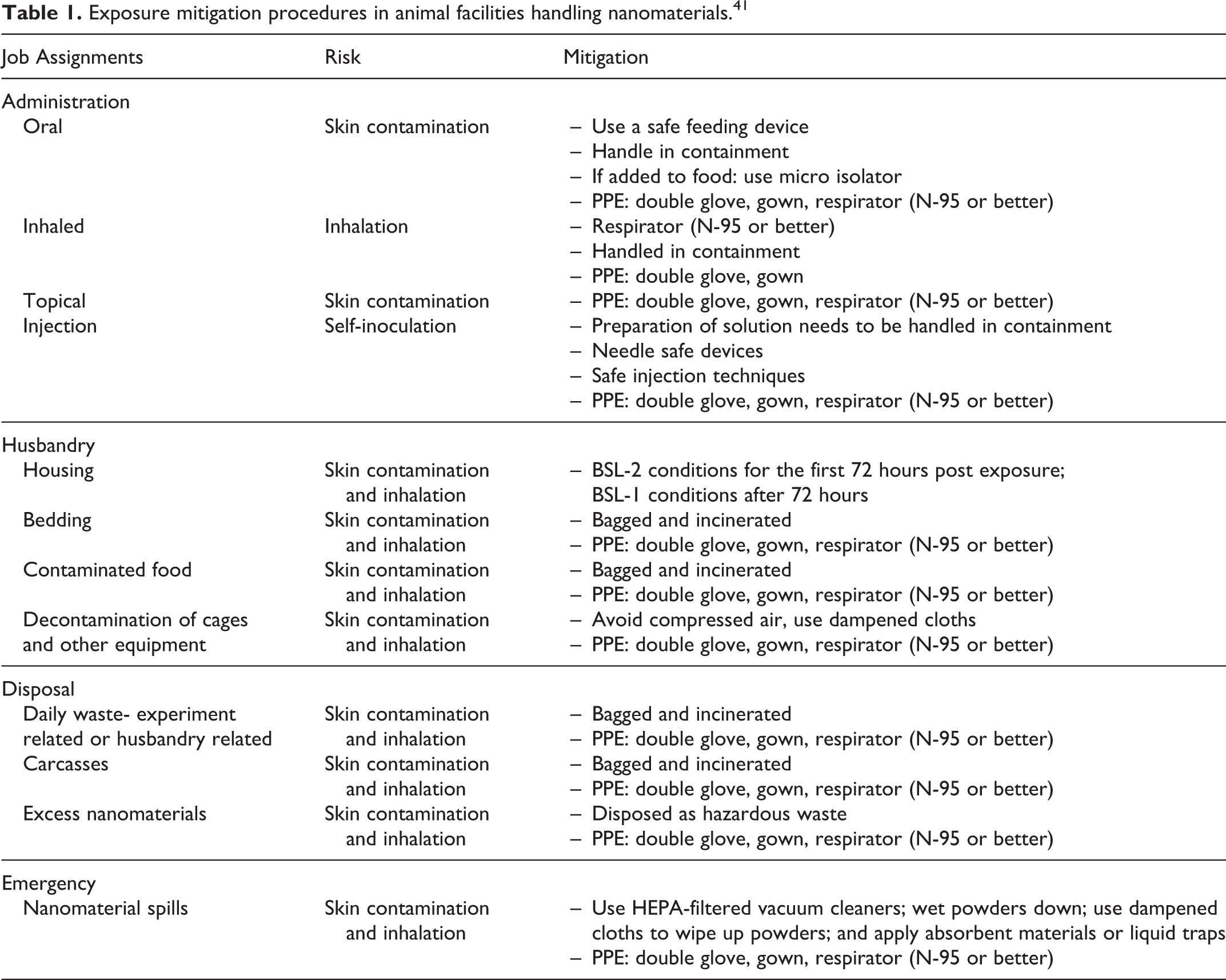
In addition to risk management guidelines from the WHO and NIOSH, many research and academic centers on the international level 38 and in the United States 39 have developed various laboratory risk management guidelines for nanomaterials. These guidelines have a number of features in common. For example, the Nanomaterial Safety Policy of the University of Florida recommends: (1) dose application to the animals, and animal necropsies, should be conducted within an exhausted hood, preferably one with HEPA filtration; (2) route of nanomaterial dose application determines how animals should be housed—aerosol dose requires housing in environmentally controlled cages and dosing by ingestion or injection requires conventional housing; (3) animals custodians should always wear appropriate PPE to prevent exposure to airborne materials or animal waste on surfaces; and (4) custodians disposing of contaminated bedding should wear the appropriate PPE, including, but not be limited to; protective eye wear, disposable gloves, dust mask, closed front disposable gown, hair and shoe covers. 40 Another nanomaterial safety policy (at the University of Texas) describes general exposure mitigation measures for different exposure scenarios in animal testing laboratories (Table 1). 41
In addition, University of Florida has institutional oversight of research protocols to ensure adequate safety and health control measures through the Institutional Animal Care and Use Committee and the Institutional Biosafety Committee. In other institutions oversight can be based on dedicated safety and health committees such as the Emory University Research Health and Safety Committee, which reviews research protocols and provides recommendations for safety policy on matters relating to biosafety/chemical safety for all types of research including explicitly research with nanoparticles. 42
Exposure mitigation procedures in animal facilities handling nanomaterials. 41
Summary
The use of nanomaterials in animal testing laboratories for evaluating their toxicity and biological activity is increasing due to expanding commercial uses of nanomaterials in consumer products and in medical applications. This increase in the laboratory use of nanomaterials results in a greater potential for nanomaterial exposure to laboratory workers. Such unintentional exposures could be harmful and should be adequately controlled. Proactive guidelines for safe handling of nanomaterials in laboratories are available from both public and private sector bodies and should be consulted regularly to ensure awareness of the newest, actionable nanomaterial risk prevention information.
Footnotes
Declaration of Conflicting Interests
The author(s) declared no potential conflicts of interest with respect to the research, authorship, and/or publication of this article.
Ethical Approval
The work presented here is original and has not been submitted or published elsewhere. All the authors listed have made a significant contribution to the reported study in the form of either conception, design, execution, or interpretation.
Statement of Human and Animal Rights
Not applicable.
Statement of Informed Consent
Not applicable.
Funding
The author(s) received no financial support for the research, authorship, and/or publication of this article.
