



Abstract
The Global Polio Eradication Initiative has established the goal of eliminating wild poliovirus circulation to form a polio-free world. To help achieve this goal, the WHO developed GAPIII, a global guideline implemented at the national level to minimize the risk of facility-associated poliovirus infections. The guidelines require research facilities to either destroy or contain wild type, vaccine-derived poliovirus; oral poliovirus vaccine viruses; and potentially infectious poliovirus materials for an area where polio was found or oral polio vaccine was in use. These requirements are applicable to facilities that conduct research unrelated to poliovirus but intend to use samples that may contain potentially infectious materials, such as infant stool specimens. In this case study, we demonstrate our approach to comply with the GAPIII guidelines, identify opportunities to improve the guidelines for international public health research, and provide recommendations for biosafety officers to help research facilities comply with changing global guidelines such as poliovirus containment.
Keywords
Introduction
Global Polio Eradication Initiative
The current Global Polio Eradication Initiative Strategic Plan established the end goal for the world to be polio-free by 2018. 1 The containment phase of this strategic plan affects facilities that conduct research unrelated to poliovirus but intend to use samples that may contain oral polio vaccine (OPV) viruses or circulating polio viruses, such as stool from healthy vaccinated infants. Since 1988, when the Global Polio Eradication Initiative was developed, the annual number of reported poliovirus cases globally in 2017 was reduced by 99%. 2 However, to sustain the end goal of eliminating paralytic polio caused by wild poliovirus or vaccine viruses, OPV must be withdrawn from use. The first step was removal of the type 2 poliovirus in the trivalent oral vaccine. 3 The type 2 poliovirus in the trivalent oral vaccine is a live attenuated serotype with a high potential for reversion, which may cause paralytic polio.4,5 By May 2016, 155 countries that were also WHO Member States transitioned from the trivalent OPV (tOPV) to the bivalent OPV (bOPV; types 1 and 3 only) upon the request of regional authorities, due to the lower potential for reversion.3 -5 This transition will be facilitated by the introduction of IPV, an inactivated poliovirus vaccine, to help maintain immunity against the type 2 poliovirus to prevent the reemergence of wild poliovirus.1,5 In addition to the bivalent OPV transition, WHO poliovirus eradication guidelines required WHO Member States to survey their laboratories for infectious materials, including wild type and vaccine-derived poliovirus and potentially infectious materials. 1 WHO guidelines required these materials to be destroyed or placed under appropriate biocontainment conditions to ensure the end goal of eradication and prevent the reintroduction of poliovirus. 1 WHO was aware that this requirement might impact facilities that intended to use potentially infectious materials that may contain OPV for conducting research unrelated to polio. 6 Currently, there are no estimates on the number of facilities or the number of samples that were and will be affected by this strategic plan. As of August 2016, 173 countries and territories out of 194 WHO Member States reported to WHO that they no longer held any wild poliovirus or vaccine-derived type 2 poliovirus. 3 In June 2017, 30 countries designated 86 poliovirus essential facilities 7 that handle and store needed infectious poliovirus materials or potentially infectious materials. 1 Overall, the Global Polio Eradication Initiative outlined the requirements and procedures necessary to achieve the end goal of global polio eradication, but the guidelines did not explicitly state requirements for facilities with samples that may contain OPV. New draft guidelines were released for comments in September 2017 for facilities with samples that may contain OPV. 8 At the time of this manuscript publication, the guidance document had not yet been finalized.
WHO Global Action Plan and the Role of the Pan American Health Organization
As part of the Global Polio Eradication Initiative, the WHO developed a framework of biorisk management standards for research facilities known as the Global Action Plan, Third Edition (GAPIII). GAPIII was established to prevent the release and minimize the consequences of an inadvertent or deliberate release of infectious poliovirus.1,6 WHO was aware that facilities may be reluctant to destroy potentially infectious OPV materials, especially for research unrelated to poliovirus, and recommended they follow the GAPIII guidelines for handling and storing these materials. 6 The guidelines are outlined by annexes for different types of poliovirus materials. The original 2014 GAPIII only provided Annex 2 for facilities holding wild poliovirus and Annex 3 for facilities containing OPV/Sabin poliovirus materials. 9 At this time, GAPIII did not provide standards for facilities with samples that may contain OPV (eg, stool collected from healthy infants who received their standard immunization schedules). In 2015, GAPIII was revised to include such standards under Annex 6, although there was a window of time from October 2014 to May 2015 that this information was not available. In addition, Annex 6 is for the safe handling of new samples potentially containing poliovirus materials, obtained after the switch to bOPV. 1 Thus, it seems unclear which standards facilities should follow with current samples that may contain OPV (eg, frozen infant stool repositories). Although according to GAPIII, all materials collected in a time and place where tOPV was used should comply with Annex 3. 1 The annexes in GAPIII recommend that facilities adopt a biorisk management policy, emergency response plan, biological agents and toxins inventory, and documents for evidence of conformity such as a standard operating procedure (SOP). 1 However, GAPIII does not specify the details that should be covered in these documents because facilities are expected to work with their biosafety officers (BSOs) to determine the appropriate documentation. In addition, GAPIII requires research facilities to determine the need for personal protective equipment (PPE), personnel training, and personnel vaccination, 1 but the instruction for these requirements remains vague (eg, “Procedures should provide the required biorisk training, determine effectiveness of biorisk training, provide refresher biorisk training, restrict personnel from performing tasks for which they are not trained, and maintain adequate records”). 1 GAPIII also outlined 3 phases for poliovirus essential facilities to implement these standards. Worldwide, we are currently in Phase 2 as efforts continue to eliminate transmission of wild poliovirus in Afghanistan, Pakistan, and Nigeria.1,3 In South America, Phase 2 has been completed. As countries in the Americas undergo these GAPIII phases, the Pan American Health Organization (PAHO) has had an integral role in tracking GAPIII essential facilities in the Americas. 10 In 2015, the PAHO meetings held in Bogotá, Columbia, and Brasília, Brazil, described the role of essential facilities in containing infectious poliovirus materials, including RNA or DNA. PAHO is responsible for informing WHO when it is appropriate to initiate the containment certification process, 10 which ensures facilities are in compliance with the GAPIII requirements. The GAPIII Containment Certification Scheme (GAPIII-CCS) outlines this process and details the issuing of certificates for essential facilities and requirements for the teams conducting audits and provides a list of documents required for the essential facility in review. 11 However, GAPIII-CCS was not endorsed by the WHO Strategic Advisory Group of Experts on Immunization until October 2016, 12 after the July 31, 2016, deadline to comply with poliovirus containment conditions, and the instructions for obtaining essential facility status remain unclear. GAPIII outlines the biocontainment standards for research facilities given the Global Polio Eradication Initiative, but the documents fail to identify which annex a facility should follow with samples that may contain OPV, and little instruction is provided for acquiring essential facility status.
Drafted Guidance for Non-Poliovirus Facilities
In September 2017, WHO released a draft guidance document for non-poliovirus facilities for comment. 8 Non-poliovirus facilities include facilities that collect and store clinical and environmental samples. 8 These facilities pose a risk of poliovirus transmission if samples were collected when wild polioviruses or OPV-derived viruses were circulating, including routine OPV immunizations. 8 The drafted guidance document provides risk mitigation strategies based on the risk category of the facility. 8 The risk category can be determined from the type of sample and expected use or procedure used with the sample. 8 The guidance document also requires all facilities to declare their holdings to national authorities, although little information is provided for this procedure. 8 At the time of this manuscript publication, the guidance document had not yet been finalized.
Applications in Academic Research: A Case Study
The Global Polio Eradication Initiative and the standards in GAPIII developed by WHO affected our multinational research collaboration’s ability to preserve stool samples as a biobank for ongoing and future research. These approximately 4000 stool samples are the product of a longitudinal cohort study with the purpose of assessing the relationships between maternal and infant nutrition and the response to rotavirus vaccines.13,14 The study had and has no intention to study poliovirus, either wild or vaccine related. The study entailed 5 years of effort to collect biological samples and data and approximately $700 000 USD of combined funding from federal, foundation, university, and in-kind support from Bolivia and the United States. These healthy infants, as part of their routine vaccination schedule, were vaccinated with tOPV from May 2013 to March 2015. Thus, it is possible but not confirmed that some of the collected stool samples from healthy infants during their first year of life may have contained polioviruses from tOPV, the polio vaccine in their routine vaccinations. The preservation of these samples was important because they contribute to a rich data set and biobank of longitudinal infant-mother samples linked to anthropometry, nutrition, immunological data, and sociodemographic information, which is required to answer fundamental questions on rotavirus vaccine performance. Data and biological samples are rarely available from such young infants, and even fewer studies have samples from infants living at high altitudes, such as in Bolivia. In December 2015, we were notified of PAHO’s request to destroy these infant stool samples because some of the samples may have contained vaccine viruses from tOPV, and information was not provided at the time for a compliant method to treat the samples (eg, extracted RNA). Through the described case study, we sought to ensure all necessary safeguards were in place to preserve these stool samples from healthy infants for future global research and comply with the GAPIII guidelines provided at the time. Through disseminating our experience, we also aimed to support other research facilities’ ability to comply with poliovirus containment requirements and identify opportunities to improve the development of the GAPIII guidelines for research facilities.
Methods
A research facility in La Paz, Bolivia, Instituto de Biología Molecular y Biotecnología (IBMB-UMSA), was informed in December 2015 of the WHO and PAHO guidelines to either contain, refer, or destroy samples potentially containing poliovirus or OPV material. IBMB-UMSA then notified their partners at Emory University that because some of the stool samples from these healthy infants may contain viruses related to tOPV from routine vaccination, they must be destroyed or transported to an essential facility.
Consider Routes of Action
According to the PAHO meetings in 2015, the only solution to prevent sample destruction was to store the samples at an essential facility or refer the samples to an essential facility. However, there were no existing essential facilities in Bolivia. Thus, the principal investigators at IBMB-UMSA and Emory decided to export two-thirds of the samples to Emory—with the intent of Emory becoming an essential facility—based on Emory’s containment resources. Long-term storage of the samples was necessary to enable ongoing and future funded research. The remaining one-third of the samples in Bolivia were destroyed according to the PAHO guidelines. This action preserved the samples but impaired the Bolivian researchers’ analysis of these samples and led to inequity in the global research collaboration.
Contact Collaborators and Seek Expert Opinions
In May 2016, the Biosafety Office (BSO) at Emory was contacted to determine the appropriate documentation to become an essential facility and decide the best method for transporting the samples because little information was provided in GAPIII. The BSO consulted with the National Polio Containment Coordinator (NPCC) based at the Centers for Disease Control and Prevention (CDC) in the United States. After discussion, NPCC provided a letter of approval to document Emory’s status of an intended future essential facility and recommended that the research laboratory obtain a CDC import permit from the Division of Select Agents and Toxins. These documents were later shared with a member of Bolivia’s Poliovirus Containment Committee at the Ministry of Health and PAHO-Bolivia to ensure compliance.
Sample Transport
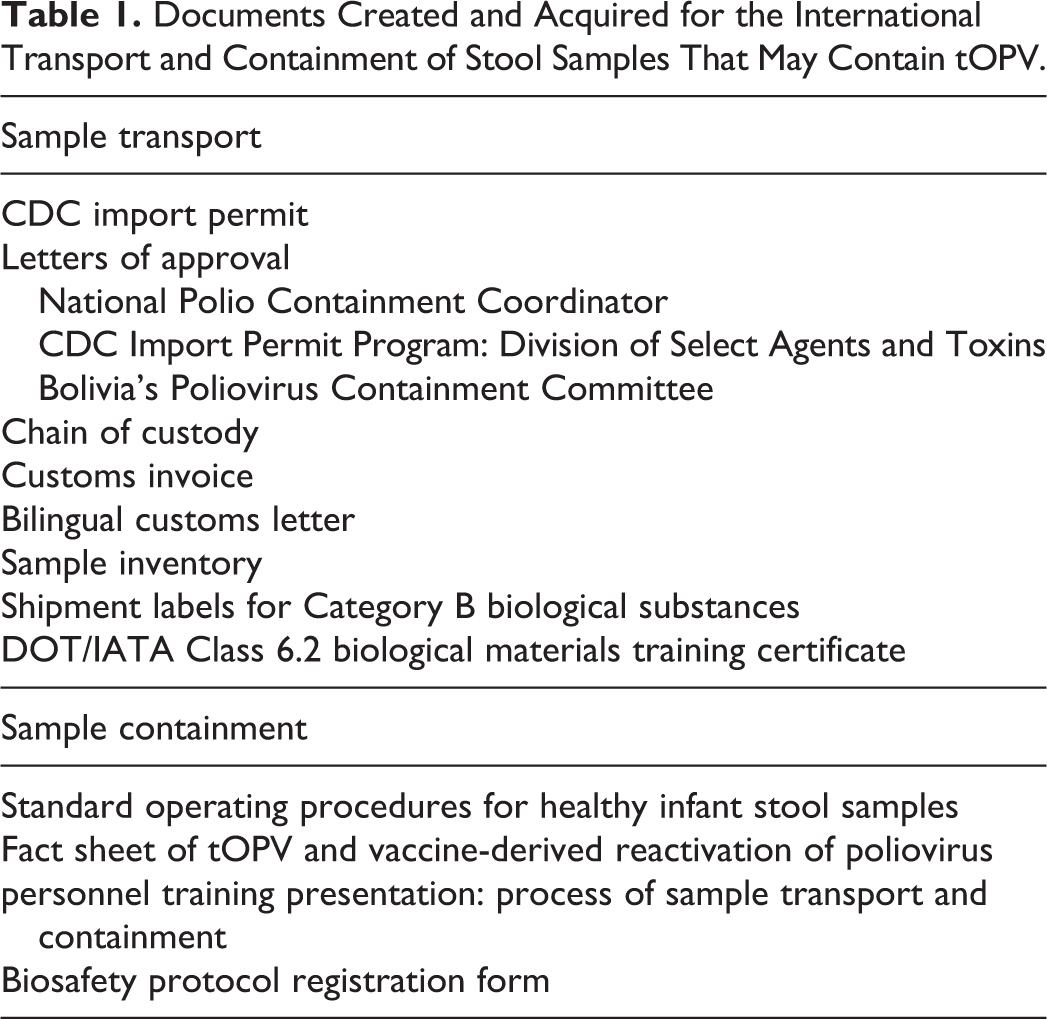
The Emory BSO met with the Emory research laboratory to determine the best process for sample transport from La Paz, Bolivia to Atlanta, Georgia. After consultation with various shipping companies, World Courier was the only shipping company who could transport the stool samples on dry ice out of Bolivia. Documentation for sample transport is listed in Table 1. Prior to shipping, laboratory personnel at IBMB-UMSA updated the sample inventory, created new sample labels, and performed an inventory and quality control assessment to ensure all samples on the inventory list were accounted for in each freezer box.
Documents Created and Acquired for the International Transport and Containment of Stool Samples That May Contain tOPV.
In June 2016, the principal investigator from Emory traveled to Bolivia to facilitate the sample shipment. The stool samples were packaged in a triple-layer packing system as Category B Infectious Substances (UN 3373).15,16 An assembly line was established with each person designated a specific task to avoid samples thawing while the boxes were prepared for shipment. Each freezer box contained a label of its contents, was taped closed, wrapped in paper towels, secured with a sticker inscribed with the box ID, and placed in an airtight gallon-sized Ziplock freezer bag. The excess Ziplock bag material was then wrapped tightly around the box and taped with the box label clearly visible through the plastic. Each packaged freezer box was then immediately placed back into the –80°C freezer. This process continued until all freezer boxes were prepared for shipment. Styrofoam coolers (13.25′′ × 9.25′′ × 9′′) with at least 2′′ in thickness were acquired in addition to cardboard boxes that fit the coolers without any additional space between the cooler and cardboard box. The packaged freezer boxes were removed from the freezer, placed in coolers, and the cooler number noted in the sample inventory and chain of custody forms. Approximately 16.5 kg of dry ice was added to each cooler to ensure all sides of the 8 to 9 freezer boxes were evenly covered, the sides of the cooler were loosely taped on only 2 sides to allow for dry ice venting, and the top cardboard box flaps were closed and taped. The cardboard boxes were labeled. Upon arrival of the shippers, IBMB-UMSA completed the chain of custody form. Six cardboard boxes containing coolers with a total of 50 freezer boxes along with associated documentation were shipped through World Courier from Bolivia to the United States.
Sample Containment
While the samples were prepared for shipment in Bolivia, the research laboratory at Emory began efforts to comply with the GAPIII guidelines for essential facilities. Based on the guidelines, the BSO and the National Containment Polio Coordinator at the CDC agreed and communicated the appropriate documentation for sample storage and containment to the research laboratory. As it was unclear which annex was applicable at the time to samples that may contain tOPV, the research laboratory considered Annex 3 requirements when completing the evidence of conformity documents. These GAPIII requirements for Annex 3 included: a biorisk management system, risk assessment, poliovirus inventory, personnel competency, personal protective equipment, personnel vaccination, decontamination methods, emergency response procedures, and security controls. 1 In addition to standard biosafety procedures required by Emory, a lock was purchased for the –80°C freezer, which is located in a laboratory with restricted keycard access. When the samples arrived at Emory, the chain of custody form was completed, and the samples were placed in the access-controlled freezer for long-term storage in the BSL-2 laboratory. The location of these samples was updated in the sample and freezer inventory. For the biorisk management system and risk assessment, investigators at Emory completed a biological materials biosafety form requested by Emory BSO using a customized software program (BioRAFT, Cambridge, MA). A specific SOP for the stool samples was also created, which included instructions for handling and tracking sample use, sample disposal, decontamination methods, emergency response procedures, and required PPE. For employee training, all laboratory personnel were required to read and sign a newly created informational brochure on tOPV and the associated health concerns (Supplementary Figure 1 available in the online version of the article). A training presentation was also given to the research group about the samples, the process to obtain them, and the required biosafety procedures for anyone handling the samples. Any employees that would potentially handle the samples were required to obtain an additional dose of the inactivated poliovirus vaccine, regardless of receiving polio vaccination as a child, and receive task-specific training from a senior employee. A formal presentation of this case study and its response was provided to the Emory University Biosafety Committee on October 26, 2016.
Discussion
Reflection
After receiving notice of the GAPIII standards, we learned valuable lessons that are important to consider for BSOs, research facilities, and global collaborations faced with changing global policies, such as poliovirus containment.
Specifically, we learned that as policies evolve, it is critical to establish communication channels with principal investigators, research staff, and regional authorities such as the National Poliovirus Containment Coordinators to ensure biocontainment compliance. These communication channels will facilitate implementing new guidelines and assure collaborators are informed of any changes. In doing so, this will help protect employees from infection, prevent the reintroduction of infectious materials, and ensure sample preservation.
However, it is important to note that communication between WHO, countries, and regional authorities may not always be clear as the guidelines undergo development. When the guidelines are unclear and expert recommendations cannot be provided, it is best to employ the most conservative methods based on biocontainment standards for sample transport and containment. For example, GAPIII provides the following information for conducting transport activities: “ensuring transport requirements are identified and implemented, including legal requirements and national and international guidelines; ensuring the international transport of poliovirus meets the equivalent biosafety and biosecurity standards required for external transport outside the facility; ensuring adequate packaging systems, materials, labels, PPE and documentation are available and used as part of the transport process.” 1 The guidance for sample transport is vague; therefore, we followed conservative methods for sample transport and containment after consultation with Emory University’s biosafety officer. We obtained a CDC import permit and 2 letters of approval from NPCC and a member of the Bolivian Containment Committee and packaged the samples within 3 receptacles as Category B Infectious Substances (UN 3373). We also included a sample inventory, chain of custody form, additional labels, and a bilingual letter to customs informing them about the contents of the package. Resources are emerging to help address the confusion over the GAPIII transport and containment requirements, such as the June 2017 Containment Advisory Group (CAG) meeting report and the CDC webpage with information about poliovirus containment for research facilities.17,18 A drafted guidance document for non-poliovirus facilities also provides mitigation strategies for containment of clinical and environmental samples. 8 Thus, when the guidelines are unclear and additional recommendations are not provided, it is best to follow the most conservative biocontainment standards for sample transport and containment.
Due to the ambiguity of the GAPIII guidelines, we maintained records of the sample transport and containment process. The documents we compiled for sample transport and containment are illustrated in Table 1. To transport and preserve the samples, we used a triple-layer packing system15,16 and followed a principle similar to the “no touch, strict disinfection” that has been used for Ebola. 19 Safe transport and handling procedures were documented in the sample-specific SOP. For example, when handling samples, trained personnel wore PPE, disinfected work surfaces, and tracked the samples with the chain of custody form and inventory. Retaining documentation of our steps for the sample transport and containment process will not only provide evidence of conformity but also allow for reflection and changes in the future.
Advocating to regional authorities, such as the National Poliovirus Containment Coordinators and the WHO, for guideline improvements and further clarity is crucial for ensuring safe, compliant implementation in research facilities. In addition, organizing a forum to enable a collaborative discussion among stakeholders may also provide solutions and equity in safe implementation. It is important to voice the experiences of principal investigators, research staff, BSOs, and global collaborators in implementing potential new guidelines as they undergo review from advisory committees.
Opportunities to Improve GAPIII Guidelines
From our experiences and lessons learned implementing GAPIII requirements for poliovirus containment, we have identified the following opportunities to improve the guidelines.
The biocontainment conditions outlined in GAPIII have impacted and will impact research facilities conducting non-poliovirus research with samples that may contain viruses related to tOPV such as academic research facilities (eg, universities) working with clinical samples, clinical research facilities, national research institutions, and global research collaborations. Currently, the drafted guidance document for non-poliovirus facilities provides mitigation strategies specific to the risk category of a facility. 8 However, it is unclear how facilities declare their non-poliovirus materials to national or regional authorities. Therefore, we recommend GAPIII specifically state that national and regional authorities should document and communicate the procedures and forms required so research facilities can “declare their holdings to national authorities and maintain a working inventory of materials in their possession.” 8
In addition to clarifying the requirements for facilities with samples that may contain tOPV, it is also important to outline a solution to store samples for future research in countries without essential facilities and institutions that lack the resources to refer samples to an essential facility. The draft guidance for non-poliovirus facilities provides containment requirements for facilities while final disposition is being determined; however, this is only outlined as a short-term measure. 8 In countries without essential facilities, laboratories cannot locally preserve their samples, which will inhibit future research and create future research inequity among global partners. Furthermore, countries with essential facilities may not have the capacity to contain a large number of samples from other laboratories. For example, in Bolivia, despite the GAPIII requirements to either transport samples to an essential facility for containment or destroy them, the Poliovirus Containment Committee found it was difficult to help researchers preserve samples in Bolivia because Bolivia has no essential facilities. Therefore, the only option available to researchers was to destroy their samples. IBMB-UMSA was the only facility in Bolivia able to transport samples to another country due to their global collaboration with Emory. To permit future use of samples in countries without essential facilities and maintain research equity, we recommend GAPIII provide alternative solutions to destroying samples that ensure sample integrity so that countries can continue to advance their many non-poliovirus research activities (immunizations, diarrhea, nutrition, microbiome, infectious diseases, etc).
Conclusion
Our case study illustrates the implementation of the GAPIII requirements for poliovirus containment in a global research collaboration. Given the changing and in some cases vague requirements, we followed a framework to comply with the GAPIII standards to transport and contain stool samples from healthy infants vaccinated with tOPV as part of their routine vaccination schedule. From this experience, we learned valuable lessons for BSOs to consider to help research facilities comply with changing global guidelines. Specifically, it is (1) important to establish communication channels with collaborators and experts, (2) best to employ the most conservative biocontainment methods, (3) necessary to maintain records of the sample transport and containment process, and (4) essential to advocate for guideline improvements and clarity. The lessons we learned will help protect employees, ensure sample preservation, prevent the reintroduction of infectious materials, and contribute to equity in global research collaborations. In addition, the following opportunities were identified to improve the GAPIII guidelines: provide a procedure of how to appropriately declare non-poliovirus materials to national authorities and for countries without essential facilities, provide an alternative solution to destroying samples to permit their future use and maintain equity across countries. Applying the lessons learned from this case study and improving the GAPIII biocontainment guidelines will help ensure research facilities’ compliance, maintain global research equity, and promote public health research.
Footnotes
Acknowledgments
We acknowledge the contributions of Dr Volga Iñiguez, Doctor Emeritus at the Instituto de Biología Molecular y Biotecnología, Universidad Mayor de San Andrés and member of Bolivia’s National Poliovirus Containment Committee, for sharing her experiences. We would also like to thank Dr Walt Orenstein and Dr Olen Kew for their insightful contributions.
Declaration of Conflicting Interests
The author(s) declared no potential conflicts of interest with respect to the research, authorship, and/or publication of this article.
Funding
The author(s) received no financial support for the research, authorship, and/or publication of this article.
Supplemental Material
Supplementary material for this article is available online.
References
Supplementary Material
Please find the following supplemental material available below.
For Open Access articles published under a Creative Commons License, all supplemental material carries the same license as the article it is associated with.
For non-Open Access articles published, all supplemental material carries a non-exclusive license, and permission requests for re-use of supplemental material or any part of supplemental material shall be sent directly to the copyright owner as specified in the copyright notice associated with the article.
