



Abstract
This study evaluated the persistence of Burkholderia mallei China 7 deposited on glass, Hypalon rubber glove, and stainless steel, as well as inactivation with vaporous hydrogen peroxide fumigation of a ∼15-m3 chamber. A suspension of B mallei China 7 at ∼1 × 10⁸ colony-forming units was dried on coupons of each test surface. One set of coupons was held at ∼20°C to 22°C and 40% to 55% relative humidity and sampled for viable B mallei at 1 hour, 16 to 18 hours, 4 days, and 7 days. A second set of coupons was subjected to vapor-phase hydrogen peroxide fumigation. For persistence of B mallei on all materials, a significant reduction in recoverable log10 colony-forming units was observed over the 7-day period, in which no growth was observed by day 4 for glass and day 7 for glove and stainless steel. For all materials subjected to vapor-phase hydrogen peroxide exposure, qualitative growth assessment (incubated for 7 days) showed complete inactivation of B mallei and biological indicators. The results indicate that B mallei can remain viable for several days under ambient laboratory conditions on glass, rubber glove, and stainless-steel materials. Moreover, B mallei is inactivated on these materials when exposed to vapor-phase hydrogen peroxide without observable physical damage to the test materials.
Burkholderia mallei, the etiologic agent of glanders, is considered an obligate mammalian pathogen, with solipeds serving as the reservoir for infection. 1 Natural glanders infections occur primarily in horses, donkeys, and mules, but most mammals have some degree of susceptibility. As B mallei is listed by the Centers for Disease Control and Prevention as a potential bioterrorism agent (www.selectagents.gov/SelectAgentsandToxinsList.html), the deliberate misuse of B mallei poses a severe threat to public health and safety with a high potential to cause mass casualties or devastate the economy, critical infrastructure, or public confidence.
Although glanders primarily affects animals and transmission occurs from animal to animal and from animal to human, the transmission from human to human is rare. Human B mallei infections present as either nasal-pulmonary (glanders) or cutaneous (farcy), and the disease may be acute or chronic. 1 Inhalation of aerosol or dust containing B mallei can lead to septicemic, pulmonary, or chronic infections of the muscle, liver, and spleen. The disease has a 95% fatality rate for untreated septicemic infections and a 50% mortality rate in antibiotic-treated individuals. 1 The use of B mallei as a weapon occurred in World War I, when the Germans intentionally infected Allied horses and mules. 2 In World War II, the Japanese conducted biological warfare experiments against prisoners with B mallei and other biological agents. 2 Other documented infections in humans during the 20th century occurred occupationally in butchers, horse handlers, laboratory staff, and veterinarians. 3
With the advances in biotechnology, nonclinical, and clinical research, the potential for laboratory-acquired infections (LAIs) while working with pathogenic organisms is a constant concern. The most common routes of infection are inhalation, percutaneous inoculation, direct contact with contaminated surfaces, mucous membranes, and ingestion. 4 Occupationally, exposure to B mallei occurs through exposed skin, such as the hands, face, and neck. 5 There have been 8 documented cases of B mallei LAI in the United States. The most recent case occurred in 2000 in a microbiologist at the US Army Medical Research Institute of Infectious Diseases, in which a lapse in wearing appropriate personal protective equipment, particularly gloves, may have contributed to the infection. 6 Concerns over LAI have recently been heightened due to the release of Burkholderia pseudomallei from containment at the Tulane National Primate Research Center, which may have resulted from contact with contaminated clothing worn in the select agent laboratories (www.cdc.gov/media/releases/2015/s0313-burkholderia-pseudomallei.html). Therefore, the purpose of this study was to evaluate the persistence of viable B mallei on common laboratory material surfaces as well as inactivation with vapor-phase hydrogen peroxide.
Materials and Methods
Test Organism
All portions of testing were performed under biosafety level 3 conditions in accordance with the Biosafety in Microbiological and Biomedical Laboratories, fifth edition. For testing, fresh cultures of B mallei China 7 (ATCC 23344; American Type Culture Collection, Manassas, Virginia) were prepared in advance of coupon inoculation as previously described. 7
Test Materials
For this study, testing was conducted with the following materials: glass (ASTM C1036; Brooks Brothers Glass & Mirror, Columbus, Ohio), Hypalon rubber (Honeywell Safety Products, Smithfield, Rhode Island), and stainless steel (grade 304, gauge 12; Adept Products, West Jefferson, Ohio). Coupons (1.9 × 7.5 cm) were cut to uniform length and width from a large piece of material and autoclaved at 121°C for 15 minutes to sterilize. A visual assessment of each coupon was performed to ensure that no physical changes or defects occurred due to the sterilization process.
Persistence and Decontamination Testing
For persistence testing, 3 inoculated coupons and 1 blank (not inoculated) were used for each test material. Material coupons were placed horizontally in groups by material type within the center of a Class III biological safety cabinet (BSC III) and inoculated with a 100-µL aliquot of the stock B mallei suspension as 2 rows of 5 droplets (10 µL per droplet) across the surface of the coupons, yielding an inoculum of approximately 1 × 10⁸ colony-forming units (CFU). After inoculation, the materials were left undisturbed to dry under ambient conditions (approximately 22°C and 40% relative humidity) for 1 hour. During persistence testing, the BSC III ran under normal operating conditions with respect to airflow and negative pressure. The temperature and relative humidity were monitored in real time with a HOBO U12-006 data logger (Onset Computer Corporation, Bourne, Massachusetts).
At 1 hour, 16 to 18 hours, day 4, and day 7 postinoculation, a set (3 replicates, 1 blank) of each test material was processed for organism viability. Coupons were placed into 50-mL conical tubes (1 coupon per tube) containing 10 mL of sterile phosphate-buffered saline (Sigma, St Louis, Missouri), and bacteria were extracted by agitating the tubes at 200 revolutions per minute on an orbital shaker for 15 minutes at room temperature. Following extraction, a 1.0-mL aliquot of each extract was removed, and 10-fold serial dilutions were prepared in sterile phosphate-buffered saline. Aliquots (100 μL) of the undiluted extract and each serial dilution were plated in triplicate onto Chocolate II agar (BD Diagnostic Systems, Franklin Lakes, New Jersey) and incubated for 18 to 24 hours at 37ºC. All plates were enumerated, and average counts for each triplicate were calculated, with CFU/mL determined by multiplying the average number of colonies per plate by the reciprocal of the dilution.
For decontamination, test coupons and 1 blank (not inoculated) of each test material were prepared as described above. Following the 1 hour of drying, the coupons were transferred into a 15-m3 BSC III as previously described.8,9 In parallel, Spordex VHP Biological Indicators (STERIS Corporation, Mentor, Ohio) containing Geobacillus stearothermophilus spores and VHP Chemical Indicator NB305 Strips (STERIS Corporation) were used to verify the decontamination process. Sixteen biological and chemical indicators were placed at separate locations within the ARCA chamber and subjected to decontamination; as a positive control, a single biological indicator and chemical indicator were affixed to the outside of the test chamber that was not decontaminated. The decontamination procedure was performed with the VHP 1000ED Biodecontamination System (STERIS Corporation), in which fumigation parameters were used as previously described.8,9 Briefly, the decontamination process consisted of dehumidification (10 minutes; ≤6.9 mg/L, relative humidity), conditioning (20 minutes; 6.5 g/min, hydrogen peroxide), decontamination (5.5 hours; 5.0 g/min, hydrogen peroxide), and aeration phases (>4 hours), which were all controlled by the hydrogen peroxide generator. Four 12-inch fans were placed inside the test chamber to provide turbulence for maximizing vaporous hydrogen peroxide distribution. The hydrogen peroxide concentration, relative humidity, and temperature were monitored in real time with a data point capture frequency of 1 minute. The hydrogen peroxide was monitored with an ATI Series B12 2-wire gas transmitter connected to a remote hydrogen peroxide sensor (0-1000 parts per million [ppm]; Analytical Technology, Inc, Collegeville, Pennsylvania). Temperature and relative humidity were monitored in the control chamber with a Yokogawa DX2010 (Yokogawa Electric Corporation, Tokyo, Japan) connected to an Omega HX93 AC temperature/relative humidity probe (Omega Engineering, Inc, Stamford, Connecticut).
To evaluate the effectiveness of vapor-phase hydrogen peroxide to completely inactivate B mallei, a qualitative growth assessment was used as described previously. 10 Following the decontamination run, each test coupon and biological indicator were removed from the test chamber, individually placed into 50-mL conical tubes containing 20 mL of nutrient broth, and cultured at 37ºC for B mallei and 55ºC to 60ºC for the biological indicator. All cultures were visually inspected for growth (turbid culture) or no growth (clear culture) after incubating for 1 and 7 days.
Statistical Analysis
Data were expressed as mean log10 CFU of recoverable bacteria. For assessing the persistence of B mallei on each material type, a 2-way analysis of variance was used to compare changes in mean log10 CFU recovered as a function of time and material type (SigmaPlot 12; Systat Software, Inc, San Jose, California). Tukey’s test was used for post hoc comparisons among material types at each period (SigmaPlot). P ≤ .05 was used as the level for significance.
Results
Persistence Testing
During the persistence test, the average temperature was 21.3ºC (range, 20.1ºC-21.9ºC), and the average relative humidity was 42.4% (range, 40.0%-55.4%; Figure 1). The inoculum added onto each test material coupon was determined to be 7.94 log10 CFU, in which 6.46, 6.83, and 6.26 log10 CFU were recovered after the 1-hour drying time from glass, rubber glove, and stainless steel, respectively (Figure 2). For all materials, a significant reduction (P < .05) in recoverable, viable B mallei log10 CFU was observed over the 7-day period. For glass, a significant decrease (P < .05) to 3.19 log10 CFU was recovered within 16 to 18 hours; however, no viable B mallei was detected at 4 and 7 days (Figure 2). For the rubber glove, significantly lower (P < .05) mean log10 CFU was recovered at the 16- to 18-hour (4.32) and 4-day (1.72) points, respectively; no viable B mallei was observed by day 7 (Figure 2). Similarly, significant decreases (P < .05) were observed for stainless steel, in which 2.66 and 1.25 log10 CFU were recovered at the 16- to 18-hour and 4-day time points, respectively, with no viable B mallei was observed by day 7 (Figure 2). For all materials, a significant reduction (P < .05) in recoverable, viable B mallei log10 CFU were observed over the 7-day period.
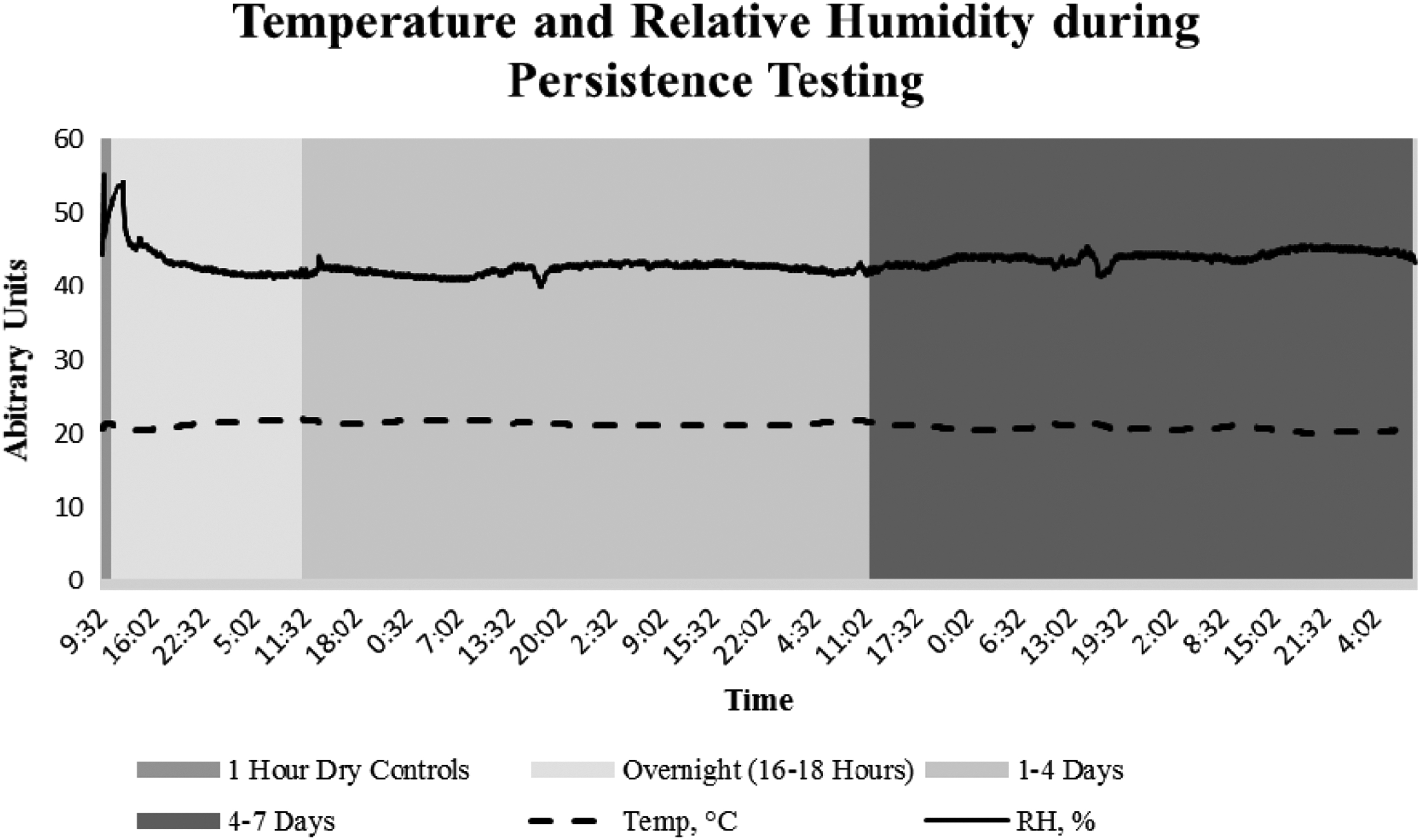
Profiles of temperature and relative humidity (RH) measured in real time during the 7-day persistence test.
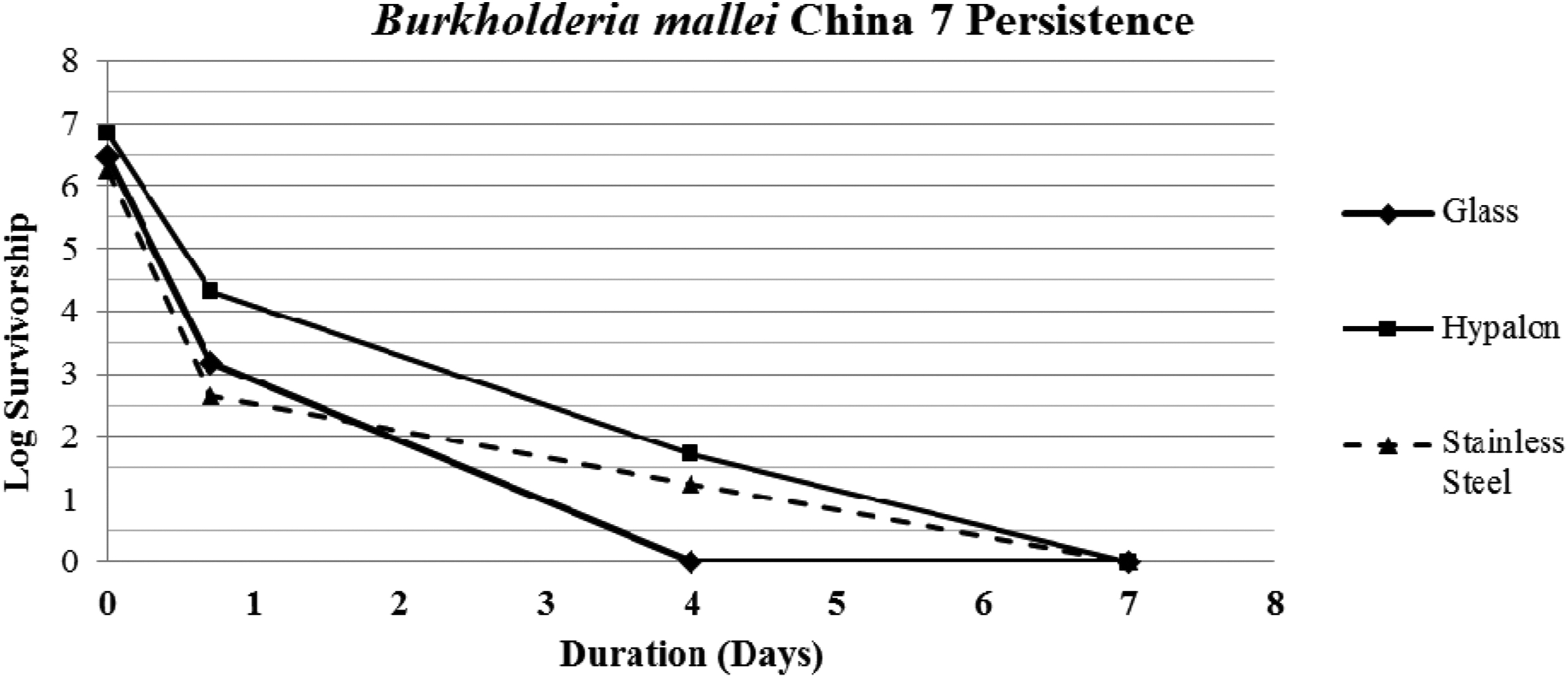
Mean viability (log survivorship) of Burkholderia mallei China 7 recovered from glass, Hypalon rubber, and stainless steel.
When changes were compared in the mean log10 CFU recovered from glass, rubber glove, and stainless steel over the observed time course, significant differences (P < .05) were observed between rubber glove and both glass and stainless steel within 16 to 18 hours. At 4 days, significant differences (P < .05) were observed between rubber glove and glass as well as between stainless steel and glass.
Decontamination Testing
During the decontamination run with the VHP 1000ED Biodecontamination System to fumigate a 15-m3 chamber, the conditioning phase peaked at approximately 355 ppm and decreased to a level of approximately 250 ppm during the decontamination phase (Figure 3). The relative humidity peaked during conditioning to approximately 96% and slowly decreased during the decontamination phase, while the temperature during the entire decontamination run was 21.4ºC ± 0.4ºC. Following decontamination, all chemical indicator strips present in the fumigated test chamber changed color, indicating exposure to the vapor-phase hydrogen peroxide. The chemical indicator strips maintained outside the test chamber did not change color. Upon visual inspection, no physical damage was observed for the hydrogen peroxide–exposed coupons.
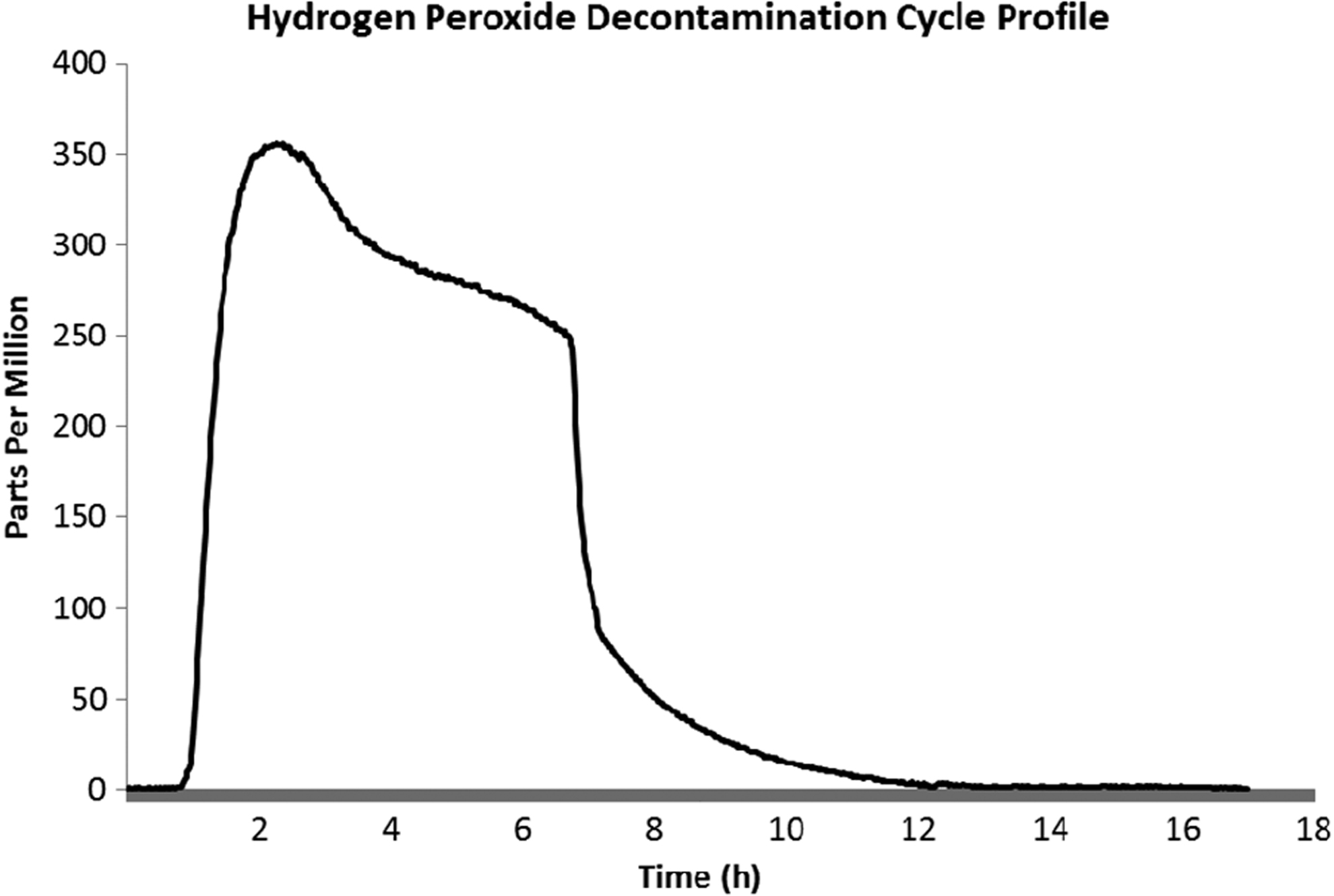
Profile of hydrogen peroxide concentration during the decontamination run.
For all coupon types, vapor-phase hydrogen peroxide fumigation completely decontaminated B mallei China 7 as demonstrated by the lack of viable growth in liquid cultures through 7 days of incubation; all blank coupons were negative for growth (Table 1). All biological indicators exposed to vapor-phase hydrogen peroxide exhibited no growth through 7 days in culture. The unexposed biological indicator exhibited growth as determined by the presence of visible turbidity in liquid cultures.
Decontamination Efficacy of Burkholderia mallei China 7 and Biological Indicators Following Vapor-Phase Hydrogen Peroxide Fumigation on 3 Test Materials (n = 3/Material).
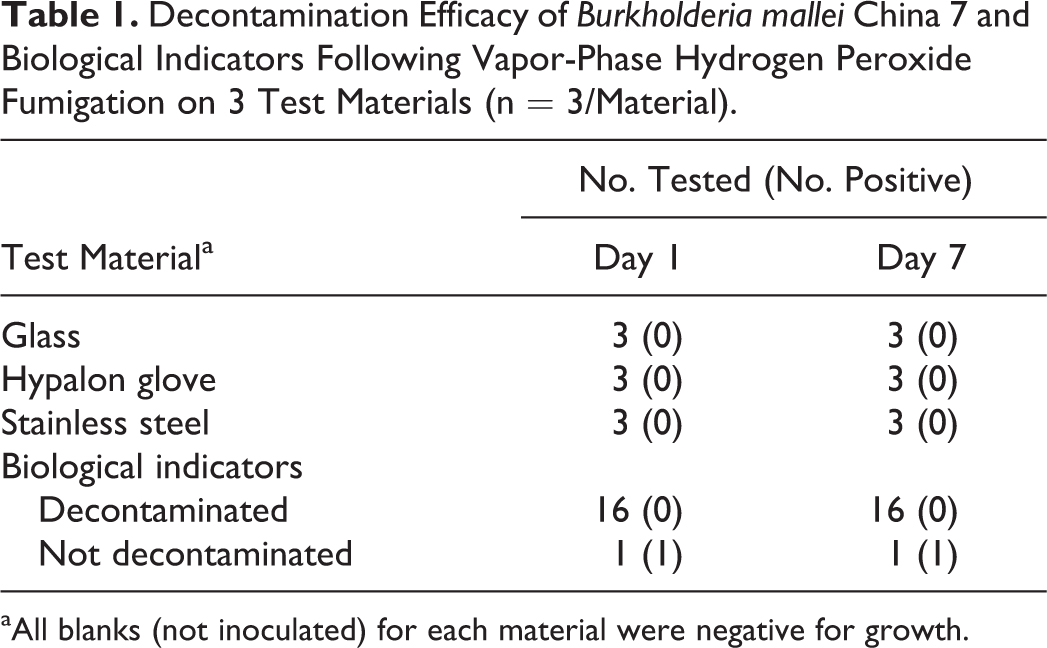
All blanks (not inoculated) for each material were negative for growth.
Discussion
The persistence of biological agents outside a host is influenced by environmental conditions and the materials with which these agents contact. In wet, humid, or dark environmental conditions, B mallei may remain viable for 3 to 5 weeks and can persist in room temperature water for a month. 1 Currently, little is known about the persistence of B mallei deposited onto nonporous surface materials and maintained at ambient laboratory temperature and relative humidity. However, if B mallei remains viable for an extended period on material surfaces in the laboratory, such persistence can pose a potential contact hazard.
The present study demonstrates that under ambient conditions (20°C-22°C and 40%-55% relative humidity), B mallei China 7 viability decreased to nondetectable levels within 4 to 7 days following inoculation onto nonporous laboratory materials. This suggests that B mallei can remain a contact hazard for risk of human exposure, thereby necessitating decontamination. It should be noted that the persistence testing utilized a quantitative method in which the bacteria were extracted off the material coupons and subjected to dilution plating. It has been suggested that for instances in which the recovery of microorganisms from test materials is <100%, the disinfection efficacy could be overestimated. 11 In the present study, recovery of B mallei after 1 hour of drying ranged from 79% to 86% for all 3 test materials. Therefore, it is possible that a similar overestimation may occur when assessing persistence with an extraction-plating procedure. Although no viable organisms were quantified in plated extracts from glass (day 4), rubber glove (day 7), and stainless steel (day 7), it is possible that some viable bacteria could remain on the surfaces of each material type. Therefore, the addition of a decontaminant treatment to completely inactivate any residual viable B mallei is warranted.
Several studies have demonstrated the inactivation of B mallei in water and that deposited on surfaces7,12 –18; however, there is currently no criterion established for determining an appropriate level of decontamination for B mallei. As noted previously for other biological agents,9,10,19 –21 complete inactivation may be a suitable requirement following remediation. In the present study, B mallei inoculated onto glass, rubber glove, and stainless steel and exposed to vaporous hydrogen peroxide was decontaminated >6 logs, as demonstrated by the lack of growth (no turbidity) in liquid cultures after 7 days of incubation. Although a quantitative approach was used in the persistence testing, the use of liquid cultures provides a qualitative assessment for evaluating decontamination performance with respect to meeting a suggested goal of complete inactivation. Moreover, utilizing a qualitative approach provides for the most conservative evaluation of decontamination and minimizes any potential overestimation of efficacy.
The data from this study can provide end users, safety experts, health professionals, and regulatory agencies information regarding the persistence and decontamination of B mallei on nonporous surfaces. Moreover, this information can help safety professionals make informed decisions regarding the manipulation and use of B mallei in the laboratory to minimize or prevent the risk of LAI by implementing the appropriate combination of engineering controls, personal protective equipment, and hazard safety assessments of established standard operating procedures.
Footnotes
Declaration of Conflicting Interests
The author(s) declared no potential conflicts of interest with respect to the research, authorship, and/or publication of this article.
Funding
The author(s) received no financial support for the research, authorship, and/or publication of this article.