




Abstract
Eucalyptus citriodora
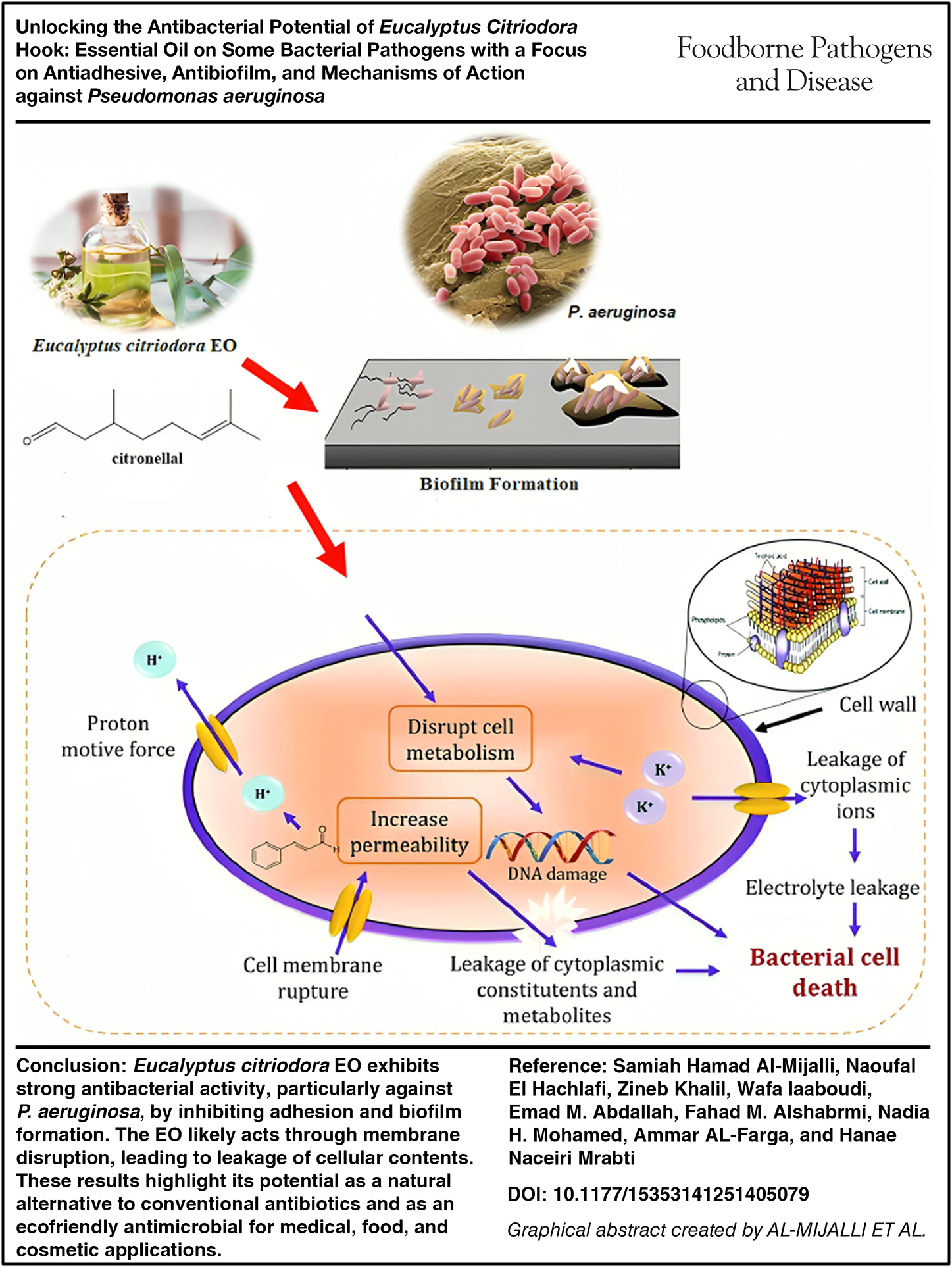
(lemon eucalyptus) is a medicinal plant commonly used as an antiseptic agent to prevent infection and promote healing. The aim of this exploration was to investigate for the first time the antibacterial mode of action of a gas chromatography–mass spectrometry chemically characterized E. citriodora essential oil (EO) obtained by microwave-assisted hydrodistillation. First, the chemical investigation revealed citronellal (30.67%) and citronellol (19.14%) as the major components. E. citriodora EO represented remarkable antibacterial properties, as demonstrated by significant zone of inhibition in the disc-diffusion test against all tested bacterial pathogens, including Listeria innocua ATCC 33090, L. monocytogenes ATCC 13932, Proteus mirabilis ATCC 25933, Salmonella typhimurium ATCC 700408, and Pseudomonas aeruginosa ATCC 27853. The minimum inhibitory concentration (MIC) and minimum bactericidal concentration (MBC) values confirmed these findings showing antibacterial efficacy at low concentrations ranging 5.75–92 µg/mL for MICs and 11.5–184 µg/mL for MBCs. These results were comparable with gentamicin. The MICindex revealed that E. citriodora EO has bactericidal effects. We evaluated the antibacterial properties of E. citriodora EO and determined its mode of action using advanced tests with P. aeruginosa as a typical pathogen. The time-kill test revealed dose-dependent inhibitory effects on the cell proliferation of P. aeruginosa, affecting its membrane permeability based on the time and concentration of the EO. E. citriodora EO also caused damage to the cell membrane, resulting in leakage of cellular constituents, including RNA and DNA. Anti-quorum sensing activity was tested by inhibiting biofilm formation, showing that E. citriodora EO effectively inhibited biofilm formation. The UV–visible investigation on the release of cellular materials absorbed at 260 nm showed significant leakage of cytoplasmic substances, including proteins, DNA, and RNA, indicating devastation to bacterial cell membrane integrity. In addition, the use of E. citriodora EO significantly inhibited P. aeruginosa adhesion on 304 L stainless-steel surface, making it more suitable for applications requiring better wetting ability and surface interactions, particularly in food production.
Get full access to this article
View all access options for this article.