



Abstract
Background:
Reishi mushroom is one of the most commonly used supplements among cancer patients. However, limited data exists on why patients choose Reishi. This study aimed to explore patients’ expectations and barriers to using Reishi.
Methods:
We conducted a cross-sectional survey study of a cancer population from Mainland China who reported using Reishi. Participants were recruited using a customer database from Zhongke Health International LLC. Patients’ expectations and barriers to Reishi use were assessed using a modified version of the Attitudes and Beliefs Toward Complementary and Alternative Medicine (ABCAM) survey. Multivariable linear regression models were applied to examine whether socio-demographic and clinical factors, as well as Reishi usage patterns, influenced participants’ attitudes toward Reishi.
Results:
Among 1374 participants, the most common sources of information about Reishi products were friends (49.78%) and family (36.83%). More than half (55.9%) used additional traditional Chinese herbal remedies in combination with Reishi. The most frequently cited expectations for Reishi use were boosting immunity (45% strongly agreed) and improving physical health (41% strongly agreed). 72% identified cost and insurance coverage as the primary barriers to Reishi usage. Approximately 10% considered side effects and limited research evidence as barriers. Stage IV cancer and duration of Reishi use >5 years were significantly associated with higher expectations and lower perceived barriers.
Conclusion:
This study identified the most common expectations and barriers to Reishi use in cancer care in Mainland China. These findings can help clinicians better understand patient perspectives and integrate herbal supplements more effectively into supportive cancer care.
Introduction
Over 80% of cancer patients use complementary and alternative medicine (CAM) in conjunction with conventional cancer treatments to reduce symptom burdens and improve quality of life.1,2 Herbal medicine is a popular form of CAM that has seen a substantial increase among the cancer population.3,4 Previous studies have found that herbal medicine usage is strongly affected by the attitudes of patients, particularly their expectations and barriers within the context of cultural background and traditional knowledge, even more so than the clinical and demographic factors of patients. 5 A survey study of 969 cancer survivors revealed that patients who expected greater benefits from herbal medicine, from relieving symptoms to curing cancer, were significantly more likely to use herbal medicine. 2 Prior studies have also highlighted potential barriers, such as lack of knowledgeable physicians and concerns about side effects, which were associated with lower herbal medicine usage, especially among minority patients.2,5 Thus, understanding these attitudes is essential for meeting patients’ needs and facilitating the effective integration of herbal medicine into their daily cancer care.
Medical mushrooms have become one of the most widely used herbal medicines worldwide,6 -9 with usage reaching up to 60 to 70% in cancer populations in certain counties.8 -10 Reishi (Ganoderma Lucidum) is one of the most popular, ranking among the top 10 most searched-for herbs on the Memorial Sloan Kettering Cancer Center About Herbs site. 7 Increasing studies have demonstrated its potential beneficial effects regarding cancer, including enhancing the immune system, reducing the toxicity of cancer treatments, and improving overall quality of life.4,7,11,12 However, there is currently limited information on the reasons why cancer patients choose to use Reishi and the challenges they may face in using Reishi. While studies have explored patients’ attitudes toward CAM,2,5 it remains unclear whether patients perceive CAM as a holistic approach or if they hold distinct opinions about individual herbs. Consequently, the evidence currently available may not sufficiently guide Reishi usage to meet patients’ needs.
To our knowledge, there are no previous studies focused on these particular views of cancer population. Therefore, we conducted a cross-sectional survey study of Chinese cancer patients and survivors to explore their perceived expectations and barriers regarding Reishi. Furthermore, we aim to understand the sociodemographic and clinical factors that influence these expectations and barriers. By providing insights into these perspectives, our findings offer novel insights into the development of patient-centered integrative cancer care strategies utilizing herbal medicine. They may also help clarify how both specific expectations and broader health beliefs influence the decision to use individual CAM therapies like Reishi.
Materials and Methods
Sample and Study Design
We conducted a cross-sectional survey study involving Chinese cancer patients and survivors using Reishi products between October 2022 to December 2022. Eligible participants included adults with a history of any cancer types or stages, those able to understand written and spoken Mandarin, and individuals who had previously or were currently using Reishi products. This study was approved by the Ethics Committee of Xiyuan Hospital, China Academy of Chinese Medical Sciences (2022-XLA129-1).
We identified potential participants who met the eligibility criteria via information using the Zhongke Health International LLC database. It is a commercial customer registry used to manage product distribution and customer service. When customers purchase Reishi products, they provide basic information such as name, gender, and phone number, which may be used for purposes like refill reminders or follow-up inquiries. Customers were informed and given the opportunity to opt out of the database at any time. Trained research personnel reached out to potential participants to confirm eligibility, explain the study aims and procedures, and obtain oral or written consent using phone or the Chinese messaging tool WeChat. Surveys were completed either online or via phone, depending on preference of the participant. Upon completion of the survey, each participant was given gift of a value of approximately $2. The Chinese survey platform WJX (Changsha Ranxing IT Ltd.) collected the data for this study, for which statisticians at Memorial Sloan Kettering Cancer Center conducted the analysis.
Study Variables
Outcomes: Expectations and Barriers
We used a modified version of the Attitudes and Beliefs toward Complementary and Alternative Medicine (ABCAM)—MABCAM instrument to evaluate expectations and barriers of cancer patients and survivors regarding Reishi use. The ABCAM was originally developed by Mao et al, 13 which evaluates the attitudes and beliefs of cancer patients about CAM use. Sun et al 2 translated the ABCAM into Chinese, adapted it in the context of Traditional Chinese Medicine (TCM), and validated it in the Chinese cancer population (expectation domain: Cronbach’s alpha coefficient = .94 and barrier domain: Cronbach’s alpha coefficient .87), under the permission and supervision of the original authors. To tailor the instrument for our study, we substituted all terms of “Traditional Chinese Medicine” with “Reishi.”
Expectations
The translated ABCAM has 9 items assessing expectations, including boost my immune system, improve my physical health, help me live longer, reduce symptoms, help me cope with the experience of having cancer, help cure my cancer, prevent future development of health problems, harmonize my mind and body, and reduce stress. We added additional 3 items specific to the potential benefits of Reishi, including reduce fatigue, improve sleep, and improve appetite.14 -16
Barriers
The barriers encompass 2 domains: “treatment concerns” and “logistical challenges.” Treatment concerns reflect patients’ concerns about using certain treatments for cancer care, which includes may not be based on scientific research, may interfere with the conventional cancer treatments, and may have side effects. In addition, we added uncertainty on the quality of the product. Logistical challenges represent patients’ obstacles related to resources, expense, and issues with access to using certain treatment for cancer care. Items not applicable to Reishi products, such as difficulties in decoction or lack of time for TCM treatment, were excluded. Six remaining items include the costs are not covered by insurance, may cost too much money, hard to adhere to long period treatments, lack of professional guidance, hard to taking the supplement, and hard to tolerate the taste.
We used a four-point Likert scale (1 = strongly disagree, 2 = disagree, 3 = agree, 4 = strongly agree) to assess the perceived expectations and barriers of cancer patients regarding their Reishi usage. Participants were asked questions about their agreement with statements reflecting their attitudes. Total scores of each domain were calculated by summing the individual items and normalizing them to a value between 0 and 100, with higher scores indicating greater expectations or barriers.
Co-Variables
Our survey collected socio-demographic (age, gender, education, employment status, and location), and cancer-related clinical factors (cancer type, years since cancer diagnosis, cancer stage, and current cancer treatment status). We also collected data regarding patient Reishi usage, including source of learning about Reishi products, duration of Reishi usage, and whether or not Reishi usage was combined with other TCM usage.
Statistical Analysis
Descriptive statistics were used to assess expectations and barriers scores and items, as well as co-variables (eg, age, gender, and cancer type), using frequencies, proportions and means (standard deviation [SD]).
To explore factors that may influence the expectations and barriers of patients toward Reishi, we first conducted ANOVA tests to assess whether perceived expectations and barriers differed by each participant characteristic (demographic, clinical and Reishi utilization). Factors with a significance level of P < .2 were considered for further evaluation as independent variables for multivariable linear regression models, with perceived expectations and barriers scores as dependent variables. Multivariable linear regression models were two-sided with a significance level of P < .05 with characteristics as the independent variables and expectations and barriers as the dependent variables. Analyses were conducted using SPSS (version 26; IBM Corp).
Results
Characteristics of Participants
We received completed surveys from 1374 (85.9%) participants out of the 1600 cancer patients and survivors that we reached out to. Patients were recruited from 22 of the 34 total provincial level administrative regions (70.6%), with the majority of patients from the East region (51.4%). The ages of survey participants ranged from 25 to 100 years, with a mean age of 68.4 years (SD, 10.3 years). The majority were female (891, 64.8%), had less than college education (1122, 81.7%), and were unemployed or retired (1283, 93.4%). The most common types of cancer were breast (27.1%) and lung (20.1%) cancer, with a mean time since diagnosis of 8.2 years (SD, 6.3 years). Two-thirds (930, 67.7%) of participants were classified as having stage I to III cancer (Table 1).
Characteristics of Participants and Their Impact on Expectations and Barriers.

Other cancer types include brain, bone, head and face, esophagus, and other.
Reishi Utilization
The most common sources of knowledge of Reishi products were friends (49.78%) and family (36.83%). Other sources of learning about Reishi products were doctors/professionals (20.16%), other patients (16.81%), literature (14.41%), cancer organizations (8.59%), media (4.74%), and pharmacists (1.02%). Participants had most commonly been using Reishi for over 5 years (49.1%), followed by usage for less than 1 year (20.5%), usage for 1 to 3 years (15.9%), and usage for 3 to 5 years (14.5%). The majority (55.9%) of participants used Reishi in conjunction with other TCM herbs.
Expectations and Impact Factors
Among 1374 participants, the mean score of perceived expectations of Reishi for cancer care was 82.7 (SD, 13.5) out of a possible 100. The most common expectations were that Reishi would boost their immune system (98% agreement, with 45% strongly agreeing) and improve their physical health (98% agreement, with 41% strongly agreeing; Figure 1).

Patients’ expectations toward Reishi.
ANOVA analysis revealed 3 characteristics that may impact the expectations of participants toward Reishi (P < .20), with higher expectation scores: female gender (P = .081), cancer stage IV (P = .024), and >5 years since taking Reishi (P < .001; Table 1).
We further included these 3 potential factors for multivariable linear testing (Table 2a). We found significant differences in expectation score in the cancer stage and time since taking Reishi. Compared to participants with early stages (I-III), those with stage IV cancer were associated with higher expectation scores (95% CI = 0.9-7.2, P = .012). Participants who were taking Reishi for greater than 5 years have significantly higher expectation scores for Reishi usage compared to those started taking Reishi for less than 1 year (95% CI = 1.8-6.2, P < .001).
Multivariate Linear Regression.

Barriers and Impact Factors
For the barriers’ domain, the mean score of the treatment concerns and logistical challenges domains were 48.35 (SD, 14.00) and 57.20 (SD, 12.48), respectively, out of a possible 100. Most participants reported facing the logistical challenges of “The costs are not covered by insurance” (72%) and “May cost too much money” (72%), followed by “Hard to adhere to long period treatments” (27%) and “Lack of professional guidance” (23%). The least commonly reported barriers were the treatment concern “May not be based on scientific research” (12%) and the logistical challenge “Hard to take as a routine” (12%; Figure 2). In the ANOVA analysis, the characteristics associated with higher barrier scores were age below 75 (P = .001), less than college education (P = .067), working employment status (P = .001), <10 years since cancer diagnosis (P = .002), stage IV cancer (P = .018), combined use of other TCM herbs (P = .002), and <5 years since taking Reishi (P < .001; Table 1).
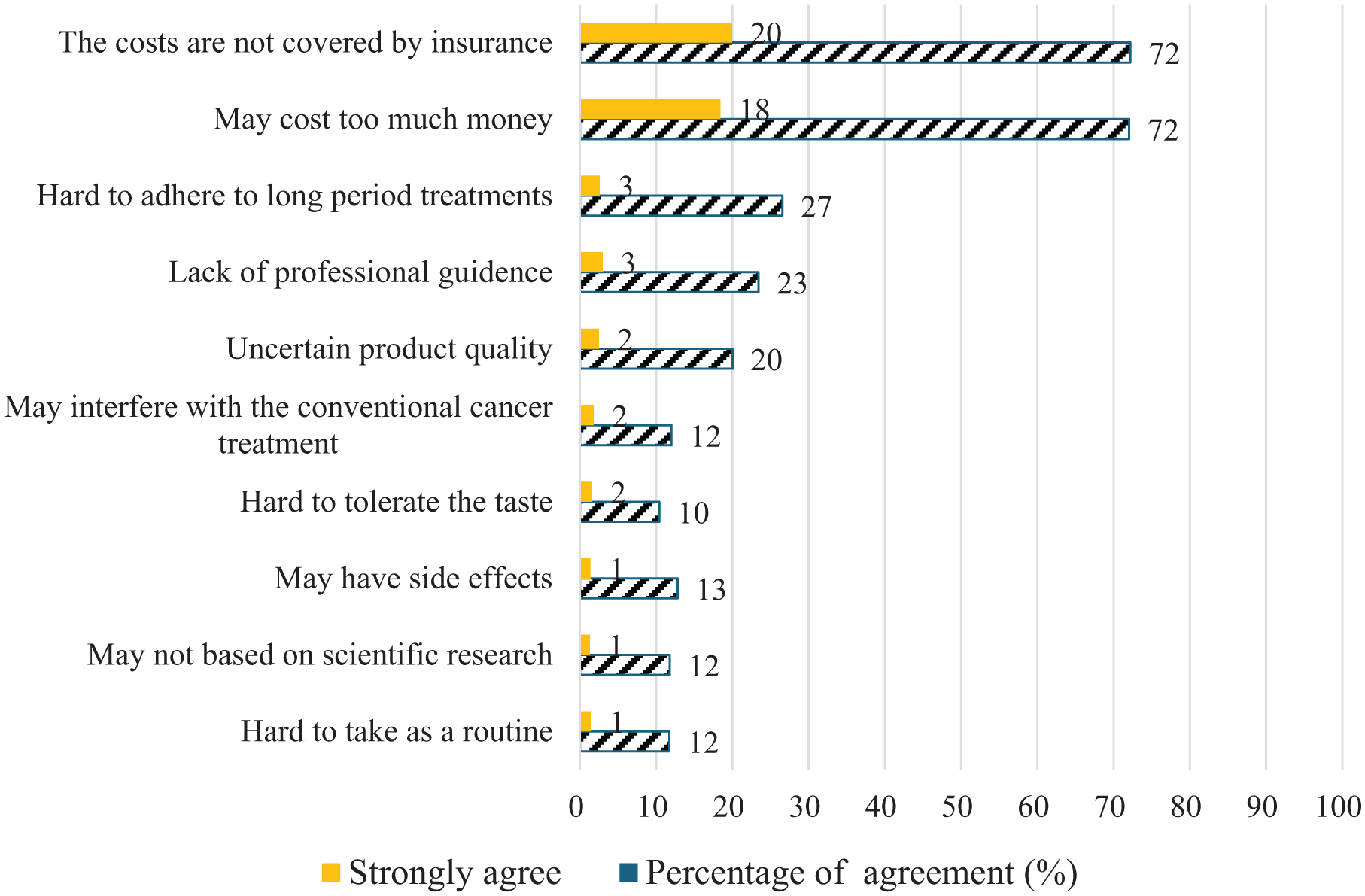
Patients’ barriers toward Reishi.
We further included these 7 potential factors for multivariable linear testing (Table 2b). Among them, cancer stage and time since taking Reishi showed significant differences in barriers scores in the multivariable analysis. Participants with stage I to III cancer were found to have higher barrier scores than participants with stage IV cancer (95% CI = 0.5-5.9, P = .021). Compared with participants who used Reishi for over 5 years, those using Reishi for <1 year (95% CI = 0.9-57, P = .006), 1 to 3 years (95% CI = 0.3-5.4, P = .027), and 3 to 5 years (95% CI = 0.1-4.8, P = .044) experienced significantly higher barriers for Reishi usage.
Discussion
This cross-sectional study is the first to explore patients’ views toward Reishi use in cancer care. Analyzing data from 1374 participants, we identified patterns of Reishi usage, common expectations (boost immune system and improve physical health), common barriers (cost and insurance coverage), and factors influencing patient views toward Reishi use (cancer stage and years since taking Reishi). These findings can help clinicians better understand potential unmet needs—such as insurance coverage, patient-provider communication, and healthcare access—in cancer care that patients are attempting to address through Reishi and possibly other herbs and dietary supplements.
In our study, nearly half of patients have used Reishi for more than 5 years, and the top 2 expectations for using it are to boost their immune system and improve physical health. This study contrasts slightly with expectations toward other integrative health modalities, such as acupuncture, for which patients have expectations of benefit for more specific symptoms, like pain or fatigue, rather than global benefits related to immunity and general physical health. 17 Our findings align more closely with those of another cross-sectional study that examined patients’ expectations for using Traditional Chinese Medicine in general 2 ; this other study similarly found that over 95% of patients expected TCM to improve immunity and physical health. There is preliminary research suggesting that Reishi could potentially have immune-modulating effects in healthy adults; however rigorous trials are needed in the cancer population.11,18 There are limited studies that have investigated its effects on physical health in cancer patients. A pilot randomized trial of non-small cell lung cancer patients on chemotherapy did not find significant differences in quality of life relative to placebo, although Reishi appears to be safe and have minimal toxicity. 19 Further research is needed to confirm whether patients’ expectations about immunity or other health benefits of Reishi are supported by the scientific evidence.
Our study also found that patients with metastatic and advanced stages of cancer had higher expectation of benefit from Reishi. This population often experiences more cancer- and treatment-related side effects and toxicities but has limited treatment options available. Prior research has shown that higher symptom burden is associated with higher interest in using complementary or integrative health therapies, which could potentially explain these study findings. 20 Additionally, although treatment strategies for patients with advanced cancer in China follow standard oncology guidelines (eg, National Comprehensive Cancer Network [NCCN]), 21 insurance coverage for these treatments—particularly newer, innovative therapies—varies depending on geographic region (eg, urban vs rural), employment status, and hospital level.22 -24 Inadequate insurance coverage may also lead some patients to seek help from Reishi or other traditional medicine modalities. Another clinical characteristic associated with higher expectation of benefit from Reishi is use of Reishi for 5 or more years. However, long-term data on Reishi use is lacking, particularly with regards to the additional benefits and risks from prolonged use, as well as safety considerations. 11 It is critical to examine dosing and treatment course in future trials to determine the optimal length of time for maximum benefit and minimum risk.
In our study, high costs and lack of insurance coverage were the most common barriers to Reishi use. This is not surprising, as these economic factors are also the most reported barriers to accessing other integrative health modalities, such as acupuncture.25,26 Some estimates indicate patients spend more than $32 billion annually on dietary supplements. 27 Financial toxicity is a growing concern in cancer populations.28,29 Healthcare professionals should help guide cost-benefit discussions with patients to mitigate the risks of financial toxicity.
Meanwhile, surprisingly, only around 10% of patients were concerned about the side effects and research evidence of Reishi. This suggests that patients may use Reishi based on their personal beliefs. It may also be associated with the fact that the study population was relatively older and had lower education levels compared to a nationally representative cancer population. 30 This lack of awareness could lead to the misuse of herbal medicines, including Reishi. Additionally, in an analysis of 30 dietary supplements marketed for immune health during the pandemic, 57% had inaccurate labels, and 43% had listed ingredients that were not detected on third-party lab testing. Due to the lack of regulations and limited evidence, caution is warranted with regards to Reishi use, and expectations should be tempered by a balanced discussion of the evidence with medical professionals. Of note, our study found that only 20% of patients received information about Reishi from doctors. Indeed, previous studies have shown that patients with lower levels of trust in healthcare system/professionals are more likely to seek care from CAM therapists including herbal medicine.31,32 Poor communication or dissatisfaction with conventional care may also lead to underreporting or non-disclosure of CAM use. 33 Healthcare professionals should play an active role in building trust and guiding supplement use, particularly as our study also revealed over half of patients are using Reishi with other TCM herbs, thereby increasing the risk of harmful herb-drug interactions. Rigorous research is needed on the wide range of other factors that may drive patients to use Reishi.
Our study has several limitations. First, our participants were predominantly older and female. Individuals who are younger and male may have varying attitudes and barriers toward Reishi. Second, because the study was conducted in China—where TCM is more culturally and clinically integrated into cancer care—Reishi use may have been influenced by participants’ familiarity with or preference for TCM. As reflected in our findings, over half of the participants took other TCM herbs alongside Reishi. This suggests that Reishi use in this context reflects not only personal choice, but also broader cultural practices in integrative cancer care, which may differ from those in other cultural settings. Third, all participants in this survey were consumers of Reishi products, which may have led to higher expectations and fewer perceived barriers compared to individuals who do not take Reishi. Our study sample was also drawn from a company database with a pre-existing customer relationships, so participants may have been more engaged and willing to respond, as reflected by our high survey response rate relative to other Chinese public health studies. Similarly, since all participants used Reishi products from Zhongke Health International LLC, their attitudes may differ from those who choose products from other companies. The above factors may all affect the generalizability of our findings. Finally, most participants were long-term Reishi users, which may introduce selection bias, resulting in more positive attitudes toward Reishi. However, we examined the impact of duration of Reishi use on patients’ expectations and perceived barriers to account for this potential bias.
Despite these limitations, our study utilized a large sample size and validated surveys to examine cancer patients’ attitudes toward Reishi, one of the most widely used herbal supplements in cancer care. The findings may help improve clinician-patient communication by addressing patients’ needs and providing proper education on herbal supplement use. Additionally, the results highlight the need for further research to align with patient expectations, particularly regarding Reishi’s potential effects on immune system support and physical health, to promote evidence-based use of herbal supplements.
Footnotes
Acknowledgements
We are grateful to the participants for their participation and to the research staff for their support in this study.

Ethical Considerations
This study was approved by the Ethics Committee of Xiyuan Hospital, China Academy of Chinese Medical Sciences (2022-XLA129-1).
Consent to Participate
Trained research personnel reached out to potential participants to confirm eligibility, explain the study aims and procedures, and obtain oral or written consent using phone or the Chinese messaging tool WeChat.
Author Contributions
Xiaotong Li: Conceptualization, Formal analysis, Methodology, Writing – original draft. Anna Ye: Writing – original draft. Eunbin Kwag: Writing – review and editing. Jerrin Bawa: Writing – original draft. Lingyun Sun: Writing – review and editing. Susan Q. Li: Data curation. Yajia Zhou: Resources. Jun J. Mao: Conceptualization, Methodology, Data curation, Supervision, Funding acquisition, Writing – review and editing. Kevin T. Liou: Supervision, Writing – review and editing.
Funding
The author(s) disclosed receipt of the following financial support for the research, authorship, and/or publication of this article: Laurance S. Rockefeller Fund supported the Herbal Research and Education in Oncology program at the MSK Integrative Medicine Service. The study was partly sponsored by the National Institutes of Health/National Cancer Institute Cancer Center grant (number P30 CA008748) and Zhongke Health International LLC.
Declaration of Conflicting Interests
The author(s) declared the following potential conflicts of interest with respect to the research, authorship, and/or publication of this article: Jun J. Mao reports grants from Tibet Cheezheng Tibetan Medicine Co Ltd and Zhongke Health International LLC outside the submitted work. Kevin T. Liou is supported by a grant from the National Cancer Institute at the National Institutes of Health (K08CA266927). Dr. Feng is a co-author of this paper and serves as the Chief Engineer of Zhongke Health Industry Group Corp., Ltd. The author’s role in the company did not influence the design, execution, or interpretation of the study results. All other authors declare no conflicts of interest related to this research.
Data Availability Statement
The data of this study will be available from the corresponding author upon reasonable request.