



Abstract
Background:
Empirical evidence shows that life satisfaction is positively related to character strengths, and although this association has been observed in different populations, it is scarce in breast cancer patients. This study analyzes the relationship between character strengths and life satisfaction in Spanish women diagnosed with breast cancer.
Methods:
A sample of 117 women completed the Satisfaction with Life Scale (SWLS) and the Spanish version of the VIA Inventory of Strengths (VIA-IS). Correlation analysis and regression modeling were performed to determine which strengths predict life satisfaction.
Results:
The results of the correlation analysis showed that 15 strengths were positively and significantly associated with life satisfaction, with the highest correlations corresponding to zest, hope, curiosity, social intelligence, love, gratitude, and judgment. Regression modeling indicated that of these, zest and hope were key strengths for predicting life satisfaction.
Conclusions:
These findings suggest that intervention programs based on the development of zest and hope could help to improve life satisfaction and, therefore, the psychological well-being of women with breast cancer.
Breast cancer had the highest incidence rate for types of cancer worldwide in 2020. 1 A diagnosis of breast cancer usually produces emotional distress2-4 that affects subjective well-being.5-7 Two closely related components define subjective well-being: affective and cognitive. The first concerns a person’s emotional reactions to life events and represents the balance between positive and negative affect. 8 The cognitive component refers to life satisfaction, defined as a person’s evaluation of their life as a whole, 9 in which actual life circumstances and achievements are compared with previous personal expectations. 10
One of the most widely used instruments for assessing life satisfaction is the Satisfaction with Life Scale (SWLS). 11 Studies in several different populations have found that SWLS scores are positively associated with positive affect, 12 optimism, 13 emotional intelligence, 14 and self-esteem. 15 Scores on the SWLS have also been negatively associated with scores on perceived stress, anxiety, and depression,12,16,17 as well as negative affect, 16 pessimism, 13 and aggressive behavior. 18
Some research with breast cancer patients has found higher levels of life satisfaction among women who are older,19,20 married,17,21 living in urban areas, 20 or who have undergone breast-conserving surgery. 22 Women with high scores on of life satisfaction also tend to have high scores on positive affect, flourishing, optimism, emotional intelligence, resilience, self-esteem, social support, and adaptive reactions during survival.21,23-27 Conversely, they tend to show lower levels of negative affect, depression, anxiety, stress, pessimism, and fear of recurrence.23-25
Empirical evidence shows that life satisfaction is positively related to character strengths, and this association has been observed in different populations. 28 Character strengths refer to positive traits that express our core values and which are reflected in thoughts, feelings, and behaviors. They are considered to be universal and to remain relatively stable over time but susceptible to change through psychological interventions. 29 The Values in Action Classification of Strengths (VIA) was developed by Peterson and Seligman 30 to classify psychological strengths and to encourage research aimed at identifying and enhancing positive qualities in people. This classification includes 24 strengths grouped into 6 universal virtues: (1) wisdom and knowledge, comprising judgment, creativity, perspective, love of learning, and curiosity; (2) courage, composed of bravery, persistence, authenticity, and zest; (3) humanity, comprising social intelligence, kindness, and love; (4) justice, composed of leadership, fairness, and teamwork; (5) temperance, composed of self-regulation, forgiveness, modesty, and prudence; and (6) transcendence, comprising hope, gratitude, spirituality, humor, and appreciation of beauty and excellence.
A great deal of research has been conducted on the relationship between character strengths and health. The strengths of the heart, such as hope, gratitude, zest, curiosity, and love, 31 have been found to be important predictors of life satisfaction 28 and they are negatively associated with depression, anxiety, and stress. 32 These associations have been observed in different populations.31,33-37 For example, research with informal caregivers of patients with dementia found that gratitude, zest, love, and hope were positively associated with life satisfaction and negatively with caregiving burden, although the most relevant strength in this respect was hope.34,35 Research with adolescents has observed a similar relationship between hope and life satisfaction.31,33,36,37 In people with physical illness, higher levels of zest, hope, and leadership were found to be related to fewer problems of depression and anxiety, whereas bravery, humor, and kindness were associated with the recovery of satisfaction with life. 38
Regarding women with breast cancer, studies analyzing the association between character strengths and life satisfaction are scarce. However, there is some evidence that interventions based on positive psychology can increase the quality of life and life satisfaction of these women.39-44 For example, Casellas-Grau et al 40 carried out a systematic review on positive psychology interventions in breast cancer patients and found that mindfulness-based approaches, expression of positive emotions, spiritual interventions, hope therapy, and meaning-making interventions enhanced quality of life, well-being, hope, benefit finding, and optimism. In addition, according to Peterson et al 38 strengths are involved in promoting both resilience in the face of adversity and adaptive coping with physical illness. Therefore, knowing which strengths are related to greater life satisfaction could serve as a basis for designing more effective and efficient intervention programs based on character strengths-based programs to help women with breast cancer cope better with the disease. The aim of the present study was to determine which character strengths are positively related to life satisfaction in women diagnosed with breast cancer. Based on the empirical evidence, we expected to find, in general, a positive association between strengths and life satisfaction, and in particular with the strengths of hope, gratitude, curiosity, zest, and love.
Method
Participants
The sample was composed of 117 Spanish women with a diagnosis of breast cancer. Age ranged from 31 to 75 years (M = 51.45, SD =8.80), age at diagnosis ranged between 30.25 and 69.50 years (M = 47.33, SD = 8.59), with a mean time since diagnosis equal to 4.13 years (SD = 5.37). Participants were recruited through ASAMMA, an association providing support and advice to women who have undergone breast cancer surgery. To participate in the study, women had to have a diagnosis of breast cancer, not have a diagnosis of any other cancer, and have signed the informed consent. Table 1 shows descriptive characteristics of the sample.
Characteristics of the Sample (N = 117).

Instruments
Data were first collected regarding the sociodemographic and disease-related variables that are shown in Table 1.
Character strengths were explored using the 72-item Spanish version of the VIA Inventory of Strengths (VIA-IS),30,45 validated by the VIA Institute (www.viacharacter.org). Three items assess each character strength on a 5-point Likert-type scale. The score for each strength is the mean of scores on its 3 corresponding items, and thus ranges from 1 to 5. Higher scores reflect a greater presence of that strength. Cronbach’s α coefficients ranged from .34 (self-regulation) to .77 (zest), with 71% of coefficients being above .60.
Life satisfaction was assessed with the Spanish version 46 of the Satisfaction with Life Scale (SWLS), 11 which has been validated with cancer patients. 24 The SWLS comprises 5 items, each rated on a Likert-type scale ranging from 1 (strongly disagree) to 7 (strongly agree). High scores reflect high level satisfaction with life. Cronbach’s alpha coefficient was .82.
Procedure
This study was conducted in agreement with the Declaration of Helsinki, being approved by the Ethics Committee of the University of Malaga, Spain. The ASAMMA psychologist contacted the participants who voluntarily agreed to take part in the study. None of those invited declined to participate. All of them signed the informed consent and were informed about the objectives of the study. The 2 questionnaires were then completed in a single session lasting approximately 30 minutes, supervised by a psychologist.
Data Analysis
We began by conducting a descriptive statistical analysis of scores on the VIA-IS and SWLS. Pearson correlation coefficients between SWLS and VIA-IS scores were then calculated to analyze the relationship between life satisfaction and strengths. According to Cohen’s criterion, we considered correlation coefficient values of |.10| as weak, |.30| as moderate and |.50| as strong association. 47 Finally, and to identify which strengths predict life satisfaction, we performed a regression modeling to eliminate the overlap between them. In the regression modeling, each strength was entered in a stepwise fashion, with sociodemographic and disease variables as control variables. In the first step, the following predictors were entered (model 1): age; marital status (0 = single, divorced, widowed; 1 = married); primary education (0 = other; 1 = primary); secondary education (0 = other; 1 = secondary); employment status (0 = homemaker, unemployed, sick leave, retired; 1 = employed); time of diagnosis in years; treatment received: chemotherapy (0 = no, 1 = yes), radiotherapy (0 = no; 1 = yes), endocrine therapy (0 = no; 1 = yes), monoclonal antibody (0 = no; 1 = yes); and lymphedema as a sequela (0 = no; 1 = yes). In subsequent steps, each strength with an association with life satisfaction greater than | .30 | was entered into the model, starting with the one with the highest correlation value. The contribution of the predictor was evaluated by the change in R2 at each step. If the increase in R2 was statistically significant, the strength was incorporated into the regression model. If the increase in R2 was not significant, the next predictor was introduced.
Results
The descriptive statistics for scores on the VIA-IS and SWLS are shown in Table 2. The correlations between them are shown in Table 3. The correlation of 15 strengths with life satisfaction were positive and statistically significant, although only 7 yielded a moderate or strong correlation above the |.30| cutoff: zest, hope, curiosity, social intelligence, love, gratitude, and judgment. These were the strengths that were therefore entered as predictors in the regression modeling.
Mean and Standard Deviation for Life satisfaction and Character Strengths (N = 117).

Pearson Correlations Between Life Satisfaction and Character Strengths (N = 117).
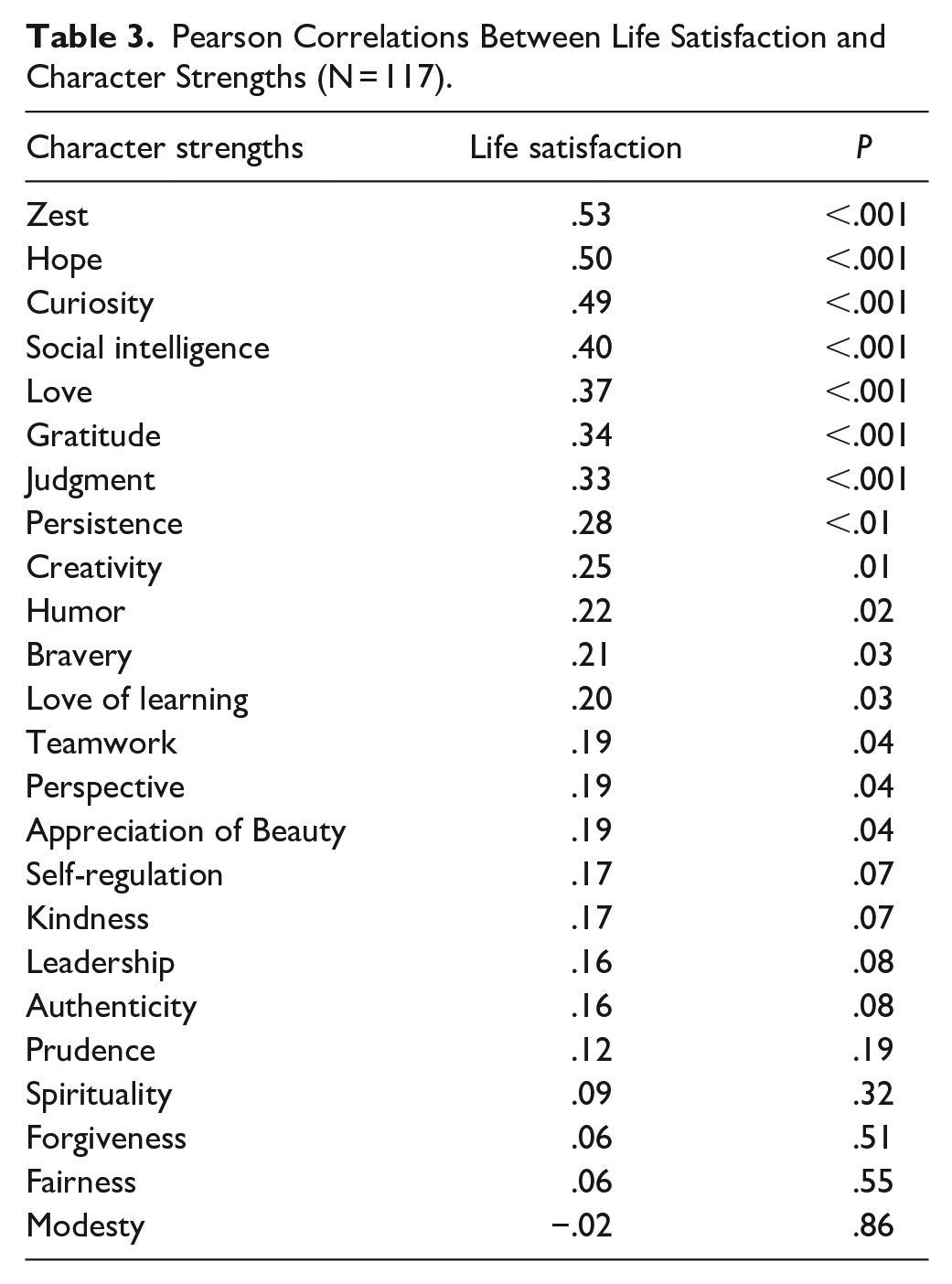
Table 4 shows the results of each step in the regression modeling. Model 3 was the selected model, with the strengths of zest and hope being statistically significant, yielding an R2 equal to .38 and F (14, 102) = 4.41, P < .001.
Model Comparison With Life Satisfaction as Dependent Variable (N = 117).

Selected model.
Table 5 displays the results for the final model. Among the control variables, only educational level was statistically significant, indicating that women with breast cancer with a low educational level tend to score lower on life satisfaction. The results also show that zest and hope are positively associated with life satisfaction.
Results of the Regression Analysis (Model 3) With Life Satisfaction as the Dependent Variable (N = 117).

Discussion
The aim of this study was to determine which strengths are related to life satisfaction in women diagnosed with breast cancer. We first conducted a correlation analysis between satisfaction with life and the strengths described in the VIA-IS. Here we expected to find, in general, a positive association between life satisfaction and strengths, and in particular, a stronger relationship with strengths of the heart. To eliminate overlap between strengths, regression modeling was performed, adding in stepwise fashion each strength whose correlation with life satisfaction was greater than |.30|, and considering sociodemographic and disease-related characteristics as control variables.
Overall, and in line with our expectations, the results showed positive correlations between life satisfaction and strengths. Specifically, 15 strengths yielded a statistically significant correlation with life satisfaction: zest, hope, curiosity, social intelligence, love, gratitude, judgment, persistence, creativity, humor, bravery, love of learning, teamwork, perspective, and appreciation of beauty and excellence. Of these, 7 showed a moderate or strong correlation above |.30|: zest, hope, curiosity, social intelligence, love, gratitude, and judgment. These results are consistent with previous studies showing that strengths of the heart are important predictors of life satisfaction 29 and are negatively related to depression, anxiety, and stress.32,48 Our findings therefore add to knowledge about the relationship between life satisfaction and strengths, in this case in women diagnosed with breast cancer.
Regression modeling identified educational level, zest, and hope as the best predictors of life satisfaction. Regarding educational level, the results showed that women with breast cancer who have only completed primary education tend to have a lower level of life satisfaction than do those with a higher level of education. This relationship has not been reported previously in either the general population 49 or in breast cancer patients.19-21 It is possible that women with only primary education also have a lower socioeconomic status and fewer psychosocial resources, which could lead to a lower level of subjective well-being. Further research is needed to clarify these issues with a larger sample of women with breast cancer.
Regarding zest, the results indicated that women with higher levels of this strength tend to show greater life satisfaction. Within the VIA classification, zest is associated with the virtue of courage and it is defined as approaching a specific situation or life in general with enthusiasm and energy. 29 Therefore, people with a high level of zest generally feel more activated and motivated when living their lives. Zest has been shown to be positively related to high engagement with life and negatively related to anxiety and boredom, 50 and it appears to be a protective variable for suicide in young people and a characteristic related to resilience. 51 Recently, research has found that zest plays a relevant role in buffering pain in breast cancer patients. 52 According to Park et al, 29 zest is related to high satisfaction with life because individuals who possess this strength focus on the “here and now.”
Regarding hope, the results showed that women with higher levels of this strength tend to report greater life satisfaction. In the VIA classification, hope is linked to the virtue of transcendence and it is defined as having optimistic thinking, that is, hoping for the best in the future and focusing on the good that is to come. 29 Hope is an action-oriented strength, as it implies motivation and confidence that desired goals can be achieved. Our findings here are consistent with previous research in different populations showing that hope is positively related to life satisfaction, well-being,33,35,37 happiness,28,29,48 physical and mental health, 53 and quality of life, 54 and also that it mitigates the negative consequences of trauma and stress. 55 In women with breast cancer, higher levels of hope have been linked to better quality of life 56 and lower levels of perceived stress. 57 The present results therefore corroborate the key role that hope plays in life satisfaction and support those studies that highlight its relevance to emotional adjustment across the lifespan.
Previous research has found that certain personality profiles are related to how an individual copes with breast cancer. In this regard, Cerezo et al 7 identified 2 personality profiles: the first was characterized by adequate psychological adjustment, without psychopathology or anxiety symptoms, with higher levels of optimism, life satisfaction, and positive affect, and lower levels of negative affect; the second was characterized by a tendency toward somatoform disorder, dysthymia or bipolarity, and anxiety symptoms, with lower scores on the above-mentioned positive psychological variables and higher scores on negative affect. Other recent studies have similarly found that women with breast cancer who show a greater tendency to experience positive emotions, with higher levels of self-esteem, optimism, and clarity and emotional regulation, also score higher on resilience or life satisfaction.5,23,24 Our results here add to current knowledge in this respect, identifying the strengths of hope and zest as personality traits that may be associated with better coping with the cancer experience and greater psychological adjustment. An interesting focus for future research would therefore be to analyze the relationship between these strengths and other mental health indicators, such as anxiety or depression, and also to study their possible role as mediators or moderators in the relationship between stressors associated with breast cancer and these health indicators.
According to Proyer et al, 58 strengths-based interventions should focus primarily on those strengths with high correlation with life satisfaction. The present research may therefore have important clinical implications, insofar as it suggests that the well-being of women with breast cancer could be enhanced through interventions built around developing the strengths of hope and zest. Some psychological interventions aimed at increasing hope among cancer patients have been described in the literature. For example, Rustøen et al 44 developed HOPE-IN, focused on belief in oneself and in one’s own competence and performance in life. More recently, Berg et al 39 developed the AWAKE program to promote hope and quality of life in young adult cancer survivors. This 8-week program consists of educational videos, mood and activity level monitoring sessions, and telephone counseling. The results of these studies highlight hope as a key element in coping with the aftermath of cancer and re-establishing life goals.
It is important to note that the above-mentioned studies were carried out with cancer patients in general, not specifically women with breast cancer, and hence further research targeting this population is needed. Furthermore, although some therapeutic activities designed to build hope may also have an impact on zest, specific components aimed at promoting the latter would need to be added to intervention programs. To our knowledge, there are no specific zest intervention protocols for people diagnosed with cancer, although they do exist for other populations such as those with chronic pain. In this context, Graziosi et al 59 found that those individuals who focused on zest in their day-to-day lives experienced less interference with their functioning due to pain. More generally, Uliaszek et al 60 proposed that zest can be developed with behavioral activation techniques that relate to people’s interests, hobbies, and talents.
The present study has several limitations. First, we used self-report questionnaires to collect data, which may lead to response bias. Second, patients were chosen by convenience sampling through a specific patient support association, which may restrict the generalizability of the results. And third, causal relationships between strengths and life satisfaction cannot be established, given the correlational nature of the study.
In conclusion, this study extends knowledge about which variables are related to life satisfaction in women diagnosed with breast cancer, identifying zest and hope as key character strengths that may play a protective role in the face of difficulties during this disease. In practical terms, this suggests that those women who live their life with enthusiasm and energy, who hope for the best in the future, and who set goals and take action to achieve them are likely to have higher levels of life satisfaction. The 2 strengths of zest and hope could therefore be key elements in the design of positive psychology-based interventions aimed at increasing and improving well-being among women with breast cancer. More specifically, interventions should include activities that help them to set goals, establish ways of achieving them, and approach life with enthusiasm and energy. Future research should design and test the effectiveness of a psychological intervention that includes activities based on the strengths of zest and hope in women with breast cancer.
Research Data
sj-docx-1-ict-10.1177_15347354231197648 – Supplemental material for Life Satisfaction and Character Strengths in Women With Breast Cancer: Zest and Hope as Predictors
sj-docx-1-ict-10.1177_15347354231197648 for Life Satisfaction and Character Strengths in Women With Breast Cancer: Zest and Hope as Predictors by Lorena M. Soria-Reyes, M. Victoria Cerezo, Paula Molina and María J. Blanca in Integrative Cancer Therapies
Footnotes
Declaration of Conflicting Interests
The author(s) declared no potential conflicts of interest with respect to the research, authorship, and/or publication of this article.
Funding
The author(s) disclosed receipt of the following financial support for the research, authorship, and/or publication of this article: This study was supported Grupo de investigación consolidado CTS-110, Junta de Andalucía.
Ethics Approval Statement
This study followed the ethical standards of the Declaration of Helsinki and was approved by the Experimentation Ethics Committee of the University of Malaga (55-2017 H).
Informed Consent
All participants signed the informed consent to participate in the study.

Data Availability Statement
“The current article is accompanied by the relevant raw data generated during and/or analyzed during the study, including files detailing the analyses and either the complete database or other relevant raw data. These files are available in the Figshare repository and accessible as Supplemental Material via the SAGE Journals platform. Ethics approval, participant permissions, and all other relevant approvals were granted for this data sharing.”
References
Supplementary Material
Please find the following supplemental material available below.
For Open Access articles published under a Creative Commons License, all supplemental material carries the same license as the article it is associated with.
For non-Open Access articles published, all supplemental material carries a non-exclusive license, and permission requests for re-use of supplemental material or any part of supplemental material shall be sent directly to the copyright owner as specified in the copyright notice associated with the article.
