



Abstract
Background:
Baduanjin exercise is a traditional Chinese Qigong exercise. This study aimed to investigate the effects of Baduanjin exercise on the quality of life and psychological status of postoperative patients with breast cancer.
Methods:
A systematic review and meta-analysis were conducted. Eight databases were searched from inception to December 15, 2021, restricting the language to English and Chinese. RevMan5.3 software was employed for data analysis. This study was registered in PROSPERO, number CRD 42020222132.
Results:
A total of 7 randomized controlled trials (RCTs) with 450 postoperative breast cancer patients with or without Baduanjin exercise were collected. Compared with the group without Baduanjin, those who practiced Baduanjin showed significant improvement in quality of life (WMD = 5.70, 95% CI 3.11-8.29, P < .0001). Subgroup analysis showed significant improvement in physical (WMD = 1.83, 95% CI 1.13-2.53, P < .00001) and functional well-being (WMD = 1.58, 95% CI 0.77-2.39, P = .0001), which were measured by the functional assessment of cancer therapy-breast (FACT-B). Subgroup analysis also showed that role-physical (WMD = 11.49, 95% CI 8.86-14.13, P < .00001) and vitality (WMD = 8.58, 95% CI 5.60-11.56, P < .00001) were significantly increased, as measured by a 36-item Short Form survey (SF-36). In terms of psychological health, Baduanjin exercise reduced patients’ anxiety (WMD = −8.02, 95% CI −9.27 to −6.78, P < .00001) and depression (WMD = −4.45, 95% CI −5.62 to −3.28, P < .00001).
Conclusions:
Baduanjin is an effective exercise, which can significantly improve the quality of life and psychological health of breast cancer patients after operation.
Introduction
Globally, breast cancer is the most common cancer in women, with roughly 2.3 million new cases worldwide in 2020. 1 Though the mortality rate of breast cancer is not exceptionally high, its economic and social burdens are significant, especially in countries with a low social-development index.2,3 As research has shown, breast cancer survivors are more likely to have worse quality of life (QOL) and mental health.4,5
Surgery (breast-conserving and total mastectomy), chemotherapy, and radiotherapy are conventional treatment methods for breast cancer.6-8 These therapies, however, may lead to complications in breast cancer survivors.9,10 In particular, recent studies have shown that surgery may cause sleep disturbance, life-threatening hemorrhage or infection, skin flap necrosis, and articular impairments.8,11-14 With the negative influence of these complications, postoperative patients are at higher risks of suffering from low QOL, anxiety, and depression.15-17 To address these QOL and mental health challenges, Baduanjin exercise, which is a traditional Chinese Health Qigong, has been proposed as a cost-effective treatment for postoperative patients.18-20
Baduanjin, sometimes referred as the 8 Section Brocade, includes 8 sections of movements to be conducted routinely. It is a combination of breathing and body movement fitness methods. Compared with traditional exercises, Baduanjin focuses more on improving body strength and psychological construction by developing balanced maintenance of body and mind.21,22 Furthermore, Baduanjin exercise is easy to learn and practice without equipment or field restrictions.23-25 After the establishment of the Chinese Health Qigong Association (CHQA), Baduanjin has been improved to meet the needs of many individuals, even those experiencing physical or psychological illnesses. 26 One study examining the effects of Baduanjin on postoperative dyspnea patients, for example, showed that Baduanjin exercise can help patients recover. 27 Hence, Baduanjin has been proposed as a potentially cost-effective form of palliative care for postoperative patients without any side effects compared to traditional therapies.
Previous studies have shown that Qigong can improve the QOL of breast cancer patients after chemotherapy.28,29 Meng et al 30 also found that Qigong was beneficial for improving the QOL and mental status of women with breast cancer. However, limited studies have investigated the effects of Baduanjin exercise as well as the comparative impact of different intervention times on postoperative patients with breast cancer. To fill this research gap, this study systematically reviewed randomized controlled trials (RCTs) to explore the efficacy and safety (adverse events) of Baduanjin on the QOL and psychological status of postoperative patients with breast cancer.
Methods
Study Registration
This systematic review and meta-analysis follows the Preferred Reporting Items for Systematic Reviews and Meta-analyses (PRISMA). The details are shown in Supplemental Table 1. The protocol for this systematic review was registered on PROSPERO, number CRD 42020222132.
Search Strategy
The following databases were searched up to December 15, 2021: PubMed, Web of Science, Scopus, the Cochrane Library, China National Knowledge Infrastructure (CNKI), Chinese Scientific Journal Database (VIP), Wanfang Data, and Chinese Biomedical Literature Database (CBMDisc). In addition, the reference lists of all included articles were also been reviewed. The final search was conducted using relevant keywords, including Baduanjin, 8 trigrams boxing, 8 brocade, Qigong, breast cancer, and breast neoplasm. A detailed description of the search strategies is presented in Supplemental Table 2.
Selection Criteria
In selecting studies to be included in the systematic review and meta-analysis, the following inclusion criteria were used:
the study used a RCT design;
Study participants were postoperative patients with breast cancer, regardless of nationality, race, and age;
the study intervention included Baduanjin exercise; and the intervention group was compared with a suitable control group (eg, routine rehabilitation training, routine health education, psychological nursing, diet nursing, medication guidance, etc.).
the study measured outcome indicators of interest and utilized validated measurement tools.
The primary outcome in this systematic review was QOL, as measured by valid instruments such as the Functional Assessment of Cancer Therapy for Breast Cancer (FACT-B) scale and the Medical Outcomes Study 36-item Short Form survey (SF-36). The FACT-B scale is specifically designed for breast cancer patients. It contains 36 items divided into 5 domains (physical well-being, social well-being, emotional well-being, functional well-being, and the breast cancer-specific subscale) that are used for assessing QOL in patients after breast cancer surgery.31,32 Scores for each item range from 0 to 4, with corresponding answer options of “not at all,” “a little bit,” “somewhat,” “quite a bit,” and “very much.” Higher scores indicate better QOL. Additionally, SF-36, 33 which assesses physical functioning, role-physical, bodily pain, general health, vitality, social functioning, role-emotional, mental health, and reported health transition, is used to evaluate QOL. Higher scores reflect better QOL.
The secondary outcomes were psychological indicators, as measured by the Self-Rating Anxiety Scale (SAS) and Self-Rating Depression Scale (SDS). The SAS is a 20-item self-reported questionnaire used to evaluate anxiety. It is a commonly used scale with convincing results and broad adoption among clinicians.34,35 Each item has a score of 1 to 4. Option “1” means “has little or no time”; “2” means “has little time”; “3” means “has much time”; “4” means “has most or all of the time.” Patients with higher scores are more anxious. The SDS, 36 the assessment for depression, is similar to that for anxiety, but the scale for evaluation are different. The SDS consists of 20 items, with each item asking respondents how often they have encountered certain feelings or symptoms in the previous week. This scale contains 10 inverse scoring questions. Questions A, B, C, and D are based on 1, 2, 3, and 4 points, while the reverse score is based on 4, 3, 2, and 1. The total score ranges from 20 to 80. A higher score indicates greater depression.
Beyond the above inclusion criteria, this study used the following exclusion criteria: (1) studies in which Baduanjin was combined with other types of exercises; and (2) studies with less than 10 patients.
Literature Selection and Quality Assessment
Two reviewers (Ren ZY and Song Y) independently screened titles and abstracts, eliminated articles that did not meet the inclusion criteria, and read the full text. Finally, articles that met the inclusion criteria were obtained. The Cochrane Handbook Tool 5.1.0 was used to judge the risk of bias for each article, and the risk of bias was graded as high, low, or unclear. 37 The tool included the following domains: random sequence generation, allocation concealment, blinding, incomplete outcome data, selective reporting, and other biases. The quality of each article was also judged based on agreement between 2 reviewers (Ren ZY and Song Y) or after consultation with a third reviewer (Ye XX).
Data Extraction
Two reviewers (Ren ZY and Song Y) independently extracted data with an Excel table, including the following information: general information about the article (author, published year, study design, and study setting); patient characteristics (sample size and age); intervention group (intensity and duration); control group; intervention time; main outcomes; and other related findings. If any disagreements occurred between the 2 reviewers, then a third reviewer (Ye XX) joined the discussion or participated in finding a solution.
Statistical Analysis
The RevMan5.3 software from the Cochrane Collaboration was used for statistical analysis. The estimates, that is, weighted mean difference (WMD) with 95% confidence interval (95% CI), were pooled with a fixed-effects model if no statistical heterogeneity was present. If P < .05 and I 2 > 50%, then statistical heterogeneity was present. Subgroup analysis of heterogeneity was performed to reduce the heterogeneity. If the heterogeneity was still large, then the random effects model was used for analysis.
GRADE Quality of Meta Evidence
The Grading of Recommendations, Assessment, Development, and Evaluations (GRADE) guidance tools were used to assess the quality of evidence for the meta-analysis results. The GRADE system assesses study risk of bias, publication bias, imprecision, inconsistency, and assigns grading levels of high, moderate, low, and extremely low for each outcome.
Results
Literature Search
Of the 156 articles identified from the database search, 24 potentially eligible articles were retrieved for full-text review. Of them, 17 articles were excluded, because they comprised nonrandomized controlled studies (n = 2), included subjects that did not meet the inclusion criteria (n = 1), had interventions that did not meet the inclusion criteria (n = 8), did not use outcomes of interest (n = 4), were repeated publication (n = 1); or did not have available data (n = 1). A total of 7 papers38-44 met the inclusion criteria and were used for further analysis. The process of review is shown in a flowchart in Figure 1.

The flowchart of the selection for including study.
Study Characteristics
Overall, 7 studies, including 450 postoperative patients with breast cancer, were used in our meta-analysis. These studies were conducted across 6 Chinese provinces, and the ages of the included patients ranged from 32 to 72 years. The specific forms of intervention were different among studies. The intervention times for the postoperative patients with breast cancer ranged from 1 to 6 months. Among them, 2 studies, 2 studies, 1 study, and 1 study had a duration of intervention of 638,41, 339,40,43, 1 44 , and 2 months, respectively. 42 Moreover, the intervention frequency of these studies ranged from 2 to 5 times a week, and the intervention duration lasted for 30 minutes each time. Data on main outcomes, which were obtained using FACT-B, SF-36, SAS, and SDS, were pooled from the aforementioned studies and included in our meta-analysis. Detailed information of the included articles is listed in Table 1.
The Baseline Characteristics of Included Trials.

Abbreviations: CNKI, China national knowledge infrastructure; VIP, Chinese scientific journal database; CBMDisc, Chinese biomedical literature database.
Quality Assessment
A quality assessment of the included articles was conducted to detect bias. Four studies used the random number table method,39,40,42,43 and 1 study used a computer to generate random numbers to select patients. 41 In terms of allocation concealment, 3 out of 7 studies clearly defined the allocation concealment method.41-43 With regard to the blinding method, 2 studies blinded the participants and personnel,41,42 and 2 studies blinded the outcome assessment.41,42 As for incomplete outcome data, 5 out of the 7 included studies specifically described the number and reasons for participants dropping out.39-43 The methodological quality and risk of bias of the included studies are shown in Figure 2.

Risk of bias graph and summary for the including 7 RCTs.
Meta-Analysis of Baduanjin for QOL in Postoperative Patients with Breast Cancer
Five studies38,40-43 measured QOL of postoperative patients with breast cancer by using the scores of FACT-B and SF-36. Of these 5 studies, 4 40-43 assessed QOL with the FACT-B tool. The FACT-B examines the following 5 dimensions: physical well-being, social well-being, emotional well-being, functional well-being, and breast cancer subscale. This article analyzed the 5 dimensions separately. In total, it was found that the Baduanjin exercise significantly increased the FACT-B total scores by using the random-effects model with low heterogeneity (P = .22, I 2 = 35%). Figure 3 shows that the Baduanjin exercise group had higher values than the control group (WMD with 95% CI = 5.70 (3.11, 8.29), P < .0001). Then, a random-effects model analysis was conducted to pool the results of the physical well-being score, and this showed that the Baduanjin exercise group had a significantly higher effect than that of the control group (WMD with 95% CI = 1.83 (1.13, 2.53), P < .00001, I 2 = 0%). But subgroup meta-analyses of the social well-being dimension indicated that no difference existed between the Baduanjin exercise and control groups (random-effects model, P = .02, I 2 = 69%, WMD with 95% CI = 0.04 (−1.46, 1.53), P = .96). For the dimension of emotional well-being, results also showed that no difference could be detected between the Baduanjin exercise and control groups (WMD with 95% CI = 0.95 (−0.10, 2.00), P = .08). Subgroup meta-analyses of functional well-being demonstrated that a significant difference existed between the 2 groups (WMD with 95% CI = 1.58 (0.77, 2.39), P = .0001). Lastly, our meta-analysis indicated that the Baduanjin exercise group (random-effects model, WMD with 95% CI = 0.92 (−0.54, 2.38), P = .22) did not improve breast cancer subscale scores compared with the control group.

FACT-B in postoperative patients with breast cancer with Baduanjin.
Two studies38,43 evaluated QOL of postoperative patients with breast cancer by SF-36 questionnaire. The SF-36 tool includes 8 dimensions, including role-physical, vitality, physical functioning, bodily pain, social functioning, general health, role-mental, and mental health. The subgroup meta-analyses showed that Baduanjin exercise improved QOL of postoperative patients with breast cancer in the dimensions of role-physical (WMD with 95% CI = 11.49 [8.86, 14.13], P < .00001, I 2 = 0%) and vitality (WMD with 95% CI = 8.58 [5.60, 11.56], P < .00001, I 2 = 0%), but no statistical difference was found for physical functioning, bodily pain, social functioning, general health, and mental health (physical functioning: WMD with 95% CI = 0.97 (−1.57, 3.50), P = .45, I 2 = 0%; bodily pain: WMD with 95% CI = 0.81 (−1.97, 3.58), P = .57, I 2 = 0%; social functioning: WMD with 95% CI = −0.50 (−16.91, 15.90), P = .95, I 2 = 62%; general health: WMD with 95% CI = 2.97 (−0.05, 5.99), P = .05, I 2 = 0%; role-mental: WMD with 95% CI = 3.03 (−3.18, 9.24), P = .34, I 2 = 5%; mental health: WMD with 95% CI = 7.47 (−1.01, 15.94), P = .08, I 2 = 75%). The details are shown in Figure 4.
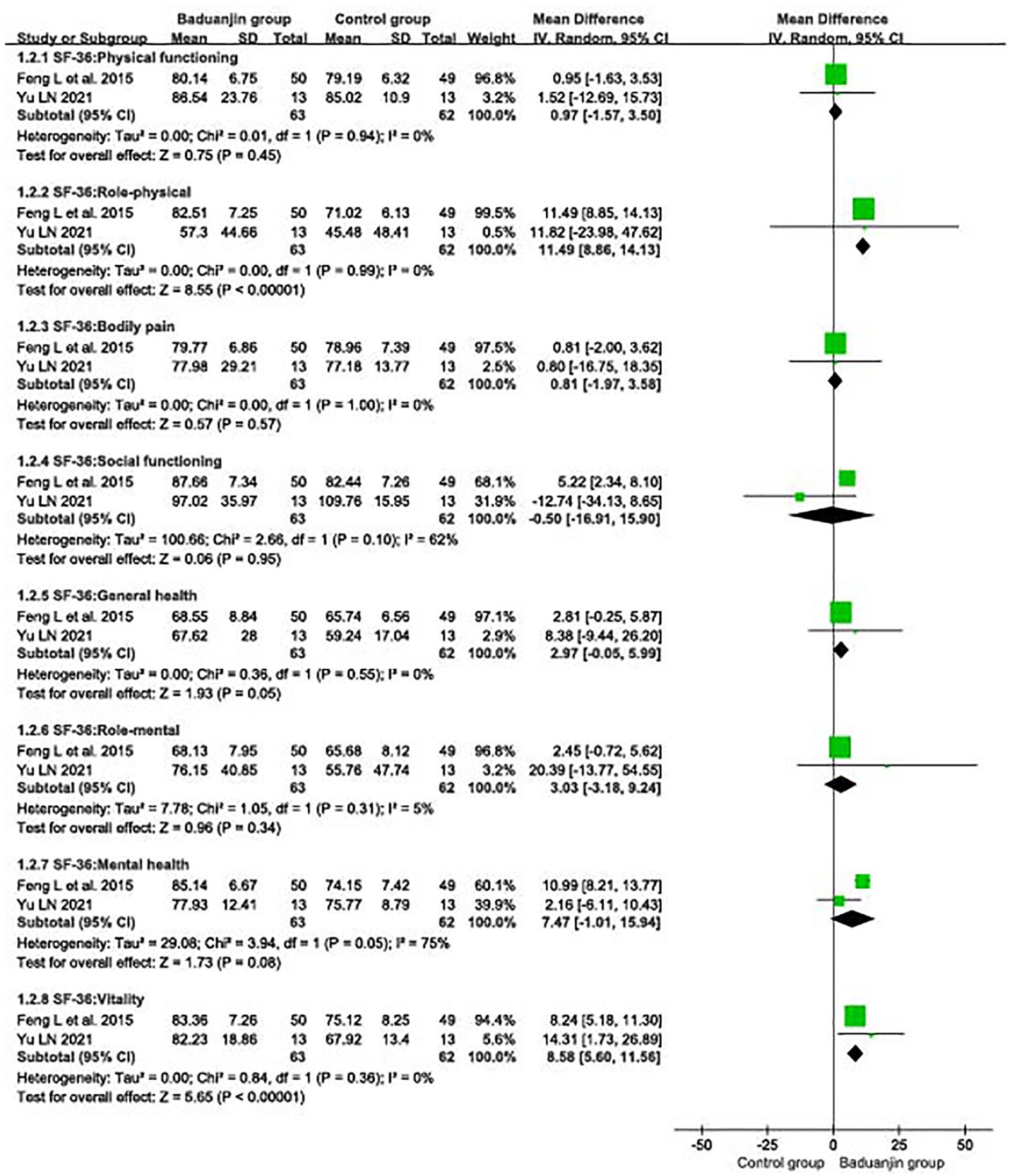
SF-36 in postoperative patients with breast cancer with Baduanjin.
Meta-Analysis of Baduanjin for Anxiety in Postoperative Patients with Breast Cancer
Three studies39,40,44 measured the anxiety of postoperative patients with breast cancer by using the SAS tool. Results of the meta-analysis showed that Baduanjin exercise remarkably reduced anxiety compared with the control group (fixed effects model, WMD with 95% CI = −8.02(−9.27, −6.78), P < .00001). The details are shown in Figure 5.

Anxiety in postoperative patients with breast cancer with Baduanjin.
Meta-Analysis of Baduanjin for Depression in Postoperative Patients with Breast Cancer
Two studies40,44 measured depression among postoperative patients with breast cancer by using the SDS tool. Results of the meta-analysis showed that the pooled results of depression for the Baduanjin exercise group were lower than those of the control group (fix effects model, WMD with 95% CI = −4.45(−5.62, −3.28), P < .00001). The details are shown in Figure 6.

Depression score in postoperative patients with breast cancer after Baduanjin.
Adverse Events
Each of the included studies did not report adverse events.
GRADE Evidence of Outcomes
The GRADE system was used to evaluate the quality of evidence among the included studies and found that there was extremely low to low quality for each main outcome. This may be due to the risk of bias resulting from poor or absent methods of randomization, allocation sequence concealment, and blinding. In addition, breast cancer occurrence and development might produce inconsistencies. Furthermore, each study’s sample size was insufficient, and it was likely that imprecision and publication bias may have been introduced. The details of this meta-analysis in terms of evidence quality are presented in Table 2g.
The GRADE Tool for the Pooled Results of Different Periods in the Patients After Breast Cancer Surgery.
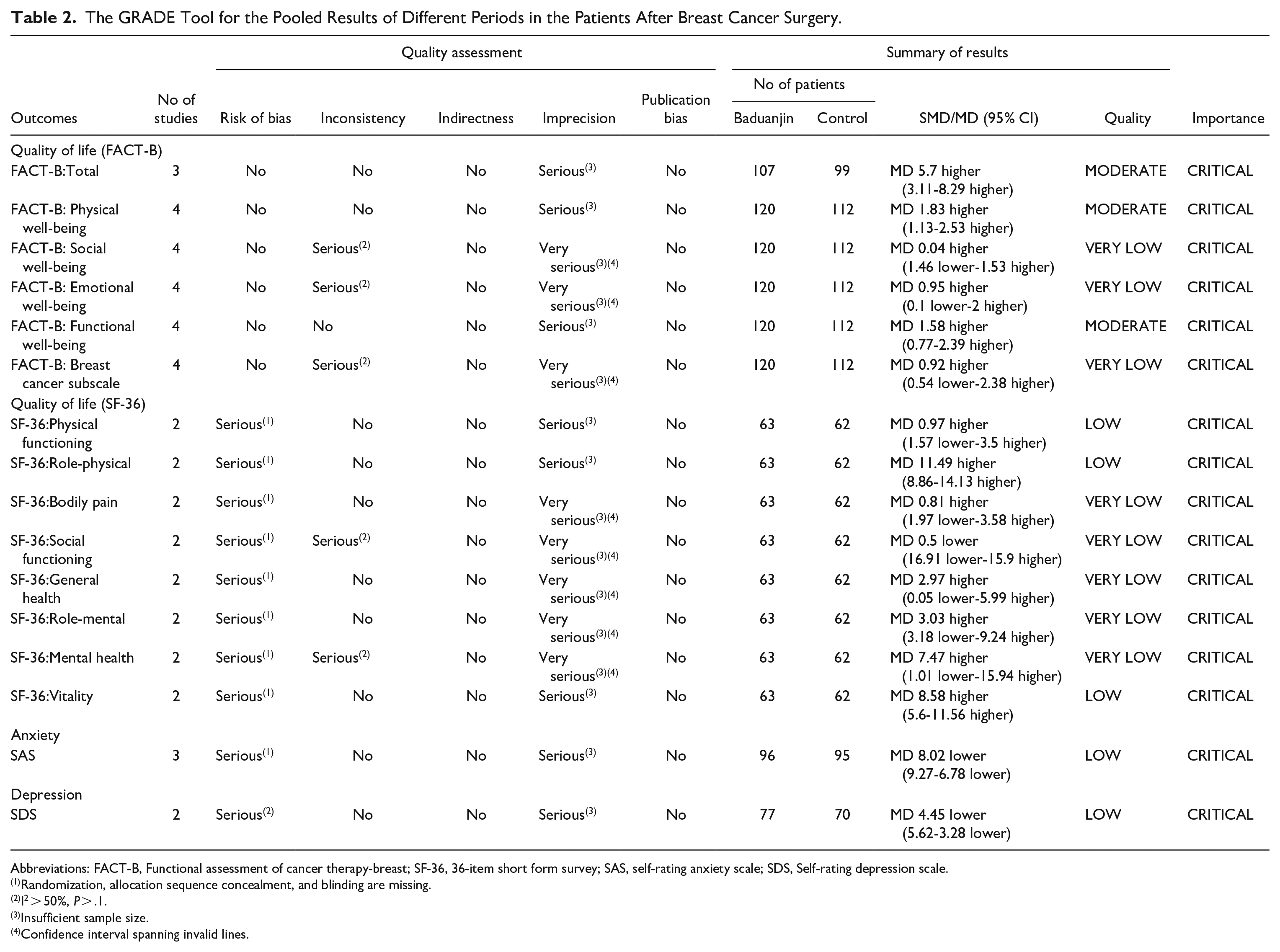
Abbreviations: FACT-B, Functional assessment of cancer therapy-breast; SF-36, 36-item short form survey; SAS, self-rating anxiety scale; SDS, Self-rating depression scale.
Randomization, allocation sequence concealment, and blinding are missing.
I2 > 50%, P > .1.
Insufficient sample size.
Confidence interval spanning invalid lines.
Discussion
A significant number of breast cancer patients experience serious health problems following treatment, and this must be addressed. Baduanjin exercise has emerged as a promising intervention for people who have recovered from breast cancer. In particular, Baduanjin may improve QOL and the patient’s mood. To the best of our knowledge, this is the first study to systematically review the effect of Baduanjin exercise on the QOL and psychological status of post-operative breast cancer patients. This systematic review and meta-analysis examined 7 RCTs, including 450 post-operative breast cancer patients. Results showed that Baduanjin interventions improved the QOL of postoperative patients with breast cancer when compared with patients without Baduanjin. Subgroup analysis found that Baduanjin exercise also improved physical function and vitality in postoperative patients with breast cancer. Furthermore, in terms of anxiety and depression relief, Baduanjin exercise had a significant effect. Overall, our study found that Baduanjin could improve the QOL and reduce negative psychological status among postoperative patients with breast cancer.
QOL is a common cancer treatment indicator that is widely used to measure the health status of breast cancer patients. This indicator, as measured by the SF-36 and FACT-B scale, captures physical, emotional, functional, and social well-being, as well as bodily pain and vitality.31,32 In terms of the overall impact on QOL, this study found that Baduanjin exercise was more effective than conventional nursing. This study also found that Baduanjin had significant effects on the physical, functional well-being and vitality of postoperative patients with breast cancer. These findings are in line with other studies in the literature, which explore the effects of Baduanjin and exercise generally on the QOL of post-operative breast cancer patients. For instance, a large number of studies have indicated that moderate and continuous exercise can reduce side effects after breast cancer treatment.45-47 Furthermore, a prior meta-analysis found that Baduanjin exercise could alleviate cancer-related fatigue in patients and improve their QOL and sleep quality. 48
Beyond overall QOL, this study also explored the extent to which Baduanjin might affect social well-being. Based on the social well-being subscale, the meta-analysis found that Baduanjin exercise did not significantly improve social well-being. There are a variety of reasons why the intervention may not have led to a significant difference in social well-being within this population. Firstly, studies have demonstrated that overall disease awareness does not have a significant effect on patients’ social well-being. 49 This is likely reflected in the current study, where even if postoperative patients’ awareness of breast cancer improved after the Baduanjin intervention, their social well-being may not have increased compared to the control groups. Secondly, other studies have found that treatment methods had no significant effects on social support,50-52 which is consistent with the results of this meta-analysis. Thirdly, a relatively short intervention is unlikely to shift social well-being. For the breast cancer subscale, responses to phrases like, “feeling unnatural to the way you wear clothes,” “feeling attractive to the opposite sex,” “feeling like a woman,” and others are all reflections of a person’s long-term values, which are unlikely to change with a short-term Baduanjin intervention. Studies have shown that only long-term interventions will improve the breast cancer subscale of patients. 51
Furthermore, this study found that Baduanjin exercise did not have a statistically significant effect on pain. 53 This is consistent with some studies that show null or absent effects of exercise on postoperative pain. However, it is important to note that these data may be affected by the nature of the painful injury, the intensity or duration of the practice, or the timing of the intervention concerning the damage. 54 For example, a recent systematic review showed that patients with pain have poorer outcomes regarding pain, general health, psychological, and family functioning as compared with those without pain. 55 Shifts in pain may also be reflective of or affected by changes in mental health. Pain can have a negative impact on mental health; postoperative pain in breast cancer patients may also be exacerbated by poor mental health. 56 Although the current review found that Baduanjin exercise did not lead to significant changes in patients’ social well-being and bodily pain, verification through future research is still needed.
With regard to mental health, this study found that Baduanjin exercise, particularly when accompanied by Wuxing music can remarkably relieve anxiety and depression in post-operative breast cancer patients. Negative psychological status is one of the most common post-treatment complications of breast cancer patients and is mostly caused by pain and physical dysfunction. Perennial anxiety and physical dysfunction can also increase depression in patients, influencing their QOL.57-59 This study showed that Baduanjin relieved psychological distress among post-operative breast cancer patients, and this is consistent with other research. For instance, previous studies have confirmed that Baduanjin can reduce psychological distress among patients with colorectal cancer, 60 ischemic stroke, 61 and female premenstrual syndrome. 62 Moreover, according to a prior study, music appeared to be effective for reducing anxiety and depression in breast cancer patients undergoing radiotherapy, 63 and that is consistent with findings in this study.
In addition to the benefits of Baduanjin exercise on post-operative breast cancer patients, the practice has also been found have positive effects on other diseases and areas of health. For example, Baduanjin has been found to effectively relieve lower back fatigue, 64 improve pulmonary function among chronic obstructive pulmonary disease patients, 65 and increase the QOL of patients with heart failure. 66 Because of these broad benefits, it seems reasonable to consider Baduanjin as an adjuvant treatment for breast cancer patients. At present, most studies focus on the short-term effects of Baduanjin exercise, whereas long-term studies are limited. Thus, clinical RCTs are still needed to verify the long-term efficacy of this intervention. In addition, efforts to standardize this intervention, particularly in clinical settings, should be prioritized. Future research could demonstrate the effectiveness of a joint adjuvant treatment scheme that combines traditional Chinese medicine and modern intelligent technology. For example, mobile devices and applications can lead patients through a structured Badjuanjin exercise plan while simultaneously measuring relevant indicators. Such technologies may not only streamline research efforts in this area, they can allow for widespread adoption of this effective intervention.
Lastly, it is important to note that this study had a number of limitations. First, there was variability in the training type, time, and intensity of the intervention among the selected studies, and this may have impacted the results. Second, the training frequency of Baduanjin and the disease severity of postoperative patients varied, and this may have contributed to significant clinical heterogeneity. Third, the monitoring effect on Baduanjin had not been stated clearly, as the way that postoperative patient’s exercises were done at home and in the follow-up conducted with supervision may have affected results. Fourth, given the small number of studies included, the analysis was limited, and the results may not be representative of the entire population. And lastly, the lack of compliance in postoperative patients may also have an impact on the experimental results. For example, the negative attitude toward the Baduanjin exercise and self-evaluation of the patients in the intervention group may have influenced the accuracy of the results.
Conclusion
Current evidence shows that Baduanjin exercise can improve the quality of life and alleviate anxiety and depressive state among postoperative patients with breast cancer. Large-scale multicenter RCTs with high-quality designs are needed to provide more reliable research evidence.
Supplemental Material
sj-docx-1-ict-10.1177_15347354221104092 – Supplemental material for Effectiveness of Baduanjin Exercise on Quality of Life and Psychological Health in Postoperative Patients With Breast Cancer: A Systematic Review and Meta-analysis
Supplemental material, sj-docx-1-ict-10.1177_15347354221104092 for Effectiveness of Baduanjin Exercise on Quality of Life and Psychological Health in Postoperative Patients With Breast Cancer: A Systematic Review and Meta-analysis by Xin-Xin Ye, Zi-Yang Ren, Somayeh Vafaei, Jun-Meng Zhang, Yuan Song, Yang-Xin Wang and Pei-Ge Song in Integrative Cancer Therapies
Footnotes
Author Contributions
Xin-Xin Ye undertook the study design, completed literature searching, data extraction, data analysis, drafted and revised this paper. Zi-Yang Ren completed literature searching, data extraction and drafted this paper. Yuan-Song completed literature searching and data extraction. Jun-Meng Zhang, Yang-Xin Wang, and Somayeh Vafaei revised this paper. Pei-Ge Song undertook the study design and critically revised this paper.
Declaration of Conflicting Interests
The author(s) declared no potential conflicts of interest with respect to the research, authorship, and/or publication of this article.
Funding
The author(s) received no financial support for the research, authorship, and/or publication of this article.

Supplemental Material
Supplemental material for this article is available online.
References
Supplementary Material
Please find the following supplemental material available below.
For Open Access articles published under a Creative Commons License, all supplemental material carries the same license as the article it is associated with.
For non-Open Access articles published, all supplemental material carries a non-exclusive license, and permission requests for re-use of supplemental material or any part of supplemental material shall be sent directly to the copyright owner as specified in the copyright notice associated with the article.
