



Abstract
Ginsenosides, the key components isolated from ginseng, have been extensively studied in antitumor treatment. Numerous studies have shown that ginsenosides have direct function in tumor cells through the induction of cancer cell apoptosis and the inhibition of cancer cell growth and enhance the antitumor immunity through the activation of cytotoxic T lymphocytes and natural killer cells. However, little is known about the function of ginsenosides on myeloid immunosuppressive cells including dendritic cells in tumor, tumor-associated macrophages, and myeloid-derived suppressor cells in the tumor microenvironments. Those myeloid immunosuppressive cells play important roles in promoting tumor angiogenesis, invasion, and metastasis. In the review, we summarize the regulatory functions of ginsenosides on myeloid immunosuppressive cells in tumor microenvironment, providing the novel therapeutic methods for clinical cancer treatment.
Keywords
Introduction
Ginsenosides are the major active components extracted from ginseng. According to its chemical properties, ginsenosides have been divided into 3 types: ginsenoside diol type (type A), including Rb1, Rb2, RC, Rd, Rh2, and so on; ginsenoside trial type (type B), including Re, Rf, Rg1, Rg2, Rhr; and phenolic acid type (type C), such as Ro, Rh3, Ri, F4. 1 Recently, rare saponins and glycosides in ginsenosides can be also provided by biotransformation.2,3 The results demonstrated that ginsenoside and its biotransformation products have remarkable pharmacological activities such as antitumor and improving immune system. 4 Most data have shown that ginsenosides can improve the immune function of the body to carry out the antitumor role through increasing T-cell antitumor activity and enhancing the cytotoxicity of natural killer cells on tumor.5-8 Ginsenosides also inhibit the proliferation of tumor cells and induce their apoptosis directly.9-13 However, little is known about the function of ginsenosides on immunosuppressive cells in the tumor microenvironment. A majority of tumor immunosuppressive cells are myeloid-derived hematopoietic cells, including dendritic cells (DCs) in tumor, tumor-associated macrophages (TAMs), and myeloid-derived suppressor cells (MDSCs).14,15 Plenty of evidence indicates that the tumor microenvironment alters myeloid cells by converting them into potent immunosuppressive populations (tumor immunosuppressive cells) that facilitate tumor growth.16,17
In human body, myeloid cells arise from multipotent hematopoietic stem cells that develop into mature myeloid cells with multiple functions through sequential steps of differentiation physiologically. The 3 major groups of terminally differentiated myeloid cells—macrophages, DCs, and granulocytes—are essential for the physiological functions of the immune system. These cells protect organisms from pathogens, eliminate necrotic cells, and mediate tissue remodeling through the innate and/or adaptive immune response.18,19 However, in the tumor microenvironment, the roles of those myeloid cells were changed to promote tumor angiogenesis, invasion, and metastasis.14,20,21
In the review, we have summarized the regulatory function of ginsenosides in myeloid immunosuppressive cells in the tumor microenvironment, providing novel therapeutic methods for clinical use.
Components and Transformation of Ginsenosides
There are 3 key constituents of ginseng, namely, saponins, polysaccharides, and phenolic compounds. 22 Ginseng’s saponins are generally called ginsenosides, the basic structure of which consists of a steroidal core with various sugar moieties and arabinose attached to the C3, C6, and C20 positions. Classically, ginsenosides are grouped into 2 major categories (panaxadiol saponin and panaxatriol saponin) based on different functional structures on the C6 position. Panaxadiol saponin, which contains 1 hydrogen, includes Rb1, Rb2, Rb3, Rd, Rg3, Rg5, Rh2, Rs11, Rk1, F2, and CK. Panaxatriol saponin, which contains a sugar side-chain, includes Re, Rg1, Rg18, Rh1, Rh4, Rp1, Rf, and F1.23,24 Most ginsenosides have been extensively investigated and emphasized in cancer chemoprevention and therapeutics (Table1).1,12,22 However, little was known about the functions of some rare ginsenosides due to the quantity and processing of those products. 25
Major Ginsenosides With Anti-Tumor Activity.
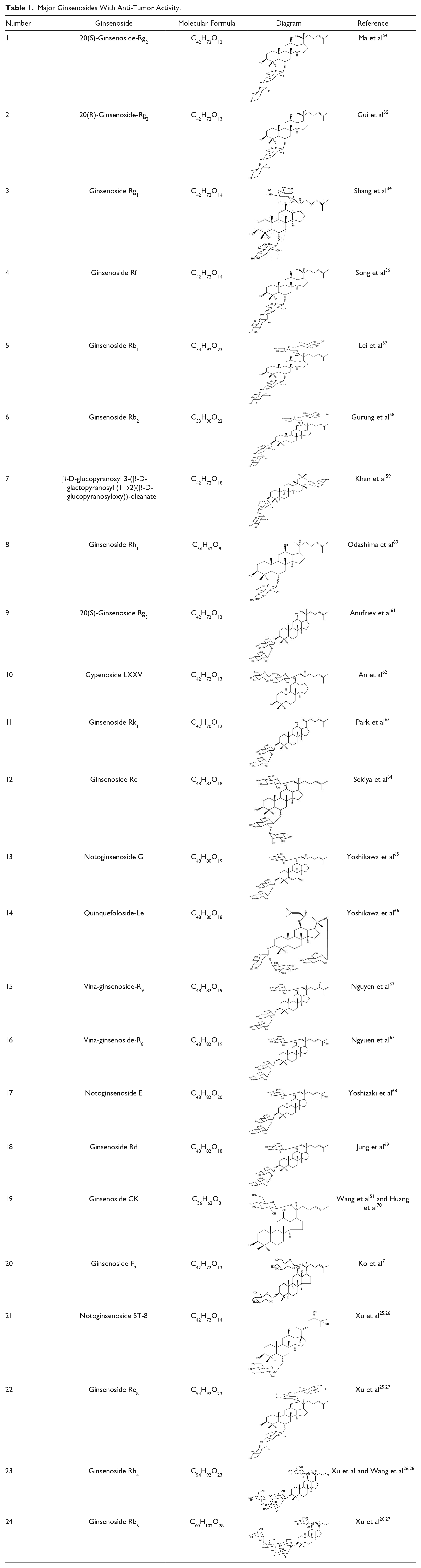
Our research group spent several years on the biotransformation of Panax ginseng as a fermentation matrix and its active single saponin compounds as biocatalytic substrates to solve the problems of the quantity and production of rare ginsenosides. Fruitful proceedings have been accomplished through our research, including the establishment and optimization of biotransformation methods for the ample supply of some rare saponins, the discovery and elucidation on new saponin structures that provide potential anticancer agents, and others (Table1).26-28 We also found that several rare or new ginsenosides enhance antitumor immune response in the tumor microenvironment,25,26 and unpublished data, which will provide some novel medical products for clinical use of ginsenosides.
Regulatory Roles of Ginsenosides on Myeloid Immunosuppressive Cells
Ginsenosides Induce the Alteration of Tumor-Associated Macrophages
It is well-known that the tumor microenvironment is important for cancer development and metastasis. TAMs, one of the myeloid immunosuppressive cells in the tumor microenvironment, correlate with tumor progression and poor prognosis. 29 The accumulating evidence supports that TAMs are typical pro-tumor macrophages (M2), which are responsible for releasing immunosuppressive cytokines, chemokines, and growth factors such as arginase, vascular endothelial growth factor (VEGF), platelet-derived growth factor, and interleukin-10 (IL-10), rendering tumor-specific cytotoxic T lymphocytes hyporesponsive and promoting tumor angiogenesis. 30
Accumulating reports have shown that ginsenosides, the major active component of ginseng, had a potential to effectively convert TAM to the M1 subset of macrophages and enhance anti-tumor activity of M1 macrophages (Figure 1). Li et al 31 demonstrated that ginsenoside Rh2 preferably decreases the expression levels of vascular endothelial growth factor, MMP2, and MMP9 (matrix metalloproteinase-2 and -9) on TAM to convert TAM from the M2 to M1 type, and further inhibiting/killing tumors. And ginsenosides Rg1 and Rg3 could facilitate macrophages with enhanced tumor cell killing ability by nitric oxide (NO) production (Figure1).32-34 20(S)-Protopanaxatriol (PPT) is one of the major metabolites of ginsenosides. Inducible nitric oxide synthase (iNOS) and cyclooxygenase-2 (COX-2) are important enzymes that mediate inflammatory processes. Improper upregulation of iNOS and/or COX-2 has been associated with the pathogenesis of inflammatory diseases and certain types of human cancers. PPT blocked the increase in lipopolysaccharides-induced iNOS and COX-2 expressions through inactivation of NFκB by preventing I-κBα phosphorylation and degradation. Thus, it may be possible to develop PPT as a useful agent for the prevention of cancer or inflammatory diseases (Figure1). 10

Roles of ginsenosides on function of tumor-associated macrpophages (TAMs) in tumor microenvironment.
Ginsenosides Enhance Antigen-Presenting Capability of Dendritic Cells
DCs, the most powerful professional antigen-presenting cells, which are involved in the interaction between innate and adaptive immune responses, play an important role in the suppression of tumorigenesis and tumor development.35,36 However, the suppression function of DCs in cancer patients contributes to tumor evasion of immune recognition and tumor progression. 37 Both immature and mature DCs in tumor-bearing hosts may be coordinated by the tumor microenvironment to suppress T functions. 14 MHC-II+CD11c+ tumor DCs have been shown to suppress the antitumor immune responses of CD8+ T cells through arginase 1 production, which is the same immunosuppressive mechanism as those of TAMs and MDSCs.38,39 Interestingly, plasmacytoid DC in prostate tumors also use arginase 1 and IDO to inhibit anti-tumor function of CD8+ T cells, suggesting that immunosuppressive mechanisms might be shared across different myeloid cells in the tumor microenvironment.40,41
The functional activation or conversion of DC in tumor patients is an essential mechanism of ginseng as an immunomodulator.42,43 There are emerging data that ginsenosides, as the functional contents of ginseng, are involved in enhancing the function of DCs in the tumor microenvironment. Ginsenosides activate the DCs and promote adaptive immune responses to exert anticancer effects in tumor-bearing mice.44,45 Huang et al 46 found that ginsenoside Rg1 had adjuvant effects on DCs by promoting the production and secretion of cytokines (such as tumor necrosis factor-α) and chemokines (such as IL-8, IP-10), and further explored its antitumor activity combined with OVA in the lymphoma mouse model. Ginsenoside Rg1, as a cancer vaccine adjuvant, also activated antitumor immune responses directly. Ginsenoside Rg1 and Rh1 stimulate DCs to promote T cell proliferation and enhance the antitumor activity of LPAK by the treatment of PHA and IL-2, indicating that Rg1 and Rh1 may be the effective immunotherapeutic compounds. 47 Recent studies have shown that ginsenoside Rg3 is a ginseng saponin that has its cytotoxic effect on tumor cells. In addition, Rg3-induced immunogenic cell death on tumor cells is characterized by the cell surface exposure of some chaperone proteins, which affect DC maturation and the uptake and presentation of tumor antigens. The data suggest that Rg3 has antitumor activity due to its cytotoxic effect and its ability to induce DC function.45,48
Ginsenosides Downregulate the Number and Function of MDSCs
MDSCs, which were dramatically increased in peripheral blood of patients or mouse models with cancer, are very important in tumor immune evasion in the tumor microenvironment.14,49 Some data have shown that intraperitoneal administration of Ginseng compromises MDSC function to induce T cell proliferation and the secretion of IL-2 and interferon-γ in tumor-bearing mice. The downregulation of iNOS and IL-10 suggest that Ginseng can restrain the suppressive function of MDSCs. 50 Furthermore, study in colorectal cancer xenograft bearing mice model had shown that ginseng-derived compound K (C-K) had a significant effect on MDSCs. It was found that the percentages of apoptosis in early and late MDSCs was higher in the C-K treatment groups than those in the control groups. C-K also significantly decreased the expressions of immunosuppression-related genes COX-2 and Arg-1, and inhibited the secretion of IL-1β, IL-6, and IL-17 to inhibit CT26 cancer progression in mice. 51 The effect of ginseng activity on macrophages extends to the immunosuppressive phenotype, such as Korean Red Ginseng, which blocks abnormal differentiation and suppressive function of MDSCs resulting in immune-activating events such as T-cell proliferation and the secretion of interferon-γ and IL-2, which were regulated by STAT3 (Figure 2).50,51
Effect of ginsenosides on differentiation and function of myeloid-derived suppressor cells (MDSCs) in tumor microenvironment.
Lee et al 52 found that one herbal extract, H9, enhanced antitumor roles of chemotherapeutic drugs doxorubicin/cyclophosphamide (AC). Ginsenosides Rg1 and Rb1, as 2 major marker compounds of H9, were involved in decreasing the number of MDSC population in 4T1 tumor-bearing mice (Figure 2).
Recently, the scientists from the National Cancer Institute in the United States found that Sheng Qi formula (SQF) delivered in the drinking water of mice bearing 4T1 inflammatory breast tumors resulted in reduction in all the following factors: tumor growth, numbers of tumor MDSC, functionality of the remaining MDSC, and circulating levels of IL-1 and granulocyte-colony stimulating factor. Combination therapy with SQF and paclitaxel or cyclophosphamide resulted in additive reduction in tumor growth and synergistic effects on MDSC. Ginsenosides Rg1, Re, Rb1, and Rd have been found as major functional components of SQF further (Figure 2). 53
Conclusion
In the review, we summarized which ginsenosides can regulate the number and function of myeloid immunosuppressive cells (tumor DCs, TAMs, and MDSCs) to enhance the anticancer ability of the body and avoid the growth, metastasis, and recurrence of tumor cells in the tumor microenvironment. These data suggest that the roles of ginsenosides on tumor myeloid immunosuppressive cells may be regarded as one novel therapeutic method for clinical cancer treatment.
Future Prospect
Ginsenosides, as the immunomodulatory drugs, may assist with other clinical antitumor antibodies such as anti-PD-1 antibodies by reducing the number of myeloid immunosuppressive cells and inhibiting their functions to improve tumor microenvironment for enhancing antitumor activity of those antibodies. Recently, we and some other scientists improved the production process of several rare ginsenosides by the biotransformation of Panax ginseng. We found that those ginsenosides also had strong antitumor immune activity and inhibited the function of myeloid immunosuppressive cells in the tumor microenvironment, suggesting that more ginsenosides may be found to improve tumor microenvironment by inhibiting tumor myeloid immunosuppressive cells, and become strong immunoregulatory drugs for cancer treatment.
Footnotes
Acknowledgements
The authors thank the Pharmacy Department staff who technically supported us for the realization of this article.
Declaration of Conflicting Interests
The author(s) declared no potential conflicts of interest with respect to the research, authorship, and/or publication of this article.
Funding
The author(s) disclosed receipt of the following financial support for the research, authorship, and/or publication of this article: This work was supported by National Natural Science Foundation of China (Grant Nos. 81572868, 81803680, 81803796, 81803649); Science Foundation of Shangdong (Grant No. ZR2018LC012); Jilin Province Science and Technology Development Project in China (20170307031YY, 20180520050JH); and Foundation of Jilin Educational Committee (JJKH20170726KJ).
