



Abstract
Aim. The objective of this study was to evaluate the combined effect of a known galectin-3 inhibitor, PectaSol-C modified citrus pectin (MCP), and 2 novel integrative polybotanical compounds for breast and prostate health, BreastDefend (BD) and ProstaCaid (PC), on invasive behavior in human breast and prostate cancer cells in vitro, respectively. Methods. The effect of MCP and BD and of MCP and PC on invasiveness was assessed by cell adhesion, cell migration, and cell invasion assays. Secretion of urokinase plasminogen activator (uPA) was determined by Western blot analysis. Results. Although low concentrations of MCP (0.25-1.0 mg/mL) do not suppress cell adhesion of breast or prostate cancer cells, the combination of MCP with BD or PC synergistically inhibits adhesion of these cells. Dose-dependent inhibition of breast and prostate cancer cell migration by MCP (0.25-1.0 mg/mL) is synergistically enhanced by BD (20 µg/mL) and PC (10 µg/mL), respectively. BD or PC did not further inhibit the invasion of breast and prostate cancer cells by MCP; however, the combination of MCP with BD or PC suppressed secretion of uPA from breast and prostate cancer cells, respectively. Conclusion. The combination of MCP with BD and of MCP with PC synergistically inhibits the metastatic phenotypes of human breast and prostate cancer cells, respectively. Further studies confirming these observations in animal models of breast and prostate cancer metastasis are warranted.
Keywords
Introduction
Breast cancer is the most diagnosed cancer and the leading cause of cancer deaths in females, with more than 1.38 million new cancer cases and 458 400 deaths estimated to have occurred in 2008 worldwide. 1 Prostate cancer is the second most diagnosed cancer and the sixth most common cause of cancer death in males, with more than 903 500 new cancer cases and 258 400 deaths estimated to have occurred in 2008 worldwide. 1 The major reason for such a high mortality of breast and prostate cancer patients is cancer metastasis. 2 Cancer metastasis consists of several interdependent processes including uncontrolled growth of cancer cells, their invasion through surrounding tissues, migration to distant sites of the human body, and adhesion, invasion, and colonization of other organs and tissues. 3 Therefore, inhibition of cancer cell proliferation and invasiveness could lead to the inhibition of cancer metastasis, which would eventually increase the survival of cancer patients.
A variety of natural compounds, some of them recognized and used in traditional chinese medicine, demonstrated activity against growth and invasiveness of cancer cells by the modulation of specific signaling pathways.4,5 We have recently demonstrated that BreastDefend (BD), a new polybotanical compound consisting of different medicinal mushrooms, herbs, and purified nutritional compounds, suppressed proliferation and invasive behavior of highly metastatic MDA-MB-231 breast cancer cells. 6 Also, ProstaCaid (PC), another polybotanical compound, has been recently shown to specifically inhibit the growth and metastatic potential of highly invasive PC-3 prostate cancer cells.7,8 In addition, modified citrus pectin (MCP) inhibited cancer growth and breast and prostate cancer metastases in laboratory animals.9,10 Moreover, MCP has suppressed proliferation and induced apoptosis of prostate cancer cells. 11 The antimetastatic properties of MCP, and also its potential for increasing apoptotic responses of tumor cells to chemotherapy by inhibiting galectin-3’s anti-apoptotic function, has been established in the literature for its potential use in the treatment of multiple human malignancies. 12
In the present study, we evaluated the synergistic effects of BD and MCP on the invasive behavior of highly metastatic MDA-MB-231 breast cancer cells. We have also evaluated the synergistic effects of PC and MCP on the invasive behavior of highly invasive PC-3 human hormone refractory prostate cancer cells. Here we show that BD with MCP, and PC with MCP, markedly inhibit invasiveness of breast and prostate cancer cells, respectively.
Materials and Methods
Cell Culture and Reagents
Highly invasive human breast cancer cells (MDA-MB-231) and prostate cancer cells (PC-3) were obtained from ATCC (Manassas, VA). The cells were maintained in DMEM medium supplemented with penicillin (50 U/mL), streptomycin (50 U/mL), and 10% fetal bovine serum (FBS). Media and supplements came from GIBCO BRL (Grand Island, NY). FBS was obtained from Hyclone (Logan, UT). BreastDefend (BD), ProstaCaid (PC), and modified citrus pectin Pectasol-C (MCP) were supplied by the EcoNugenics, Inc (Santa Rosa, CA), and their compositions were previously described.6,8,11 BD, PC, and MCP stock solutions were dissolved in dimethylsulfoxide and stored at 4°C.
Cell Viability
Cell viability was determined by the tetrazolium salt method, according to the manufacturer’s instructions (Promega, Madison, WI). Briefly, breast and prostate cancer cells were cultured in a 96-well plate and treated for indicated times with MCP (0-1.0 mg/mL) in the absence or presence of BD (20 µg/mL) or PC (10 µg/mL), respectively. After 24 hours, the cells were harvested and absorption was determined with an ELISA plate reader at 570 nm, as previously described. 13 Data points represent mean ± standard deviation (SD) in the representative experiment of triplicate determinations. Similar results were obtained in 2 independent experiments.
Cell Adhesion, Migration, and Invasion Assays
Cell adhesion of MDA-MB-231 and PC-3 cells, treated with the combinations of MCP, BD, and PC, was evaluated with Cytomatrix Adhesion Strips coated with human fibronectin (Chemicon International, Temecula, CA) as previously described.6,8 Cell migration of MDA-MB-231 and PC-3 cells treated with combinations of MCP, BD, and PC was assessed in Transwell chambers as previously described.6,8 Invasion of MDA-MB-231 and PC-3 cells treated with the combinations of MCP, BD, and PC was assessed in Transwell chambers coated with 100 µL of Matrigel (BD Biosciences, Bedford, MA) as previously described.6,8
uPA Secretion
The secretion of uPA into media of MDA-MB-231 and PC-3 treated with combinations of MCP, BD, and PC for 24 hours was detected by Western blot analysis as previously described. 6
Evaluation of the Synergistic Effect
Evaluation of the treatment combination was calculated as follows: CDI = AB/A × B, where CDI is the coefficient of drug interaction, AB is the ratio of the 2-drug combination to control, and A or B is the ratio of a single drug to control. A CDI < 1 indicates a synergistic effect of the treatment combination. 14 In addition, the difference between additive and synergistic effects was evaluated by using the following formulas: A + B = SUM(A,B) corresponds to an additive effect, whereas A + B > SUM(A,B) corresponds to a synergistic effect; A or B is the ratio of a single drug to control.
Statistical Analysis
Data are expressed as the mean ± SD of 3 experiments. Statistical differences between means were evaluated using 1-way analysis of variance (ANOVA). P < .05 was considered significant.
Results
The Combination of MCP With BD or PC Suppresses Adhesion of Breast and Prostate Cancer Cells
MCP inhibited adhesion of breast and prostate cancer cells to endothelial cells in previous studies.9,10 We have recently demonstrated that BD and PC suppress adhesion of breast and prostate cancer cells, respectively, to the extracellular matrix protein fibronectin.6,8 To evaluate whether the addition of MCP to BD will further inhibit adhesion of breast cancer cells to fibronectin, MDA-MB-231 cells were treated with BD (0 or 20 µg/mL) and increased concentrations of MCP (0-1.0 mg/mL); cell adhesion was evaluated as described in Materials and Methods. Although the low concentration of BD (20 µg/mL) decreased cell adhesion of breast cancer cells by 21%, the addition of MCP further decreased adhesion by 32%, 38%, and 40% at 0.25, 0.5, and 1.0 mg/mL of MCP, respectively (Figure 1A). The combination of MCP with BD was synergistic (CDI < 1; A + B > SUM(A,B)) for all tested MCP and BD combinations. Furthermore, the addition of MCP to prostate cancer cells treated with PC (10 µg/mL) increased the inhibitory effect of PC on cell adhesion from 9% (control) to 23% (0.25 mg/mL), 38% (0.5 mg/mL), and 40 % (1.0 mg/mL; Figure 1B), and this effect was synergistic (CDI < 1; A + B > SUM(A,B)). To evaluate whether this effect was caused by the cytotoxicity against breast cancer cells, we treated MDA-MB-231 with MCP (0-1.0 mg/mL) in the absence or presence of BD; cell viability was evaluated as described in Materials and Methods. Although BD (20 µg/mL) partially suppressed viability of MDA-MB-231 cells, the addition of MCP did not increase the effect of BD (Figure 1C). In addition, the treatment of PC-3 cells with PC (10 µg/mL) only slightly decreased cell viability, and the addition of MCP (0-1.0 mg/mL) did not have any effect (Figure 1D).

The combination of MCP with BD or PC suppresses the adhesion of breast and prostate cancer cells
MCP and BD or PC Suppress Migration of Breast and Prostate Cancer Cells
Since MCP suppressed chemo-attractant-induced migration (chemotaxis) of human endothelial cells to galectin-3, 9 we evaluated whether MCP has the potency to inhibit random migration of highly invasive breast and prostate cancer cells. MDA-MB-231 and PC-3 cells were treated with MCP (0-1.0 mg/mL) for 5 and 24 hours, respectively, and cell migration was determined as described in Materials and Methods. As seen in Figure 2, MCP markedly inhibits migration of MDA-MB-231 (Figure 2A) and PC-3 (Figure 2B) in a dose-response manner. Since we recently found that BD and PC suppress migration of breast and prostate cancer cells, respectively,6,8 we evaluated whether the combination of BD and PC with MCP can have a synergistic effect on the inhibition of migration of these cells. As seen in Figure 2A, the addition of BD (20 µg/mL) to MDA-MB-231 cells treated with MCP (0-1.0 mg/mL) further inhibits migration of these breast cancer cells. The combination of a lower dose of MCP (0.25 mg/mL) with BD (20 µg/mL) demonstrated synergistic inhibition of cell migration (CD1 < 1, A + B > SUM(A,B)), whereas 0.5 mg/mL and 1.0 mg/mL doses of MCP with BD (20 µg/mL) showed additive effects (Figure 2A). Moreover, we found that the addition of PC (10 µg/mL) to PC-3 cells treated with MCP (0.25 and 0.5 mg/mL) also synergistically extended the suppression of PC-3 prostate cancer cell migration (CDI < 1, A + B > SUM(A,B); Figure 2B).

MCP and BD or PC inhibits migration of breast and prostate cancer cells
The Combined Effect of MCP and BD or PC on the Invasion of Breast and Prostate Cancer Cells
We have previously shown that BD and PC inhibit the invasion of breast and prostate cancer cells, respectively, through Matrigel.6,8 In addition, others have demonstrated that citrus pectin inhibits the invasion of MDA-MB-231 cells. 15 To evaluate whether MCP inhibits the invasion of breast and prostate cancer cells, MDA-MB-231 and PC-3 cells were treated with MCP (0-1.0 mg/mL), and cell invasion through Matrigel was determined as described in Materials and Methods. As seen in Figure 3, MCP markedly suppressed cell invasion in breast and prostate cancer cells. Invasion of MDA-MB-231 and PC-3 cells is also inhibited by BD and PC, respectively.6,8 Thus, we evaluated whether the addition of BD or PC would enhance the inhibitory effect of MCP on cell invasion. However, neither BD (20 µg/mL) nor PC (10 µg/mL) further enhanced the inhibitory effect of MCP on the invasion of MDA-MB-231 (Figure 3A) or PC-3 (Figure 3B) cells.

The combined effect of MCP and BD or PC on the invasion of breast and prostate cancer cells
MCP and BD or PC Suppress the Secretion of uPA From Breast and Prostate Cancer Cells
Since uPA is one of the key molecules associated with cancer metastasis through the induction of cancer cell adhesion, migration, and invasion 5 and we have recently demonstrated that BD and PC suppresses secretion of uPA from breast and prostate cancer cells, respectively,6,8 we evaluated whether MCP and its combination with BD or PC also inhibit uPA secretion from these cells. MDA-MB-231 cells were treated with MCP (0-1.0 mg/mL) in the absence or presence of BD (20 µg/mL). Cell culture media was collected and concentrated, and the secretion of uPA was evaluated by Western blot analysis as described in Materials and Methods. In agreement with the inhibition of cell adhesion and migration, MCP treatment slightly (0.25, 0.5, and 1.0 mg/mL) suppresses secretion of uPA from breast cancer cells, and this effect is synergistically enhanced by BD (CDI < 1, A + B > SUM(A,B); Figure 4A). To evaluate whether MCP and PC suppress uPA secretion from prostate cancer cells, PC-3 cells were treated with MCP (0-1.0 mg/mL) and PC (10 µg/mL). As expected, MCP itself suppresses secretion of uPA from prostate cancer cells, and PC further enhances activity of MCP (Figure 4B). However, the effect of the treatment combination of MCP and PC on the secretion of uPA from prostate cancer cells was additive (A + B = SUM(A,B)).
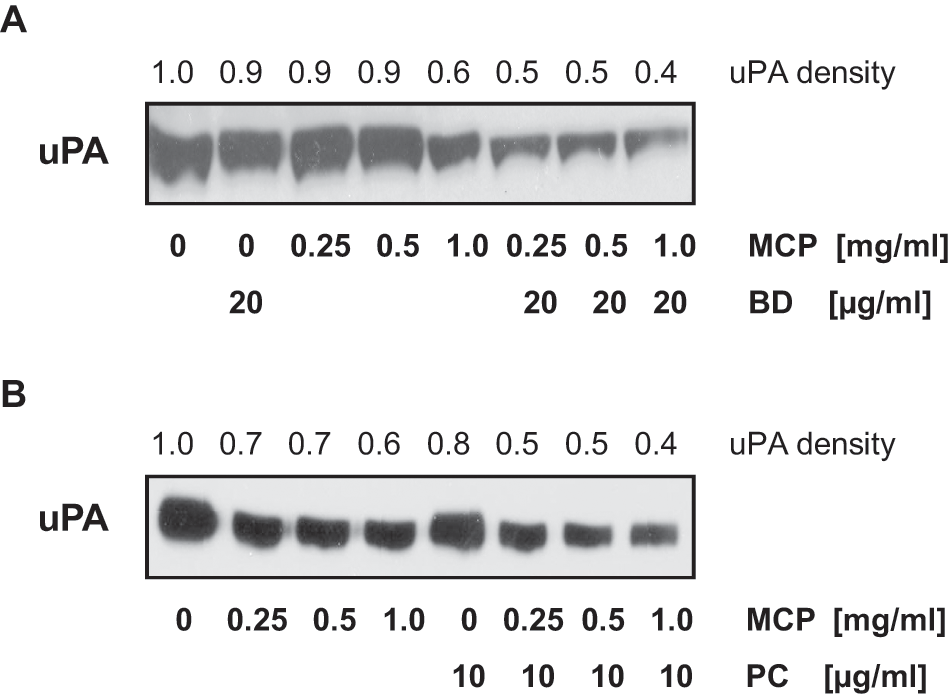
The combined effect of MCP and BD or PC on uPA secretion
Discussion
In the present study, we show that MCP, in combination with the novel polybotanical compounds, BD or PC, inhibits the invasive potential of highly metastatic human breast (MDA-MB-231) or prostate (PC-3) cells, respectively. Nangia-Makker et al 10 demonstrated that orally administered MCP inhibits the growth of human breast cancer in mice, and the authors associated this inhibitory effect with the suppression of angiogenesis, which is crucial for tumor growth. Moreover, Yan and Katz 11 recently showed that MCP inhibits growth and induces apoptosis of PC-3 prostate cancer cells in vitro at concentrations of 0.1% to 1.0% after 48 hours of treatment.
The inhibition of adhesion, migration, and invasion of breast and prostate cancer cells by MCP is mediated, in part, through galectin-3 since MCP binds to this β-galactosidase binding protein. 16 In addition to breast and prostate cancers, galectin-3 is also overexpressed in pancreatic, thyroid, colon, gastrointestinal, lung, and ovarian cancers, as well as melanoma and non-Hodgkin’s lymphoma. Galactin-3 levels are associated with highly metastatic potential and cancer progression.12,17-21 An increase of galectin-3 concentration in the sera of patients with melanoma or colorectal, breast, lung, head or neck cancers was detected in patients with metastatic disease,21-23 suggesting that MCP can be used for treatment of other malignancies with high levels of galectin-3.
We also show that MCP inhibits secretion of uPA from breast and prostate cancer cells. Because uPA controls cell adhesion, migration, and invasion through its interaction with the uPA receptor, 5 our data suggest novel antimetastatic activity of MCP through the inhibition of uPA/uPAR signaling. Mechanistically, cell adhesion and migration are mediated by the nonproteolytic activity of uPA through the interaction of uPA with uPAR and integrin receptors, whereas cell invasion is associated with the proteolytic activity of uPA. 5 uPA stimulates the conversion of plasminogen to plasmin that activates matrix-metalloproteinases, 5 which results in galectin-3 degradation.24,25 Therefore, inhibiting uPA proteolytic activity would actually result in retaining active galectin-3 and not inhibiting cancer cell invasiveness. Alternatively, inhibiting the nonproteolytic activity of uPA that suppresses cell adhesion and migration can complement the inhibition of galectin-3-dependent adhesion, migration, and invasion by MCP.
Another possible explanation of how MCP can regulate the invasiveness of cancer cells is seen on the molecular level through the inhibition of uPA expression. We have previously demonstrated that uPA-dependent motility of invasive breast cancer cells is modulated by transcription factors AP-1 and NF-κB.26,27 Interestingly, Chen et al 28 demonstrated AP-1 and NF-κB inhibition by citrus pectin in activated macrophages, but this effect was associated with the suppression of LPS/TLR-4 signaling. On the other hand, galectin-3 did not affect signaling through NF-κB in macrophages, 29 whereas galectin-3 activated NF-κB in colonic epithelial lamina propria fibroblasts and rheumatoid arthritis synovial fibroblasts.30,31 Since nuclear phosphorylated galectin-3 also interacts with other transcription factors (eg, AP-1, TTF-1, SP1, and CRE) and controls the expression of cancer-related genes, 32 it is possible that MCP inhibits the interactions between galectin-3 and NF-κB or AP-1, which results in the inhibition of the expression and secretion of uPA.
Here we also show that the combination of MCP with BD or PC synergistically inhibits cancer cell adhesion and migration. On the other hand, the inhibition of breast and prostate cancer cell invasion by MCP was not further enhanced by BD or PC, whereas the MCP/BD and MCP/PC combinations suppressed secretion of uPA from breast and prostate cancer cells, respectively. Interestingly, MCP only slightly suppresses cell adhesion but significantly inhibits cell migration, whereas BD and PC synergistically enhance the effect of MCP (Figures 1 and 2). Thus, MCP might inhibit adhesion and migration through the suppression of both uPA (current study) and galectin-3, 16 and the addition of BD or PC further enhances inhibition of uPA.6,8 Indeed, MCP inhibits secretion of uPA from breast cancer cells by 10% to 40%, and the addition of BD, which itself contributes to 10% inhibition, results in a 50% to 60% synergistic inhibition. On the other hand, MCP suppresses the secretion of uPA from prostate cancer cells by 30% to 40%, and PC inhibits uPA by 20%, resulting in the additive 50% to 60% inhibition of uPA. Future study is necessary to determine whether BD and PC, and their combinations, inhibit galectin-3. Since MCP inhibits galectin-3, 16 and BD and PC inhibit uPA,6,8 the MCP + BD and MCP + PC combinations result in the suppression of invasive behavior of cancer cells by targeting different signaling pathways and using lower doses of particular supplements.
In conclusion, a combination of the compound PectaSol-C modified citrus pectin (MCP) and BreastDefend (BD) synergistically inhibits the metastatic phenotype of human breast cancer cells, whereas a combination of PectaSol-C MCP with ProstaCaid (PC) synergistically inhibits the metastatic phenotype of human prostate cancer cells. Further studies confirming these observations in animal models of breast and prostate cancer metastasis are warranted.
Footnotes
Acknowledgements
The authors would like to thank Barry Wilk for his contributions in helping with this study, and Elaine Bammerlin for editing.
Declaration of Conflicting Interests
The authors declared the following potential conflicts of interest with respect to the research, authorship, and/or publication of this article:
Authors JJ and DS declared no conflicts of interest. Author IE acknowledges his financial interest in the compounds discussed.
Funding
The authors disclosed receipt of the following financial support for the research, authorship, and/or publication of this article: This work was supported by a sponsored research grant from EcoNugenics, Inc, Santa Rosa, California.