



Abstract
Chemoprevention is a novel approach to study the anti-initiating and anti-tumor-promoting efficacy of medicinal plants and their active principles. The present study investigated the chemopreventive potential of Aegle marmelos fruit extract in 7,12-dimethylbenz[a]anthracene-induced skin carcinogenesis and its influence on oxidative stress and the antioxidant defense system. The oral administration of A marmelos at 100 mg/kg body weight/day during peri-initiational, postinitiational, and peri- & postinitiational phases of papillomagenesis showed significant reduction in tumor incidence, tumor yield, tumor burden, and cumulative number of papillomas when compared with carcinogen-treated control. The average latent period significantly increased (7.88 weeks; control group) to 9.45, 11.11, and 11.54 weeks in different A marmelos extract (AME) experimental groups. Enzyme analysis of skin and liver showed a significant elevation in antioxidant parameters such as superoxide dismutase, catalase, glutathione, and vitamin C in AME-treated groups when compared with the carcinogen-treated control. The elevated level of lipid peroxidation in the positive control was significantly inhibited by AME administration. These results indicate that AME has the potential to reduce chemical-induced skin papillomas by enhancing the antioxidant defense system.
Introduction
Cancer is a major public health problem, being the second highest cause of death in both men and women in developed as well as developing countries. Skin cancer is one of the most common of all human cancers, and its incidence is increasing rapidly worldwide. It contributes approximately 30% of all newly diagnosed cancers in the world, and solar ultraviolet radiation is an established cause of approximately 90% of all skin cancers. 1 Human beings are exposed to a multitude of carcinogens in their environment, and the majority of cancers are considered to be chemically induced. 2 Polycyclic aromatic hydrocarbons are environmental carcinogens present in the atmosphere from combustion sources such as diesel exhaust, cigarette smoke, residential heating processes, refuse burning, industrial coke production, volcanic eruption, and oil contamination by effluents and oil spills. 3 7,12-Dimethylbenz[a]anthracene (DMBA), the site-specific and organ-specific carcinogen, is commonly employed to induce skin cancer in experimental models. DMBA-induced skin cancer is therefore ideal to test the chemopreventive efficacy of medicinal plants and their constituents.
Free radical–mediated oxidative stress can cause structural and functional abnormalities in cells, making them weak and defenseless. 4 Overproduction of reactive oxygen species has been implicated in the etiology of several disorders, including cardiovascular diseases, diabetes, cancer, and Alzheimer’s disease. 5 Antioxidant defense molecules fall into 1 o]f 2 categories: enzymatic or nonenzymatic. Mammalian cells possess elaborate enzymatic (superoxide dismutase [SOD], catalase [CAT], and glutathione peroxidase [GPx]) and nonenzymatic (reduced glutathione [GSH]) antioxidant defense mechanisms to detoxify the radicals.
Prevention is an effective strategy to control the incidence of cancer. Recent progress in molecular biology and pharmacology enhances the likelihood that cancer prevention will increasingly rely on chemoprevention. 6 It has been observed that synthetic chemopreventive agents produce toxic side effects, which have limited their extensive use. 7 Plants, vegetables, and medicinal herbs used in the folk and traditional system of medicine have been accepted currently as one of the main source of cancer chemopreventive drug discovery and development. 8
There is a growing interest in evaluation of chemopreventive efficacy of plants used in Ayurveda, and one such plant is Aegle marmelos, commonly called bael, belonging to family Rutaceae. This plant is widely found in India, Bangladesh, Burma, and Sri Lanka. It is distributed mainly within the sub-Himalayan forest, in dry hilly regions. It is called Shivadume, the tree of lord Shiva. Aegle marmelos has an important place in the indigenous system of medicine. Its edible leaf, root, bark, seed, and fruit are valued highly in Ayurvedic medicine in India.
9
In fact, as per Charaka (1500
Materials and Methods
Animal Care and Handling
The experimental procedure was approved by our institution and was done according to the guidelines set by the World Health Organization, Geneva, Switzerland, and the Indian National Science Academy, New Delhi, India. The inhibition of tumor incidence by A marmelos fruit extract was evaluated on 2-stage skin carcinogenesis induced by a single application of DMBA (initiator) and 2 weeks later promoted by repeated application of croton oil (promoter) thrice per week, following the protocol for 16 weeks. The study was conducted on random-bred, 6- to 7-week-old male Swiss albino mice with body weight 24 ± 2 g. Animals were maintained under controlled conditions of temperature (25 ± 2°C) and light (14 hours light–10 hours dark). The animals were fed a standard mouse feed procured from Aashirwad Industries (Chandigarh, India), and water ad libitum. These animals were housed in polypropylene cages containing saw dust (procured locally) as bedding material. As a precaution against infection, tetracycline hydrochloride water was given to these animals once each fortnight. The Departmental Animal Ethical Committee approved this study.
Chemicals
The initiator DMBA and the promoter croton oil were procured from Sigma (St Louis, MO). DMBA was dissolved at a concentration of 100 µg/100 µL in acetone. Croton oil was mixed in acetone to give a solution of 1% dilution.
Preparation of Aegle marmelos Extract (AME)
The fruits of A marmelos L. were collected locally after their proper identification by a competent botanist (Voucher Specimen No: RUBL-20438) from the herbarium, Department of Botany, University of Rajasthan, Jaipur, Rajasthan, India. The pulp was removed from the fruit and shade dried; the pulp was powdered in a mixture and the hydro-alcoholic extract prepared by refluxing with double distilled water (DDW) and alcohol (3:1) for 36 (12 × 3) hours at 40°C. The liquid extract was cooled and concentrated by evaporating its liquid contents. The AME thus prepared was stored at low temperature until further use. The extract was redissolved in DDW prior for the oral administration in mice. The required dose for treatment was prepared by dissolving the extract in DDW at a dose level of 100 mg/kg body weight.
Experimental Design
A total of 60 animals were randomly divided into 6 groups (10 in each) to evaluate the anticarcinogenic potential of AME against DMBA-induced skin papillomagenesis in mice. The dorsal skin of the animals in the back area was shaven 3 days before the commencement of the experiment, and only those animals in the resting phase of hair cycle were chosen for the study. The body weight of the animals was recorded weekly. The inhibition of the tumor incidence of the pulp extract of A marmelos was evaluated in 2-stage process of skin tumorigenesis using the following protocol.
Group I: Vehicle Treated (Negative Control)
Animals belonging to this group received topical application of acetone (100 µL per mouse) on the shaven dorsal skin and DDW equivalent to AME (100 µL per mouse) by oral gavage for 16 weeks.
Group II: AME Treated (Drug-Treated Control)
Animals of this group were administered AME orally at a dose of 100 mg/kg body weight, dissolved in 100 µL of DDW as vehicle to each mouse, once a day for the 16-week study period.
Group III: Carcinogen Treated (Positive Control)
These animals were applied topically with a single dose of DMBA (100 µg/100 µL of acetone) over the shaven area of the skin of the mice. Two weeks later, croton oil (1% v/v in acetone) was applied 3 times per week until the end of experiment. This group received DDW equivalent to AME (100 µL per mouse) by oral gavage for 16 weeks.
Group IV: Peri-Initiation Group
Animals of this group received the same treatment as for group III. AME (100 mg/kg body weight/animal/day) was administered by oral gavage starting from 7 days before and 7 days after DMBA application.
Group V: Postinitiation Group
The treatment pattern of DMBA and croton oil was similar to that in group III. These animals also received AME (100 mg/kg body weight/animal/day) by oral gavage, starting from the time of croton oil treatment and continued until the end of experiment (ie, 16 weeks).
Group VI: Peri- & Postinitiation Group
Animals of this group were administered AME (100 mg/kg body weight/animal/day) by oral gavage starting from 7 days before DMBA application and continued until the end of experiment (ie, 16 weeks).
The following studies were performed in mice in groups III to VI.
Tumor Study
During the 16 weeks of experimentation, mice were observed daily and weighed weekly. Papillomas appearing on the shaven area of the skin were examined and recorded at weekly intervals in all the groups. Only those papillomas that persisted for 2 weeks or more, with a diameter greater than 2 mm, were taken into consideration for final evaluation of the data. Skin papillomas that regressed after 1 observation were not considered for counting. The following parameters were taken into consideration: tumor incidence, tumor yield, tumor burden, diameter, weight, body weight, average latent period, and inhibition of tumor multiplicity.
Biochemical Study
Biochemical alterations were studied in the animals of all the groups at the time of the termination of the experiment (ie, 16th week). At the end of the 16th week, the animals were killed by cervical dislocation. The dorsal skin affected by tumors and liver of mice were quickly excised and washed thoroughly with chilled saline (pH 7.4). It was then weighed and blotted dry. Ten percent tissue homogenate was prepared from the part of the skin in 0.15 M Tris–KCl (pH 7.4), and the same was centrifuged at 2000 rpm for 10 minutes. The supernatant thus obtained was taken for estimation of lipid peroxidation (LPO) and GSH. The following biochemical parameters were estimated in the liver and skin of mice.
Lipid Peroxidation Assay
The level of LPO was estimated spectrophotometrically by the thiobarbituric acid reactive substances (TBARS) method, as described by Ohkhawa et al. 14 Briefly, thiobarbituric acid (0.6%), sodium dodecyl sulfate (0.1%), and trichloroacetic acid (20%) were added to 200 µL of the tissue homogenate (10%) prepared as described above. This mixture was heated for 60 minutes, cooled, and extracted with N-butanol–pyridine (15:1); the optical density was recorded at 532 nm, and the contents were expressed as nmol/mg of tissue.
Reduced Glutathione Assay
The level of reduced GSH was estimated as total nonprotein sulfahydryl group by the method of Moron et al. 15 The homogenate was immediately precipitated with 100 µL of 25% trichloroacetic acid and the precipitate was removed after centrifugation. Free endogenous-GSH was assayed in a total volume of 3 mL by the addition of 200 µL of 0.6 mM 5,5′-dithio-bis(2-nitrobenzoic acid) dissolved in 0.2 M phosphate buffer (pH 8.0) to 100 µL of the supernatant and the absorbance recorded at 412 nm using a UV-VIS Systronics spectrophotometer. Reduced GSH was used as a standard, and the levels of GSH were expressed as µmol/g of tissue.
Superoxide Dismutase Assay
Superoxide dismutase was assayed by the method of Marklund and Marklund, 16 and the results were expressed as U/mg protein, where U is the unit of enzyme activity defined as the amount of enzyme necessary for inhibiting by 50% the auto-oxidation of pyrogalloll in Tris–HCL buffer (50 mM, pH 7.5), measured as absorbance at 420 nm.
Catalase Assay
The CAT activity was assayed by the method of Aebi. 17 The change in absorbance was followed spectrophotometrically at 240 nm after the addition of H2O2 (30 mM) to 100 µL of the supernatant (10% of skin homogenate, prepared in 50 mM phosphate buffer and centrifuged for 10 minutes) in 50 mM phosphate buffer (pH 7). The activity of the enzyme was expressed as U/mg of tissue, where U is µmol of H2O2 disappearance/minute.
Vitamin C Assay
For the tissue ascorbic acid (Vitamin C) determination, the fresh organs (parts of skin and liver) were weighed, homogenized in acetate buffer (20 mg/mL), and extracted with cold 4% trichloroacetic acid, centrifuged, and filtered. Ascorbic acid was determined by the method of Roe and Kuether. 18
Total Proteins Assay
Total proteins were estimated by the method of Lowry et al 19 using bovine serum albumin as a standard, and the level was expressed in milligrams per gram.
Statistical Analysis
The results are expressed as the mean ± standard error of the mean. The data of biochemical determinants from different groups were analyzed using the Student’s t test.
Results
Tumor Study
Body weight, tumor size, and tumor weight at the termination of the experiment are summarized in Table 1. Animals of all groups did not show any significant variation in body weight during the entire experiment, and there was no mortality. No noticeable signs of illness were detected in vehicle or AME-treated control (groups I and II). Similarly, no papilloma was observed in such groups, whereas all DMBA-treated and croton oil–treated mice showed swelling, inflammation, and cracks and appeared lethargic during the whole experimental period.
Effect of Aegle marmelos Extract (AME) Against DMBA-Induced Skin Tumorigenesis in Mice

Abbreviation: DMBA, 7,12-Dimethylbenz[a]anthracene.
Treatment schedule of the groups is specified in Materials and Methods section.
The cumulative number of papillomas was 67 in carcinogen-treated control (Grout III), which was reduced to 22, 17, 11 in the animals treated with AME in the peri-initiation, postinitiation, and peri- & postinitiation groups, respectively (Figure 1).

Effect of Aegle marmelos extract on cumulative number of skin papillomas in experimental mice (groups IV, V, and VI) in contrast to the control (group III)
The incidence of skin tumors was 100% in DMBA-treated and croton oil–treated mice (group III), whereas in AME-treated groups the number of tumors was greatly reduced. The incidence in group IV, V, and VI was 50%, 40%, and 30%, respectively (Figure 2) at the end of the experiment.
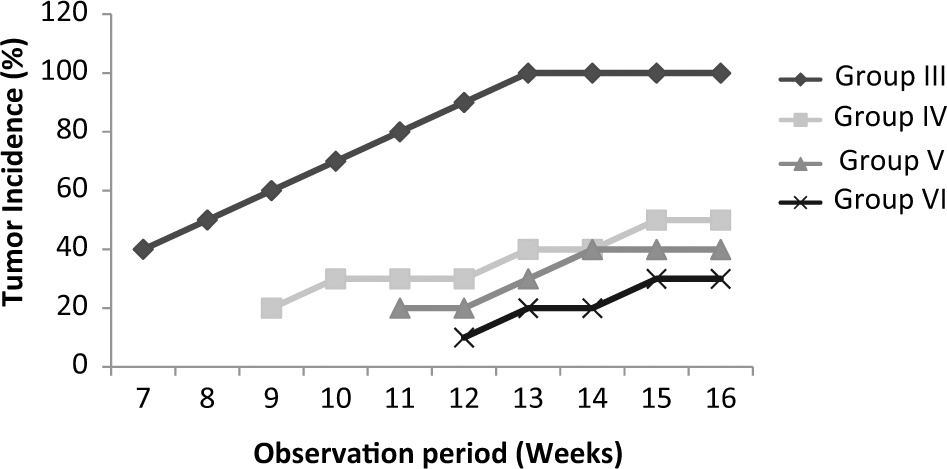
Effect of Aegle marmelos extract on tumor incidence in experimental mice (groups IV, V, and VI) in contrast to the control (group III)
Oral administration of A marmelos during the peri-initiation stage (group IV), the postinitiation stage (group V), or both the stages of DMBA-induced papillomagenesis (group VI) revealed the appreciable comparative inhibition of the tumor burden to 4.4, 4.2, and 3.6 (positive control value 6.7) and tumor yield to 2.2, 1.7, and 1.1 (positive control value 6.7) in AME-treated animals (Figures 3 and 4).

Effect of Aegle marmelos extract on tumor burden in experimental mice (groups IV, V, and VI) in contrast to the control (group III)
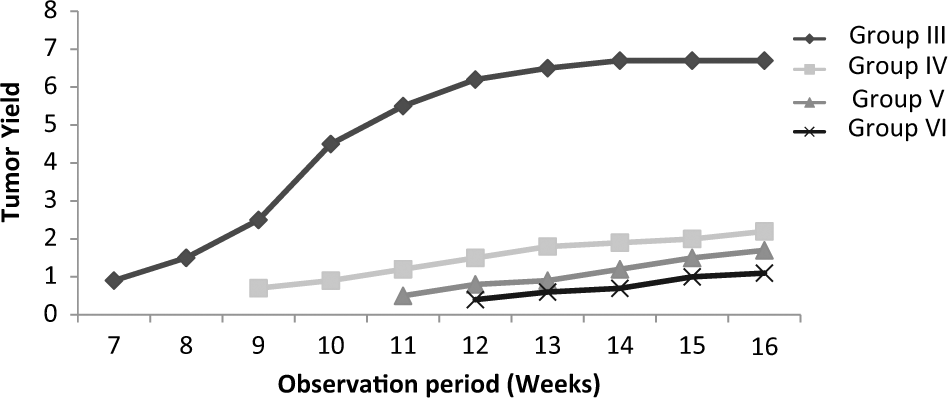
Effect of the Aegle marmelos extract on tumor yield in experimental mice (groups IV, V, and VI) in contrast to the control (group III)
The AME not only decreased the mean number of tumors per mouse but also delayed the tumor appearance. The average latent period (ie, time lag between the application of the promoter and the appearance of 50% of tumors) was recorded as 9.45 (group IV), 11.11 (group V), and 11.54 (group VI), which was considerably longer than carcinogen-treated positive control group (group III; Figure 5). The maximum inhibition of tumor multiplicity (Figure 6) was evident in peri- & postinitiation group (group VI, 83.58%) followed by postinitiation group (group V, 74.62%) and peri-initiation group (group IV, 67.16%; Figure 6). All the AME-treated groups exhibited a marked reduction in the size of tumors with respect to the carcinogen-treated control.

Effect of Aegle marmelos extract on average latent period of tumor appearance in experimental mice (groups IV, V, and VI) in contrast to the control (group III)

Effect of Aegle marmelos extract on inhibition of tumor multiplicity in experimental mice (groups IV, V, and VI) in contrast to the control (group III)
Biochemical Study
Lipid peroxidation
A considerable elevation in LPO from normal level was demonstrated in the liver and skin of group III animals. In contrast, A marmelos treatment during peri-initiation (group IV), postinitiation (group V), or peri- & postinitiation (group VI) stage significantly inhibited LPO elevation in the experimental animals when compared with the positive control (group III; Figure 7).
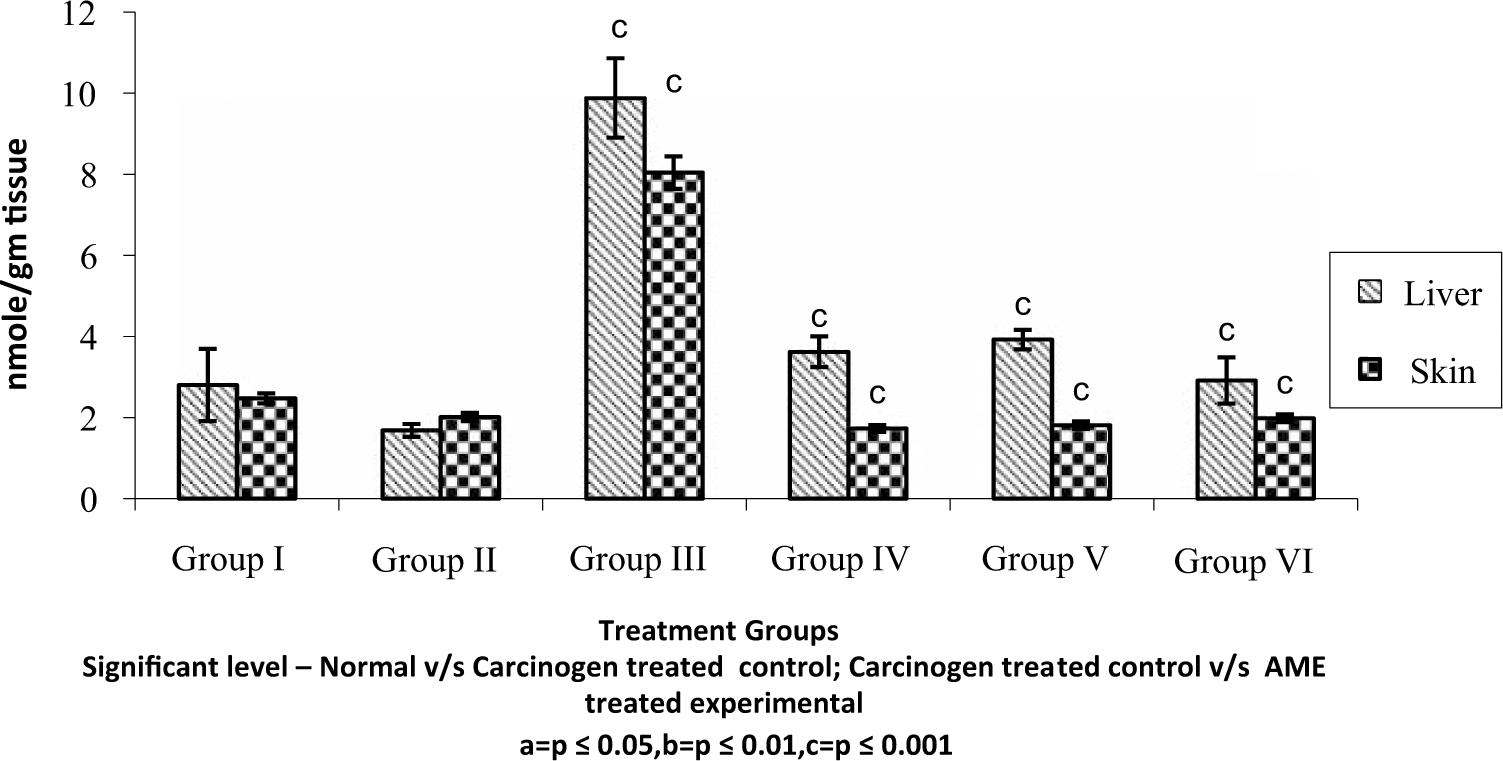
Effect of Aegle marmelos extract on DMBA-induced lipid peroxidation level (LPO) in liver and skin of experimental mice (groups IV, V, and VI) in contrast to the control (group III)
Reduced glutathione
Activity of GSH was found to be significantly reduced in the liver and skin of animals belonging to group III when compared with groups I and II. These changes reverted to near normal values on treatment with AME in group IV, V, and VI (Figure 8).

Effect of Aegle marmelos extract on DMBA-induced reduced glutathione (GSH) in liver and skin in experimental mice (groups IV, V, and VI) in contrast to the control (group III)
Catalase and superoxide dismutase
Administration of DMBA–croton oil in animals (group III) significantly decreased the enzymatic activities of SOD and CAT. In contrast, A marmelos treatment during peri-initiation (group III), postinitiation (group IV), or peri- & postinitiation (group V) stage significantly increased the extent of such antioxidant enzymes when compared with the carcinogen-treated control animals (Figures 9 and 10).

Effect of Aegle marmelos extract on DMBA-induced catalase activity (CAT) in liver and skin in experimental mice (groups IV, V, and VI) in contrast to the control (group III)

Effect of Aegle marmelos extract on DMBA-induced superoxide dismutase (SOD) in liver and skin in experimental mice (groups IV, V, and VI) in contrast to the control (group III)
Total proteins
Total proteins in skin and liver were considerably decreased from normal in the carcinogen-treated control group, whereas the same were found to be significantly elevated in both such tissues in different AME-treated groups (groups IV, V, and VI; Figure 11).

Effect of Aegle marmelos extract on DMBA-induced total proteins in liver and skin in experimental mice (groups IV, V, and VI) in contrast to the control (group III)
Vitamin C
The level of vitamin C in skin and liver of carcinogen-treated control (group III) was measured as significantly lower than the vehicle (group I) or AME-only treated animals (group II). In contrast, vitamin C level was significantly higher in skin and liver when AME was given along with carcinogen in animals of groups IV, V, and VI (Figure 12).
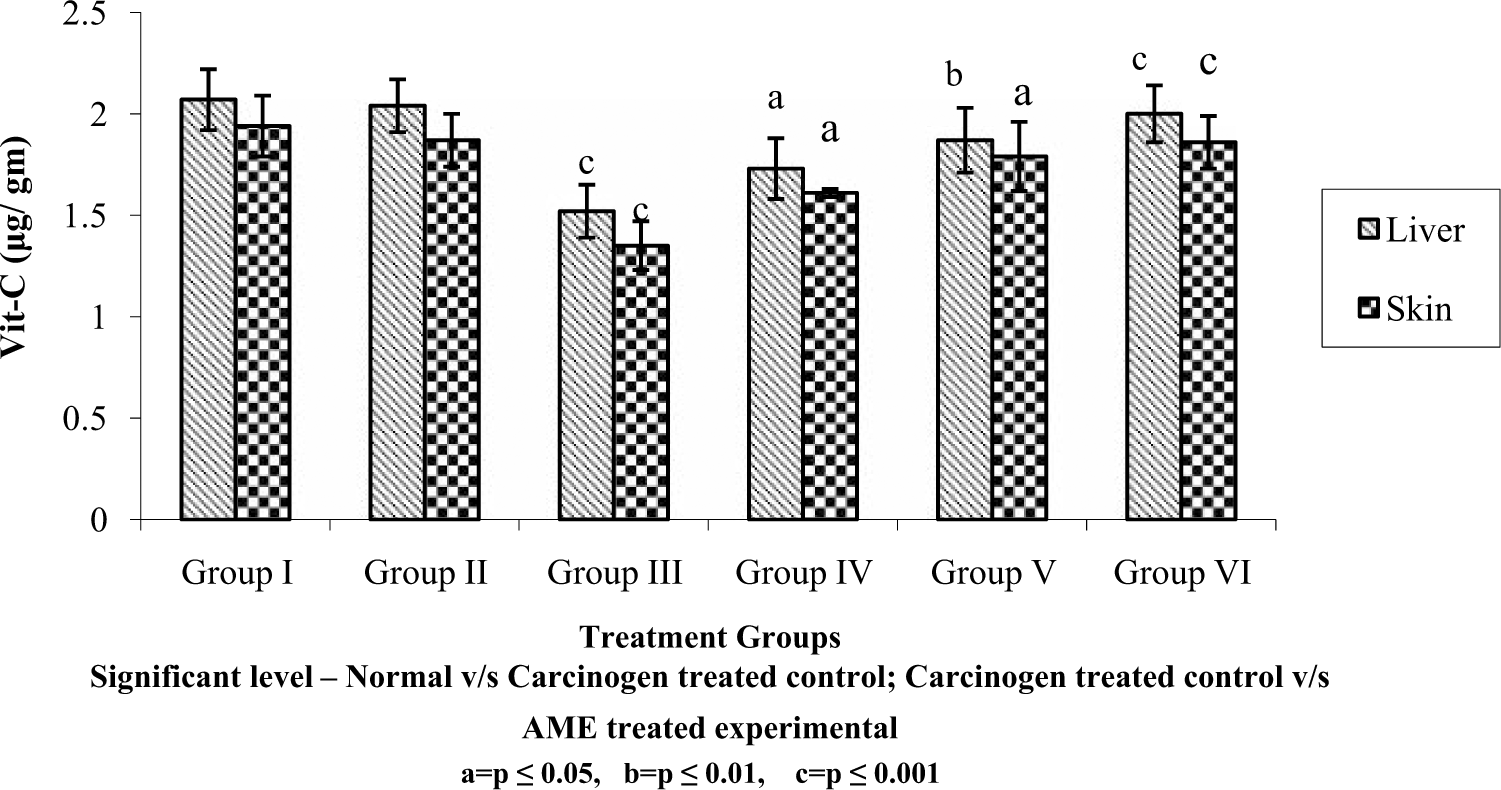
Effect of Aegle marmelos extract on DMBA-induced vitamin C in liver and skin in experimental mice (groups IV, V, and VI) in contrast to the control (group III)
Discussion
Most tumor-initiating chemicals including DMBA undergo metabolic conversion to become carcinogens, and covalent binding of a chemical carcinogen to DNA is considered a critical step in the initiation of chemical carcinogenesis.20,21 Skin tumor initiation by chemical carcinogens such as DMBA appears to be an irreversible stage that probably involves a somatic mutation, mainly in the Ha-ras oncogenes. 22 Another important aspect of carcinogenesis, especially during the tumor-promotional stage, is that carcinogens and tumor promoters generate (directly or indirectly) free radicals such as superoxide and hydroxyl radicals. 23
Skin carcinogenesis, the most common of all cancers, has been increasing in recent years worldwide. Skin is the most common site of malignancy and represents 55% of all human cancers with tremendous impact on health and morbidity. DMBA-induced mouse skin carcinogenesis is commonly used to test chemopreventive efficacy of medicinal plants and their constituents. In recent years, profound interest has been focused on the identification of nontoxic natural products that are capable of reducing the tumorigenicity of the environmental carcinogen.
Aegle marmelos, one of the most versatile traditional medicinal plants, has been known to posses a wide spectrum of medicinal properties and is used in Ayurveda to cure several ailments including cancer. In this study, an attempt was made to evaluate the chemomodulatory effects of A marmelos against DMBA-induced skin tumorigenesis.
Reactive oxygen species (ROS) are widely generated in biological systems either by normal metabolic pathways or as a consequence of exposure to chemical carcinogens leading to oxidative stress that may further result in membrane dysfunction, protein inactivation, and DNA damage, ultimately leading to carcinogenesis. 24 For protection against the deleterious effects of these ROS, organisms have developed a sophisticated antioxidant defense system that has enzymatic as well as nonenzymatic components. The antioxidant defense system include enzymes such as CAT, GSH, and SOD, whereas nonenzymatic components include nonprotein thiol GSH, some trace metals, and certain vitamins such as ascorbic acid and α-tocopherol. 25 Any natural compound with antioxidant properties may help in maintaining health when continuously taken as components of dietary food, spices, or drugs. 26 The increase in the levels of antioxidant profile, that is, GSH, SOD, and CAT, by A marmelos extract may be attributed to have biological significance in eliminating reactive free radicals that may affect the normal functioning of cells. Oral administration of AME (100 mg/kg body weight/animal/day) at the peri-initiational, postinitiational, peri- & postinitiational stages exhibited a reduction in tumor incidence, tumor burden, tumor size, and cumulative number of papillomas as documented in experimental groups.
During oxidative stress, MDA and/or other aldehydes are formed in biological systems. These can react with amino acids and DNA and introduce cross-linkages between proteins and nucleic acids, resulting in alterations in replication and transcription, leading to tumor formation. 27 Significant decrease in MDA levels by AME administration indicates reduced oxidative stress due to increase in GSH and the antioxidant enzyme CAT, thus indicating the ameliorative potential of such a plant extract against skin carcinogenesis.
Similarly, the findings of the present study also exhibit depletion of GSH with concomitant increase in TBARS level in group III by DMBA/croton oil alone treatments. In the experimental groups (IV-VI), oral administration of AME significantly elevated the level of GSH in skin and liver of mice. Furthermore, decrease of GSH with enhanced LPO was observed in DMBA/croton oil–treated mice, which suggests that cells deficient in thiol groups undergo fast LPO, as GSH is one of the guarding factors against oxidative stress. 28 Such inhibition of tumorigenesis owing to similar factors with the use of other plant extracts such as palm oil, 29 Emblica officinalis, 30 and Tribulus terrestis 31 has been reported by others.
SOD plays an important role in the antioxidant enzyme defense system as it converts superoxide radicals into hydrogen peroxide. 32 SOD and CAT protect cells by catalyzing the harmful ROS such as O2− and H2O2, respectively. Lowered activities of these enzymes were reported in several cancerous conditions, including skin carcinogenesis,30,32,33 as observed in the present study also.
Experimental studies have demonstrated that vitamin C can inhibit the formation of nitroso-compounds both in vivo and in vitro. 34 Several low-molecular-weight compounds isolated from A marmelos such as vitamin C, polysaccharides are capable of inhibiting the generation of ROS and may protect tissues from excessive oxidative damage caused by free radicals. 35
Aegle marmelos, used in various medicinal systems, and a rich source of proteins, polysaccharides, calcium, phosphorous, potassium, vitamins C and B, has been found to have anti-inflammation, antiulcer, and antidyslipidemic properties. Polysaccharides are given to cancer patients because of their direct effects on cancer cells and indirect improvements on the immune system. The current study demonstrates that A marmelos extract can activate the defense system, following exposure to the carcinogen, by elevating the level of antioxidant enzymes.
Since most of the phytochemicals having chemopreventive properties occur in low concentration in vegetables and fruits, it may be possible that selective interactions among these dietary constituents may be a long-lasting, potent, and effective modality for cancer chemoprevention. Several phytochemical constituents such as aegelin, alloimperatorin, marmelide, marmeline, marmelosin, marmesin, psoralen, skimming, tannic acid, xanthotoxol, and β-sitosterol are reported to be present in A marmelos fruit.36-38 Such phytochemicals might be responsible for reducing the carcinogen-induced lipid peroxidation in skin and liver as observed in the present study.
From the results obtained, it may be concluded that Aegle marmelos is a source of many anticarcinogenic agents and antioxidants that may be useful for the prevention of chemical-induced skin carcinogenesis. Further studies are suggested to evaluate the efficacy of this well-known plant in different tumor models.
Footnotes
Acknowledgements
The authors are thankful to Centre for Advance Studies, Department of Zoology, University of Rajasthan, Jaipur, India, for providing the necessary facilities for this study.
Declaration of Conflicting Interests
The author(s) declared no potential conflicts of interest with respect to the research, authorship, and/or publication of this article.
Funding
The author(s) received no financial support for the research, authorship, and/or publication of this article.