



Abstract
Disparities in school discipline across lines of race and disability status represent one of the most pressing issues in the field of education today. While there are many factors that perpetuate these disparities, teachers and their approaches to classroom management likely play a role. As evidence emerges on the relationship between race, disability status, and the use of punitive discipline at a national level, less is known about the ways in which teachers’ approaches to classroom management and classroom management assessment influence these trends at the classroom level. This article addresses this by exploring findings from a qualitative study examining classroom management approaches across five focus groups consisting of 25 educators to identify how educators’ management and assessment practices sustain the identities of their students. Based on these findings, recommendations for future research and practice are discussed.
Students of color and students with disabilities experience higher rates of exclusionary discipline compared with White students with and without disabilities. Black male students, for instance, are three times more likely to be suspended or expelled from school than their White male peers (U.S. Department of Education, 2021). Students of color are also more likely to be referred to special education for behavioral “problems” than White students. Once diagnosed, students of color with disabilities are more likely than their peers without disabilities to experience exclusionary punishment (Losen et al., 2015; U.S. Department of Education, 2021; Skiba et al., 2011). Disparities are greatest at the secondary level when studies find student–teacher relationships decline and disciplinary issues spike (Losen et al., 2015; Skiba et al., 2011). This study will focus on the experiences and perceptions of secondary educators given their proximity to the problem and the potential insights they can provide into the causes of these disparities.
The literature suggests that disparities in discipline are not uniform across all forms of misbehavior and instead are more pronounced for subjective misbehaviors, such as defiance, than for more objective ones, such as vandalism (Gregory et al., 2017). Experimental studies, for instance, find that teachers are more likely to recommend harsher forms of punishment for students of color compared with White students for more subjective forms of misbehavior, such as defiance and disrespect (Okonofua et al., 2016). Because subjective forms of misbehavior are harder to quantify and qualify, they are more prone to teacher interpretation and invite the influence of bias in how they are managed (Okonofua et al., 2016; Skiba et al., 2011). A disruptive behavior, for instance, may be interpreted as more or less severe depending on the perspective of the teacher. An objective behavior, on the other hand, such as vandalism, leaves less room for teacher interpretation.
Culturally sustaining approaches to classroom management assessment could be particularly effective in supporting educators in managing more subjective forms of misbehavior, enabling them to rely less on judgments and interpretations and more on carefully collected data to inform their decisions in these moments (Milner et al., 2018). Understanding how teachers currently utilize classroom management assessment to inform their decisions could provide insight into why they are more prone to rely on harsher forms of punishment for students of color compared with White students and could guide the development of more culturally sustaining assessment tools.
This article will explore how secondary educators currently use assessments to inform their management practices as well as how their assessment and management practices sustain the identities of their students. To this end, the article will first summarize the literature on classroom management and classroom management assessment as well as on culturally sustaining management and assessment. The article will then share findings from a qualitative study exploring how educators utilize assessment to inform their management decisions as well as how teachers’ assessment and management practices sustain the identities of their students. Implications for researchers and practitioners will be shared to support the cultivation of more equitable classroom management assessment tools to address disproportionate discipline.
Classroom Management Approaches and Assessments
Classroom management can be defined as the policies and practices that schools and educators rely upon to manage student behaviors to maintain safe and productive learning environments while teaching students skills related to self-management and self-discipline (Bear, 2010). Management strategies range from proactive and positive reinforcements to punitive and exclusionary discipline. Exclusionary discipline refers to discipline that results in removal from the classroom, such as referrals to the office, suspensions, and expulsions (Green et al., 2018; Losen et al., 2015). While school staff often endorse exclusionary punishment as the most effective form of discipline to correct misbehavior (American Psychological Association, 2008), research indicates that exclusionary discipline is less effective in the long run, leading to higher rates of misbehavior and absenteeism, subsequent suspensions, and eventual drop out (Green et al., 2018; Losen et al., 2015).
In the last decade, reform efforts attempted to remedy racial disparities in school discipline. Reforms such as restorative justice and positive behavioral interventions and supports (PBIS) have been widely adopted to support educators with classroom management, however, racial disparities persist (Hashim et al., 2018; Welsh & Little, 2018). In fact, several studies found that while the use of punitive discipline decreased overall as a result of these interventions, racial disparities remained when disaggregating the data by student race, suggesting that the educators responsible for administering the interventions may not have done so equitably for all students (Hashim et al., 2018). The data were not disaggregated for disability status, which, according to national trends, is often associated with larger disparities, suggesting that disparities for students with disabilities may similarly have persisted following the interventions studied (U.S. Department of Education, 2021). While there is a great deal of research on various policies designed to reduce exclusionary discipline, less is known about how educators apply these strategies or how they incorporate assessment to inform their management decisions. Thus, this study will explore how classroom management assessment influences disciplinary decisions and the extent to which assessment is administered in culturally sustaining ways to better align future interventions to the experiences and realities of classroom teaching while addressing the disparities that persist.
As in classroom instruction, assessment is an important tool in guiding educator’s management approaches and decisions. Assessment can, for example, inform adaptations of existing, or designs of new, management interventions and practices (Evertson & Weinstein, 2006; Hafen et al., 2015; Kennedy et al., 2017). Collecting data on the number and type of behavioral infractions, for instance, that persist during the course of an intervention can be useful in adapting the intervention to be more effective (Korpershoek et al., 2016). Assessment can also guide educators to better understand the causes of student misbehaviors (Kennedy et al., 2017; Taylor & Tyler, 2011). Collecting direct observational data, for instance, can assist educators in identifying the antecedent to a particular behavior to address it more readily and effectively (Hafen et al., 2015). Collecting data from students and families through conversations and interviews can also inform management approaches by helping educators to better understand how outside influences may be impacting a particular student’s behavior so that they can further adapt and individualize supports based on the needs of the student (Korpershoek et al., 2016; Wallace et al., 2016). Importantly, classroom management assessments should adhere to the standards for validity to ensure they are fair and equitable, with clear delineation for how assessment results are to be interpreted and applied (American Educational Research Association [AERA] et al., 2014). Adhering to these standards may be one way to reduce the impacts of bias and variability in how the assessment tools are administered across classrooms.
While the importance of classroom management assessment is well known, less is known about how educators use assessment in their day-to-day instruction and how assessment influences educator decisions (Korpershoek et al., 2016). In addition, there is a dearth of literature exploring how classroom management assessment may be approached in culturally sustaining ways. Thus, for the next portion of the article, culturally sustaining classroom management will be explored and opportunities for classroom management assessments to be more sustaining will be identified.
Culturally Sustaining Classroom Management and Assessment
Culturally sustaining pedagogy is an approach to instruction that honors, extends, and sustains the cultural, linguistic, and learner identities of all students (Paris, 2012). Culturally sustaining pedagogy was designed to expand culturally responsive pedagogy, going beyond merely recognizing and celebrating student identities to creating spaces where students are encouraged to develop, explore, and expand upon these identities (Gay, 2018). In classroom management, culturally sustaining pedagogy entails creating classrooms where students’ expressions of their identities as manifested in their behaviors are accepted and encouraged (Gay, 2013; Milner et al., 2018). This approach directly opposes traditional forms of classroom management, whereby student behaviors, particularly those of multiply-marginalized students of color, are surveilled and disciplined at disproportionate rates (Migliarini & Annamma, 2020). A culturally sustaining approach questions the individualistic and psychological orientation of traditional classroom management practices and instead recognizes certain behaviors as expressions of resistance, calling for educators to teach students “how to channel this resistance to dismantle systems” (Annamma & Morrison, 2018, p. 76).
Furthermore, educators who attend to this approach in their management understand that student behaviors are largely influenced by a student’s cultural, linguistic, and learner identities and thus are open to and encouraging of diverse expressions and actions, seeking to understand rather than to immediately judge certain, perhaps unfamiliar, behaviors as “good” or “bad” (Milner et al., 2018). Educators who use this approach in their management are themselves committed to developing a self-awareness of their own preferences and judgments based on their identities and strive to understand how this informs their interpretations of student behaviors that may be different from their own. Developing both an awareness of students’ identities and self-awareness can benefit educators in building and sustaining positive relationships with their students, which is a key ingredient to proactive classroom management and instilling a positive classroom culture where all students can learn and thrive (Kincade et al., 2020).
In recent years, more literature has emerged on culturally sustaining assessment in academic instruction (e.g., Hanesworth et al., 2019); however, less is understood about what culturally sustaining assessment might look like when applied to classroom management. There is an opportunity and need to explore both the assessment of student behavior, such as through the application of direct observation tools, alongside the assessment of teacher responses to behavior, such as how the use of common assessment tools may be influenced by a teacher’s identity and bias (Freeman-Green et al., 2021; Milner et al., 2018). Because we know that the greatest disparities exist for subjective forms of misbehavior, assessment tools attempting to quantify and qualify these behaviors, for instance, may be particularly prone to educator bias, making it essential that culturally sustaining assessment be considered for both student assessment tools and subsequent educator decisions (Okonofua et al., 2016; Skiba et al., 2011). For example, taking a culturally sustaining approach to traditional forms of classroom management assessment, such as Functional Behavioral Assessment (FBA), by acknowledging a student’s background, culture, and identity in the assessment process may help reduce the effects of bias (Moreno & Gaytán, 2013).
In alignment with culturally sustaining pedagogy, culturally sustaining classroom management assessments would seek to build up and encourage the full expressions of students’ identities in the classroom while holding and maintaining high expectations (Freeman-Green et al., 2021; Waitoller & Thorius, 2016). This approach to assessment would require a reorientation to classroom management, whereby “success” is not determined by how many students are silent, sitting still, and following directions, but rather would be concerned with measuring how engaged and active students are in their learning, how much joy they express in the classroom, and the extent to which they feel like they can be themselves and explore their identities (Freeman-Green et al., 2021; Paris, 2012).
Culturally sustaining classroom management assessment is not a well-studied phenomena; thus, this article seeks to explore both how educators use assessment in classroom management and how their assessment and management practices sustain the identities of their students. To this end, this article will answer the following research questions:
Method
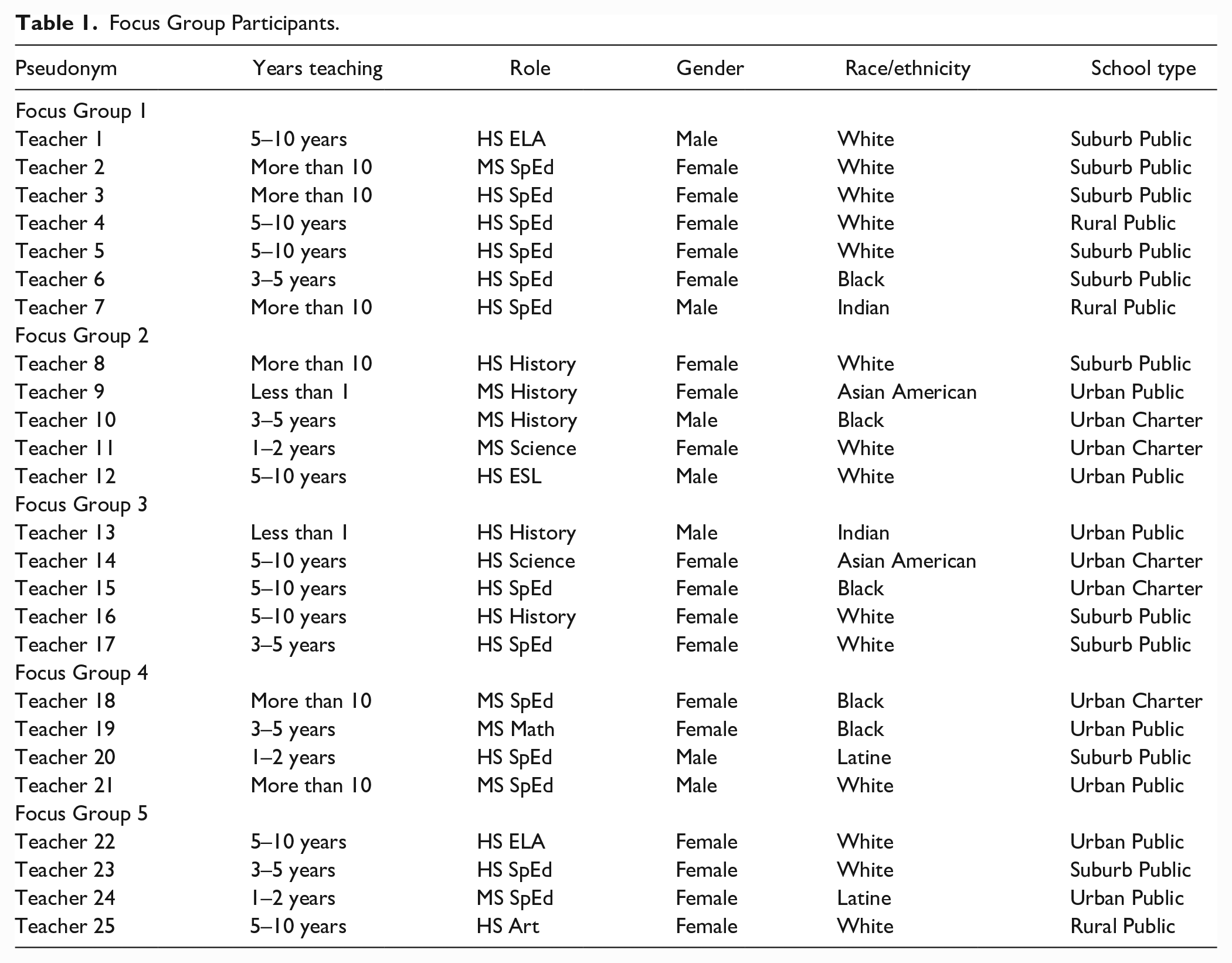
To answer the research questions, the study followed a qualitative design to understand the nuances and complexities of teacher practice in relation to classroom management assessment. Secondary educators (n = 25) working in public and/or charter schools were invited to participate in the study (see Table 1 for participant characteristics). Secondary educators were prioritized given that disciplinary disparities are greater at the secondary level (Skiba et al., 2011).
Focus Group Participants.
Two inclusion criteria were identified for teachers to participate. First, educators were required to be working in a classroom setting at the time of the focus groups. Educators in administrative roles were not included in the study. Second, educators were required to work in a public or charter school and were excluded if they worked in a private or independent school setting because private and independent schools typically serve fewer students of color and students of color with disabilities (U.S. Department of Education, 2021). Educators who met these two inclusion criteria and passed the initial screening were invited to participate in one focus group. Five 75-min focus groups were then conducted following a semi-structured procedure (Morgan, 2002). Focus groups were scheduled based on participant availability. Educators in each focus group represented a diversity of roles and geographic locations.
Recruitment Procedures
Educators were recruited through various popular educator social media sites. Studies find that roughly 75% of teachers in the United States use social media at least once a month to network with other educators, and Facebook and Pinterest are the most commonly used platforms (Market Data Retrieval, 2018; Ranieri et al., 2012). Thus, Facebook was selected as the recruitment platform for the study. Descriptions of the focus groups were posted with a link to a screener survey on popular educator Facebook group pages, including Teacher Educators in Special Education, Secondary Special Education Teachers, Teaching Strategies and Idea Sharing, and Teachers Helping Teachers Grow.
To participate, interested educators first completed the brief survey, which entailed answering two screener questions to determine eligibility, reviewing and signing a virtual consent form, sharing their demographic information, and providing details about their school. The initial pool of interested participants consisted of 108 educators. Of this pool, 41 educators met both inclusion criteria and were sent an email invitation to participate. From this group, 25 educators ultimately decided to participate. The 25 participants taught primarily in suburban (n = 12) and urban (n = 10) contexts, and several taught in rural districts (n = 3). The majority (n = 18) taught in schools where enrollment of students of color was greater than 50% and in schools where more than 50% of students received free and reduced-price lunch (n = 16). Focus groups were conducted virtually via Zoom to meet the scheduling needs and geographic diversity of the group. Following the focus groups, educators were given an Amazon gift card to express appreciation for their time.
Focus Group Procedures
The focus group protocol followed a semi-structured format, consisting of questions that were intended to guide the conversation but that left space for educators to initiate their own ideas and to build from one another’s experiences (Morgan, 2002). To this end, the topics addressed in each focus group were generally similar but offered unique insights given the composition of each group. Both open and close-ended questions were included in the protocol. An example of an open-ended question was, “How does student identity influence your management decisions?” An example of a close-ended question was, “What are some barriers you face in your use of assessment?” The full focus group guide was open-ended and allowed space for participants to introduce unanticipated topics. In several instances, follow-up or probing questions were asked to dig more deeply into a particular response. The conversations were also redirected as needed to ensure sufficient time was allocated to each question.
I led each of the focus groups. The focus groups began with introductions, followed by asking educators to elaborate on how they utilize assessment procedures in their classroom management practices and decisions and how a student’s background, identity, and disability status influence their management practices. Culturally sustaining pedagogy was brought up in several focus groups by participants when asked about the role of identity in school discipline decisions; however, it was not introduced explicitly. Instead, participants were prompted to reflect on how they think about the role of identity (their own and their students) and how they sustain student identities in their management and assessment practices.
Researcher Positionality
I write this article from the perspective of a White cisgender female without a disability. I was formerly a high school special education teacher, and my research examines the influence of teacher bias on disparities in school discipline. I am specifically interested in understanding how teacher mindsets and practices are aligned/misaligned with culturally sustaining instruction and what barriers prevent the embodiment of a culturally sustaining approach. I center critical theories in my work and am committed to challenging the status quo as it perpetuates historical and contemporary racist, ableist, and other marginalizing ideologies in educational research.
Data Analysis
Throughout the data collection and analysis process, I engaged in ongoing reflexivity, specifically examining how aspects of my identity as a White cisgender female and former educator influenced key decisions and interpretations of the data. Assumptions and biases based on my identity and experiences were carefully noted in a reflexive journal to ensure the role of my identity remained a consideration in all aspects of the research process.
I recorded, transcribed, and analyzed data from each of the focus groups. Analysis was conducted iteratively and through multiple readings of each transcript, moving between first- and second-level coding (Saldaña, 2015) to identify key themes and contradictions. A qualitative data analysis software, Dedoose, was utilized for the storage of transcripts and coding procedures and to house memos and concept maps. Due to the absence of a second coder, careful attention was placed on the process of creating and cleaning the emergent coding tree through multiple readings of each transcript. Codes were developed through an initial review of the transcripts, and transcripts were reviewed a second time to cross-check the coding tree. The nodes themselves were also cleaned and refined through multiple readings. The final coding tree consisted of eight parent nodes and 43 child nodes, or subcodes. Contradictions were identified and resolved through member checking, whereby several participants were contacted and asked to review and clarify certain findings through brief follow-up conversations. The follow-up conversations were conducted to resolve discrepancies several weeks after the focus groups and following initial data analyses. An example of a contradiction was understanding how teachers made meaning of and enacted school discipline policies that they disagreed with.
First-level coding focused on assigning codes based on the meaning of participants’ words, such as specific attitudes, challenges, or practices that were mentioned. Codes that emerged in this first-level coding included parent nodes such as “sustaining student identities” and child nodes such as “student–teacher relationships” and “creating a safe space.” Second-level coding, also called axial coding (LeCompte & Schensul, 1999), consisted of identifying relationships across codes. These relationships were examined to identify larger themes across the focus groups that seemed to emerge. For example, exploring how participants discussed their own and their students’ identities and how knowledge of their students’ backgrounds influenced their decisions was explored relative to how they approached assessment and classroom management more broadly. To summarize analyses and to elaborate on these themes, analytic memos and concept maps were created. The findings describe and elaborate on the four major themes that I identified through the data analysis procedures.
Findings
The analysis focused on how participants used assessments to inform management decisions and how their use of assessment and management practices sustained the identities of their students. The analysis resulted in four key findings, which will be described in detail below.
Theme 1: Relying on Instincts
The first finding was a general acknowledgment of the importance of formal assessments to inform management decisions while recognizing barriers to using assessment tools, instead relying on informal measures and instincts to inform practice. Educators in the study attributed this gap between an ideal approach and their actual approach to various barriers outside of their control, including class size, time constraints, and an overall lack of training and support. Teacher 15 said, Knowing that, like the [assessment] process to get to the root of behavior and actually make like a meaningful change and understanding what the student needs, I don’t necessarily have the time for so sometimes choosing to do like what’s quicker and faster.
This quote demonstrates the tension that arose in the focus groups between recognizing an ideal approach while also contending with barriers, such as time constraints. In a second example, Teacher 13 mentioned using formal assessment tools but not doing so genuinely given a lack of training. They said, “At least the majority of the teachers will just check, yes or no, to those [formal assessment] questions . . . I don’t know how sincere they are actually. It’s just you’re doing it for the sake of doing it because I think you need to know or you should at least be trained to know more about a student so some of these assessments, I think these are just like formalities.” Teacher 17 similarly noted a lack of training as a barrier to engaging in formal assessments genuinely. She said, I don’t really feel that I have adequate training to do one [a functional behavior assessment] . . . Like I can do it, so that we can check the paperwork off the list, but for it to actually be meaningful and impactful on the student’s behavior . . . I definitely don’t feel like I have the training.
Instead of using formal assessments to inform management decisions, several educators in the study tended to rely on instincts and informal measures to inform their practice both due to the barriers mentioned above as well as a concern for the ramifications of formal assessment and tracking procedures. Teacher 16, for instance, said, But there’s nothing really formal . . . We don’t like to track their behaviors because of the program that I’m in, they believe that a lot of their emotional issues causes the behavior and they don’t want it to be on their record. So we kind of just say things informally and in passing.
The lack of the use of formal assessment tools was noted as one cause of inconsistency in management across classrooms. Teacher 14 said, Honestly, everyone considers serious behavior concerns differently . . . For some colleagues like hey cursing is a serious behavior that jumps all levels . . . For some is like oh it’s okay it’s a level one or two, it’s a minor behavior concern, a bigger concern will be like fighting or violence in the classroom.
Teacher 8 had a similar experience of inconsistency across classrooms and attributed it to a lack of administrative support and coherent school-wide management and assessment expectations. She said, We just aren’t heard by administration like we’ve asked numerous times for more clear-cut consequences that go beyond just the conversation calling home because they haven’t really resulted in any real change. And because there’s just no follow through by administration unless it’s something really severe . . . I feel like we just have kind of given up on a lot of that.
This quote describes how, according to Teacher 8, the lack of administrative support has led to teachers creating their own systems in each classroom, resulting in inconsistencies.
Theme 2: Implementing School-Wide Systems of Assessment and Management
The second finding was in regard to the implementation of school-wide systems of assessment and management. In contrast to the first finding whereby informal measures and instincts were more readily relied upon to inform management decisions, the second finding suggested that school-wide systems of tracking and assessment can improve consistency in management across classrooms but at the same time they can vary in their efficacy depending on how they are implemented. PBIS came up most frequently as a school-wide system adopted by participants’ schools, whereby schools would track and assess positive behaviors and provide rewards to students when they reached a certain threshold. These systems were often used in conjunction with broader efforts at the school level to apply consistent classroom management strategies across classrooms. The efficacy of these system-wide approaches to behavior management assessment and tracking varied. Teacher 4 shared, “We started a PBIS program and when we try to, you know, do the warm and fuzzy, it’s not as effective as I’ve seen it in let’s say elementary.”
Teacher 22 felt differently and expressed that she interpreted PBIS to be more of a mindset than a tracking system. She also expressed that the tracking of positive behaviors solely without shifting teacher mindset led PBIS in some cases to fail. She said, I think a lot of people think of PBIS as, you know, a kid does something well, give them a candy or give them points . . . I look at it as more of a lifestyle kind of concept, you know sort of like an attitude. I feel like a lot of times schools will get this buzzword and they just kind of run it into the ground. When I started doing it, I said, I have to look at ways that I can say yes, instead of saying no, and it was nice because it sort of helps not just the kids with the classroom management, but also me with my own mental health. . . . Looking at what kids are doing right instead of focusing on what kids are doing wrong and that’s I think that mindset of what the system is supposed to be.
Teacher 22’s observation sheds light on the importance of teacher mindset and deeply understanding the spirit and core principles of top-down, system-level approaches to management and assessment, such as PBIS. In the case of PBIS, according to Teacher 22, this meant an intentional shift from focusing on negative behaviors to focusing on student assets and what “kids are doing right.”
Theme 3: Centrality of Relationships
The third finding was the centrality of student–teacher relationships and the importance of self and student identity awareness to prevent management issues and to sustain student identities in the classroom. Teachers described that the more they got to know their students, for instance, the easier behavior management became and the less they relied on punitive forms of discipline to enforce certain classroom rules. Teachers considered these relationships to be central in their ability to maintain student buy-in and engagement. Teachers described the importance of taking a genuine interest in getting to know students’ lives outside of school. This was typically done informally, through conversations; however, several teachers mentioned utilizing interest surveys at the beginning of the year as an assessment tool to get to know students. Teacher 12, for example, said I basically do a new student survey [at the start of every year] . . . and I try to have a document where every time that I learn something new about a student there’s a new Excel cell that I make.
Outside of this, teachers in the study generally did not mention utilizing assessment as a means to measure the quality of their relationships with students and instead relied upon informal encounters to get a sense of how they were relating to different students and where they could improve. For example, Teacher 9 stated, So one thing I have been doing intentionally is I will try to talk to them outside of my classroom, for example, and I will find topics to chat with them about, especially those kids who are having like behavioral issues. . . . Seeing them outside my class and letting them see me . . . because just those small talks will help students to, you know, feel that “Oh, you are also a human, right.”
This quote exemplifies the informal approach to relationship building that was not necessarily captured through data and assessment but that teachers relied upon to maintain positive relationships with their students.
Within relationship building, teachers in the study also acknowledged the importance of understanding a student’s identity. Teacher 21 said, I think when the teachers don’t understand the student’s entire identity, it creates a problem because we expect okay, well, we want this done at this time, but we don’t understand that students can’t always do that because they’re worrying about okay well who’s gonna take care of my siblings when I get home, do I have to cook dinner.
In this way, getting to know students’ backgrounds was noted as an essential ingredient in building and maintaining positive rapport. Teacher 1 shared, “I think, the biggest thing is knowing your population, doing your own research, driving around the neighborhood . . . I’ve done that before where I get to see where my kids are living.” Teacher 6 echoed the importance of this particularly when teachers are not predominantly from the communities in which they serve. She said, I teach at a majority-minority school but our staff is the opposite . . . I definitely would say taking time to get to know your students, their community and their lives, you know outside of the classroom is important. . . . Ensuring that the kids know that you care about them.
Teachers who acknowledged their own identities and backgrounds in relation to their students, both in ways that they were similar and different, also expressed an awareness of the importance of withholding judgment and being careful not to rely too heavily on interpretations to inform management decisions. Teacher 1 shared, I think my biggest conflicts in the classroom came from a misunderstanding of what the student was expecting and what I was expecting. . . . We’re not all coming from the same experiences and we have to have the wherewithal to go, “okay they’re not in the same situation you’re in.”
Theme 4: Letting Go of Control
The fourth and final finding was a willingness to let go of perceived control and acknowledge that a little bit of chaos in the classroom is acceptable. Teachers in the study described a shift in how they viewed classroom management from a tool to enforce order to one that instead promoted inclusivity and safety, creating a classroom where all student identities are welcomed, accepted, and sustained. Shifting the goal of classroom management from one of promoting order to one of promoting inclusivity and identity sustenance promoted greater student engagement and less problematic behaviors. Teacher 11 stated, I feel like behavior can be a little bit more on the back burner when curriculum is exciting. For example, like today, we played a game . . . and it was really chaotic and it was insane but the second I opened my mouth, to give the next hint it was dead silence because they’re so excited to play.
Teacher 11 went on to describe letting go of control and giving students agency and ownership in the classroom. She said, And also like flipping the classroom on its head a bit too like scholars respect teachers and believe a teacher be put on a pedestal but every scholar should be treated with respect, every scholar should feel that they are seen and that they are unique . . . Making school a place that they want to be in and they feel they are seen and they are heard is a really big factor.
Assessment was not something that came up as a strategy to support this shift in orientation to classroom management, presenting an opportunity to reimagine what assessment might look like in support of sustaining student identities and creating classrooms that are engaging and student-centered.
Discussion
The findings from this study reveal that assessments do not consistently inform classroom management practices and that, when utilized, are often done so in a superficial manner more to “check a box” than to genuinely track student progress and to inform management decisions. This may be largely the result of school-level barriers, such as time constraints, as well as a lack of training in both how to apply and how to analyze and utilize data from management assessments. The findings also suggest that educators engage in a variety of management practices to sustain the identities of their students, namely through building positive student–teacher relationships and through letting go of elements of control in their classrooms, allowing students to take ownership of their learning. These practices were often not formally measured or assessed by teachers in the study, offering an opportunity to expand current assessments and to design new ones that incorporate measures on sustaining student identities, such as measuring the quality of student–teacher relationships, classroom inclusivity, student feelings of belonging, and teacher mindsets. Designing validated measures to fully capture these important dimensions of classroom management through assessment represents an opportunity for the field coming out of this study.
Utilizing Assessments in Classroom Management
In response to the first research question, the findings suggest that assessments are not used genuinely and consistently across classrooms to inform management decisions. This is in line with the literature suggesting that assessments are, at times, not utilized effectively in classroom management processes (Korpershoek et al., 2016). A lack of time and training may be one possible reason for the lack of the genuine use of assessment to inform management strategies. A second possible reason may be the lack of cohesive school-wide systems and sets of expectations for assessing and managing student behavior, leading teachers to rely on instincts and informal measures to inform their management decisions.
The lack of formal assessments contributes to inconsistencies in management practices across classrooms as teachers do not have a clear method to determine the severity and appropriate response to various student behaviors, instead relying on their judgments to inform their practices. The literature suggests that decisions based on interpretations and instincts as well as decisions made quickly under time pressure are more prone to bias (Okonofua et al., 2016). In this way, management practices that are informed by instincts may be more susceptible to bias. At the same time, formal assessments are not infallible, and assessments that are not implemented with deep knowledge and consideration of student identity and the broader socio-political context that influences student behavior may also be susceptible to bias (Korpershoek et al., 2016). In addition, while formal assessments are often statistically validated, they may not be used in the way they are intended or adapted appropriately to meet the unique and individual identities of all students (AERA et al., 2014). Therefore, there is an opportunity to explore how traditional formal assessments may be modified to capture and integrate aspects of culturally sustaining pedagogy, promoting both an acknowledgment of as well as commitment to sustaining the identities of students to ensure assessments are promoting equity and not reproducing disparities. There is also an opportunity to explore how standards for validity might be applied and adapted in culturally sustaining ways.
In several instances in the data, participants shared that their school adopted PBIS to inform management and assessment practices through the deliberate tracking and rewarding of positive behaviors. The efficacy of this approach seemed to vary as PBIS was also susceptible to inconsistent and superficial implementation. One teacher noted that PBIS requires a shift in mindset to work effectively and that this is more essential and foundational than the actual reward-tracking systems themselves. This shift in mindset was described as choosing to see positive behaviors and student assets instead of negative behaviors and student deficits, which improved the teacher’s own mental health as well as her rapport with students. Seeing and sustaining student assets is one essential ingredient of culturally sustaining pedagogy, and a more explicit focus on shifting teacher mindset through PBIS to be more asset-based in their orientation to management may be a fruitful future direction to explore (Gay, 2018).
Utilizing Management and Assessment Practices to Sustain Student Identities
In response to the second research question, various management practices emerged that attempted to sustain the identities of students. In alignment with the literature on culturally sustaining pedagogy, these practices represented a shift away from traditional management approaches to instead create classrooms where students’ identities were seen, heard, and sustained by centering and providing students agency over their own learning (Migliarini & Annamma, 2020). Student–teacher relationships were also paramount in teacher management practices, particularly in getting to know students and their backgrounds and allowing this knowledge to inform management decisions. This finding aligns with extensive former research on the importance of student–teacher relationships for classroom management and school success (Kincade et al., 2020) as well as literature suggesting proactive and positive interactions with students, such as through positive greetings at the door, improve engagement and reduce problematic behaviors (Cook et al., 2018).
While teachers in the study shared management practices that were sustaining in nature, they did not demonstrate an awareness of how these practices might be captured in assessments and how assessments could improve culturally sustaining management interventions. Aside from the use of student inventory surveys as a tool to get to know and build relationships with students, there were no additional examples of assessment tools used in conjunction with sustaining practices. This is not surprising, as scant tools exist that explicitly assess culturally sustaining practices in classroom management (Korpershoek et al., 2016). Integrating a culturally sustaining approach into traditional assessment tools, such as Functional Behavioral Analysis protocols, while also providing new tools that capture additional dimensions of classroom management that are culturally sustaining, such as through the measurement of student engagement and feelings of safety and belonging, presents an important next step and opportunity for the field.
Limitations and Implications
There are several limitations in this study that should be considered. First, the data sources from this study were limited to teacher perceptions shared through focus groups. Actual discipline data, for example, which could be gathered through school records or classroom observations, was not collected and thus teacher opinions could not be corroborated through their actual classroom practices. Because the present study was interested in understanding teacher perceptions, this limitation was not detrimental to the findings; however, it presents an opportunity for future research to include alternative data sources in addition to focus groups with educators. Second, student perceptions were not considered in this study and thus it is possible that the ways educators perceived their practices to sustain the identities of their students did not actually translate into the creation of inclusive and equitable learning environments for all students. Thus, there is an opportunity to explore student perceptions in addition to teacher perspectives in future studies to gain a fuller understanding of culturally sustaining management practices and approaches to assessment.
Several implications arose as a result of this study for both researchers and practitioners to consider. For researchers, there is an opportunity to continue and expand the study of culturally sustaining pedagogy in the context of classroom management practices and assessment. Little is known about culturally sustaining assessment as it relates to classroom management, and there is an opportunity to explore what assessment tools might look like and how culturally sustaining pedagogy as a management approach might be captured through data. In addition, studying how traditional classroom management assessment tools do or do not promote culturally sustaining management practices could be an alternative approach to future research and could inform how existing tools could be expanded or adjusted to be more sustaining of student identities.
For practitioners, there are similarly several implications that arise from this study. First, supporting educators to both understand how to apply and how to effectively analyze and utilize data from classroom management assessment tools is paramount. Providing educators with assessments to use and providing adequate training is essential to ensure that assessments are integrated more readily into classroom management practices and interventions. In addition, there is an opportunity to consider how to effectively assess classroom management practices through a culturally sustaining lens and to ensure assessment tools consider and capture equitable outcomes and sustaining management practices for all students. Schools may also consider how certain structures or processes help or hinder the use of management assessment in classrooms. Schools may consider, for instance, providing additional time and opportunities for collaboration in professional development for teachers to plan for and consider how to integrate assessment more regularly into their management approaches and interventions.
There is an opportunity for assessment to inform and guide classroom management practices and to help ensure that they are culturally sustaining. Supporting educators to collect and use data in ways that contribute to inclusive classroom environments and that encourage the use of culturally sustaining management practices could be an important lever for change in reversing the deleterious effect of disparities in school discipline. Thus, both researchers and practitioners can consider how to integrate assessment more regularly into classroom management practices while ensuring that assessment supports and encourages culturally sustaining management approaches.
Conclusion
While disparities in school discipline across race and disability status are not a new phenomenon, less is known about the role of classroom management assessment in perpetuating or disrupting these inequities. This study sheds light on the experiences of educators while providing valuable insights into how we can create more culturally sustaining assessment tools as one lever to address disparities in school discipline. Ultimately, culturally sustaining classroom management assessments can be used as tools for equity, and it is imperative to continue uncovering and exploring opportunities for implementing culturally sustaining assessments in classroom management processes.
Footnotes
Declaration of Conflicting Interests
The author declared no potential conflicts of interest with respect to the research, authorship, and/or publication of this article.
Funding
The research reported here was supported by the Division on Career Development and Transition (DCDT) Graduate Student Research Scholarship and IES Predoctoral Interdisciplinary Research Training (IES-PIRT) Program through Grant #R305B200010. The opinions expressed are those of the authors and do not represent views of DCDT or IES.
