




Abstract
The multidimensional characteristic of learning has received little attention in the network literature, resulting in fragmented empirical evidence on learning networks. To address this gap, we introduce a framework that allows a better understanding of the multidimensionality of learning networks by employing the concept of multiplexity in the network literature. Our proposed conceptual framework for multiplex learning networks includes a 3-E typology (exploration, exploitation, and exaptation), which serve as distinct layers within the multiplex networks. We also provide a hypothetical scenario to demonstrate the potential of our multiplex learning networks framework for HRD scholars and practitioners. Moreover, we extend our framework to a multilevel model that connects individual-level learning relationships to team-level relationships. Our framework’s theoretical and practical implications are discussed, and future research directions are suggested.
Introduction
Social network analysis (SNA) is increasingly popular in people analytics and human resource development (HRD) as a useful method, process, and theory to comprehend relationships among social units (Han et al., 2019; Leonardi & Contractor, 2018). The analysis of people’s interactions aids in the development of people analytics strategies in organizations by identifying key employees who assist others in achieving their goals more efficiently and performing tasks more creatively (Leonardi & Contractor, 2018). Technological advancements open new opportunities to collect and analyze a wide range of network data within an organization. Scholars have begun to strategically integrate SNA and HR practices (Soltis et al., 2018).
In this trend, HRD scholars have recognized the unique contributions of SNA to the field and its potential to enhance HRD theories and practices (Han et al., 2019; Hatala, 2006; Yoon, 2018). One important purpose of HRD is to foster individual, team, and organizational learning (Khan, 1999). SNA can aid this purpose by understanding learning networks and the flow of knowledge within an organization (Han et al., 2019; Yoon, 2018). Organizations can use SNA results to identify structural inefficiencies in learning networks and implement more effective HRD interventions targeting the key actors to facilitate informal learning (Han et al., 2019). In the HRD literature, SNA has been utilized to analyze different learning-related networks, such as information and idea sharing (Parise, 2007).
However, little attention has been paid to understanding the multidimensional characteristics of learning from a network perspective (Decius et al., 2023). Despite a general consensus on the multidimensionality of learning, different definitions of its dimensions have been proposed (Marrian & Bierema, 2013), and most studies on learning-related networks have not appropriately addressed the multidimensionality. For example, the focus of an advice network can vary, such as solutions, problem reformulation, and legitimation (Cross et al., 2001); however, when analyzing an advice network, existing studies often use a general question about whom respondents reached out to for work-related advice (e.g., Klein et al., 2004; Li et al., 2021), which does not capture the multiple aspects of advice.
The multidimensionality of learning can lead to different types of learning networks in the workplace. Then, how can the multiple dimensions of learning be conceptualized and depicted as the different types of networks in the workplace? How do these different types of learning networks interrelate and contribute to the organization? Unfortunately, there are no clear frameworks for HRD scholars to address these questions. Despite extensive empirical studies on the types of learning networks in the workplace (e.g., Ho et al., 2021; Klein et al., 2004; Wang et al., 2014), with no theoretical framework on the multidimensionality of learning within networks, evidence remains fragmented.
It is necessary to establish a robust theoretical basis for understanding multiple types of learning behaviors in networks in the workplace. The concept of multiplexity has been recognized in recent network literature, in which two or more relationship types exist between two actors, a common occurrence in management settings (Ertug et al., 2023; Magnani et al., 2021). Multiplexity helps to understand the complexity of learning’s multidimensional characteristics in the workplace. A multiplex network refers to “a set of coupled layered networks” (Zhu et al., 2022, p. 2), and in this paper, we employ the idea of multiplex networks to develop a framework to understand the multidimensionality of workplace learning from a network perspective.
This paper aims to propose a conceptual framework for multiplex learning networks in the workplace. The proposed framework is based on learning types, which serve as distinct layers within multiplex learning networks. To begin, we review workplace learning and its multidimensionality and propose a typology for comprehending different workplace learning types based on organizational learning and ambidexterity literature. Building on the reviews and typology, we propose a conceptual framework, along with analyses of multiplex learning networks using a hypothetical scenario, demonstrating its potential for HRD scholars and practitioners. To address the need for reflecting the nested structure of organizations, we further extend the framework to a multilevel system by connecting multiplex learning networks within a team to networks between teams within an organization.
Our proposed framework aims to make invaluable contributions to the fields of HRD, people analytics, and related areas by integrating the concept of the multidimensionality of learning (Decius et al., 2023; Marrian & Bierema, 2013) and multiplexity in the network literature (Ertug et al., 2023; Magnani et al., 2021). This study is expected to establish a theoretical foundation for understanding actors’ exchange of information, ideas, and resources across multiple learning layers to unleash employees’ full potential and foster change and organization development.
Workplace Learning and Social Networks
Workplace learning can be defined as the process in which individuals engage in structured and unstructured learning activities to acquire the requisite knowledge and skills to meet work-related requirements (Jacobs & Park, 2009). By establishing these theoretical underpinnings, this section sets the groundwork for our framework of multiplex learning networks in the workplace.
The Connection between Learning and Network Theories
Integrating learning and network theories yields a holistic understanding of how individual cognition and social structures intersect and enables a flow of knowledge and information that promotes the dynamics of information exchange. Learning theories attempt to explain how people acquire new knowledge, skills, and behaviors by examining social cognitivism, behaviorism, and constructivism ideas that could influence the learning process in different contexts (Wang, 2012; Yilmaz, 2011). Network theories examine how individuals are connected through various social interactions, exploring the patterns and structures of these connections (Moliterno & Mahony, 2011) and also provide insights into how learning spreads in a social context (Knight & Pye, 2005). In essence, as network theory looks at systemic interconnections, learning theory examines changes in the individual and offers a lens to understand interactions between nodes that determine knowledge flows in networks.
From a social learning theory perspective, learning is strongly impacted by social environments and interactions with others (Bandura, 2001; Wang, 2012). Social learning theorist Bandura emphasized modeling and observation of others as central to how people learn new patterns of thinking and behavior (Grusec, 1992). People often learn through observation, imitating behaviors, and experiencing reinforcement. Network theory provides a compatible framework with Bandura’s view by examining how learning dynamics occur through social networks (Van der Krogt, 1998). It is also corroborated by Vygotsky’s social learning theory, which focuses more on social interaction for cognitive development (Tu, 2000).
When linking learning with network theories, social interactions are the primary source of learning (Melo & Beck, 2015). Learning emerges from interpersonal connections rather than solely individual characteristics. (Knight & Pye, 2005). The configuration of networks can create opportunities for social learning; strong networks promote a foundation for effective workplace learning (Pataraia et al., 2014). Further, actors’ learning behaviors in workplace learning networks contribute to shaping the learning infrastructure and systems (Govaerts & Baert, 2011).
Learning Network Theory
Integrating learning and network perspective, learning network theory (LNT) offers a comprehensive framework for understanding how people learn and acquire knowledge through social interactions in the workplace (Poell et al., 2000; Van der Krogt, 1998). LNT, as a descriptive theory, explains learning-work dynamics, particularly emphasizing the tension between the development of human potential and work processes. It aligns with the contemporary workplace environment characterized by increasing complexity and rapid change (Franken et al., 2018). In such environments, individuals cannot solely rely on their own knowledge and skills to navigate workplace challenges. Instead, they continuously learn by interacting with their network ties across organizational boundaries (Wise & Cui, 2018). While recognizing that not all learning solely depends on social or relational interaction, LNT focuses on learning networks, making it well-suited for representing workplace learning (Poell & Van der Krogt, 2000). Learning networks can take various shapes depending on agent dynamics and work characteristics (Poell et al., 2000; Van der Krogt, 1998). LNT highlights building and leveraging learning networks that foster a learning ecosystem in which new knowledge and innovative practices can emerge and be shared, creating opportunities for generating fresh ideas.
Workplace Learning
Workplace learning is an ongoing process involving formal and informal processes (Watkins & Marsick, 1992), incidental learning (Elkjaer & Wahlgren, 2006; Watkins & Marsick, 1992), and planned or unplanned activities (Hodkinson & Hodkinson, 2004). Further, to overcome the incompatibility between formal and informal learning, which prevents a cohesive understanding of workplace learning, Jacobs and Park (2009) proposed a three-dimensional conceptual framework. Their three dimensions are location of the learning (off the job or on the job), degree of planning (unstructured or structured), and role of trainer (passive or active). Hager (2011) also highlighted a growing interest in workplace learning, necessitated by an inclusive perspective of both formal and informal learning as well as more intricate and layered aspects such as relationships, communication, and making sense of information.
In recent years, there has been a notable shift in the workplace learning process, which can be partially attributed to the integration of social network perspectives in the interactions and collaborations among employees (Van Waes & Hytönen, 2022). Learning in the workplace is a social and political process that involves interactions with others (Vince & Saleem, 2004). Acknowledging the significance of building relationships with others is a crucial basis for workplace learning (Boud et al., 2009). Organizations can cultivate a valued workplace learning culture by integrating various learning techniques with an established network of interactions that prioritize ongoing learning (Park & Choi, 2016).
Multidimensionality of Workplace Learning
Adult learning in the workplace is multidimensional, meaning that multiple learning types exist (Merriam & Bierema, 2013). One example of such multidimensionality is Argyris and Schön’s (1974) single-loop and double-loop learning. There are several alterations of Argyris and Schön’s (1974) idea, such as lower- and high-levels (Fiol & Lyles, 1985) and incremental and radical (Miner & Mezias, 1996). Despite the different terms used to elaborate each scholar’s unique perspectives on learning, they commonly agree that the first type of learning occurs within existing norms, routines, and knowledge, while the second type involves questioning them to explore alternatives (Tosey et al., 2012). Building on single- and double-loop learning, a third type of learning, known as triple-loop learning, has been proposed, focusing on correcting the ‘system’ with new alternatives (Tosey et al., 2012). However, this concept has limited theoretical grounding and empirical evidence to support it (Tosey et al., 2012).
Concerning the relational aspect, few studies have explored learning types and behaviors. For example, Eraut (2007) proposed a typology of learning from workplace relationships, including three distinct relationships: “work processes with learning, learning activities within work, and learning processes at or near the workplace” (p. 409), focusing on categorizing multiple learning opportunities or sources in networks. Milligan et al. (2014) also identified four learning behaviors in informal networks: “consuming knowledge and resources, creating new knowledge, connecting people and resources, and contributing new knowledge back to the network” (p. 4). However, both typologies are limited by their lack of theoretical foundations.
Exploration, Exploitation, and Exaptation: 3-E typology
We propose the 3-E typology that reflects the multidimensionality of workplace learning, aiming to overcome the limited theoretical foundation of learning typologies. We adopt exploration and exploitation, introduced by March (1991), as a typology of organizational learning. The literature concerning organizational ambidexterity (OA), which encompasses exploration and exploitation, has been widely explored. Furthermore, the OA framework has been tested and supported across various contexts (Hardy III et al., 2019; Kjellström et al., 2022; Zacher et al., 2016). As such, the exploration-exploitation has been empirically demonstrated in the management literature, which provides a solid foundation to establish and propose our 3-E typology in the workplace context.
While the components of exploration and exploitation describe two distinct types of learning, we argue that a component is missing in this typology that could explain the movement beyond constrained growth. This additional component is called exaptation. Exaptation meets the calls from scholars who believe that the current exploration-exploitation framework does not meet today’s complexity (Dew & Sarasvathy, 2016; Markman et al., 2009). In this study, we propose the 3-E typology of workplace learning, including the three components of exploration, exploitation, and exaptation.
Exploration and Exploitation
Exploration involves the activities of “search, variation, risk-taking, experimentation, play, flexibility, discovery, [and] innovation” (March, 1991, p. 71), whereas exploitation involves activities of “refinement, choice, production, efficiency, selection, implementation, [and] execution” (March, 1991, p. 71). Exploitation has been associated with efficiency, certainty, and variance reduction, while exploration has been related to search, discovery, and innovation (O'Reilly & Tushman, 2013). Exploration and exploitation represent knowledge expansion and refinement, respectively (Hardy III et al., 2019). Although the typology was coined to describe organizational-level learning strategies (March, 1991), it can be applied to individual-level learning to explain individuals’ distinct strategic choices, mindsets (Greco et al., 2019), and behaviors (Hardy III et al., 2019; Kjellström et al., 2022; Zacher et al., 2016).
This typology has been developed in the literature relating to organizational ambidexterity and learning, studying the ability of an organization to explore new and exploit existing capabilities simultaneously (Liu et al., 2019). The main idea is that both separate functions need to be balanced to maintain sustainability (Liu et al., 2019; March, 1991). Scholars have delved deeper into the tension between these distinct learning types (Greco et al., 2019; Hardy III et al., 2019) and the optimal balance between the two (Uotila et al., 2009). Organizations that solely prioritize exploration or exploitation tend to become obsolete (Markman et al., 2009).
These two learning types need to be integrated into necessary and iterative processes for an organization’s short- and long-term success (Liu et al., 2019). This interactive perspective presents the two within the same organizational structure, both of which contribute to the organization’s sustainability in a sequential manner, enabling changes to occur over time (O'Reilly & Tushman, 2013). For employees, this view provides employees with the autonomy to make judgments on how to divide their time between the two (O'Reilly & Tushman, 2013).
Exaptation
The existing exploration-exploitation typology lacks a mechanism to entirely disrupt existing knowledge. Some scholars have questioned whether the exploration-exploitation typology is sufficient to address current complexity and periodic disruptions, thereby suggesting the need for advancing the typology (Markman et al., 2009). To address the need, the term exaptation was coined to highlight the processes of identifying and utilizing an entity’s latent functionality, leading to a complete shift in the function it previously performed (De Sordi et al., 2019). Exaptation can be defined as “new patterns of interaction among agents around the use of new kinds of artifacts leading to the emergence of new functionality, which in turn induces new kinds of relationships among production, technology, and consumption” (Bonifati, 2010, p. 743). Exaptation can be considered as the third pattern of the invention that provides the flow of information to new functions and forms, with the first being demand-pull and the second being supply-push (Dew & Sarasvathy, 2016)
Exaptation is associated with four entities that are linked to management: tacit knowledge, data, process, and skills (Dew & Sarasvathy, 2016). For tacit knowledge, an organization’s human capital becomes the focus through competence and intellectual capital management (Dew & Sarasvathy, 2016). Second, the data entity focuses on transferring organizational knowledge to new applications. Third, advances in technology have made it easier to repurpose processes, including advancing managerial processes, workflow, and business process execution language (De Sordi et al., 2019). The last entity, skills, involves adding new skills to better address uncertainty and ambiguity, including entrepreneur skills, sensemaking, and heuristic creation (De Sordi et al., 2019).
3-E Typology
Exploration, Exploitation, and Exaptation Defining Characteristics.
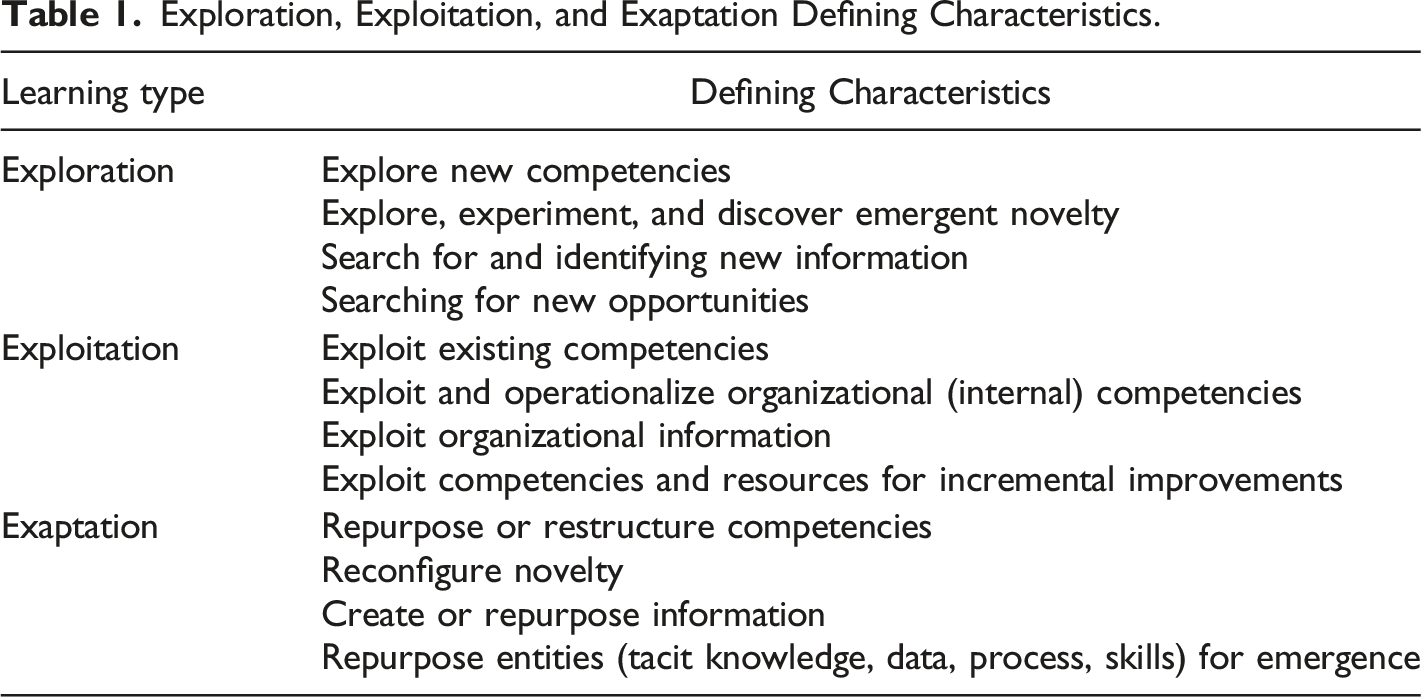
The 3-E typology aligns with the existing frameworks of relational learning types and behaviors (Eraut, 2007; Milligan et al., 2014). Exploration entails the pursuit of new knowledge or resources in Milligan et al. (2014). This learning type parallels Hardy III et al.’s (2019) conceptualization of exploration being associated with knowledge expansion, which is related to contribution behaviors by Milligan et al.’s (2014) typology.
Exploitation includes consuming knowledge or resources. However, we view exploitation beyond individual-level consumption, recognizing it as a process that not only directly acquires knowledge but also feeds this knowledge back to the system for broader consumption at a team and organization level. Additionally, Eraut’s (2007) typology comprises three relationships, all of which are only associated with exploitation; its relationships exploit knowledge, experience, and skills from co-workers. However, Eraut’s (2007) model does not account for the creation of new knowledge or repurposing processes to innovate products or enter new markets.
Lastly, exaptation involves the repurposing of knowledge and resources, making use of both existing and new knowledge. It is not necessarily responsible for capturing all knowledge creation described in Milligan et al. (2014). Instead, it encompasses broader behaviors such as repurposing and reconfiguring organizational entities (i.e., tacit knowledge, data, process, skills), and is more contextually relevant to the problem or product rather than being applicable to all knowledge.
Multiplex Networks and Workplace Learning
Multiplexity refers to the co-existence of multiple social relationships between actors, which is a common occurrence in management settings (Ertug et al., 2023; Magnani et al., 2021). In multiplex networks reflecting the multiplexity, each layer corresponds to a single field in which actors are connected to each other by specific relationship rules, such as information-seeking and idea-sharing (Cai et al., 2018; Magnani et al., 2021). Multiplex networks allow researchers to examine the nodes’ and layers’ characteristics as vectorial terms, taking into account multiple layers, differently from the traditional single-layer networks (Battiston et al., 2017). Scholars often use the terms multiplex networks and multilayer networks interchangeably (Battiston et al., 2017). To avoid any confusion, we use multiplex networks throughout this study, describing “a set of coupled layered networks, in which each layer can have different particular features from the rest and support different dynamic processes” (Zhu et al., 2022, p. 2).
Failing to consider multiplexity results in a limited understanding of the complexity of social connections in the workplace (Ertug et al., 2023). Most studies have separately examined social networks in the workplace as single layers without considering the multiplexity (e.g., Ho et al., 2021; Klein et al., 2004; Wang et al., 2014). For example, Ho et al. (2021) investigated the influence of formal (supervisory) and informal (trust-based) networks on work passion. Also, Wang et al. (2014) decoupled the collaboration network and knowledge network to investigate the influences of their structure features on firms’ exploratory innovation.
To address the limitations of single network studies, recently, increasing studies have explored multiplex networks in the workplace. For example, Brennecke (2020) investigated dissonant ties to describe the multiplexity of positive and negative relationships regarding problem-solving-seeking networks. Also, Methot et al. (2016) explored the multiplexity of workplace friendship, which involves work-related interactions and personal relationships; according to this study, employees can experience emotional exhaustion when performing conflicting roles in different networks. Related to learning networks, Cai et al. (2018) investigated five types of networks within an organization, including one formal (i.e., working) and four informal (i.e., communication, important business, borrowing, resignation discussion) networks. They approached their analysis in two ways: (1) analyzing each layer in consideration of interlayer connections (i.e., unfolded multiplex network), and (2) analyzing a superimposed multiplex network by superimposing all its single layers. Their investigation revealed the interconnectedness of social relationship layers in the workplace. Furthermore, their findings support the notion that individuals who possess high centrality within an unfolded multiplex network tend to exhibit high performance.
The 3-E typology identifies discrete relational learning patterns in the workplace while retaining a holistic view of their interactions. Drawing from LNT, the concept of multiplexity within the 3-E typology recognizes that learning encompasses collaborative processes in a networked workplace environment that influences both individual and collective learning (Poell et al., 2000; Van der Krogt, 1998). In essence, when we use multiplex networks in understanding and employing the 3-E typology, we can offer a more detailed articulation of how various interconnected learning networks can facilitate knowledge flows and skills development within and/or between networks. It provides analytical lenses to uncover structures and practices that genuinely support the multidimensionality of workplace learning.
Multiplex networks are particularly useful in analyzing the multidimensionality of workplace learning because they allow for different dimensions of learning to be mapped in distinct layers. Each layer can correspond to a specific type of learning between actors. e.g., by applying our 3-E typology, the first layer can represent the relationships that help employees explore new information and opportunities that do not exist in the organization (i.e., exploration), the second can illustrate relationships in relation to the flow of organizational information (i.e., exploitation), and the third can show the relationships that facilitate individuals to repurpose information and competencies (i.e., exaptation). Multiplex networks provide a more nuanced understanding of complex learning relationships in the workplace. This can help organizations to identify areas for improvement and develop more effective strategies for promoting learning and development among employees.
Conceptual Framework of Multiplex Learning Networks
Building on the groundwork in the previous section, we propose a conceptual framework of multiplex learning networks in the workplace. We use the 3-E typology as a framework showing multiple learning layers; the defining characteristics summarized in Table 1 help to differentiate three types of learning behaviors in the multiplex networks. The conceptual framework of multiplex learning networks with a hypothetical scenario is depicted in Figure 1. Conceptual framework of multiplex learning networks of a hypothetical team. Note. circles represent nodes (i.e., team A members; Blue = IT specialists; Orange = UX designers; Black = Project manager) and arrows correspond to learning ties.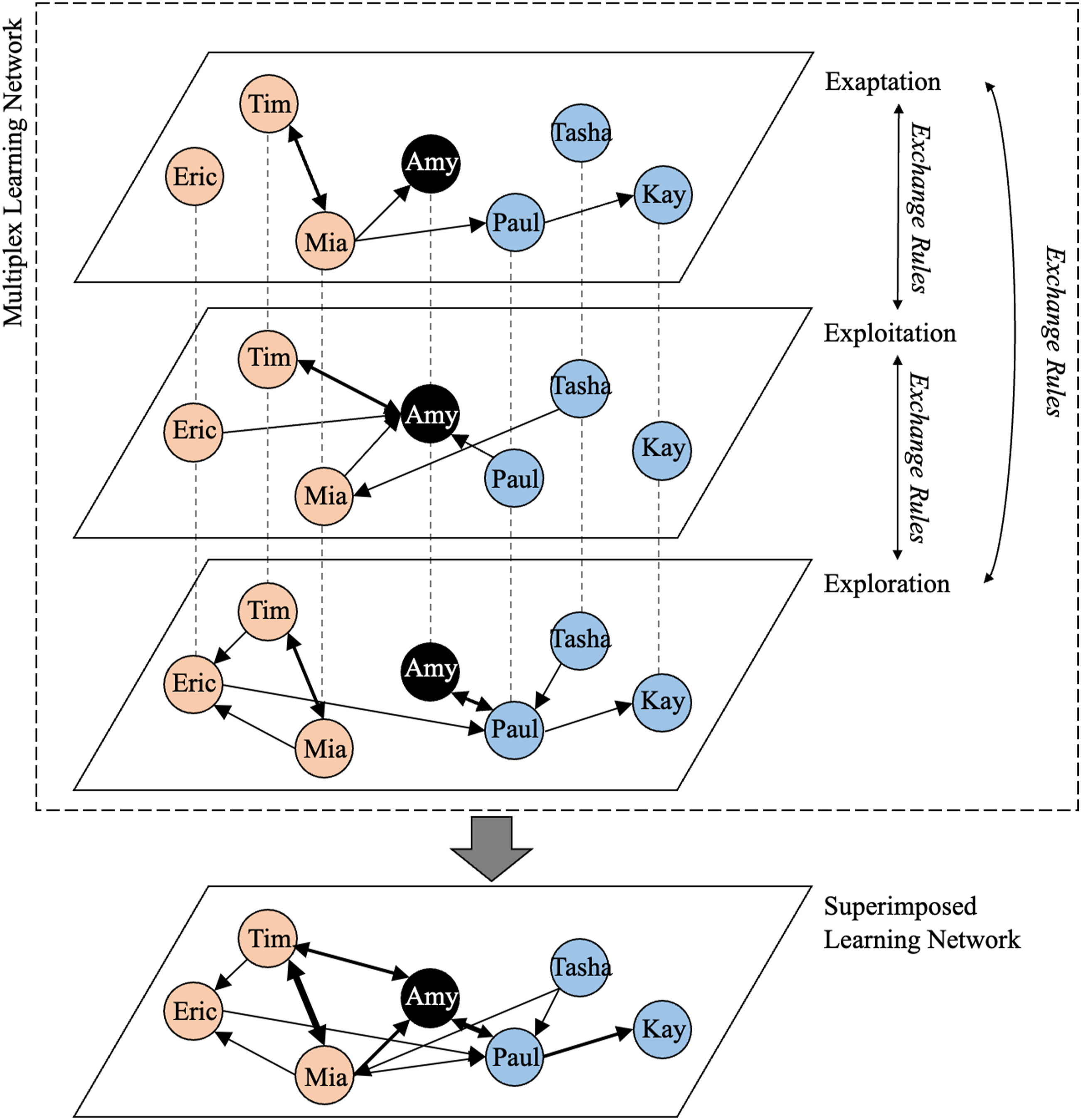
Multiplex Learning Networks with A Hypothetical Scenario
The scenario involves a new product development project team in a high-tech organization. The team consists of seven members: three IT specialists (Kay, Paul, Tasha), three User Experience (UX) designers (Eric, Mia, Tim), and one project leader (Amy) who has an IT background. Paul and Tim are the most experienced members in their respective domains. All names are fictitious. The team aims to develop a product that provides users with a seamless experience to control their home appliances using the company’s mobile app. Information technology specialists are responsible for developing hardware and software components and closely working with UX designers to ensure that the product is user-friendly with an intuitive interface.
Team members answered network questions to ask whom they reached out to when they sought new information and resources (exploration), existing information and resources (exploitation), and repurposing and restructuring their information and resources (exaptation). For example, according to the exploration layer in Figure 1, Eric answered that he reached out to Paul when seeking new information and resources; Tim and Mia indicated Eric. This hypothetical scenario only investigated different types of learning in 3-E, focusing on information and resources. For the uses of the 3-E typology in future network research, it should be noted that HR researchers and practitioners could develop their own network questions that address the research focus, such as opportunities. To facilitate future use, the suggested network questions to measure each learning network in closed- and open-ended formats (Borgatti et al., 2022), and to measure the weights of the ties are provided in Appendix A.
In the dotted area of Figure 1, the 3-E layers are connected within the framework. The total system of learning interactions is depicted as a superimposed learning network (SLN). Three different learning networks of 3-Es illustrate the possibility of showing different results depending on the types of workplace learning. For example, in the Exploration network, Paul, a senior IT specialist, can be identified as one of the key members of the team. He could be a hub of this team for new knowledge. In exploitation relationships in which team members seek existing information and resources in the team, Amy, as a project leader, was identified as a central connector, showing the highest in-degree centrality. Understandably, as a project leader, Amy may play a key role in distributing organizational information and resources to the team. Lastly, regarding the exaptation network, given that exaptation requires recursive exchanges, in the hypothetical team, only one paring (Tim and Mia) fully engaged in exaptation, and IT members rarely participated in exaptation; it could imply a potential failure to create a new product, different from traditional organizational archetypes. As illustrated, different key players or relationships could be identified depending on the type of workplace learning in the network research.
In addition to the distinct layers, we further propose a superimposed learning network (SLN) that depicts the total system of learning interactions. In this scenario, we developed SLN by superimposing the three learning network layers. In this example, weights were calculated by counting the learning connections regardless of learning type. It means we did not impose different weights on 3-E layers when superimposing them. This scenario follows the multiplex network practices in the previous network studies (e.g., Cai et al., 2018; Magnani et al., 2021; Zhu et al., 2022). In the hypothetical example, Amy was the member showing the highest in-degree centrality, indicating she was the one who was most often contacted, followed by Paul.
On the other hand, Mia was the member who actively reached out to other team members to learn from them, showing the highest out-degree, weighted centrality. SLN provides a simplified and overarching view of the multiplex learning network with three single layers. We suggest that it can be used as an efficient tool to illustrate learning networks. Although, in this illustration, we constructed SLN by simply adding up the connections of different learning types, we discuss other potential approaches to aggregating the learning layers in the discussion.
Additionally, the hypothetical data, R script, and supplementary document for more details are available at https://doi.org/10.6084/m9.figshare.24365380.v1 (Nimon & Yoo, 2023). We presented an example analysis of our heuristic example in the supplementary file. The supplementary document presents the node measures, network measures, and multilayer community detection results of our hypothetical scenario.
Exchange Rules
We propose exchange rules that relate to connecting the exploration, exploitation, and exaptation layers. Organizational learning, in this context, can be framed as a process marked by the iterative and recursive exchange rules across the three layers of the multiplex learning networks. The integration of these three Es into the larger system becomes the key to successfully achieving organizational learning. According to learning network theory (LNT), interactions between organizational agents are the primary source of learning (Poell et al., 2000; Van der Krogt, 1998). However, the connection between different learning types is missing in LNT and organization learning theories. Exchange rules are essential to ensure coherence across organizational structures and to optimize learning across organizational agents. If the exchange rules are not developed and incorporated into the system’s processes, then the 3-Es are disconnected, and organizational learning is incomplete. Anything less than complete connections across the 3-E layers would provide less than optimal conditions in which organizational learning only occurs in pockets within the organization rather than being distributed across all relevant agents and departments.
As exchange rules, an organization and/or a team are expected to develop the internal processes and expected behaviors to connect the three different types of learning networks and disseminate them to employees. The shared rules can be further articulated and transformed by both top-down and bottom-up processing. In particular, learning is an important medium to build shared mental models in a team (Van den Bossche et al., 2011). Although this project does not cover the flow and dynamics of the exchange rules, researchers could use SNA to analyze and visualize it as a different aspect of a multiplex learning network.
Additionally, successful exchanges could be achieved not only by rules but also by agents who play a bridge role between layers. The agent behaviors to connect the three different types of learning in the workplace could be grasped by SNA. In our scenario, for example, Mia and Tim built bi-directional relationships when they sought new opportunities (exploration) and repurposed the existing information (exaptation). And Tasha reached out to Mia when she sought existing policies, rules, and resources (exploitation). In this process, Tasha may indirectly receive information from Mia that was exchanged with Tim in the exploration and exaptation relationships. In this case, Mia became a bridge between Tim and Tasha across 3-E learning layers. As such, an actor becomes a bridge to connect information across learning network layers.
An Extended Framework of Multiplex Learning Networks: A Multilevel Model
In the previous section, we proposed multiplex learning networks with a clear boundary. However, a network theory of organizations should be multilevel to account for the nested structure in organizations (Moliterno & Mahony, 2011). Single-level research methods have potentially “obscured important cross-level relationships and causal mechanisms” (Moliterno & Mahony, 2011, p. 448). Thus, we conceptually extend our multiplex learning networks framework to a multilevel model (see Figure 2). A multilevel extension of multiplex learning network. Note. Blue = IT specialists; Orange = UX designers; Black = Project manager.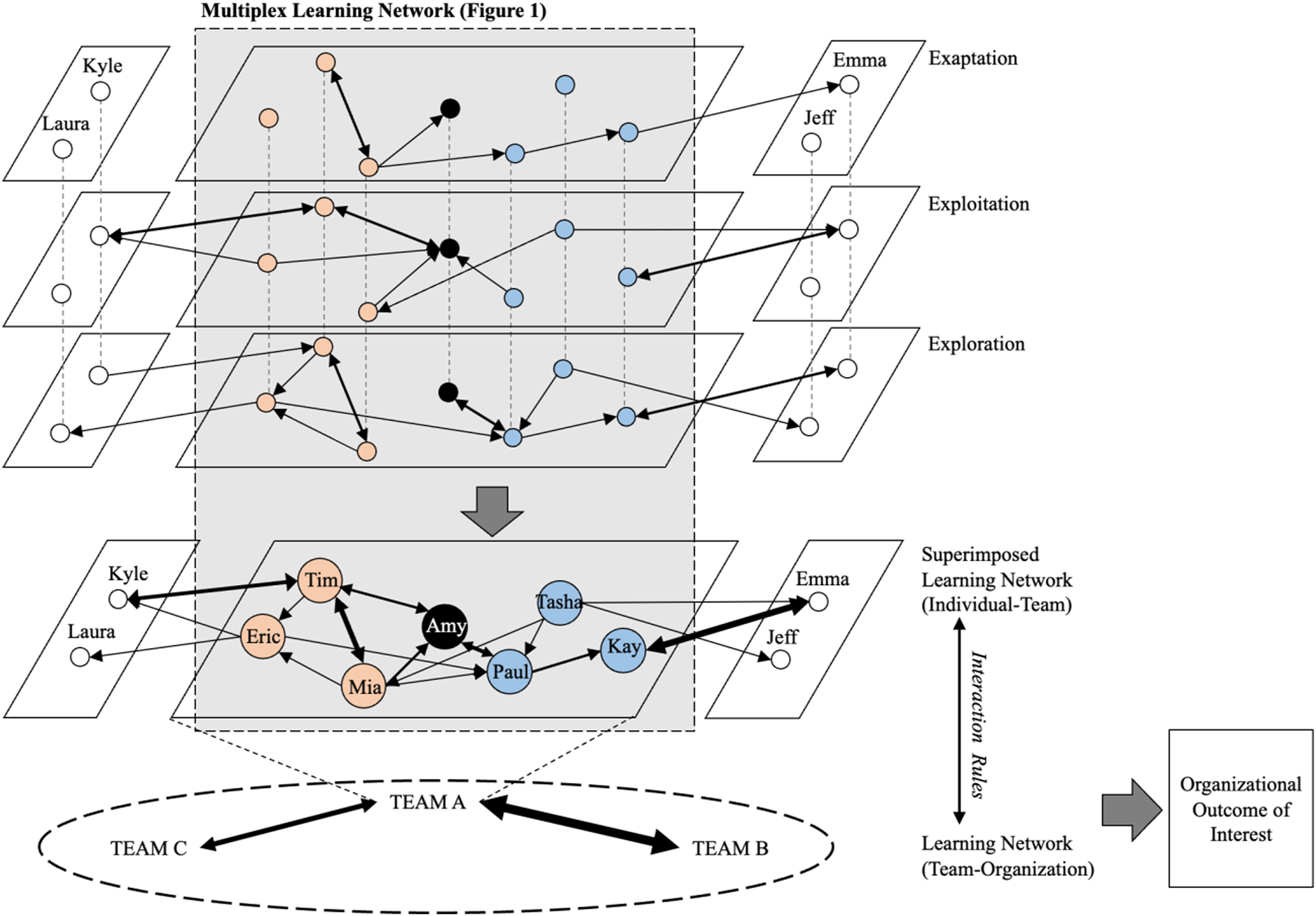
In this multilevel model, we focus on two aspects: boundary extension and cross-level interactions. First, when defining and analyzing social networks, defining a boundary is necessary but difficult (Borgatti et al., 2022). Internality and externality can be viewed differently depending on how we define a network boundary. Although Figure 1 illustrates the complete networks with a clear team boundary, team members can build learning relationships with individuals outside of the team. Researchers could collect network data without any boundaries so that participants openly answer key sources to whom they reach out. As Figure 2 depicts, Eric reached out to not only Paul but also Laura in Team C to explore new information and resources (exploration). Moreover, within the hypothetical team, Kay did not show exploitation behaviors with team members; however, she reached out to Emma in Team B to get existing information about an organization (exploitation). As such, extending the boundary provides a better picture of the learning networks in an organization. To minimize complexity in the future, Figure 2 only includes four actors from teams B and C.
Second, at the organizational level, inter-team multiplex learning networks can be illustrated, with teams being the nodes. In Figure 2, Team A played a bridge role between Teams B and C. Team members’ relational learning behaviors with external members can be used to operationalize inter-team ties. Individual learning relationships with external members could be aggregated into team-level learning behaviors. The cross-level interactions can be analyzed from two perspectives: (1) how the higher-level network structure (inter-team) constrains the lower-level relationships (interpersonal), which is a top-down structural effect, and (2) how lower-level networks affect structuring the higher-level networks, a bottom-up structural effect (Moliterno & Mahony, 2011). In particular, Kim et al. (2006) argued that if the bottom-up structural process restricts the ties at the higher level, it leads to the phenomenon of network inertia.
We propose interaction rules to connect cross-level network structures constructively. Interaction rules play a pivotal role in shaping and managing the flow of learning across levels in an organization. Whereas the exchange rules address connecting the three components that make up the 3-E typology, interaction rules explain how organizations manage the abovementioned top-down and/or bottom-up structural influences in the multiplex learning networks. To be clear, interaction rules provide a guideline to connect individuals to each other beyond their unit boundaries as agents (Bandura, 2001; Wang, 2012), not a programmed set for employees. And these rules include rewards for certain outcomes (Ried et al., 2019).
We argue that creating and sharing interaction rules with employees maximizes the value of workplace learning and leads to organizational success. Building and disseminating the right interaction rules that fit organizational culture is crucial to avoid the network inertia caused by structural constraints and ensure that the contents in multiplex learning networks are smoothly transferred across levels. If the cross-level interactions become interrupted by inhibiting constraints or cease to exist, organizational learning does not achieve a state of flow or coherence (Rosso, 2014; Schatz & Stodd, 2023). There could be discordance between team members and the team due to differences in learning focus. For example, a team member focuses on exploitation in learning, which navigates the existing information and resources in the organization, whereas the team focuses on seeking new information (exploration) to pursue disruptive innovation. The learning-focus gap across levels leads to inefficiency and a decrease in performance. In this aspect, consistent interaction rules across levels would be advised, which aligns learning behaviors and outcomes across levels. The interaction rules ensure that employees are provided with a clear understanding of what is expected from an organization. It reduces confusion and uncertainty in navigating ideal learning.
We further posit that these rules influence and are influenced by power dynamics in an organization. To illustrate, consider a scenario involving agents collaborating on an exaptation activity to innovate a new product. Within this team, a leader may possess a power-distance advantage due to the leader’s role. To ensure that requisite information is shared among all agents, regardless of any power-distance dynamic, specific rules of interaction should be identified for the activity, in this case, for the exaptation activity. Interaction rules serve as a mechanism through which individuals can seamlessly build learning relationships across hierarchical, functional, and structural boundaries. Interaction rules help to reduce conflict and complexity by allowing clear guidelines for sharing information across boundaries (Krippendorff, 2009; Umpleby, 2009).
Discussion
The proposed conceptual framework of multiplex learning networks advances HRD theories and practices by integrating workplace learning and SNA. Based on the 3-E typology, three learning layers are mapped in the multiplex learning networks framework and construct a superimposed learning network. The multiplex learning networks framework incorporates the concept of multidimensionality in the workplace learning literature (Decius et al., 2023; Marrian & Bierema, 2013) and multiplexity in the network literature (Ertug et al., 2023; Magnani et al., 2021). Our proposed framework can enable HRD scholars to examine learning in the workplace as a multidimensional and multilevel concept by illustrating a hypothetical scenario and data. It is noted that the supplementary document for more details is shared via Figshare (Nimon & Yoo, 2023). This study expands our understanding of workplace learning types toward multiple layers in the learning network. Further, our proposed concepts to connect distinct layers in the multiplex network (i.e., exchange rules) and different levels of learning in an organization (i.e., interaction rules) provide insight into building learning networks to create more effective learning flows and generate innovations in an organization. In this section, we discuss the implications of our framework and future research suggestions.
In addressing complex problems in business, utilizing networks to distribute information and create new knowledge is an effective way of assuring that all necessary agents engage in problem-solving processes (Weber & Khademian, 2008). The distribution of information involves the dissemination of information to participants who need the information in a timely manner, verification that each participant received the information, and that the information is integrated across all participants to create new knowledge that is applicable to the complex problem. Our framework of multiplex learning networks contributes to integrating the three components of exploration, exploitation, and exaptation in the process of distribution of information. Future research is recommended to utilize networks to integrate the 3-Es within an organization to ensure that coherence is achieved across all organizational agents.
This study provides researchers with a theoretical framework to investigate multidimensions of workplace learning from a network perspective, which makes sense of the multiplexity of networks. Our framework contributes to people analytics by helping not only to analyze learning networks but also to collect high-quality network data. It helps researchers determine the focus of learning networks. Instead of researching learning-related relationships based on fragmented network studies, researchers could design network research on workplace learning based on the 3-E typology as a theoretical guide. In other words, using our multiplex learning networks framework, researchers are advised to answer the following question first: Which type of learning do you aim to investigate? After identifying the focus of their research, our framework facilitates researchers to determine the boundary of learning networks.
We expect that our framework will initiate more empirical studies on learning networks in a cohesive way. Building on our multiplex learning networks framework, future research could explore how employees’ 3-E learning behaviors are differently mapped and their different impacts on individual and organizational outcomes in various workplace contexts. Moreover, to increase the quality of the empirical network studies, we further ask for more studies on developing more rigorous network questions to investigate learning relationships. Although we suggested several potential network questions in Appendix A, it is essential to develop reliable and valid measures to collect high-quality network data consistently in HRD and related fields. We also suggest analyzing the structural equivalence between these layers by using quadratic assignment procedure (QAP) correlations to see. As a non-parametric technique, QAP does not require the independence assumption among networks (Krackhardt, 1987). The QAP could be extended to the multiple regression QAP (MRQAP) to determine one matrix’s effect on another, controlling for multiple covariates (see Han et al., 2019, showing a hypothetical application of MRQAP in the HRD context in detail). Using MRQAP, scholars could explore explanatory relational variables that predict 3-Es in multiplex learning networks. Our framework further contributes to synthesizing network research on workplace learning. Future research could categorize the existing empirical research on learning into the 3-E typology and meta-analyze how network features are related to individual and organizational outcomes.
We further emphasize the importance of existing all three components in the 3-E typology for an organization to achieve sustainable improvement by proposing exchange rules to connect these three layers. If one component is missing, this could be indicative of an organization not meeting the requirements of reinventing itself, leading to the problem of the organization remaining stagnant. In today’s globally connected environment, organizations must constantly reinvent themselves to avoid stagnation. To achieve this, it’s important to identify all three components (3-Es) that represent constant re-inventive behaviors in an organization and potentially show a culture of reinvention. Our framework, moreover, provides insight into the potential tension between layers due to inter-layer force and intra-layer force (Magnani et al., 2021). Future research could investigate the tensions across the 3-E learning layers from a quantitative or qualitative perspective.
In connection with learning network theory (LNT), our framework could be advanced by incorporating workflow. The multiplexity of learning networks could be connected to the multidimensionality of work. Uhl-Bien and Arena (2018), for example, viewed exploration as an entrepreneurial activity and exploitation as an operational core. In addition, we could suggest exaptation is an innovative activity to re-construct existing resources. An advanced framework of multiplex learning networks incorporating workflow could explain complicated dynamics and tensions between learning and work, and provide insight into HRD strategies to manage those dynamics and tensions. Relatedly, Lundgren and Poell (2023) elaborated on HRD activities in learning and work networks by investigating the roles of HRD professionals and managers; they interact and engage in intricate workflow interactions and collaborations. At the core of their argument lies the identification of different network types, which offer a nuanced understanding of the multifaceted interactions that underpin organizing learning activities in the workplace. It resonates with the idea of multiplex learning networks as dynamic systems that require ongoing negotiation and coordination among actors. HRD professionals and managers form a complex web of learning and work relationships (Lundgren & Poell, 2023), which could embody our multiplex learning network. By presenting these insights within the framework of multiplex learning networks, the current paper advances LNT. We deepen the comprehension of the complex relationships in workplace learning, thus paving the way for more informed HRD strategies in workplace learning.
Extending our framework to a multilevel model could lead to a comprehensive learning network theory. The potential benefit of developing a multilevel, multiplex learning network model is that lower-level, higher-level, and cross-level effects can be identified and understood better (Moliterno & Mahony, 2011). Building on our premature extension, future research could advance our multiplex learning networks framework to connect to strategic HR theories and practices. While learning organization theories focus on learning that occurs within the organization, organization learning occurs when fundamental changes are made by the organization (e.g., vision, ideology, structure) (Meyer, 1982; Watkins & Kim, 2018). Watkins and Kim (2018) also highlighted that researchers should be able to “differentiate between learning in and learning by organizations” (p. 16). By taking a strategic perspective, our multiplex learning networks framework has the potential to contribute theories and practices in HRD and related areas, which better aligns with organizational strategies and processes.
Limitations
Our proposed framework for multiplex learning networks has several limitations that could provide potential avenues for future research. The first limitation pertains to our assumption of learning. In this study, we assume learning to be a directional tie, whereas bidirectional exchanges among all team members may be ideal for learning. How to define learning could influence managing, analyzing, and cultivating multiplex learning networks in the workplace. Also, our framework does not take into account self-loop in workplace learning. However, self-reflection, as a type of self-loop learning, is a critical component of workplace learning (Marsick, 1988). In network research, self-loops are “links from a node to itself” (Wei et al., 2011, p. 2).
Second, in our hypothetical illustration, we developed SLN by employing a straightforward method, which involves adding up connections across learning layers. This method is consistent with previous network studies that superimpose layers (e.g., Cai et al., 2018; Magnani et al., 2021; Zhu et al., 2022). However, it is worth noting that we can explore other sophisticated and nuanced approaches available beyond simple addition or averaging. For instance, we propose the concept of weighted aggregation, where varying weights are assigned to learning types based on their respective influences on expected outcomes, such as efficiency or creativity. To the authors’ knowledge, there is no established theoretical foundation for assigning these weights to 3-Es for a specific outcome. Thus, we suggest that future research could empirically investigate the optimal combination of the weights on the 3-Es to maximize predictive ability. Furthermore, in future research, there is an opportunity to directly measure these weights by using survey questions to assess the perceived values of 3-Es in achieving particular outcomes. These weights could be determined based on the perspectives of participants or their supervisors, Reflecting the perceived importance of the three types of learning.
Third, although our framework delineates three different layers of multiplex learning networks, it remains insufficient in elucidating more intricate networks that extend beyond its scope. For instance, our framework cannot address the intricacy of individuals belonging to multiple networks in a workplace setting, such as scenarios involving multi-team systems or informal sub-groups. It could influence learning networks in the workplace. In light of this, hypergraphs can be an alternative approach for analyzing the complexity. Compared to the traditional SNA approach that builds networks by linking pairs of nodes, hypergraphs introduce the concept of hyperedge, enabling researchers to establish connections among more than two nodes (Bretto, 2013). By employing hypergraphs in relation to our multiplex learning networks, scholars could capture the complex dynamics of collective learning connections. e.g., Cencetti et al. (2021) analyzed the evolution and formation of higher-order interactions that go beyond pairwise interactions within social networks, utilizing hypergraphs.
Lastly, this study has a limitation in developing measures for exchange and interaction rules. We introduced two unique concepts aimed at bridging multi-layer and multi-level constructs in the multiplex learning networks: (1) exchange rules connecting three learning layers and (2) interaction rules connecting cross-level network structures. While we provided the conceptual distinctions between these rules, we did not delve into the specific methods for testing them. Testing exchange rules can be relatively straightforward, involving methods such as matrix correlations. Contrarily, testing interaction rules can be more intricate due to the challenges related to reliability and validity in network research. For future research, we suggest two potential approaches to testing interaction rules. First, the predictability of the superimposed learning network can serve as a proxy for the effectiveness of the interaction rules that connect individual-level learning relationships to organizational outcomes. Future research could examine the superimposed learning network’s ability to predict organizational outcomes of interest. Second, in cases where organizations establish robust interaction rules, it might be beneficial to develop a survey to assess the extent to which these rules are being adhered to and employees' perceived effectiveness regarding these rules. By utilizing this survey, scholars can establish statistical links between the results from learning analysis, survey results, and organizational outcomes.
Practical Implications
For HRD practitioners and managers, highlighting gaps in the integration among the three components of exploration, exploitation, and exaptation could aid in identifying areas in need of development. It helps them to identify inhibiting constraints and bottlenecks of the development and distribution of new knowledge in an organization. By utilizing networks to integrate 3-Es, HRD practitioners and managers can distribute the necessary information across the required organizational agents. For people analytics practices, it is recommended to focus efforts on the potential utilization of artificial intelligence and machine learning technologies to identify these gaps automatically based on our multiplex learning frameworks. This application could provide a type of decision-making support system for managers and leaders. An example could involve knowledge-based decision support systems (DSS). Knowledge-based DSS “capture, organize, leverage, and disseminate not only data and information but also knowledge about the firm” (Cheu et al., 2010, p. 87). Knowledge-based DSS could be programmed using the framework of multiplex learning networks presented in the current study.
An organization that can integrate the three components of exploration, exploitation, and exaptation can reduce the energy required to create new knowledge and bring new products or services to market, thus increasing its competitive advantage. Recently, Schatz and Stodd (2023) highlighted the creation of a learning ecosystem in which learning activities could be linked together via learning technologies and data, to improve the efficiency and sustainability of workplace learning. Our multiplex learning networks framework practically contributes to the establishment of a learning ecosystem by integrating the 3-Es into a holistic network. Integrating these three components assures that all organizational agents’ learning activities are connected to each other in all formal and informal networks in the workplace, leading to unleashing employees’ full potential and developing a new product or service using the least amount of organizational resources and energy.
Footnotes
Declaration of Conflicting Interests
The author(s) declared no potential conflicts of interest with respect to the research, authorship, and/or publication of this article.
Funding
The author(s) received no financial support for the research, authorship, and/or publication of this article.

Appendix
Table A1
Example Questions to Collect Network Data for Multiplex Learning Networks.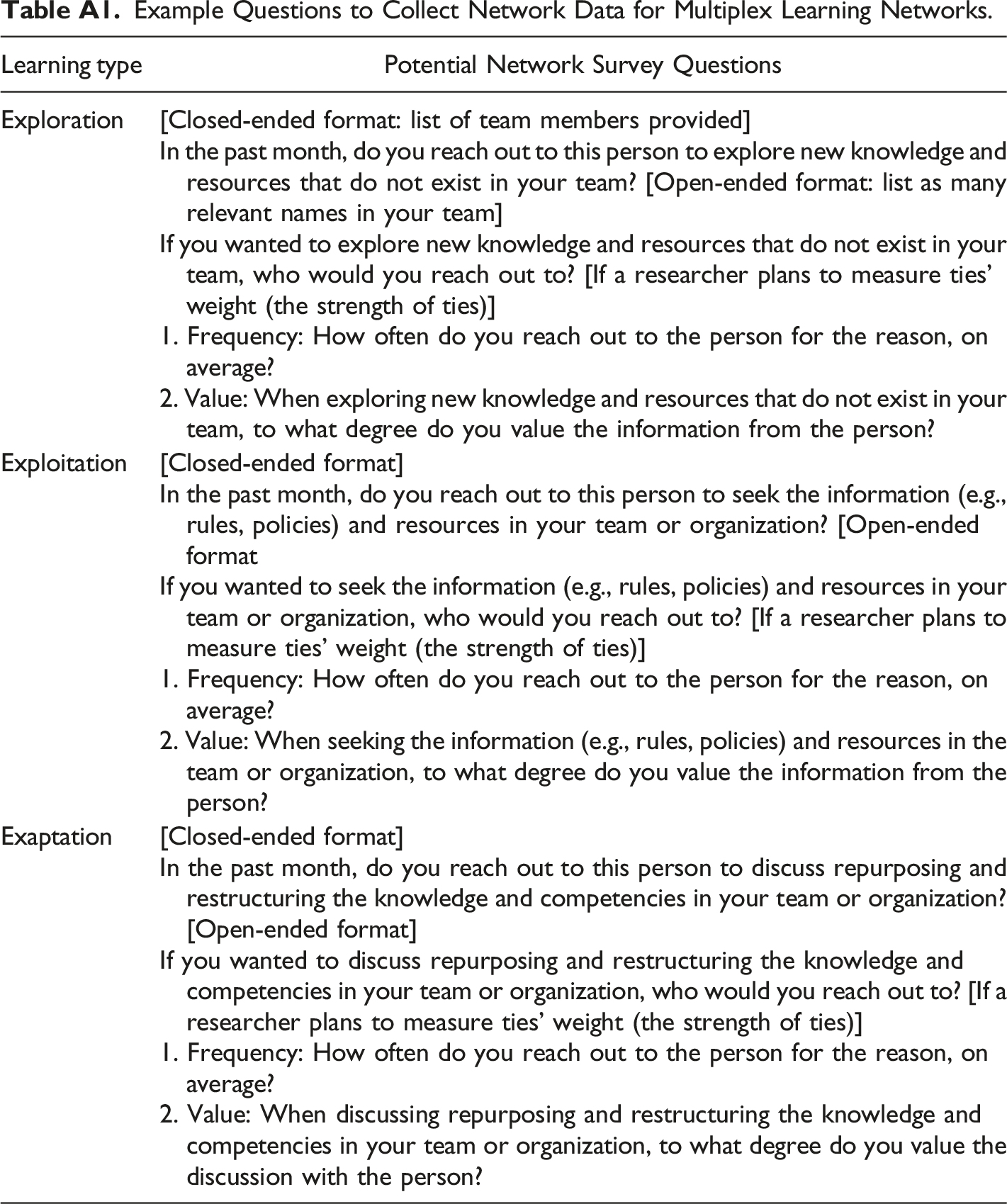
Learning type
Potential Network Survey Questions
Exploration
[Closed-ended format: list of team members provided]
In the past month, do you reach out to this person to explore new knowledge and resources that do not exist in your team? [Open-ended format: list as many relevant names in your team]
If you wanted to explore new knowledge and resources that do not exist in your team, who would you reach out to? [If a researcher plans to measure ties’ weight (the strength of ties)]
1. Frequency: How often do you reach out to the person for the reason, on average?
2. Value: When exploring new knowledge and resources that do not exist in your team, to what degree do you value the information from the person?
Exploitation
[Closed-ended format]
In the past month, do you reach out to this person to seek the information (e.g., rules, policies) and resources in your team or organization? [Open-ended format
If you wanted to seek the information (e.g., rules, policies) and resources in your team or organization, who would you reach out to? [If a researcher plans to measure ties’ weight (the strength of ties)]
1. Frequency: How often do you reach out to the person for the reason, on average?
2. Value: When seeking the information (e.g., rules, policies) and resources in the team or organization, to what degree do you value the information from the person?
Exaptation
[Closed-ended format]
In the past month, do you reach out to this person to discuss repurposing and restructuring the knowledge and competencies in your team or organization? [Open-ended format]
If you wanted to discuss repurposing and restructuring the knowledge and competencies in your team or organization, who would you reach out to? [If a researcher plans to measure ties’ weight (the strength of ties)]
1. Frequency: How often do you reach out to the person for the reason, on average?
2. Value: When discussing repurposing and restructuring the knowledge and competencies in your team or organization, to what degree do you value the discussion with the person?