




Abstract
Research findings indicate an age-related decline in worker’s growth and learning. In this paper, we investigate to what extent these results may be affected by measures (e.g., growth need strength scale) that are influenced by educational approaches to workplace learning, framing learning as intentional processes of knowledge acquisition guided by educators. Based on Human Resource Development (HRD) and non-HRD literature, we propose that these measures may not fully capture learning processes of older workers who seemingly prefer learning outside of formal educational contexts (e.g., spontaneous, strengths-based, and collaborative forms of learning). We examine measures of growth motives and learning behaviors and conclude that these are strongly influenced by an educational perspective, encouraging inaccurate conclusions regarding older workers’ learning interest and activity. We provide suggestions for the development of new measures inspired by a noneducational perspective on work-related learning, for instance by tapping into spontaneous, strengths-based, and collaborative forms of learning.
Keywords
Introduction
Although there is wide agreement on the role that lifelong learning plays in sustaining employability among working adults (Kornelakis, 2014; Nijhof, 2005), substantial debate remains about whether growth motives decline in older adulthood. For example, meta-analytic findings by Kooij et al., (2011) show an age-related decline in employee growth motives, referring to the interest in learning. Similarly, a systematic review by Kyndt & Baert (2013) report an age-related decline in workers’ learning behaviors, referring to their participation in formal and informal learning activities. Yet other mostly qualitative studies suggest that older workers are still actively involved in learning, but have different learning preferences compared to younger workers. For example, findings from several studies suggest that older workers prefer to broaden and refine their current knowledge base instead of acquiring completely new knowledge (Beier & Ackerman, 2003; Canning, 2011; Fenwick, 2012a, 2012b), maintain a strong need to control how and when they engage in learning activities (Fenwick, 2012a; 2012b), and select interactive and bi-directional learning processes (Canning, 2011; Paloniemi, 2006; Warhurst & Black, 2015).
We propose that these seemingly contrary research findings can be best understood and reconciled by critically examining how workers’ growth motives and learning behaviors have been measured, based on the distinction between educational and noneducational perspectives on learning at work proposed by Doornbos et al. (2004). According to Doornbos et al. (2004), measures that derive from educational perspectives frame learning mostly in terms of the intentional acquisition of new and well-defined knowledge that is guided by an educator and that produces individual knowledge and skills. In contrast, what Doornbos et al. (2004) refer to as noneducational perspectives conceptualize learning as largely implicit and participative processes that result in not just individual learning, but also in a shared understanding through the interaction with others. Whereas traditionally most of the activity within the field of Human Resource Development (HRD) relied on educational perspectives on learning (e.g., training courses, seminars, and educational programs) and companies still spend vast amounts of money on formal training (Schürmann & Beausaert, 2016), over recent years the emphasis on activities inspired by noneducational perspectives (e.g., stimulating embedded developmental relationships or a learning culture) has increased (Clarke, 2004; Faller et al., 2022). Based on research findings that show distinct preferences among older workers in how to learn (e.g., Tikkanen, 2002), we suggest that measures grounded in the educational perspective on work-related learning do not fully capture the age-related and developmental processes in learning that occur among older workers, who we define as workers aged 55 and older based on previous HRD literature (e.g., Rocco et al., 2003; Shuck et al., 2016). As a consequence, measures inspired by educational perspectives (see e.g. Garavan et al., 2010; Rowold & Shilling, 2006; Zoogah, 2010) could fail to capture learning activities among older workers and lead to erroneous conclusions about older worker motives and learning activity, and further encouraging negative age stereotypes about older worker learning (Posthuma & Campion, 2009). To identify to what extent current measures have been influenced by educational and noneducational perspectives on work-related learning, and how this may have influenced research findings on the developmental processes among older workers, we ask the following research question: How have workers’ growth motives and learning behaviors been measured in terms of educational and noneducational approaches to learning at work, and to what extent may this account for research findings that show an age-related decline in workers’ growth motives and learning behaviors?
To provide a foundation for this analysis, we begin by discussing theories and findings on the relationship between age and work-related learning, critical differences between educational and noneducational perspectives on work-related learning, and the implications of the educational perspective for older workers. Next, we examine the influence that each perspective has had on research findings regarding the relationship between age and work-related learning by analyzing the measures that were used in two seminal meta studies, namely Kooij et al.’s (2011) meta-analysis on growth motives of workers and Kyndt and Baert’s (2013) systematic review of work-related learning. Both meta-studies report a negative relationship between worker age and growth motives (Kooij et al., 2011) as well as participation in work-related learning (Kyndt & Baert, 2013). However, our analysis of the measures used to assess motives and participation in learning in these studies suggests that they derive largely from the educational perspective, and so fail to take into account older worker growth motives and work-related learning activities captured in noneducational measures. To address this gap in the literature, we conclude by proposing an agenda for future HRD research regarding the development of new measures for growth motives and learning behaviors that are more suitable for older workers. We also discuss implications for HRD professionals.
The Relationship Between Age and Work-Related Learning
Theories of adult development and aging, such as the Selection Optimization and Compensation (SOC) model (Baltes & Baltes, 1990) and Socio-emotional Selectivity Theory (SST; Carstensen, 1995), propose that growth and learning generally decrease in later adulthood. According to the SOC model, e.g,. aging individuals face depleting resources (e.g., time and energy) and therefore prioritize the allocation of resources toward loss prevention, loss recovery, and the maintenance of functioning compared to reaching higher levels of functioning (i.e., growth and learning, Baltes et al., 1999). Similarly, SST proposes that older adults are more likely to perceive their future time as limited with few remaining opportunities, and therefore prioritize goals that maximize present affective outcomes, such as experiencing positive emotional states and meaningfulness compared to goals that maximize future outcomes (e.g., acquiring new knowledge). In line with these theories, the aforementioned meta-analysis by Kooij et al. (2011), that has been cited almost 1000 times, and more recent empirical studies (Cornwell et al., 2022; Inceoglu et al., 2012; Kooij et al., 2014) found support for a negative relationship between workers’ age and growth-related motives.
Another influential study focused on work-related learning (Kyndt & Baert, 2013). In this study, work-related learning was defined as the engagement in formal and informal learning activities both on and off the job, whereby employees acquire or improve knowledge, skills and attitudes that change their present and future professional achievement and organizational performance. Formal learning refers to learning activities that are typically structured in terms of learning context, support, time, and objectives and that are mostly organized through courses provided by a trainer or training institution. In contrast, informal learning is characterized by a low degree of planning and organizing in terms of the learning context, support, time, and objectives of learning activities, and often results from engagement and reflection in daily work-related activities in which learning is not the primary goal. Based on their systematic review, Kyndt and Baert (2013) found that older employees reported lower learning intentions and participated less in formal and informal learning activities compared to younger workers.
However other mostly qualitative studies suggest that older workers are still actively involved in learning (e.g., Billet & van Woerkom, 2008; Canning, 2011; Fenwick, 2012a, 2012b; Paloniemi, 2006; Warhurst & Black, 2015). In a related vein, Armstrong-Stassen and Ursel (2009); Van der Heijden (2015) and Korff et al. (2017) also found a positive relationship between developmental Human Resources (HR) practices and the career satisfaction and retention of older workers. We suggest that a possible explanation for these inconsistent findings may lie in the distinction between educational and noneducational perspectives on learning at work, as proposed by Doornbos et al. (2004).
Educational versus Noneducational Perspectives on Learning at Work
Several typologies of work-related learning have been developed. These typologies are often based on only one dimension of work-related learning, such as the place of learning (e.g., learning on-the-job vs. learning off-the job, Harris et al., 2001) or type of learner control (e.g., formal, non-formal, informal and self-directed learning, Mocker & Spear, 1982). In the latter typology, formal learning refers to a situation where learners have little control over the objectives or means of learning; nonformal learning to a situation where learners control the objectives but not the means of learning; informal learning to a situation where learners control the means but not the objectives of learning; and self-directed learning to a situation where learners control both the objectives and means of learning (Mocker & Spear, 1982).
Differences Between Educational and Noneducational Perspectives on Work-Related Learning (Adapted From Doornbos et al., 2004).
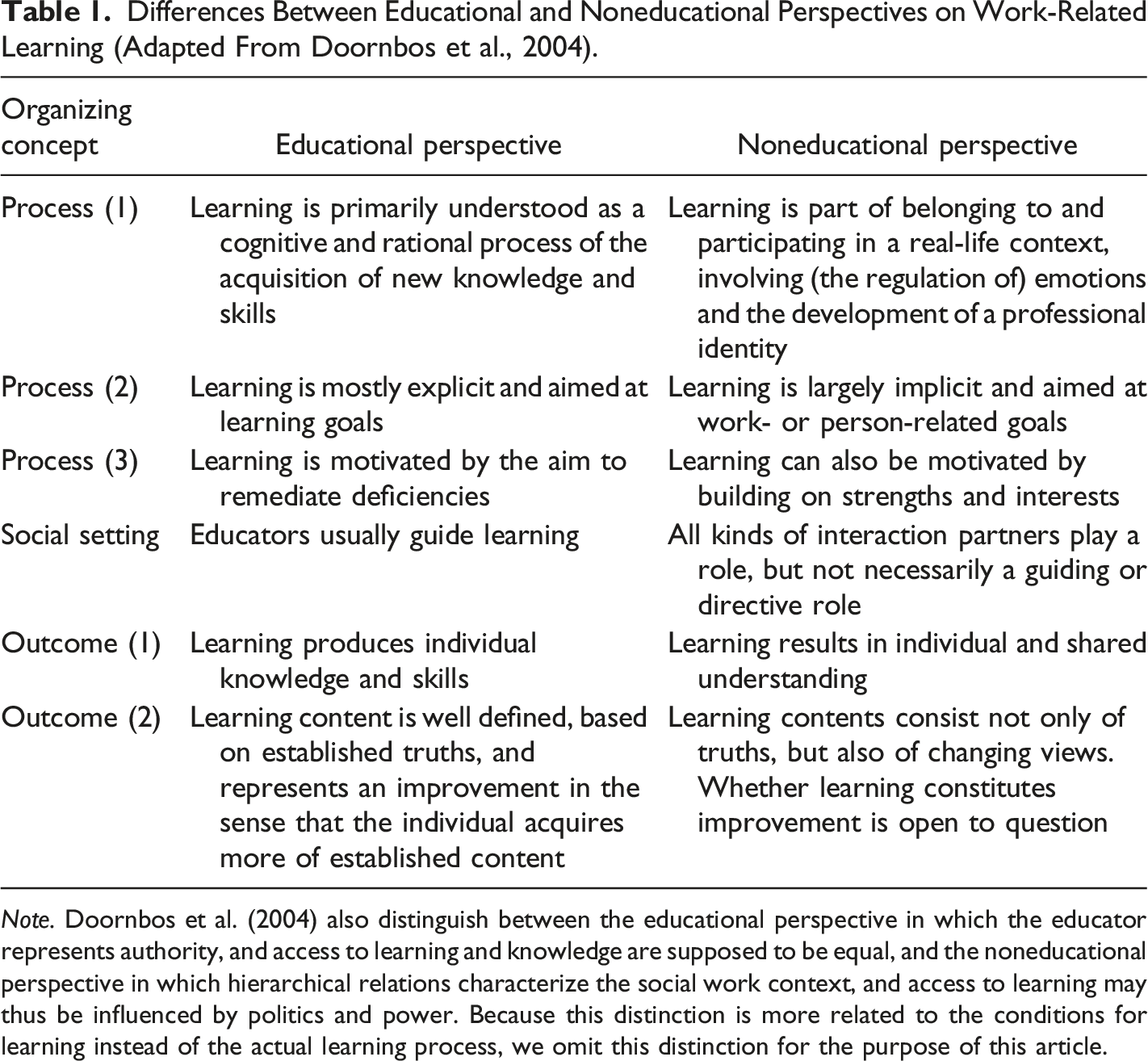
Note. Doornbos et al. (2004) also distinguish between the educational perspective in which the educator represents authority, and access to learning and knowledge are supposed to be equal, and the noneducational perspective in which hierarchical relations characterize the social work context, and access to learning may thus be influenced by politics and power. Because this distinction is more related to the conditions for learning instead of the actual learning process, we omit this distinction for the purpose of this article.
The educational perspective frames learning as a cognitive and rational process that is aimed at the acquisition of new knowledge and skills (Table 1, process 1). This perspective is mostly explicit and aimed at pre-specified learning goals (Table 1, process 2). Another aspect of the educational perspective, even though originally not identified by Doornbos et al. (2004) is that it frames a person’s deficits as their greatest opportunities for development (van Woerkom et al., 2016), thereby compelling learners and teachers to identify weaknesses and to gear learning activities towards fixing these deficiencies (Zakaria et al., 2016) (Table 1, process 3). Regarding the social setting, in an educational perspective, educators or trainers usually guide the learning process (Table 1, social setting), and decide about the learning goals, strategies, and how to measure learning outcomes, whereas the learners are supposed to commit to the decisions made and follow the trainer. Furthermore, in an educational perspective the outcomes of learning are defined in terms of individual knowledge and skills (Table 1, outcome 1) and as it is assumed that learning content is based on established truths, as an improvement in terms of acquiring more knowledge and skills (Table 1, outcome 2).
In a noneducational perspective, learning is not defined as a mainly cognitive process, but as a participatory process involving emotions and the development of professional identity (Table 1, process 1). Learning at work is seen as a mainly implicit process that is not aimed at learning goals, but at task or person-related goals (Marsick & Watkins, 2015, 2018) (Table 1, process 2). Learning is defined in terms of ongoing activities that are inseparable from the context in which they take place. Furthermore, besides learning that is based on problems or deficits, learning may also occur by building on individual strengths or interests (Meyers et al., 2015) (Table 1, process 3). During the learning process, different types of interaction partners play a role, but not necessarily a guiding or directive role (Marsick & Watkins, 2015, 2018) (Table 1, social setting). Finally, in a noneducational perspective on work-related learning, learning does not only result in individual but also in shared understanding (Table 1, outcome 1) and since learning contents do not only consist of undisputed truths, but also of changing views, learning does not by definition lead to improvement (Table 1, outcome 2).
Both perspectives complement each other and are not mutually exclusive, meaning that perspectives on work-related learning may be educational in some respects, and noneducational in other respects. Also, the nature of learning processes may change over time, for example by being largely implicit and noneducational at the start and gradually becoming more educational in terms of being more explicit and aimed at learning goals (Doornbos et al., 2004).
Implications of the Educational Perspective for Older Workers
The educational perspective on learning at work has received much criticism from HRD researchers (McGuire & Gubbins, 2010) based on the awareness that natural opportunities for learning occur every day in a person’s working life (Marsick & Watkins, 2015) and most of the learning in organizations consists of learning that occurs outside the realm of formal training and learning (Noe et al., 2014). However, in this paper we propose that it may be particularly problematic when it comes to investigating growth motives and learning behavior among older workers. Below we discuss the implications of adopting an educational perspective in terms of its six critical features for older worker development and we reason why educational approaches are less suitable for fully capturing the learning processes of older workers.
Learning as a Cognitive and Rational Process of Knowledge Acquisition
Framing learning exclusively in terms of cognitive and rational processes of knowledge acquisition is particularly problematic in relation to older workers because these processes appeal to a range of human cognitive functions (e.g., reaction time, processing new information) that are known to decline with age (Salthouse, 2012). As a result, older workers may struggle with the increasing onslaught of new information, especially when they cannot determine their own learning pace (Kraiger, 2017), and cannot readily determine what is immediately relevant to them and their learning goal (Fenwick, 2012a). Framing learning only in terms of the acquisition of new information is also problematic because after decades of job experience, older workers rarely face completely new situations (Tikkanen, 2002), and may not quickly evaluate something as new. Instead of valuing the acquisition of new knowledge, they often prefer to broaden and refine their current knowledge base (Canning, 2011; Fenwick, 2012b) and tap into their stock of knowledge and experience to enhance their work functioning (Ng & Law, 2014; Taneva et al., 2016; Tikkanen, 2002) or to shape their identity in their professional role (Warhurst & Black, 2015).
Learning as an Explicit Process that is Aimed at Learning Goals
An educational perspective is unlikely to capture spontaneous and implicit adult learning processes (Doornbos et al., 2008) that are dominant in the workplace and may even account for most learning within organizations among all age groups (Noe et al., 2014). For younger workers it is easier to pinpoint learning because of their continuous experience of mastering new challenges and unknown tasks (Hommelhoff et al., 2020; Tikkanen et al., 2002). In contrast, for older workers who have gained much expertise through their experiences in practice and who have developed an intuitive grasp of the situation, it can be very hard to explicate how their knowledge base has changed, and to what extent they are still engaged in learning (Tikkanen, 2002). Since several studies (Ackerman, 2000; Beier & Ackerman, 2001, 2003) found a strong positive association between age and knowledge level up to an age of sixty years, it is clear that older workers are apparently still engaged in learning, though they may often not be aware of it.
Learning as a Process Aimed at the Remediation of Deficiencies
Older workers shift their focus from remediating their declining resources to optimizing and developing personally meaningful goals in the workplace (Ng & Law, 2014). Since time becomes more precious (Carstensen, 2006), older workers tend to become more aware of what they want to spend their time on (Migliore, 2015; Warhurst & Black, 2015), instead of advancing their career or growth in a broader sense (Fenwick, 2012b). Capitalizing on unique strengths and qualities developed over the lifespan, older workers are more likely to identify learning goals in terms of building knowledge in domains that are personally interesting and relevant to successful aging. Further, over the lifespan, when dealing with problems, challenges, or life-adjustment situations individuals learn more about their own strengths and deficits (Bosma & Kunnen, 2001) and develop stronger and clearer (professional) identities based on this knowledge. In line with these developmental changes, older workers are positioned to select or create trait-related experiences that deepen and refine their (professional) identity and become more able and motivated to play to their strengths (e.g., Roberts & Caspi, 2003). These findings are in line with Kanfer and Ackerman (2004), who similarly argue that as workers age they turn more towards tasks that support their self-concept and provide opportunities for events that promote a positive sense of competence and self-concept. This means that older workers become more selective in their learning activities based on the realization that “you cannot be all things to all people, and therefore do not need to learn everything” (Fenwick, 2012b, p. 1010). As a result, focusing on the solely remediation of performance deficiencies, defined from the organizational perspective and based on productivity goals (e.g., number of widgets produced daily or sales volume over a quarter), often fails to motivate older workers.
Learning as a Process that is Guided by Educators
Older workers have a stronger need for exercising control over how, when, and for what purposes they engage in learning activities (Fenwick, 2012b). Because older adults tend to have broad experience, they are often more critical consumers of traditional forms of ready-made training (e.g., online or classroom learning) that are guided by educators and the relevance of the content of the training is often an issue for them (Fenwick, 2012a; Tikkanen & Nyhan, 2008; Warhurst & Black, 2015). Older workers also have a need for acknowledgement of their prior experience and therefore a preference for more personalized types of learning that are connected to their own experiences and skills and that have immediate relevance to their present job (Canning, 2011).
Research with older learners supports the notion that older adults often prefer learning from peers to learning from educators in formal educational settings. External guidance of their learning by a professional association, in the form of needing to log learning activities and taking courses and exams may even be experienced as disrespectful (Fenwick, 2012a; 2012b), and training is sometimes not perceived as a real opportunity for development (Taneva et al., 2016; Warhurst & Black, 2015). When it comes to participating in lengthy trainings or college programs that may help them to make a shift in their career, older workers tend to be reluctant to invest their time because they fear that they might not have enough time in the labor market, and lower chances to be hired (Billet & van Woerkom, 2008).
Learning as a Process that Produces Individual Knowledge and Skills
An educational perspective frames learning at work as a unilateral transfer of knowledge, from experts to novices, and categorizes individuals as knowledge providers or recipients, rather than coproducers of knowledge. As noted previously, however, older workers prefer learning with others (Warhurst & Black, 2015), and learning in the context of work communities (Paloniemi, 2006) where they may share their accumulated work and life experiences with others (Canning, 2011; Migliore, 2015; Warhurst & Black, 2015), thereby satisfying their need for generativity and social embeddedness (Lang & Carstensen, 2002). Therefore, learning of older workers should not only be defined in terms of the consumption of pre-existing knowledge that leads to individual knowledge and skills, but also in terms of processes of co-learning and exchange that lead to shared understanding. This ties in with a recent change of perspective on intergenerational learning that traditionally has been seen as a unidirectional knowledge transfer process from one generation to the other, but more recently has been framed as a bidirectional development process of knowledge co-creation (Bjursell, 2015; Gerpott et al., 2016).
Learning Content is Based on Established Truths
For many older workers learning is a social practice that involves sharing, discussing, questioning, critiquing, and revising prior knowledge and experience with others (Canning, 2011; Penuel & Cohen, 2003; Warhurst & Black, 2015). As a result of these practices new knowledge may emerge, and a competition between the old and the new knowledge may call for discussion of what is best (Doornbos et al., 2004). Whether this social practice always leads to improvement is difficult to measure and is dependent on who is being asked and whose interests are served. Hence, a noneducational perspective, which conceptualizes learning outcomes in terms of how attitudes and behaviors change, and not necessarily in terms of advancement and improvement along a single dimension, appears a more suitable criterion for older workers. In addition, career advancement is not a motive for the learning processes of older workers since many of them have reached the highest position possible in the company and do not have options for future job transfers (de Lange et al., 2010). As a result, the motivation to advance one’s career might not be the best way to capture growth motives of older workers. Instead, growth motives may be more related to refining their current work practices at a more detailed level (Billet & van Woerkom, 2008; Taneva et al., 2016).
Measures of Workers Growth Motives and Learning Behaviors
Two seminal meta-studies reported a negative relationship between workers’ age and their growth motives and learning behaviors. Kooij et al.’s (2011) meta-analysis found a negative relationship between age and growth motives of workers and Kyndt and Baert’s (2013) systematic review found older employees to report lower learning intentions and to participate less in formal and informal learning activities compared to younger workers. To better understand the extent to which these conclusions might be influenced by the use of criterion measures derived from an educational perspective on growth and learning, we scrutinized the measures that were used in both studies.
Measures of Growth Motives
Kooij et al. (2011) conducted a meta-analysis to investigate the relationship between age and several work-related motives (e.g., security, social, and growth motives). Table 2 gives an overview of the 31 studies on the relationship between age and growth motives that were included in the meta-analysis by Kooij et al. (2011). Half the studies (n = 15) reported a negative relationship with age, with 14 studies reporting no significant relationship with age, one study reporting a positive relationship with age, and one study reporting a negative relationship with age for progression and a non-significant relationship with age for personal growth (Wong et al., 2008). Nearly half the studies in this meta-analysis (n = 14) used the growth need strength scale (Hackman & Oldham, 1975), three studies used Warr’s Higher Order Need Strength scale (Warr et al., 1979), four studies used Vroom’s (1964) valence measure, and 10 studies used other measures, such as Rounds et al. (1981) Minnesota Importance Questionnaire, Porter’s (1961) Need Importance Questionnaire (self-actualization scale), work values (Manhardt, 1972), and the Motivational Trait Questionnaire Desire to Learn subscale (Kanfer & Ackerman, 2000).
Examination of these measures suggest that many of the growth motives measures consist of a mix of items from the educational and noneducational perspectives. As shown in Table 1, process 1, many scales include items that refer to growth as a cognitive and rational process related to the acquisition of new knowledge and skills (educational perspective) and items that frame growth in terms of belonging to and learning in a real-life context (noneducational perspective). For example, in line with the educational perspective, the growth need measure (Hackman & Oldham, 1975), the desire to learn measure (Kanfer & Ackerman, 2000), the Motivation Questionnaire (Wong et al., 2008) and the higher order need strength measure (Warr et al., 1979) ask whether respondents would like opportunities to learn new things from their work or whether a person is motivated by opportunities for further training and development (Wong et al., 2008). However, many of these measures also include items that refer to growth as part of belonging to and learning in a real-life context. For instance, the growth need measure (Hackman & Oldham, 1975) refers to opportunities for personal growth and development in one’s job, and in a job where there is considerable opportunity to be creative and imaginative. Warr et al.’s (1979) higher order need strength measure refers to challenging work. To our surprise, we did not come across items that refer to the emotional nature of learning or to the development of a professional identity, that are also part of the noneducational perspective of the learning process (Table 1, process 1).
In line with the educational perspective, many of the measures frame growth as a deliberate, conscious, intended, and self-directed process, by referring to activities that are performed with the explicit goal of learning (Table 1, process 2), or by making explicit reference to the words learning, personal growth or development, thereby only capturing learning processes that respondents are aware of (Doornbos et al., 2008). This is evident in measures that ask respondents to indicate how important it is for them that work encourages the development of knowledge and skills (Chiang & Jang, 2008; Hackman & Oldham, 1975; Kanfer & Ackerman, 2000; Manhardt, 1972; Porter, 1961; Vroom, 1964; Warr et al., 1979; Wong et al., 2008) or whether they are naturally motivated to learn (Kanfer & Ackerman, 2000). However, some measures also hint at more implicit learning processes that are aimed at work- or person-related goals, and not so much at learning goals, in line with the noneducational perspective. For instance, the growth need strengths measure (Hackman & Oldham, 1975) refers to the need for stimulating and challenging work, and the higher order need strength measure (Warr et al., 1979) refers to achieving something that the individual personally values.
Even though not many measures are explicitly based on a deficit approach (Table 1, process 3), in line with the educational perspective, some items refer to challenging tasks that workers can learn from (Hackman & Oldham, 1975; Warr et al., 1979), whereas very few measures acknowledge that learning can also be motivated by building on current strengths and interests (Table 1, process 3), in line with the noneducational perspective. Some measures, however, ask how important it is for people to have a job in which they can use their skills to the maximum (Hackman & Oldham, 1975; Warr et al., 1979), to achieve something that you personally value (Warr et al., 1979), whether participants prefer to have a job which provides constant opportunities for them to learn new and interesting things (Hackman & Oldham, 1975) or whether they try to learn as much as they can when they become interested in a task (Kanfer & Ackerman, 2000).
Since growth motives measures refer to how much an individual values job characteristics that relate to achievement, mastery and higher levels of functioning (Kooij et al., 2011), they hardly refer to the (guiding or non-guiding) role that others play in the developmental process (Table 1, social setting). This also means that, in line with the educational perspective, growth and learning are seen as only producing individual knowledge and skills; that is, no reference is made to learning processes that lead to shared understanding, as emphasized in the noneducational perspective (Table 1, outcome 1).
Furthermore, in line with the educational perspective, several measures frame learning in terms of improvement or advancement (Table 1, outcome 2) by asking whether people would prefer a job in which there is a chance for them to get promoted (Ford et al., 1985; Markham et al., 1985) or advance in the organization (Chiang & Jang, 2008; Hackman & Oldham, 1974; Manhardt, 1972; Rounds et al., 1981; Rowe & Snizek, 1995; Wong et al., 2008). Other scales leave it more open whether prior or new learning constitutes improvement or advancement (e.g., by including items referring to the chance to learn new things (Warr et al., 1979), which is more in line with the noneducational perspective.
In conclusion, even though measures for growth motives in Kooij et al. (2011) do not refer to learning processes that are guided by educators, they are still considerably influenced by an educational perspective on learning. Many of these measures refer to learning as an intentional process of knowledge acquisition, that leads to career advancement or improvement in terms of individual knowledge and skills.
Measures of Work-Related Learning
Kyndt and Baert (2013) conducted a systematic review including 56 empirical studies of employee learning or learning intention with the aim of examining which antecedents of work-related learning have been identified in previous research. Based on 29 studies that included age as a predictor or correlate of employee learning/intention, Kyndt and Baert (2013) concluded that older employees have lower learning intentions and participate less in learning activities than their younger colleagues. Of these 29 studies that are presented in Table 3, 14 studies reported a negative relationship between age and at least one measure of work-related learning (Blau et al., 2008; Booth, 1991; Chan & Auster, 2003; Elman & O’Rand, 2002; Greenhalgh & Mavrotas, 1994; Harris, 1999; Maurer et al., 2003; Renkema et al., 2009; Sanders et al., 2011; Simpson & Stroh, 2002; Taylor & Urwin, 2001; Thangavelu et al., 2011; Warr & Birdi, 1998; Xiao & Tsang, 2004). Additionally, one study reported a negative relationship for three country samples (Canada, Switzerland, and the Netherlands), and a positive relationship in one country sample (United States) (Leuven & Oosterbeek, 1999), and one study reported a negative relationship for men and a non-significant relationship for women (Green, 1993).
Two studies reported an inverted U shape relationship with middle aged workers scoring higher than their younger and older colleagues (Greenhalgh & Mavrotas, 1994; Salas-Velasco, 2009) and nine studies reported a non-significant relationship with age (Cavanaugh & Noe, 1999; Forrier & Sels, 2003; Ito & Brotheridge, 2005; Kyndt and Baert, 2011; Noe, 1996; Rowold & Shilling, 2006; Schulz & Rossnagel, 2010; Tharenou, 1997, 2001). One study reported a positive relationship with age for one of the scales (motivation to learn) and a non-significant relationship with another scale (participation in e-learning activities) (Garavan et al., 2010). One study found that given that a worker was employed by a firm that provides training (which was less likely for older workers), age had no influence on participation in training (Oosterbeek, 1996).
Of all 29 studies, most studies (n = 20) included measures that were focused exclusively on participation or intention to participate in formally organized learning activities (Blau et al., 2008; Elman & O’Rand, 2002; Forrier & Sels, 2003; Garavan et al., 2010; Green, 1993; Greenhalgh & Mavrotas, 1994; Harris, 1999; Kyndt and Baert, 2011; Leuven & Oosterbeek, 1999; Oosterbeek, 1996; Rowold & Shilling, 2006; Salas-Velasco, 2009; Sanders et al., 2011; Simpson et al., 2002; Taylor & Urwin, 2001; Thangavelu et al., 2011; Tharenou, 2001; Warr & Birdi, 1998; Xiao & Tsang, 2004; Zoogah, 2010). Nine of the 29 studies included measures that did not differentiate between participation or intention to participate in informal and formal learning activities (Booth, 1991; Cavanaugh & Noe, 1999; Gaillard & Desmette, 2010; Garavan et al., 2010; Ito & Brotheridge, 2005; Maurer et al., 2003; Noe, 1996; Renkema et al., 2009; Tharenou, 1997) and only two studies differentiated between formal and informal activities or focused exclusively on informal learning activities (Chan & Auster, 2003; Schulz & Rossnagel, 2010).
Measures of Formal Learning Activities or not Distinguishing Between Formal and Informal Learning
Measures of participation in formal learning activities usually ask participants to indicate if they had participated in any kind of organized education or training during a particular period of time, thereby defining learning as a process that takes place outside the real-life work context. The measures that did not differentiate between formal and informal learning activities usually include a range of learning activities that might take place within or beyond the organized training setting.
Both types of measures usually consider learning at least partly as a cognitive and rational process of the acquisition of new knowledge and skills, in line with the educational perspective (Table 1, process 1). This is evident from the reference to activities, or participation in training, classes and programs that are meant to improve knowledge and/or skills or lead to certification (e.g., Blau et al., 2008; Elman & O’Rand, 2002; Forrier & Sels, 2003; Maurer et al., 2003). The measures that do not differentiate between formal and informal learning also tap into learning as a part of participating in a real-life context (Table 1, process 1), for instance by referring to activities such as working with more experienced people (Booth, 1991), taking different job assignments (Maurer et al., 2003), or asking for feedback (Noe, 1996). None of the items tap into the emotional nature of learning or the development of a professional identity, that are also part of the noneducational perspective of the learning process (Table 1, process 1).
In line with the educational perspective, measures of formal learning typically consider learning as an explicit process aimed at learning goals (Table 1, process 2), by referring to learning contexts (e.g., training, courses, etc.) that are designed to facilitate learning. Even undifferentiated measures make very little reference to learning as an implicit process (Table 1, process 2). An exception to this is the measure by Noe et al. (1996), which refers to activities such as asking for feedback or changing behavior because of feedback. Whereas the undifferentiated measures sometimes include items that refer to learning processes outside an educational context, they still frame learning in terms of an explicit process by referring to activities (e.g., taking different job assignments) that are performed in order to learn (Booth, 1991; Maurer et al., 2003; Noe, 1996) or with development intentions (Renkema et al., 2009).
Some measures refer explicitly to remediating deficiencies as an aim of learning (Table 1, process 3), in line with the educational perspective. An example of this is the item by Noe et al. (1996) that refers to asking for feedback regarding skill weaknesses. A more implicit reference to a deficit approach is the item “Have you been placed with more experienced people to see how the work should be done”? (Booth, 1991). None of the measures reviewed referred to learning as a process of building on strengths and interests in line with the noneducational perspective (Table 1, process 3), except for one item by Noe (1996) that referred to willingness to participate in development activities (i.e., being interested in attending meetings and seminars on new work methods).
In line with the educational perspective (4), all formal learning measures refer to forms of learning (e.g., training, courses) that are externally guided by trainers or educators or to the interaction with career counselors (Maurer et al., 2003). In line with the noneducational perspective, the undifferentiated measures also include items that refer to interaction partners who play a non-directive role in the learning process (Table 1, social setting), such as more experienced people (Booth, 1991), or do not specify the interaction partner (e.g., asking for feedback; Maurer et al., 2003).
All measures frame learning as a process that produces individual knowledge and skills, whereas none of the measures acknowledge that learning may also result in shared understanding (Table 1, outcome 1). Furthermore, several measures assume that learning represents an improvement or advancement (Table 1, outcome 2), e.g., by referring to improvement of skills (Elman & O’Rand, 2002; Maurer et al., 2003; Noe, 1996). None of the measures included items that leave it open whether new learning constitutes improvement (e.g., changing views or perspectives).
In sum, measures of formal learning that were included in Kyndt and Baert (2013) build heavily on the educational perspective. Although some undifferentiated measures were included in this study, these measures and items also appear to build to a large extent on the educational perspective.
Measures of Informal Learning
In line with the noneducational perspective, the measure by Chan & Auster (2003) partly considers learning as an implicit process that occurs during participation in a real-life context (Table 1, process 1). For example, this measure includes items that refer to work activities such as having discussions with colleagues or writing for the professional literature. However, the measure makes no reference to the emotional aspect of learning or to the development of a professional identity (Table 1, process 1), or to the remediation of deficiencies or building strengths (Table 1, process 3), but rather seems to tap exclusively into the individual outcomes of the learning process (Table 1, outcome 1). Even though some items refer to interaction partners (e.g., colleagues or listservs) that do not necessarily play a guiding role, the measure still captures forms of learning that are guided by others, such as on-the job-training (Chan & Auster, 2003), which is in line with the educational perspective (Table 1, social setting). In accordance with the noneducational perspective, the measure leaves it open whether prior learning constitutes improvement (Table 1, outcome 2) by simply measuring the number of hours spent in a typical month on activities that are associated with learning.
Conforming to an educational perspective, the measure by Schulz & Rossnagel (2010) makes no reference to the real-life work context and seems to target highly intentional, and goal directed learning processes (Table 1, process 1 and 2) by referring to the learning plan and learning goals of participants. The measure makes some reference to the emotional aspect of learning, and to the development of a professional identity, by asking whether participants felt more effective and safe because of their new knowledge and whether they felt like they knew the essentials of their professional domain (Table 1, process 1). Whereas the measure does not tap into learning that is inspired by the participant’s strengths, it makes some reference to participants’ interests (Table 1, process 3) (“My interest in the topic I have learned is still high” p: 386). Even though the measure does not assume that the learning process is guided by others, it also does not refer to other interaction partners that are involved in the learning process (Table 1, social setting) and focuses exclusively on individual outcomes of learning (Table 1, outcome 1). By asking how satisfied participants were with their most recent learning success, and whether participants have become more effective in their work, learning was clearly framed in terms of improvement, in line with an educational perspective (Table 1, outcome 2).
In conclusion, even though both measures of informal learning are to a certain extent influenced by a noneducational perspective, the educational perspective is still present by tapping into forms of learning that are guided by others (Chan & Auster, 2003), and by referring exclusively to highly individual, intentional, and goal-directed learning processes that are disconnected from the real-life work context and that are supposed to lead to improvement (Schulz & Rossnagel, 2010).
Discussion and Conclusion
In line with theories on lifespan development, empirical evidence accumulated during the past few decades using surveys indicates an age-related decline in work-related learning. In contrast, several qualitative studies show that older workers are still actively involved in learning, even though their learning preferences differ from those of their younger coworkers. We explain this paradox by considering these findings in the context of educational and noneducational perspectives on adult learning processes and we suggest that measures that are inspired by an educational perspective may be less suitable to fully capturing learning and development among older workers.
Our analysis of measures and constituent items used in the two major published meta-studies on the relationship between age and growth motives (Kooij et al., 2011) and work-related learning behaviors (Kyndt & Baert, 2013) suggests that the lion’s share of measures used in the meta-studies were considerably influenced by an educational perspective that places emphasis on intentional knowledge acquisition, career advancement, the development of new knowledge, and the use of a top-down learning process guided by the instructor. In contrast, qualitative studies highlight older worker preferences for learning autonomy, the use of self-directed learning processes, and learning in collaborative settings. Building on the distinction between educational and noneducational perspectives by Doornbos et al. (2004), we suggest that the observed age-related decline in growth motives and work-related learning may be due to criterion insufficiency; namely that the measures of growth and learning did not sufficiently include items from the noneducational perspective.
We further suggest that the predominant use of measures inspired by an educational perspective may lead to inaccurate conclusions regarding older workers’ interest and activity in learning, and ultimately to an aggravation of negative age stereotypes with respect to being less motivated to learn, less willing to change, and less productive (Ng & Feldman, 2012; Warr & Birdi, 1998). Ultimately, negative age stereotypes may also lead to a vicious circle by making older workers feel insecure about their learning ability and their chance of succeeding in a training program (Hess et al., 2003; Wolfson et al., 2014).
Besides the influence of the way that growth motives and learning behavior have been assessed, surveys on the relationship between age and learning will also be influenced by how older workers fill in these questionnaires. When filling out training interest surveys, older workers are likely to base their response on previous experiences they have with training that might not have been designed to accommodate their needs (van Rooij, 2012), for instance regarding self-pacing, or tying the learning content to the individual’s prior knowledge or experiences (Beier & Ackerman, 2005). Additional research is sorely needed to develop and employ measures that capture late adult development and that are more sensitive to noneducational learning episodes. Whereas it might be true that older workers are less interested in types of learning that are characterized by educational features, they might still be very much interested and active in noneducational types of learning. This is also in line with theories on lifespan development such as SST that propose that older workers prioritize maximizing present affective outcomes, such as sharing their viewpoints with coworkers, rather than maximizing future outcomes such as acquiring new knowledge.
Since there is no systematic relationship between age and job performance (Ng & Feldman, 2008; Salthouse, 2012), it is also likely that aging workers develop many capacities that compensate for their declining functions (Billet & van Woerkom, 2008). Evidence to support this notion is provided in several studies that report a positive association between age on the one hand and knowledge level (Ackerman, 2000; Beier & Ackerman, 2001, 2003), accuracy (von Krause et al., 2022), problem solving (Salthouse, 2012), and emotion regulation and coping skills (Kraiger, 2017; Scheibe & Zacher, 2013) on the other hand.
Below we provide a research agenda for HRD research regarding the development of measures that may help to capture more comprehensive developmental processes among older workers by better incorporating elements of the noneducational perspective. More particularly, we will use the six elements of a noneducational perspective as suggested by Doornbos et al. (2004) to provide suggestions for future research.
Implications for HRD Research
First, there is a need for measures that tap into learning processes regarding emotion regulation and the development of a professional identity (Table 1, process 1). When individuals age and gain more life experiences, they tend to get better in regulating their emotions (Bal & Smit, 2012; Johnson et al., 2017; Scheibe et al., 2016), keeping calm, and thinking out of the box in stressful situations (Canning, 2011; Fasbender et al., 2019). New measures need to be developed that capture these learning processes that are positively associated with age and highly relevant to the workplace. We also found that extant measures did not capture the development of a professional identity (e.g., “What does it mean to be a teacher?”, and “What kind of teacher would I like to be?”; Sachs, 2005). However, aging workers are active in selecting or creating trait-related experiences that deepen and refine their professional identity (e.g., Roberts & Caspi, 2003), and professional self-efficacy is known to increase with age (Johnson et al., 2017). As a result, professional identities become stronger and clearer when employees age and develop more self-knowledge (Fasbender et al., 2019; Finegold et al., 2002). Therefore, there is a need for measures that tap into the processes that are involved in the development of professional identity.
Second, since most learning processes are spontaneous and unplanned (Doornbos et al., 2008), particularly among older workers (Warhurst & Black, 2015), appropriate measures are needed that tap into these implicit and spontaneous developmental processes at work (Table 1, process 2). As discussed previously, most extant work-related learning measures target deliberate and highly intentional forms of learning. Even the measures that are intended to capture informal learning activities tend to frame these activities as intentional learning activities, for example by asking participants about their learning goals (Schulz & Rossnagel, 2010). A better way of dealing with the implicit nature of developmental processes at work is provided by the measure informal field-based learning (Wolfson et al., 2018) that asks participants to indicate how much new learning, knowledge, skill, competencies or expertise they have gained over the last nine months by rating a range of activities (e.g., seeking feedback or advice from others, or performing a task in a new and different way). However, even this measure requires participants to frame their activities in hindsight as explicit learning activities focused on acquiring new knowledge. Hence, we need empirical research that helps to capture different kinds of unplanned, in-situ experiences (e.g., observing a colleague; getting feedback from a client) and how these affect thinking and behavioral repertoires (Doornbos et al., 2008). Also, visual elicitation techniques such as timelines or sociograms might be used to deal with the methodological challenges of measuring implicit learning processes (Warhurst & Black, 2015).
Third, there is a need to develop measures that assess learning as a process of building on strengths and interests (Table 1, process 3). Age-related research findings from the organizational (Ng & Law, 2014) and lifespan (Carstensen, 1993) literature show a fundamental age-related shift in goal focus away from remedial goals and toward optimization and the development of personally meaningful goals during later adulthood. Even though measures on strengths use exist (Kooij et al., 2017; van Woerkom et al., 2016), literature suggests that strengths can also be developed, for example by learning how to regulate them depending on the context (Biswas-Diener et al., 2011). Furthermore, the fact that older adults often use their leisure time for continued growth and development (McGuire et al., 2009), evidenced by the large supply of educational programs for elderly (Roberson, 2005), indicates that for older workers, personal interests instead of remedial goals set by others can be a powerful motivator to learn.
Fourth, given the ubiquity of teams in organizations today, more attention is needed for the development of measures that assess collaborative learning within teams (Table 1, social setting). Such measures must go beyond conceptualizing learning as a one-way developmental process, in which the interaction itself contributes to the development of one worker, but not necessarily to the development of others (Table 1, outcome 1). The learning together scale developed by Doornbos et al. (2008) provides an example of such a measure. Furthermore, research could also target how mentoring and reverse mentoring are tools for social exchange that leverage the expertise of both parties and result in shared understanding (Chaudhuri & Ghosh, 2012). Based on lifespan findings related to SST that show age-related increases in generativity and social embeddedness (Lang & Carstensen, 2002), such measures may be expected to be more sensitive to capture learning processes among older workers.
Fifth, measures need to be developed that frame learning in terms of changing views instead of assuming that learning always represents an improvement or advancement (Table 1, outcome 2). An example of this is a measure developed by Doornbos et al. (2008) that refers to activities that gave new ideas (instead of better ideas), scrutinizing performance (instead of improving performance), and starting to think differently about a subject (instead of gaining new knowledge on the subject).
Even though older workers seem to prefer informal types of learning, we are by no means suggesting that older workers should no longer engage in formal learning activities. In some cases, informal learning may not be sufficient for the acquisition of theoretical knowledge (Svensson et al., 2004) or may leave individuals feeling helpless and directionless (Conlon, 2004). However, when the measures as suggested above have become available, this opens possibilities for HRD research and theory building on what types of formal or informal learning are best suited for what purposes and for what profiles of learners (McGuire & Gubbins, 2010).
Finally, older workers are not a homogeneous group and especially older workers in blue-collar jobs are a neglected group for vocational training that are rarely offered programs that are directly geared to their needs (Teichmann et al., 2021). Whereas an analysis of the variety of types of work and older workers interests and participation in learning was beyond the scope of this paper, future studies could investigate the different learning needs of older workers in different sectors.
Implications for HRD Practice
The aging workforce is one of the main challenges for today’s organizations (Wang, 2018), and HRD practices that sustain the development of older workers should therefore become just as important as preparing young adults for the workplace (Rocco et al., 2003). At the same time, the literature has identified several stereotypes related to age and HRD, most importantly that older workers do not want to learn, older workers are not able to learn, or that investing in the development of older workers provides a poor return on investment (Gray & McGregor, 2003). A scoping review pointed out that these stereotypes may even be internalized by older workers and in turn function as a barrier to their further development (Harris et al., 2017). These stereotypes may be caused by the predominance of an educational perspective on learning at work, which does not fully capture the developmental processes of all workers, but particularly those of older workers, who rarely face completely new situations, and who may have difficulties recognizing how their knowledge base still changes. Becoming aware of how the educational perspective on work-related learning has influenced HRD initiatives, and how this may have disadvantaged older workers, will help HRD professionals to develop more appropriate learning opportunities for older workers. Examples of such learning opportunities are activities that stimulate workers to further their strengths and interests, allow them to exercise control over their learning activities, and allow them to discuss their prior knowledge and experience with others. By adopting a noneducational perspective on work-related learning, and by raising awareness of the value of noneducational learning activities among older workers and their managers, HRD professionals may help to counteract stereotypes regarding age and development and may stimulate them to invest in more suitable types of development.
Conclusion
Current measures of adult development related to growth motives and work-related learning are strongly influenced by an educational perspective. Our review of recent meta-studies on the relationship between age, growth motives, and work-related learning call for the development of more comprehensive measures that incorporate items that build on noneducational perspectives. This will be particularly important for organizations that are currently uncertain about how to best manage and capitalize on the talents of an increasingly age-diverse workforce (Noe et al., 2014). With this paper, we contribute to the HRD literature by: (1) scrutinizing current measures of growth work motives and work-related learning to demonstrate these are considerably influenced by an educational perspective and that some elements of the noneducational perspective (i.e., that learning may involve improvement in emotion regulation or developing a professional identity) are completely missing from these measures; (2) reviewing the empirical literature on aging and older workers to highlight that the predominance of the educational perspective in current measures might lead to wrong conclusions regarding older workers learning interest and activity, which in turn leads to an aggravation of age stereotypes about older workers; (3) showing the need for future research to develop new measures for growth motives and learning behaviors at work that better incorporate the noneducational perspective on learning which are more suitable for older workers; (4) providing suggestions for this future research based on the six distinctions between the educational and noneducational perspective of Doornbos et al. (2004); and (5) scrutinizing sources from HRD and non-HRD backgrounds on the relationship between age and learning, we hope to contribute to one unitary discourse on the learning of older workers. This is much needed, since until recently the discourses on lifelong learning on the one hand and older workers on the other hand were still largely separated, leading to fragmented pictures of reality (Tikkanen, 2006).
Supplemental Material
Supplemental Material - Growth Motives and Learning Behaviors Among Older Workers: Toward a More Comprehensive Assessment
Supplemental Material for Growth Motives and Learning Behaviors Among Older Workers: Toward a More Comprehensive Assessment by Marianne van Woerkom, Dorien Kooij, and Ruth Kanfer in Human Resource Development Review
Footnotes
Declaration of Conflicting Interests
The author(s) declared no potential conflicts of interest with respect to the research, authorship, and/or publication of this article.
Funding
The author(s) received no financial support for the research, authorship, and/or publication of this article.

Supplemental Material
Supplemental material for this article is available online.
Author Biographies
References
Supplementary Material
Please find the following supplemental material available below.
For Open Access articles published under a Creative Commons License, all supplemental material carries the same license as the article it is associated with.
For non-Open Access articles published, all supplemental material carries a non-exclusive license, and permission requests for re-use of supplemental material or any part of supplemental material shall be sent directly to the copyright owner as specified in the copyright notice associated with the article.
