



Abstract
Background
The staff working at day-care centers and nursing homes are in a key frontline for early detection of older people living with dementia, however, whether the staff were well prepared and if they were appropriately trained were still little known.
Method
A cross-sectional survey was conducted and the validated questionnaires exploring the awareness of dementia care, in terms of knowledge, attitude and preventive practice domain, were given to the staff working at day-care centers and nursing homes in Macao.
Results
272 samples were approached and scores of knowledge was 76.23 ± 19.62, attitude was 80.05 ± 8.92 and preventive practice was 75.59 ± 13.88, among which knowledge and preventive practice were positively related to attitude, and knowledge, attitude and preventive practice were negatively related to age. Health care assistants’ knowledge were less than social workers, managers, health professionals and clerk. Attitude of health care assistants were less positive than social workers and health professionals.
Discussion
Health care assistants and older staff had less knowledge and less positive attitude. Trainings to improve knowledge, attitude and preventive practice amongst health care assistants and older staff were recommended strongly.
Introduction
Dementia is a significant chronic neurodegenerative condition with loss of memory, language, problem-solving and other thinking abilities that are severe enough to interfere with daily life of older people. The population of Macao Special Administrative Region (SAR) is aging and older people aged 65 years and above accounted for 15.7% of the local population, 1 and there were about four thousand people living with dementia in Macao SAR and it was expected that the number of people living with dementia would increase rapidly. 2 In a dementia-friendly community, older people living with dementia are usually aging in their familiar places. The staff working at day-care centers and nursing homes are the first-line professionals to be contacted by community-dwelling older people living with dementia and are also in a key frontline for early detection of older people living with dementia, and then support older people living with dementia for their further medical consultation from primary health professionals working at Health Centers throughout Macao SAR. 3 The staff working at day-care centers and nursing homes are also well-positioned to provide appropriate community-based care to older people living with dementia and then support their family caregivers. 4 However, whether the staff working at day-care centers and nursing homes were well prepared for this and if they were appropriately trained and supported were still little known, and this uncertainty influences the prognosis, as a significant challenge to delivering the effective care.5,6 Therefore, exploring their awareness of dementia care amongst the staff working at day-care centers and nursing homes in Macao SAR would help to guide the training and support for them, and as a result could assist in the provision of the sustained and effective care for older people living with dementia and their family caregivers in Macao SAR. Therefore, this study aimed to explore their awareness of dementia care amongst the staff working at day-care centers and nursing homes in Macao SAR.
Methods
Research Design
A cross-sectional survey for the staff working at day-care centers and nursing homes throughout Macao SAR was conducted from September to October 2019.
Participants and Procedure
All the 37 day-care centers and nursing homes in Macao are regulated strictly by the residential aged care accreditation scheme of Macao SAR Government 7 to provide safe, appropriate and qualified services, therefore, the living conditions of different day-care centers and nursing homes in which reside people living with dementia are similar. The study invited all the staff working at 25 day-care centers and nursing homes, being randomly selected from the 37 day-care centers and nursing homes throughout Macao SAR, to complete the validated questionnaire exploring their awareness of dementia care.
Survey Instrument
The 30-item questionnaire exploring awareness of dementia care, in terms of knowledge, attitude and preventive practice domain was developed, based on the relevant questionnaires from Chinese communities,8,9,10 and subsequently was validated prior to being sent to participants, by 5 experts including a specialist in geriatric medicine, a specialist in public health, a senior nurse in geriatric ward, a geriatric scholar, and a social worker. The Content Validity Index (CVI) of the questionnaire was .973 and Cronbach’s α was .808 consequently. 11 The questionnaire investigated participants’ knowledge, attitude and preventive practice of dementia care. Participants were asked to choose true/false for each question in knowledge domain, strong agree/agree/no comment/disagree/strong disagree for each question in attitude domain, all of the time/most of the time/some of the time/a little of the time/none of the time for each question in preventive practice domain. The single domain score of knowledge, attitude and preventive practice ranged from 0 to 100 separately, with higher scores indicating better knowledge, more positive attitude and more appropriate preventive practice. Finally, participants’ characteristics were requested.
Data Analysis
IBM SPSS Statistics 25 was executed for all statistical analyses, of which descriptive statistical analysis produced mean, standard deviation, frequency and percentage, and inferential statistical analysis covered t-test, ANOVA test and Pearson Correlation.
Results
Sociodemographic Characteristics of the Participants
The sample comprised 272 participants who ranged from 19 to 80 years old (38.1 ± 12.7 years) and most of the participants were female (n = 228, 85.1%), health care assistants (n = 105, 39.8%), health professionals (n = 63, 23.9%), and staff with tertiary education level (n = 122, 46.7%). The common ways for the staff working at day-care centers and nursing homes in Macao SAR to gain information about dementia were public lectures (n = 141, 53.0%), TV/radio (n = 136, 51.1%) and newspaper/book (n = 103, 38.7%).
Awareness of Dementia Care Amongst the Staff Working at Day-care Centers and Nursing Homes in Macao
Awareness of Dementia Care Amongst Different Occupations at Centers & Nursing Homes. a
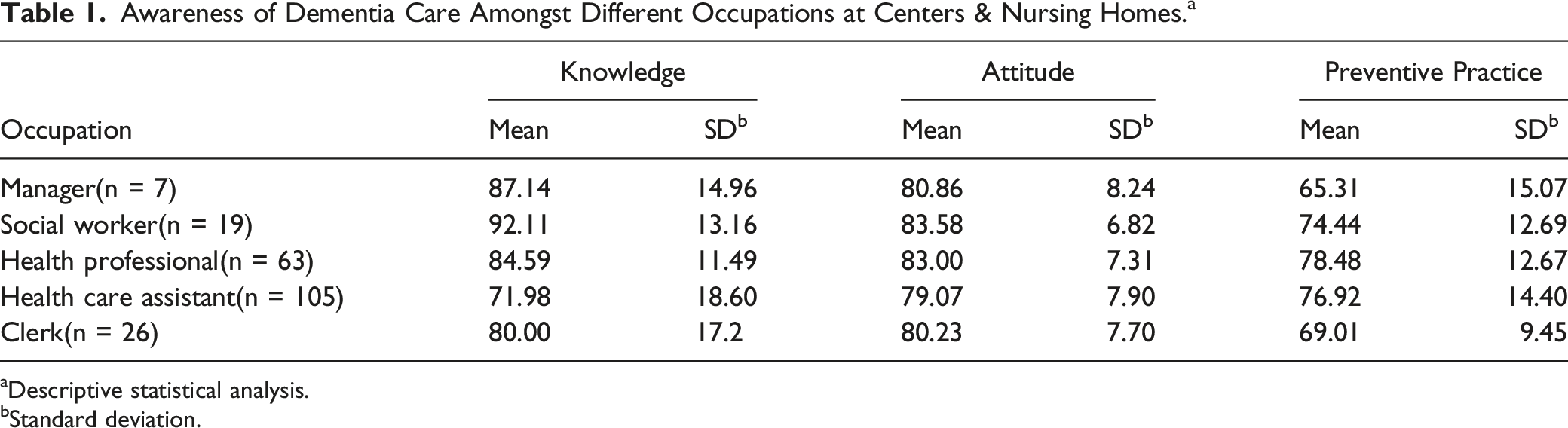
aDescriptive statistical analysis.
bStandard deviation.
Awareness of Dementia Care Amongst Different Educations at Centers & Nursing Homes. a
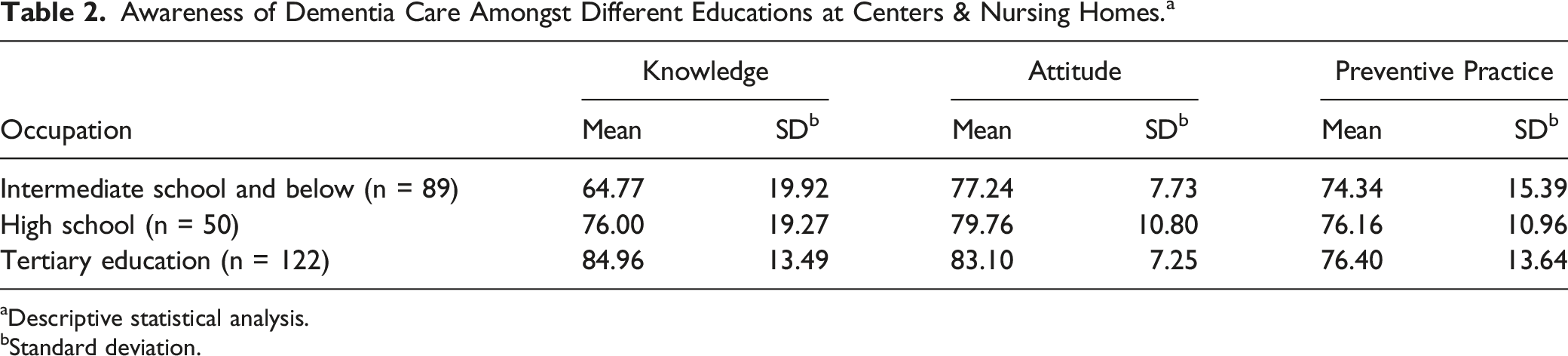
aDescriptive statistical analysis.
bStandard deviation.
Correlations a Among Awareness of Dementia Care and Characteristics of Participants.
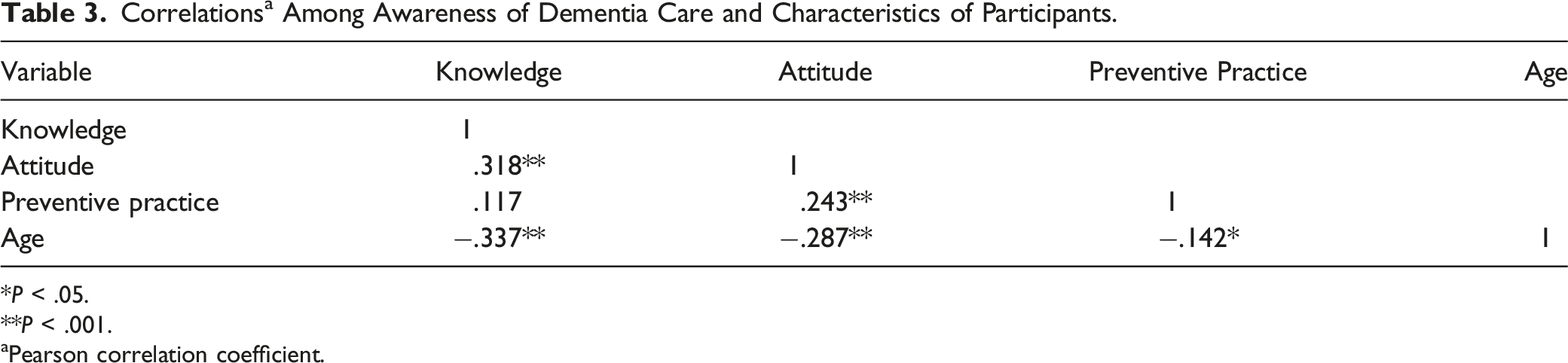
*P < .05.
**P < .001.
aPearson correlation coefficient.
Awareness of Dementia Care Between Health Professionals at Different Working Places. a
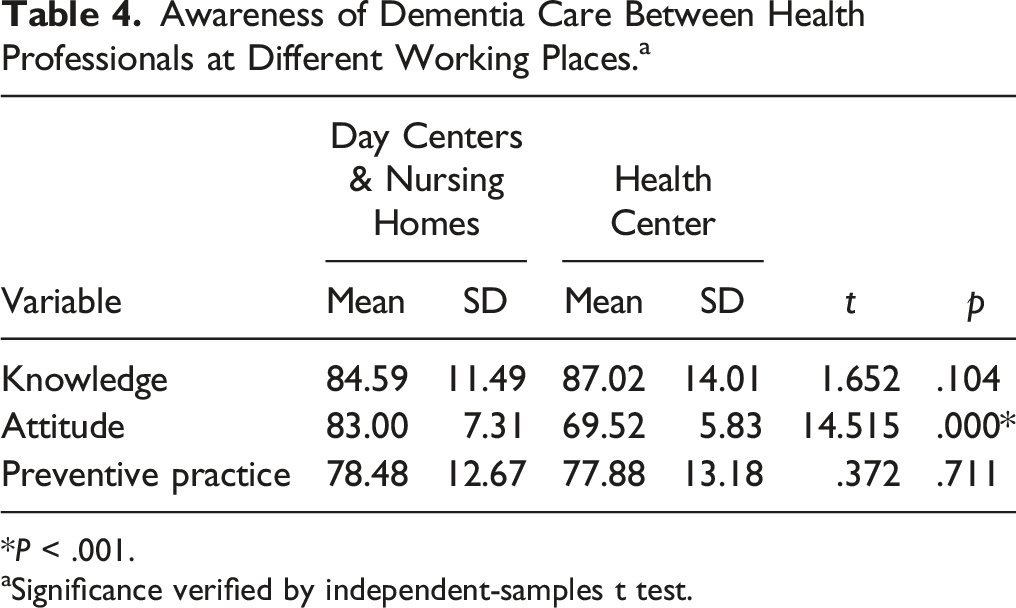
*P < .001.
aSignificance verified by independent-samples t test.
Discussion
Poor Awareness of Dementia Care Amongst the Health Care Assistants and Staff with Lower Education
The findings demonstrated that the health care assistants working at day-care centers and nursing homes in Macao SAR, of whom most were with education level of intermediate school and below, had poor awareness of dementia care, in terms of knowledge were less than the social workers, managers, health professionals and clerk, of whom all were with tertiary education level. Similar results were reported previously.5,12,13 The health care assistants working at day-care center or nursing homes in Macao SAR usually are in a significant frontline to provide long-time personal hygiene and daily living care for older people and might observe some early symptoms of suspected older person living with dementia if the health care assistants were trained well, by which might result in an early detection and well follow-up care for older people living with dementia. 13 However, most of the health care assistants working at day-care centers and nursing homes only received a very fundamental daily living care training in pre-employment course and they didn’t have any knowledge about dementia care, even the in-service trainings mentioned seldom about dementia care. 14 To face with this situation, the Dementia Working Group of Macao Health Bureau and 164 non-governmental organizations of the Dementia Friendly Community Alliance in Macao SAR have been working together since 2017 to provide information about dementia care through public multi-medias for the staff working at long-term care institutes. However, the health care assistants, always being at the grass-roots of an institute, usually had no chance to attend the academic workshops and conferences, and usually lacked resources and English proficiency to gain information about dementia because of their lower education level, 15 maybe result in their poor knowledge about dementia care.
Moreover, the study also indicated there were some misunderstandings about dementia, such as ‘hypertension and diabetes mellitus are not risk factors’, ‘dementia is part of normal aging’, and ‘memory difficulty is the only symptom of dementia’ amongst many staff working at day-care centers and nursing homes in Macao SAR. It was well known that misunderstanding of ‘dementia is a part of normal aging’ amongst family members and the staff working at day-care centers and nursing homes would directly result in a delayed diagnosis for the older people living with dementia and then their appropriate management of dementia, causing worse prognosis and poorer services for older people living with dementia. 16 Moreover, many staff working at day-care centers and nursing homes lacked knowledge about the risk factors of hypertension and diabetes mellitus for dementia, which resulted that they could not manage well the daily living care including inappropriate diet preparation and delayed seeking proper medical advice and treatment for the older people living with dementia. The study also demonstrated the common ways to gain information related to dementia were public lectures, TV/radio and newspaper/book. It was not doubt that public education was significant to improve the awareness of dementia care and promote the empowerment of the public to deal with dementia well. The common public medias, such as TV and radio etc. were proved to be the most efficient and accessible ways to disseminate knowledge about dementia care to the community, including the staff working at day-care centers and nursing homes. 17 Furthermore, recommendations of in-service trainings with a focus on knowledge about dementia care for the staff working at day-care centers and nursing homes had been strongly highlighted. 18 Therefore, Macao SAR Government has been held the “International Forum on Healthy Macao, Quality Home - Let’s build a dementia-friendly community” since 2017 consecutively and many academic lectures and activities for the professionals in Macao SAR, including the staff working at day-care centers and nursing homes, to raise their awareness and knowledge of dementia care.
The findings showed that attitude of the health care assistants working at day-care centers and nursing homes in Macao, of whom most were with education level of intermediate school and below, were significantly less positive than the social workers and the health professionals, of whom all were with tertiary education level. The health care assistants took care personal daily livings of older people at day-care centers and nursing homes in Macao SAR, usually at current poor working conditions of quite long working hours but low pay, and as discussed previously that they lacked knowledge of dementia care, which might cause their misunderstanding of some symptoms and behaviors of older people living with dementia, and then maybe resulted in their less positive attitude while taking care of older people living with dementia at day-care centers and nursing homes. 19
The Older Staff had Poor Awareness of Dementia Care
The findings indicated that knowledge, attitude and preventive practice were negatively related to age, which demonstrated that the older staff working at day-care centers and nursing homes in Macao SAR had less knowledge, less positive attitude and less preventive behavior of dementia care. It might be caused by lack of training content about dementia care was included in the fundamental pre-occupational training in the past time and even in the in-service training for the older staff working at day-care centers and nursing homes. 20 Moreover, the older staff couldn’t take care of the suspected older people living with dementia appropriately at day-care centers and nursing homes, which resulted from their lack of awareness of dementia care. Therefore, enhanced dementia care trainings to improve knowledge amongst the older staff working at day-care centers and nursing homes were recommended strongly. 21
Good Awareness of Dementia Care Amongst the Health Professionals
The study indicated that the health professionals working at day-care centers and nursing homes in Macao had sufficient knowledge and appropriate preventive practice on dementia care and the t-test result also showed that there were no statistically differences for knowledge and preventive behavior between the health professionals working at day-care centers and nursing homes and those working at Health Centers in Macao SAR. 3 Macao SAR Government implemented a rigorous licensing law to regulate the qualification of health professionals including doctors, nurses, and therapists etc. Moreover, Macao Health Bureau carries out a continuous professional development plan to encourage the health professionals, working either at hospitals or communities, to improve and update their professional knowledge and skills (Macao Health Bureau, 2023). 22 Both Macao Health Bureau and non-governmental professional organizations held many academic training courses and conferences to enforce the knowledge and capacity of the health professionals working at different settings to assess, diagnose and care for older people living with dementia.
However, the finding also showed that the health professionals working at day-care centers and nursing homes had more positive attitude than those working at Health Centers in Macao SAR, even both had positive attitude on dementia care. All the day-care centers and nursing homes in Macao are regulated strictly by the residential aged care accreditation scheme of Macao SAR Government. 7 The well trained health professionals staffing at day-care centers and nursing homes always stay with and know well about the resided people living with dementia, and then maybe resulted in their more positive attitude while taking care of older people living with dementia at day-care centers and nursing homes. 23
Limitations
The study sample did not cover all staff working at day-care centers and nursing homes throughout Macao SAR, so caution should be recommended if applying findings elsewhere.
Implications for Practice
The present study provided the baseline information with which to compare the further researches and to measure the progress of developing a dementia-friendly community in Macao SAR. Enhanced dementia care training with a focus to improve the knowledge, attitude and preventive practice on dementia care amongst the health care assistants and older staff working at day-care centers and nursing homes in Macao SAR were recommended strongly. Further researches could use the study findings and the validated questionnaire exploring the awareness of dementia care, in terms of knowledge, attitude and preventive practice domain to assess different populations for comparison.
Conclusion
This study provided initial insight into their awareness of dementia care amongst the staff working at day-care centers and nursing homes in Macao SAR and found most of the health care assistants and older staff had less knowledge, less positive attitude and less preventive behavior on dementia care. The results highlighted the significant need for enhanced dementia care trainings to improve the knowledge, attitude and preventive practice amongst the health care assistants and older staff working at day-care centers and nursing homes in Macao SAR.
Footnotes
Acknowledgments
The authors would like to thank all the staff working at day-care centers and nursing homes in Macao SAR who participated in this survey.
Declaration of Conflicting Interests
The author(s) declared no potential conflicts of interest with respect to the research, authorship, and publication of this article.
Funding
The author(s) disclosed receipt of the following financial support for the research, authorship, and publication of this article: The research was funded by the Macao Health Bureau, the Government of Macao Special Administrative Region, China.
Ethical Statement

Data Availability Statement
The data that support the findings of this study are available on request from the corresponding author. The data are not publicly available due to privacy or ethical restrictions.