



Abstract
Qualitative studies were synthesized to describe perspectives of people with dementia regarding meaningful activities. Themes of connectedness were identified using a meta-ethnography approach. The theme of being connected with self encompasses engagement for continuity, health promotion, and personal time. The theme of being connected with others includes being with others not to feel alone, doing an activity with others, and meaningful relationships. The theme of being connected with the environment encompasses being connected to one’s familiar environment, community, and nature. This synthesis suggests that connectedness is an important motivation for engagement in daily activities. Findings indicate that identifying the underlying motivation for an individual with dementia to engage in different activities is important for matching a person with activities that will be satisfying. This review may inform the development of interventions for engaging people with dementia in meaningful, daily activities and creating connectedness to self, others, and the environment.
Introduction
Engagement in personally valued, meaningful activities is an important determinant of successful aging and quality of life in older adults. 1 -3 People with dementia, however, often lack opportunities for such engagement to the extent they need and want. The most common unmet needs of people with dementia reported by themselves and their caregivers involve daytime activities, social company, and psychological distress. 4 -6 This can be due to decreased cognitive abilities, psychological and behavioral symptoms, deliberate social withdrawal outside the home, perceived stigma (or self-stigma) of persons with dementia, and beliefs and strategies of those caring for persons with dementia (eg, focusing on activities that help maintain current functional abilities without considering the individual’s preference and value, de-emphasizing values, and preference in daily activities of persons with dementia). 6 -9 People with dementia use professional supports for daytime activities and social company, but available services for daytime activities and social company may not be meaningful or valued by individuals with dementia or be matched to individuals’ varied interests and abilities. 4 -6,10 Understanding perceptions of people with dementia on meaningful activities, thus, will help better develop activity programs that can fulfill psychosocial needs and maintain or improve quality of life of persons with dementia.
This article aims to synthesize qualitative studies describing how people with dementia perceived meaningful activities. Specifically, the intent is to understand the types of activities that are meaningful to people with dementia and the underlying motivations of people with dementia for engaging in these activities.
Method
Search Strategy
To address the specific aims of this review article, a search was conducted to identify articles on meaningful activities and dementia. Meaningful activities were defined as self-chosen activities derived from an individual’s interests, preferences, values, motivations, pleasure, or sense of the importance of participating in certain activities. 11 The Sample, Phenomenon of Interest, Design, Evaluation, and Research type search strategy was used because of its suitability for identifying qualitative studies. 12 Electronic databases (including PubMed, CINAHL, and PsychINFO) were used to identify peer-reviewed journal articles, in English, published between January 1, 1990, and December 31, 2013. Initially, 796 articles were identified using the search terms listed in Table 1.
Search Terms Used in Databases

Inclusion Criteria
Once the initial search was completed, articles were selected for inclusion in the synthesis if they were qualitative studies or mixed method studies involving people with dementia living in the community or in residential care homes and included the views of people with dementia on meaningful activities. Studies had to use qualitative methods in collecting and analyzing data and use qualitative interviews as the main method for data collection. Relevant qualitative journal articles were identified without limit to specific type of qualitative study, type of dementia, or age of persons with dementia. Titles and abstracts were reviewed for inclusion criteria. Articles were excluded from this review, if all participants in a study were not people with dementia and if studies did not have findings regarding people with dementia, daily activities, and/or why they wanted to engage in these activities.
Quality Appraisal
The Critical Appraisal Skills Programme (CASP) 13 was used for quality appraisal of included qualitative studies. The CASP is a checklist that includes 10 questions assessing a study’s rigor, credibility, and relevance. Studies were not excluded based on study quality so as not to miss potentially valuable findings, but we did want to identify the relatively poorer quality studies. 14 We found no study with fewer than 7 of the 10 points (0 = worst and 10 = best) possible on the CASP checklist (Supplementary Material A).
Analysis
Articles were analyzed using Noblit and Hare’s meta-ethnographic approach. 15 Meta-ethnography is a widely used method for synthesizing multiple qualitative studies with diverse study designs. 16,17 Meta-ethnography uses the authors’ interpretations and explanations of their original qualitative studies as the raw data for the synthesis in addition to the reported quotations of participants. In other words, the revealed themes, perspectives, or concepts from each qualitative study are selected as data for synthesis. 18 This prevents misinterpretation of data from its’ original collector and preserves the meaning of the original text. 19
Noblit and Hare’s meta-ethnographic approach 15 outlines a series of specific steps that were followed in the present synthesis. While reading articles repeatedly, a list of relevant key metaphors (concepts, themes, perspectives, and phrases) was generated to describe the findings of each study. The researcher then compared metaphors of individual studies to one another (called “reciprocal translations”) and created working themes that emerged from the key metaphors. The researcher reviewed the themes that emerged to create new overarching themes that meaningfully integrated and interpreted related concepts. A second researcher checked if themes and subthemes fit well with the original data.
Results
Description of Studies
Among the initially identified 796 articles, a total of 717 articles were excluded based on title and abstract. Further 45 articles were excluded after reading full-text articles. The most frequent reason for excluding studies (97.77%) was that the data did not include perspective of people with dementia about meaningful activities. 20 Other less frequent reasons for excluding studies were participants included older adults without dementia 21 ; the article was a review article 22 ; or data were not collected through interviews. 23
A total of 34 studies met the inclusion criteria described previously. Characteristics of each study are outlined in Supplementary Materials A (a shorter version) and B. It is likely that our findings are typical of people with dementia because they were derived from 34 studies involving participants with varied characteristics. For example, participants in the studies included those living in the community (25 studies) and those in residential care homes (13 studies) and had varied stages and types of dementia and marital status. The included studies also varied in national origin, coming from the United Kingdom (13), Canada (4), United States (3), Australia (3), Sweden (3), Norway (2), Netherlands (2), New Zealand (1), Belgium (1), Israel (1), and Hong Kong (1), and race and ethnicity, involving groups who were Jewish, Black, South Asian, and British Asian. The themes and subthemes developed based on 34 studies’ findings capture common but broad perspectives of people with dementia on meaningful activities.
Description of Themes
Analyses reveled that being connected is an important motivation for people with dementia to engage in activities. Three primary themes regarding connection were identified. Persons with dementia were connected or wanted to be connected to self (theme 1), to others (theme 2), and to the environment (theme 3) through engagement in the individual’s meaningful activities. In order to fully describe these broad themes, each was further conceptualized in terms of subthemes that captured distinct approaches to connectedness. Each of these primary themes is further described by three subthemes. Some subthemes occurred less than the others because the former was more narrowly defined than the latter (eg, subtheme 1a vs subtheme 1c). Table 2 describes definitions of themes and subthemes with one quote that represents each subtheme as an example. More examples of quotes from original studies supporting each subtheme are included in Supplementary Material C.
Definitions of Themes and Subthemes.
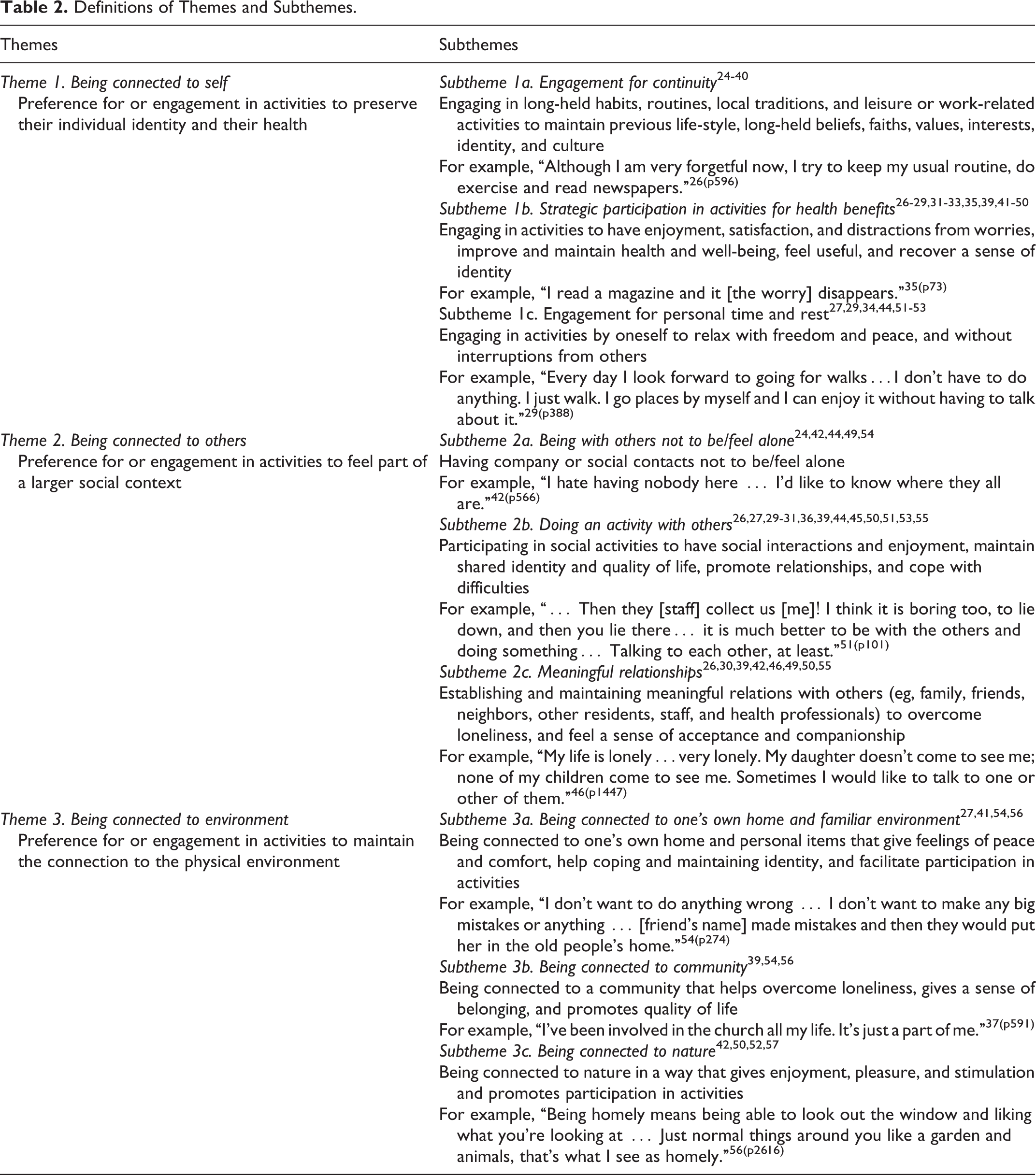
Theme 1: Being connected to self
Subtheme 1a
Engagement for continuity. Community-dwelling people with early and middle stages of dementia had a significant desire for continuing engagement in typical everyday activities that they had done before the dementia to maintain some level of continuity with their previous lifestyle, long-held beliefs, and values. 24 -34 For example, staying interesting was a value for one woman with dementia who kept watching TV programs of interest to her, reading books, and meeting friends to maintain her value of being an interesting person. 28 Two of the males had past lifestyles of hard work and valued achievement through hard work. 30 Having no activity that required hard work to achieve a goal caused these men to feel empty and uncomfortable. They therefore tried to continue engaging in daily activities, including work-related activities, to maintain their identities.
Activities supporting each individual’s habits, routines, and roles were meaningful because people with dementia could engage in these daily activities as much as possible, feel a sense of normality, and maintain their preferred lifestyle. 27 -29,31,33,35 Remaining involved in work-related activities and household chores helped some people with dementia maintain a sense of role identity; one as a previous choral conductor, another as a helpful husband for his wife with a disability, and a third as a good father for his children. 29 Helping others was another important way of maintaining continuity of lifestyle to one person with dementia related to his previous occupational role as a teacher. 25
Continuing engagement in cultural and spiritual activities helped people with dementia maintain their culture and long-held faiths. Community-dwelling older adults with early stage dementia valued cultural activities related to traditions, local history, folk music, and their own life histories. 36 Some people with dementia continued participating in spiritual activities by engaging in personal practices at home (eg, prayer and reading the Bible), attending church, playing roles and helping others in church, and by being informed of events within the wider spiritual communities. 37 -40 They were strongly motivated to engage in these spiritual activities because of their sense of identity and continuity in faith, and the fellowship with and support from other members in the spiritual community.
Subtheme 1b
Strategic participation in activities for one’s own health benefits. Community-dwelling people with dementia found enjoyment, satisfaction, and distraction from other worries by engaging in leisure activities, such as gardening, going for walks, music activities, and communal activities. 29,35,41 Listening to music and singing were identified as common past and current leisure activities, and these activities were not too demanding to do, so people with dementia could actively engage in these activities with pleasure and without thinking about dementia. 32,39,42,43 Music-related activities were also enjoyed by people with dementia because of positive benefits to their mood and concentration by soothing and uplifting their spirits and expressing themselves nonverbally. 44,45 Background music also promoted participation in routine activities by making activities more enjoyable. 45
Engaging in intellectual, physical, and leisure activities (eg, reading, doing crossword puzzles, and going out for daily walks) was meaningful to community-dwelling people with dementia because they believed that these activities would improve memory and restore their abilities. 28,32,35,41 Some women with dementia, for example, watched TV believing this would help maintain an active mind. 33 Intellectual activities, however, were avoided or abandoned if the people with dementia regarded that activity as too demanding. 27,35 Keeping an active mind, being physically active, and maintaining health and well-being were of great value to people with dementia who strategically participated in such activities to produce a sense of improved well-being. 26 -28,41 Older people with early stage dementia engaged in leisure activities and organized programs to keep busy and occupied and thus to reduce loneliness and get some distractions from social isolation. 33,46
Being or feeling useful helps older adults with dementia feel valuable to others and provides a sense of self-worth. 32,47 Some community-dwelling people with dementia maintained feeling valued and a sense of purpose by doing household chores for their busy children. 33,47 Finding new ways of feeling useful was meaningful to community-dwelling people with early stage dementia. One new way was participating in Alzheimer’s research, which provided them with an opportunity to reflect on their experiences and feel useful through the interview process. 31,48 Residents with dementia in care homes also expressed frustration and a need for feeling useful. 49,50 The search by residents for active engagement in useful activities helped them feel more satisfied with living in care homes. 49
Reviewing past experiences and one’s life was pleasurable to residents with dementia living in care homes because engaging in this activity recovered their sense of identity by compensating for their current losses. 49 Talking about past activities, experiences, and interests associated with one’s social and occupational roles were enjoyed and meaningful to people with dementia as an expression of their identity. 27,44 Looking back over pleasurable memories was a way for an individual with early stage dementia to enjoy being alone and not to feel lonely. 46
Subtheme 1c
Engagement for personal time and rest. People with dementia considered having time alone 44 and rest 51 meaningful to them. Walking outdoors by oneself was one activity that provided relaxation and a low level of social stress. 29,52 Having quiet meals alone was a way of connecting with self by allowing time for being with one’s own thoughts. 53 Being in a private space alone and engaging in activities in the private space provided people with dementia with feelings of freedom, peace, and enjoyment. 27,34
Theme 2: Being connected to others
Subtheme 2a
Being with others not to be/feel alone. Having company was meaningful to people with dementia to avoid being or feeling alone. Attending day care centers with highly satisfying levels of human contact was enjoyable to community-dwelling people with dementia. 24 Having social contact was also significantly important to residents with dementia regardless of their stages of dementia. 42,44 Residents with middle and late stages of dementia in care homes expressed fear of being alone and loneliness due to a socially isolated life at care homes. 49 Those living alone listened to the radio and watched TV in order not to feel alone and to feel a sense of connection to others by having virtual company. 54
Subtheme 2b
Doing an activity with others. Doing things together with others in a day care center promoted a sense of belonging and motivation for engagement in activities. 29 Working together in the garden was a meaningful activity to a man with dementia and his family because of a sense of shared identity as the family who worked hard together with partnership to overcome any challenge. 30 Some community-dwelling people with dementia regarded “doing things together with my partner” as an activity that positively affected their quality of life. 39 (p542) Residents with dementia in care homes were motivated to participate in group activities (eg, newspaper reading and gymnastics) offered in care homes because of a sense of belonging by doing things together with others. 51 The residents found more enjoyment in some group activities matched with their abilities and interests so that they could participate equally with others. Activities involving music, such as singing together and dancing, encouraged social interaction by being physically and emotionally close with others. 45 Engagement in cultural activities with others who shared local life experiences also facilitated their feelings of belonging by culture not by dementia itself. 36
Talking to or sharing with others was a meaningful activity for people with dementia, and the personality and attitude of the person they talked to made a difference as to whether they felt at ease and connected to others. 26 Talking and sharing with similar people, in terms of dementia or unrelated to dementia (eg, attending a women’s group), helped people with early stage dementia normalize difficulties, learn different ways of coping from others, and not to feel alone. 31 Talking to and about family gave residents feelings of being connected to their families by reminding residents with dementia of past memories and proving their existence outside of care homes. 44,50 Couples reminisced together about their shared history, especially positive memories, to maintain their shared sense of identity and couplehood and to offset their current difficult situations. 55 Looking at personally significant items (eg, family photographs, cushions made by a family member) and talking about related stories helped people with dementia maintain feelings of connection with family as well as connection with themselves. 27 Listening to music also helped people with dementia recall past memories and thus encouraged meaningful conversations with others by talking about their past experiences. 45
Subtheme 2c
Meaningful relationships. Older people with dementia who lived in either the community or long-term care facilities desired maintenance of meaningful relationships, and a loss of key relationships was a source of loneliness. 39,42,46 Some older residents with dementia felt hurt and sad when their family did not visit the homes and care for them as much as the people with dementia expected and as they had done for their families in earlier years. 50 Understanding and accepting that family members could not visit the home often helped residents with dementia maintain positive relationships with family members and a sense of acceptance by family even if the family visits were fewer than they wished. 49 Some people with dementia desired to maintain positive meaningful relationships by receiving support and love from their family, and by being respected for their remaining abilities, their autonomy, and their continued usefulness. 26 Participating in weekly get-togethers at a local café was a meaningful family ritual for one man with dementia and his family. 30 He did not actively engage in conversations, but he valued maintaining relationships with families and felt a sense of belonging. Some couples maintained their relationships and couplehood by trying to be active and sociable together, for instance, going out for Sunday lunch and doing crosswords together. 55
Theme 3: Being connected to environment
Subtheme 3a
Being connected to one’s own home and familiar environment. People with dementia want to stay in their homes because of feelings of peace and comfort at home where their life histories and memories are embedded. 41,54 Moving to a nursing home can be a significant threat to people who have a strong tie to home and value independent living. Engagement in safety maintenance activities by using a checking strategy, paying extra attention, and avoiding any activity that is beyond their current abilities were important for people with dementia living alone to stay at home and not move to a nursing home. 54 Being in familiar environments promoted a sense of coherence for people with dementia and these feelings supported participation in activities, including taking walks, shopping, and using public transportation in the familiar environment where they had grown up. 27 Being in the familiar environment with personal things such as photographs, furniture, plants, decorations, and other memorabilia, supports the continuation of self and provides the person with dementia with feelings of being at home. 56
Subtheme 3b
Being connected to community. Some older people living alone may feel confined at home as they lose the ability to drive and do not have close social contacts they can socialize with frequently. 54 Looking out through a window at home was a way they could feel connected to their communities. One woman with dementia living alone found enjoyment in being out in the community when she went out for groceries by seeing other people and feeling good in the fresh air. Being involved in the things around self and being interested in what is happening in the world were important for quality of life in both community-dwelling older people and nursing home residents with dementia. 39 Participating in activities that give an atmosphere of community (eg, parties, barbecues, and celebrations of national events) was valued. 56
Subtheme 3c
Being connected to nature. Being in nature and the enjoyment and positive feelings derived from it were strong motivations for daily walks in community-dwelling men with early stage dementia. 52 Pleasure from being connected to nature strengthened their value of staying physically active by making a routine of daily walks. The men and their wives used adaptive strategies for the men to continue engaging in outdoor walks themselves in order to compensate for their reduced ability due to dementia and to feel secure while walking. Being outdoors and gardening were important to residents with middle stage dementia because of the stimulation and pleasure nature provides. 42 (p567) Outside activities such as walking were not allowed in some care homes because of safety issues, and residents with dementia expressed how much they enjoyed participating in these activities in the past. 50
Theme Interactions
In addition to identifying unique themes, meta-ethnography also requires that interactions among themes be considered. Our analysis indicates that motivation for activities in a number of subthemes also fulfilled the activity needs described under other subthemes (see Figure 1). For example, engagement for continuity facilitated maintaining meaningful relationships and being connected to the community. Families or friends helped people with dementia continue engaging in activities matched with lifestyles, lifelong beliefs, values, and interests. For example, a wife left a note with instructions and schedules for her husband with dementia every morning to help him plan his day, engage in work-related activities, go out on errands, and go to church with his son. 29 These supports from his wife promoted not only continuing engagement but also a sense of connection to his wife and the community. Going to church also facilitated a sense of belonging to the spiritual community and meaningful relationships from church members as well as maintenance of spiritual identity and faiths. 38 Engagement for continuity was strengthened while doing an activity with others, being connected to familiar environments, and being connected to natural environments. Working together in the garden allowed a man with dementia and his family to maintain a sense of shared identity, 30 and reminiscing shared histories together promoted maintenance of their shared sense of identity and couplehood. 55 Being in familiar environments supported continuing engagement in daily activities and a continuation of self-identity. 27,56 Enjoyment from being in nature facilitated continuing engagement of staying physically active by making daily walks a routine. 52
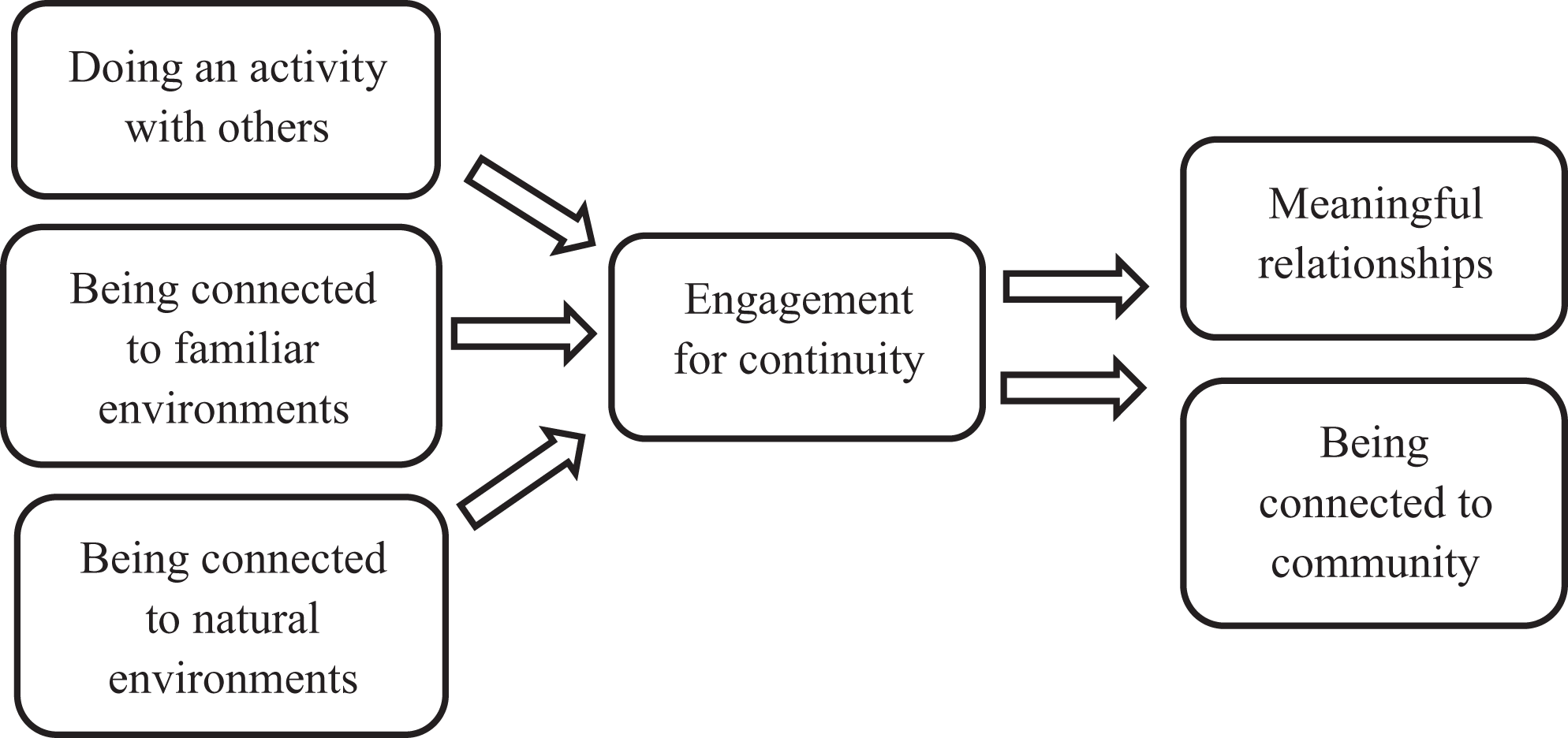
Theme interactions.
Discussion
The purpose of the present synthesis was to integrate the findings of qualitative studies on meaningful activities from the perspective of people with dementia. Our focus was on identifying the activities that are meaningful to people with dementia and the reasons that they want to engage in these activities. We found that being connected is a strong motivation for engaging in activities and engagement in meaningful activities helps the person with dementia to be connected. The findings indicate that being connected in personally meaningful ways promotes a sense of belonging along with physical, mental, and emotional health, self and social identity, independence, interdependence, and life satisfaction in people with dementia. Individual differences in ways of being connected depended on values, beliefs, interests, culture, living environment, and previous lifestyles and roles. The common meaning and motivation for engagement, however, was to be connected to self, others, and environment.
In addition to these findings about the importance of connectedness, findings from the studies synthesized here also highlight the importance of understanding each individual’s motivation for participating in a given activity. Different individuals may engage in the same activity but for different reasons or to meet different needs. Watching TV, for example, was meaningful to maintain the value of being an interesting person, 28 maintaining an active mind, 33 or not feeling alone. 54 Conversely, individuals may engage in activities that are very different on the surface, but that are motivated by a desire to meet the same need. For example, sharing a meal and gardening activities may both meet the need of being connected with one’s spouse. Thus, the critical aspects of activity are that it is personally meaningful to the individual with dementia, and that it meets their individual need. When there are mismatches between the meaning of an activity for a person with dementia and a caregiver’s perception about the meaning of that activity, frustration and conflict may occur. For example, family caregivers and staff valued social activities organized by care homes more than contact with family, whereas individuals with dementia often most highly valued contact with family. 44 Family caregivers also had little awareness that reminiscence activity and music activity were important to their relatives with dementia 44 and reported difficulty in finding meaningful activities for their loved ones. 52 Similar mismatches may be present between people with dementia and paid caregivers. In one study, being useful and maintaining religious faith was reported by people with dementia as being important for their quality of life but was not mentioned as important to their care recipients by professional caregivers. 39 These findings underscore the importance of identifying the nature and scope of meaningful activities from the perspective of people with dementia when providing person-centered care.
Understanding why the person with dementia wants to engage in a particular activity is important for caregivers and health professionals to be able to support the connectedness of people with dementia. As dementia progresses, the individual may not be able to engage in his or her valued, meaningful activity even by using compensation strategies or adaptive tools or equipment. In that case, an alternative activity could be substituted that is matched with the value or need embedded in the previous activity. Without understanding why the particular activity was important to the person with dementia, the proposed alternative activity may not be successful. One man with dementia, for instance, liked cycling because of being connected to nature. After moving to a long-term care setting, the staff knew he liked cycling and assumed that he enjoyed physical activity. They asked him to ride the indoor bicycle without knowing why he liked cycling, and he is unlikely to enjoy or want to engage in cycling when the activity is disconnected from nature. In this case, he may enjoy walking in the garden more than riding the indoor bicycle.
The cycling example just described illustrates why health professionals and caregivers should make an effort to understand the underlying meaning of engagement in activity and help the person with dementia express and engage in activities matched with their psychosocial needs, especially as dementia progresses. An awareness of connectedness as an important motivation for engagement, and of the variety of ways of being connected, will facilitate development of better interventions and care for people with dementia. Further studies are needed to identify how best to tailor interventions to meet an individual’s need and desire to be connected to self, others, and environment to assure psychosocial well-being and quality of life in people with dementia.
And finally, our findings are consistent with earlier work by Register and Herman who theorized that six interrelated processes of being connected (metaphysically connected, spiritually connected, biologically connected, connected to others, environmentally connected, and connected to society) were critical to quality of life for the elderly individuals. 58 (p344) In an evaluation of this theory in a qualitative study of community-dwelling older adults, Register and Scharer reported four processes involved with being connected in older adults, including (1) having something to do, (2) having relationships, (3) having a stake in the future, and (4) having a sense of continuity. 59 (p471) Together with the present study, these findings suggest that being connected to self, others, and environments is an important motivation for engagement in personally meaningful activities for both healthy older adults and adults with dementia. Especially, helping persons with dementia feel a sense of continuity through engagement in personally meaningful activities should be encouraged to caregivers who may increasingly de-emphasize values and preferences of persons with dementia in daily activities. 9
The present study has several strengths including the use of a meta-ethnography approach in synthesizing qualitative studies and involvement of participants with varied characteristics. The present study included multiple qualitative studies with diverse study designs and participants with varied characteristics while preventing misinterpretation of data from its’ original collector and preserving the meaning of the original text. A limitation of the present study is that only one researcher reviewed the literature and determined the eligibility of the searched studies for inclusion. Although over 700 studies were searched by the first author, the absence of another independent researcher in this process might have helped to identify additional relevant studies.
Conclusion
The aim of the synthesis of qualitative studies reported here was to identify the meanings of engagement in daily activities based on perspectives of people with dementia. Our analysis indicates that persons with dementia want to engage in personally meaningful activities to be connected with self, with others, and with the environment. These findings support the premise that being connected is an important motivation for engagement in daily activities, and underscore the importance of understanding this underlying motivation for designing person-centered activities to achieve connectedness and meet the psychosocial needs of persons with dementia. Caregivers should help persons with dementia continue engagement in personally meaningful activities, by better understanding the person’s want and need for engagement in activities and identifying varied ways of being connected in a personally meaningful way. Future studies are needed to identify if interventions tailored to meet an individual’s need for being connected to self, others, and environment affect psychosocial well-being and quality of life of people with dementia. These interventions may benefit people with dementia better than interventions that only emphasize increasing activity level and stimulation.
Footnotes
This article was accepted under the editorship of the former Editor-in-Chief, Carol F. Lippa.
Authors’ Note
Areum Han created the research question, searched and reviewed the literature, and wrote the manuscript. Jeff Radel helped in creating the research question, checked if emerging themes were well-grounded, and contributed to revising the manuscript. Joan McDowd contributed to revising the manuscript. Dory Sabata contributed to revising the manuscript.
Declaration of Conflicting Interests
The authors declared no potential conflicts of interest with respect to the research, authorship, and/or publication of this article.
Funding
The authors received no financial support for the research, authorship, and/or publication of this article.

References
Supplementary Material
Please find the following supplemental material available below.
For Open Access articles published under a Creative Commons License, all supplemental material carries the same license as the article it is associated with.
For non-Open Access articles published, all supplemental material carries a non-exclusive license, and permission requests for re-use of supplemental material or any part of supplemental material shall be sent directly to the copyright owner as specified in the copyright notice associated with the article.
