



Abstract
Objective:
We aimed to systematically search and summary the publications from 1990 to 2012 on Chinese dementia caregivers to understand the development in this field.
Methods:
We searched Pubmed and Chinese medical databases for all the original publications on the dementia caregivers in Chinese mainland until December 31st, 2012.
Results:
126 papers involved 117 studies with 11178 participants were analyzed. The earliest study on Chinese caregivers with dementia patients was published in 1990. Most studies (92%) were reported in Chinese. 85% of studies were published between 2006 and 2012, while 42% were carried out in the most developed regions.
Conclusions:
In spite of the late start, the number of publications on Chinese dementia caregivers has rapidly increased since 2006. However, the quality of studies is still need to improve in sample size, intervention and outcome design. More attentions, policies and funds should be given to support the future study in dementia caregivers.
Introduction
As the most common neurodegenerative disease in the elderly patients, dementia is becoming a big challenge in Chinese public health. With the accelerated population aging, the number of patients with dementia in China will reach 24 million in the year of 2040. 1 Regarding the mental and physical disability, patients with dementia are usually more dependent on their caregivers. Therefore, caregivers play an indispensable role in the daily life of patients with dementia. However, the caregiving process is generally described as a stressful challenge, especially in caring for patients with severe dementia. Due to the Confucian traditions in China, 90% of the Chinese patients with dementia live in family environment. Their spouses and children mainly serve as family caregivers, and more than 50% of them have psychological problems. 2 In regard to the “one-child policy” performed in Chinese mainland since 1978, there will be higher percentage of middle-aged people serving as caregivers in the near future under the pattern of family care. The caregiver issues have been attracting lots of attentions in Chinese dementia research. 3
The sources of care burden can be summarized as physical, psychological, social, and economic burden. The caregivers have to spend much time and energy for the patients with dementia in long term, which will influence their physical health, emotions, social affairs, and incomes. There are some common disturbances in dementia caregivers such as chronic illness, sleep disturbances, and cognitive decrease, which are confirmed to be associated with the caregiving career. 4 Moreover, Chinese family caregivers are usually attached with more social mandated responsibility in the daily care of their dementia relatives, while the complaints of caregivers are less expressed and neglected due to the oriental introverted personality. 5,6 Therefore, the quality of life of Chinese dementia caregivers is obviously not optimistic, and effective interventions are required to improve it.
The early attentions and investigations of Chinese caregivers of patients with dementia could be traced back to the beginning of 1990s, and the number of studies in this field has rapidly increased in the recent years. However, to our knowledge there is no article to give an overview of the studies of Chinese dementia caregivers. In our article, we aimed to summarize and comment the characteristics and problems in the published studies, so that possible improvements and hints could be found for future studies.
Methods
We searched the PubMed and Chinese medical databases such as China National Knowledge Infrastructure (www.cnki.net) and Wanfang Data (www.wanfangdata.com.cn) until December 31, 2012, for the relevant publications in the academic journal. The search terms in English and Chinese equivalents included “relative(s),” “spouse(s),” “caregiver(s),” “carer(s)”, “dementia,” “Alzheimer’s disease,” “Chinese,” “Chinese mainland,” and “China.” We considered only the original investigations with the following criteria: (1) the population of studies must be from Chinese mainland; (2) the care objectives must be clinically diagnosed as dementia; (3) the care subjects must be explicitly defined as caregivers; (4) the outcomes of investigation must be the measurements for caregivers. We extracted the basic information of each included study such as author information, year of publication, site of study, number of caregivers in the analysis, study design, methodology, and main outcomes. Statistical analysis was performed using SPSS for Windows, version 16.0. Mann-Whitney U test was used to examine the significance between different periods. Any differences would be regarded as significant if P values were less than .05.
Results
According to the criteria, 126 articles were included and analyzed, which involved 117 studies with 11178 participants. Although the number of studies was not small comparing with the English literatures in this field, the sample size in each study was limited, with less than 100 participants in 82 (70%) studies. In geographic distribution, 49 (42%) studies locally originated from the most developed regions, such as Beijing, Shanghai, and Guangzhou. Regarding the study design, 64 (55%) studies were cross-sectional; 1 (1%) study was longitudinal without intervention; 20 (17%) studies were case control; 23 (20%) studies were interventional; and 9 (7%) studies were randomized controlled trials (RCTs). The outcomes mainly concentrated on the burden, anxiety, depression, and knowledge of care in the caregivers of patients with dementia. In all, 78 (67%) studies applied the commonly used scales in Chinese version. The most frequently used scales were Symptom Checklist-90 in 30 (26%) studies, Self-Rating Anxiety Scale in 17 (15%) studies, Self-Rating Depression Scale in 17 (15%) studies, and Caregiver Burden Inventory in 11 (9%) studies. In addition, the coping style, demand, attitude, motivation, caregiving model, and economic burden in caregivers were also discussed in the studies.
According to our retrieval, the earliest study that focused on caregivers of patients with dementia was published in 1990, which was undertaken in Beijing. 7 The largest scale study enrolled 613 caregivers from Shanghai, and the results were published in 1992. 8 According to Figure 1, we could conclude that 18 (15%) articles in this field were published between the years 1990 and 2005, while 99 (85%) publications were released between the years 2006 and 2012. There was significant difference between the 2 groups (P < .001) which was determined by Mann-Whitney U test. On the other hand, the median sample size was 98(83) between the years 1990 and 2005 and 65(59) between the years 2006 and 2012, respectively. Using Mann-Whitney U test, we found there was asignificant difference between the 2 groups (P = .034). Most (92%) studies were reported in Chinese, and 9 (8%) English articles were found in PubMed, in which 4 studies were part of international cooperation, and 2 studies reported the validation of scale in Chinese version for caregivers.
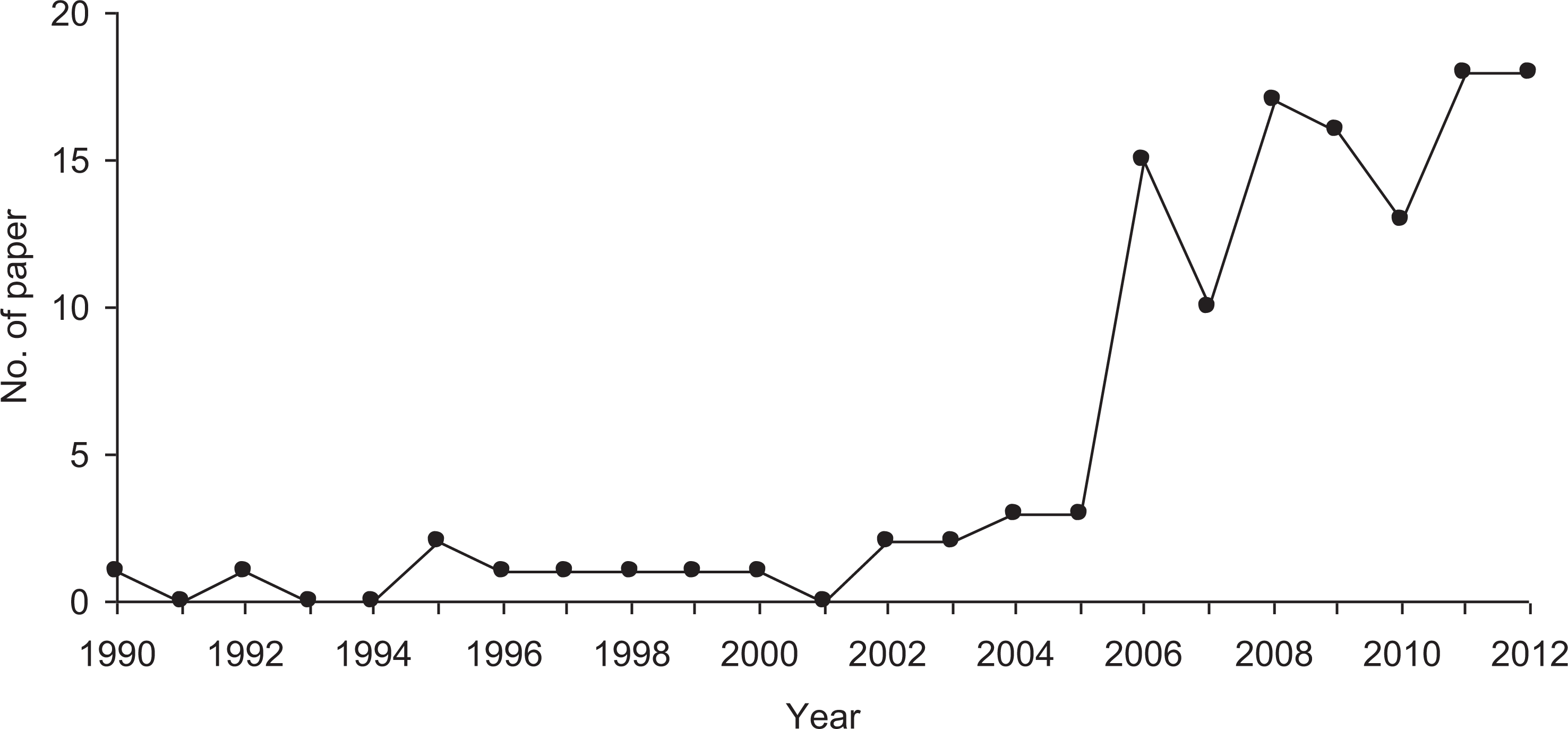
The number of articles of Chinese dementia caregivers since 1990. The number of articles of Chinese dementia caregivers was expressed as [median (quartile)]. By Mann-Whitney test, there was significant difference (P < .001) Between group of years 1990 to 2005 [1(2)] and group of years 2006 to 2012 [16(5)].
Discussion
The start of publications on caregivers of patients with dementia in Chinese mainland was later than that in theWestern world. In recent years (2006-2012), the number of articles in this field quickly increased, while the average sample size significantly decreased compared to the previous studies (1990-2005). As far as the study design was concerned, cross-sectional studies without controls were predominant. The outcomes were usually measured by Chinese version scales and concentrated in certain aspects, such as burden, demand, anxiety, and depression. Few studies discussed medical economics and social ethics in dementia caregiving. In the interventional studies, the method was relatively single with education and guidance for care skill provided by physicians and nurses. In the meantime, there were 9 mini-RCTs, and 2 studies of them were with more than 100 participants. Although RCTs are the most powerful design for current clinical research, none of the included RCTs were of high quality in methodological evaluation. The limitations were found in random sequence generation, allocation concealment, and blinding of participants, personnel, and outcome assessment. Therefore, we conclude that the quality of future studies needsto improve with more adequate study question, study design, and sample size. For the interventional studies, well-designed RCTs are recommended as the international standard as well as those focusing on the promising interventions, such as telephone guidance, systematic care plan made by expert, self-help group of peer caregivers, and networked technologies support.
The study sites were mainly located in the developed regions of southeast coast of China. Data from underdeveloped western regions were less reported. Actually, the gap between urban and rural and developed and underdeveloped regions is also an important factor that influences the caregivers. The caregivers living in urban are relatively richer and well educated. Moreover, they have more opportunities to learn and master the knowledge of dementia and care skill than those in the rural. In 2012, the proportion of urban population in Chinese mainland was 51%. Therefore, the current data may not fully reflect the complete picture of Chinese dementia caregivers. Multicenter study involving the population both from urban and from rural can be a solution for the representation of samples. Institutional care is gradually developed in the recent years and believed as the possible alteration of traditional Chinese family care in the future. With the tendency of population aging, the demand of institutional care is becoming huge, especially for the elderly patients with mental or physical disability like dementia. Institutional care is still in the exploration stage in Chinese mainland, and some restricting factors, such as the training of professional staff, resource distributions, and financial support, exist. The findings of Western world suggested that the transition to institutional care could be an extra burden for family caregivers. 9 Therefore, well-designed future studies are encouraged to focus on the advantages and disadvantages in different care patterns, such as family care, respite care, and institutional care.
With the fast growing number of patients with dementia in Chinese mainland, the health care and knowledge of dementia have been widely announced to the public by the mass media, for example, TV, radio, and newspapers. 10 Since 2001, there are annual nationwide activities on September 21, the “World Alzheimer’s day,” which are organized by the Alzheimer’s disease Chinese. The popularization of knowledge in dementia is definitely helpful to early identification and intervention of dementia in the elderly patients and planning for long-term care by their caregivers. Since 2002, dementia has been listed as a priority of disease prevention and treatment in mental health of government plan, with more pharmacological treatments for dementia covered by Chinese medical insurance system. On the other hand, dementia caregivers are also a large population that can be no less than the number of patients with dementia. Therefore, the study of caregivers is an important branch in dementia research and should be allocated with adequate funds and supports. Furthermore, interdisciplinary study of medical economics and social ethics in dementia care is also necessary on the basis of Chinese economy and culture.
Conclusion
The earliest publication on Chinese dementia caregivers was released in 1990. With the population aging, the number of publications in this field has rapidly increased since 2006. However, in order to provide reliable evidences, the study quality still needs to improve in study design, sample representation, and methodology. More studies focusing on the rural population, institutional care, and new interventions are required. More attentions, policies, and funds should be given to support future study on dementia caregivers.
Footnotes
Declaration of Conflicting Interests
The authors declared no potential conflicts of interest with respect to the research, authorship, and/or publication of this article.
Funding
The authors received no financial support for the research, authorship, and/or publication of this article.