



Abstract
The National Plan to Address Alzheimer's Disease calls for a new relationship between researchers and members of the public. This relationship is one that provides research information to patients and allows patients to provide ideas to researchers. One way to describe it is a “bidirectional translational relationship.” Despite the numerous sources of online and offline information about Alzheimer's disease, there is no information source which currently provides this interaction. This article proposes the creation an Alzheimer's research information source dedicated to monitoring Alzheimer's research literature and providing user friendly, publicly accessible summaries of data written specifically for a lay audience. This information source should contain comprehensive, updated, user friendly, publicly available, reviews of Alzheimer's research and utilize existing online multimedia/social networking tools to provide information in useful formats that help patients, caregivers, and researchers learn rapidly from one another.
As a health policy and medical researcher who has cared for a relative with Alzheimer’s disease, I am concerned by the lack of an up-to-date, comprehensive source of Alzheimer’s research information online or offline written at a level that the public can understand. This problem is not unique to Alzheimer’s research, but given the long history of the disease, 1 the lack of a central source of reliable research information for caregivers and patients is more disturbing. Fortunately, the US National Plan to Address Alzheimer’s Disease (the National Plan), a national road map to help the country prevent and effectively treat Alzheimer’s by 2025,2,3 shares my concern.
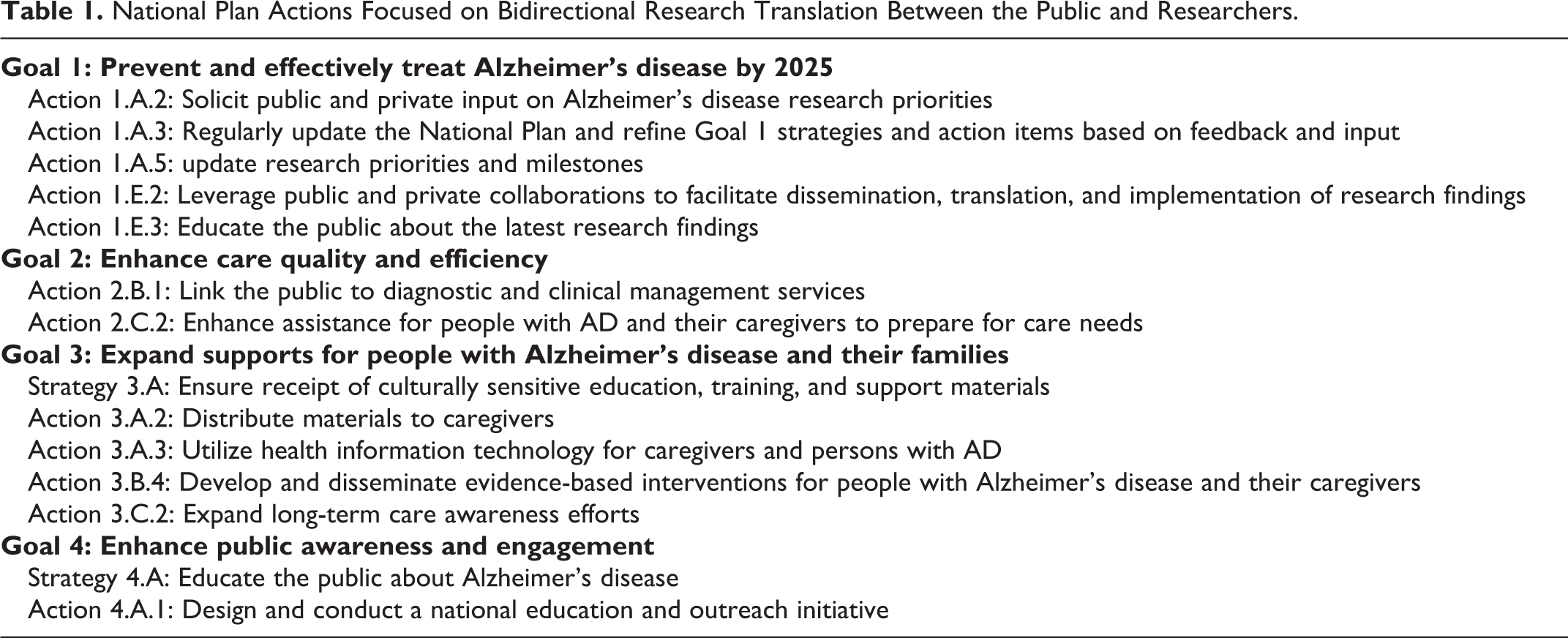
There are numerous goals, strategies, and actions in the National Plan which focus on research information being translated to the public (caregivers and patients) and the public providing ideas and guidance to researchers (see Table 1). This can be described as a “bidirectional translational relationship” between the researchers and the public. This relationship depends on the public having an easily accessible source of current Alzheimer’s research information in order to evaluate the state of research and provide suggestions to researchers based on their understanding of the existing research.
National Plan Actions Focused on Bidirectional Research Translation Between the Public and Researchers.
Currently, the best up to date, publicly accessible database of research on Alzheimer’s is the same database that is available for other diseases—PubMed.gov. 4 This research article database contains over 22 million citations of the biomedical literature, life science journals, public health journals, and online books. 5 The resource is free to anyone in the world and maintained by the National Center for Biotechnology Information. This database provides a useful resource for Alzheimer’s caregivers and patients, but is not catered to this group and is limited in a number of ways. PubMed also includes the full-text version of some, but not all articles. The full-text articles are available for National Institutes of Health funded research as a result of public access statutory requirements. 6 Although this leads to an impressive amount of information being available to the public, the ability of the public to truly access this information written in the language of various medical specialties is limited. In order to achieve the goals of the National Plan, a better approach is necessary.
The first step toward creating a better information source is to make the information user friendly. Currently, when Alzheimer’s caregivers/patients look for information on different aspects of the disease, they have to search PubMed using the best terms and connector words they can muster. Requiring the public to learn how to speak the language of the database in order to learn about the disease is unreasonable and not user friendly. Similar to the iPhone and other user-friendly innovations, a database of Alzheimer’s research information should require no information guide or code language for the public to be able to access the most useful information. The method of accessing the information should be obvious with easy to understand graphics and categories that people of all ages can easily access—just as the iPad has been made so accessible that toddlers can use it. 7
A second step is aggregating research information into easy-to-read text. When search terms are entered in PubMed, the database yields a list of research article titles. The long lists of articles can be intimidating for researchers and even more so for the public. When basic terms such as “Alzheimer’s disease” are searched for, the list of articles returned is so long that it is impossible for one person to read. Figuring out which articles are important is extremely difficult for laypersons because there are no easy-to-understand symbols that help users of the database understand what is important and what is not. The database also does not provide any label that indicates whether a particular article is written in a way that the public can understand or not. A more user-friendly source of research information would provide easy-to-ready summaries of the most important information instead of providing a list of articles. 8 For example, in a database on Alzheimer’s disease, the topic of nutrition would summarize the best information on nutrition for Alzheimer’s patients. The information should be written at the same level as all public health information for the public (8th grade level) in order to increase the likelihood of people being able to read it. In addition, a database of this nature could provide more in-depth information on the most useful research articles. However, instead of providing the entire article in the professional dialect, the database could provide an easy-to-read summary of the article which conveys all the key findings and information. All summaries of information should also be available as a PDF in order to facilitate easy creation of handouts for Alzheimer’s patients and caregivers who lack Internet access. 9 These types of summaries would also avoid the copyright concerns that arise with providing people with full-text journal articles.
Third, the research information should be provided in more than one format. PubMed only offers the title of an article, an abstract for most articles, and some free full-text articles. A better database focused on Alzheimer’s which is developed for the public would utilize the wide range of online communication tools available today including video and audio tools, networking tools, and other approaches that accommodate people with different learning styles and people of various physical abilities (ie, hearing and visually impaired). Networking tools would allow for easy interaction between researchers and patients/caregivers. In addition, given the country’s ethnic diversity, the database could include translations of research information into different languages which would make it more accessible to the nation’s public.
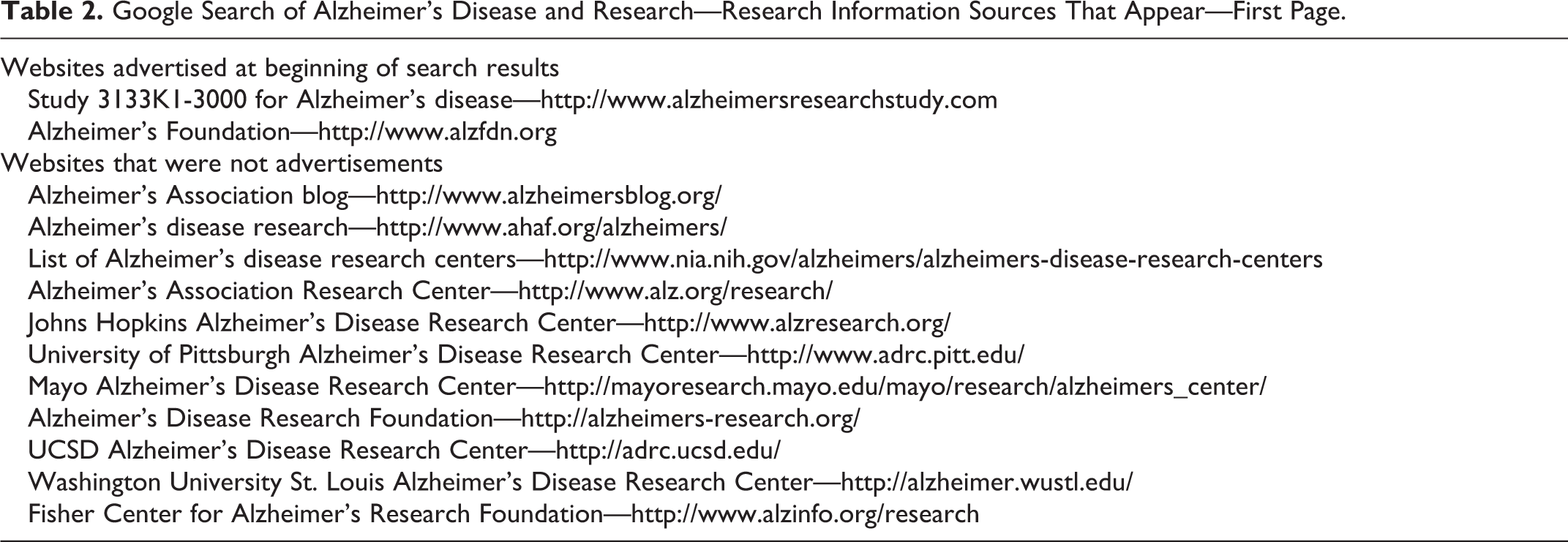
Beyond PubMed, the most authoritative source of publicly available research information, there are a variety of other information sources on Alzheimer’s disease, some of which provide research information. A Google search for “Alzheimer’s disease and research” reveals a number of sites. The most popular (appearing on the first page of the Google search) are provided in Table 2. Although these research information sources are useful, they do not fully address the concerns raised in this article and the goals established by the National Plan. However, these research information sources can serve as the foundation for the creation of better sources that meet the expectations of the National Plan. Each of these sites can be improved in various ways to provide consumers with research information in accessible formats and allow them to provide their thoughts and ideas to the researchers.
Google Search of Alzheimer’s Disease and Research—Research Information Sources That Appear—First Page.
The suggestions in this article serve as a basic framework for creating research information sources that can improve upon current efforts to provide research information to the public, namely PubMed and consumer sites for Alzheimer’s patients and caregivers. A paradigm shift in how research information is provided must occur in order to meet the National Plan goal of preventing and treating Alzheimer’s by 2025. Bold goals of this nature require bold changes. With public input and private innovation, the federal government along with private partners can develop a user-friendly, publicly accessible Alzheimer’s research information source that serves as a foundation for a new age of Alzheimer’s research, one in which researchers and the public work hand in hand to address a common challenge that affects our country and the human species. Alzheimer’s is a public health challenge and developing solutions to the disease requires the public to be completely informed.
Footnotes
Author’s Note
Its contents are solely the responsibility of the author and do not necessarily represent the official views of the National Center for Advancing Translational Sciences or the National Institutes of Health.
Declaration of Conflicting Interests
The author declared no potential conflicts of interest with respect to the research, authorship, and/or publication of this article.
Funding
The author disclosed receipt of the following financial support for the research, authorship, and/or publication of this article: in part by Award Number UL1RR031988/UL1TR000075 from the NIH National Center for Advancing Translational Sciences.