




Abstract
Introduction
Since the discovery of exosomes in 1987 by Johnstone, 1 much attention has been paid to their physiological function, and particularly to the connection between exosomes and malignant tumor. Exosomes are 30 to 100 nm discoid vesicles containing nucleic acids, proteins, and lipids that are formed, secreted, and released into the endocytic system by different cells under both physiological state and pathological conditions. 2 The physiological functions of exosomes are focused on cell communication including immune regulation, apoptosis, and cell differentiation whereas the pathological functions are focused on inflammation, tumor invasion, and angiogenesis. 3 Therefore, exosomes play an important role in the screening, diagnosis, and treatment of cancer, particularly in the metastasis of the malignant tumor. Tumor-derived exosomes (TEX) may play a significant role as biomarkers in for the early detection of tumors since they are reported believed to be involved in remodeling of the tumor microenvironment and in metastasis of malignant tumor.4,5
Cancer incidence and mortality rates continue to increase rapidly worldwide. In 91 of 172 countries, cancer is the first or second leading cause of death before the age of 70 years, and it ranks third or fourth in an additional 22 countries. 6 In the United States, 1898 160 new cancer cases and 608 570 cancer cases were projected to occur. 7 While the innovation of the traditional surgery and chemical medicine has gradually faded in recent years due to their unavoidable adverse effects on patients’ health and poor prognosis, 8 new precision therapies based on cancer immunology are also promising methods in the field of cancer pathogenesis.
Immune surveillance, T cells and the functions of the thymus constituted the foundations of targeted immune interventions and chimeric antigens. 9 Oncoimmunology (cancer immunology) utilizes the body's own immune system against cancer and tailor treatment for each patient which marks an entirely different way of treating cancer—by targeting the immune system rather than the tumor itself. 10
Exosomes have a close cooperative relationship with cancer immunology. Exosomes captured by dendritic cells can carry tumor antigen and directly stimulate the immune response of CD4+ T cells. 11 The contents of the exosomes from immune cells also attach importance to cancer immunology. FASL, perforin, and NKG2D in exosomes derived from natural killer (NK) cells can kill different tumor cells in vitro. 12 LMP1 in exosomes from Burkitt's lymphoma cell lines and B cells infected by Epstein–Barr viruses can imitate a CD40 signal to induce B cells proliferation and differentiation into plasma cells.13,14 Malignant tumors and malignant effusions can both release exosomes associated with cancer immunology. 15 Although exosomes can induce both protumor and antitumor immune responses effectively, cancer cell-derived exosomes mainly play a role in immune suppression rather than in immune activation in advanced cancer stages, which opens new avenues for immunization against cancers. 16
Despite many advances in understanding the role of exosomes in cancer immunology, there is still a lack of global and comprehensive reports that help researchers obtain a quick overview and identify meaningful research hotspots are still lacking. To the best of our knowledge, this field has not been systematically investigated. Bibliometric analysis is defined as an analysis of open publications that summarize the current research status. 17 It includes the distribution profiles, quantitative relationships, and clustering of literature. 18 It can not only summarize the past research trends but also indicate the potential hotspots for future research. 19 The visualization of the results is intuitive and inspiring. Therefore, we used this methodology to study the role of exosomes in cancer immunology.
In the present study, we analyzed the global trends in publications from 2011 to 2021, focusing on the roles of exosomes in cancer immunology and related institutions, journals, and keywords. We also visualized our research findings and comprehensively concluded the cooperative relations comprehensively. In addition, the future hotspots in this field were explored and predicted.
Materials and Methods
Search Strategies
On September 16, 2021, we searched the Web of Science (SCI-Expand) for publications focusing on the possible underlying role of exosomes as cancer immune regulators. The search was completed on a single day to avoid the bias caused by daily updates. The search strategies are presented as following: TS = (exosome∗ OR exosomal) and TS = (macrophage OR neutrophil OR (NK cell) OR (natural killer cell) OR (dendritic cell) OR DC OR (innate lymphoid cells) OR ILCs OR (T cell) OR (T lymphocyte) OR (B cell) OR (B lymphocyte) OR (regulatory T cell) OR (Treg) OR (monocyte) OR APC OR Antigen-presenting cell OR immunity OR immune OR Immunolog* OR Immunosuppression OR Oncoimmunology) and TS = (Tumor OR Tumour OR Cancer OR Neoplasia OR Neoplasm OR Malignanc∗ OR carcinoma OR adenocarcinoma OR oncology OR lymphoma OR Leukemia OR melanoma). No other types of studies were included except original articles and reviews. Two of the authors carried out the search process together. In case of disagreement regarding inclusion, the final decision was made by the experienced corresponding author. We determined whether the topics of the publications were consistent with our target topic based on their abstracts. If the abstract was not sufficiently specific to determine this, we downloaded and read the full text to make a reliable judgment. The corresponding author also reviewed the uncertain publications. The detailed enrollment and selection processes are shown in Figure 1.
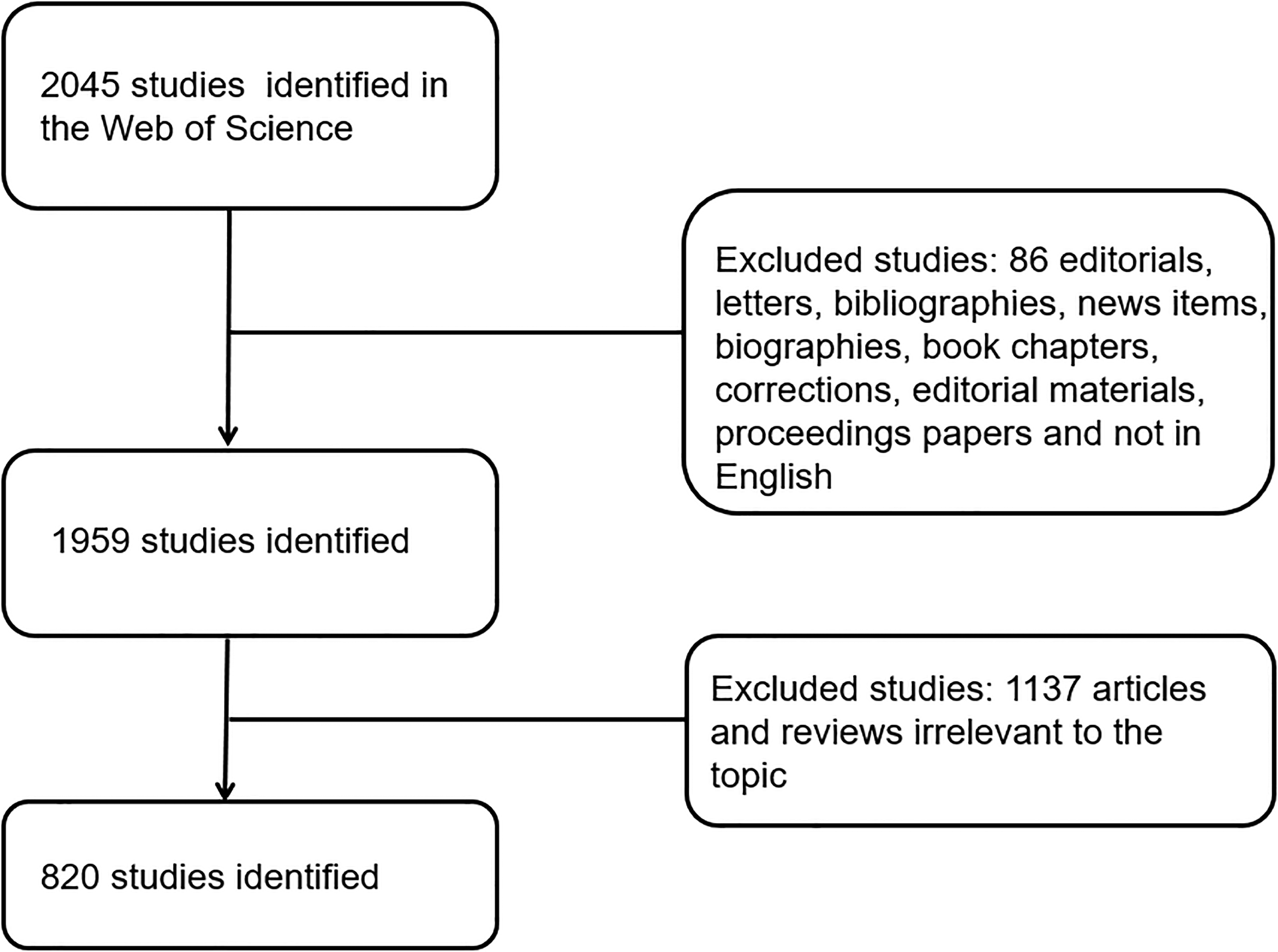
Flow diagram of the inclusion process. The detailed process of screening and inclusion.
Data Analysis
Excel in Microsoft 365 (Microsoft) was used to present the statistical results intuitively and specifically. VOS viewer 1.6.17 (Leiden University), an application for constructing and visualizing bibliometric networks which was applied to analyze the data and extract information such as keywords from it. 20 Citespace, a Java application, was used to analyze and visualize cocitation networks. The primary function of Citespace is to facilitate the analysis of emerging trends in a knowledge domain, and it can be used for keyword clustering, which is helpful in summarizing the general research direction. 21 We also used Microsoft Excel 365, Citespace and VOS viewer 1.6.17 to construct a bubble plot and maps that showed cooperation between countries, institutions, and authors.
Bibliometric Analysis
We extracted relevant information including titles, publication date, journals, countries of origin, author names, affiliations, keywords, abstracts, and other relevant information from the included publications. The impact factor (IF) represents the average number of citations per article published in the last 2 years in a certain journal in the current journal citation report (JCR) year. We acquired the IF from the JCRs published in 2020. The H-index is a criterion used to evaluate the impact of a scholar which is defined as follows: A scholar has up to h articles that received at least h citations each. The H-index represents the number of publications and the number of citations per publications comprehensively. 22 The relative research interest (RRI) is the number of publications in a certain field divided by the number of all-field publications per year. It represents changes in research trends in certain fields and gives scholars hints about possible future hotspots.
Ethics Statement
Ethics approval of this study was not required, as no human or animal tissue/samples were used in this bibliometric study.
Result
Global Trends of the Publications
Of all the countries involved in research on the role that exosomes play in cancer immunology, China ranked first in terms of the number of publications during the 10 years between 2011 and 2021 at 406. They were followed by the United States of America at 207 and Germany at 43 (Figure 2A). Although the number of publications in China has increased rapidly each year, the number of publications on this topic from other countries has ceased to increase significantly since 2018. Despite this situation, when the number of all-field publications was considered, the global interest in the role of exosomes in cancer immunology, as measured by the RRI, has increased steadily since 2012 and was expected to reach 0.0521% by 2021 (Figure 2B).

Contributions of different countries/regions to the research on exosomes in cancer immunology. (A) The number of publications, sum of citations (actual value × 0.05), H-index (actual value × 5) in the top 10 countries or regions. (B) The number of publications from the top five countries and other countries per year and the time course of the relative research interest in the field of exosomes in cancer immunology.
Additionally, despite leading in the number of publications in China, the sum of citations and the H-index of China failed to maintain the same large advantage, which indicates that the quality of publications from China did not equal their quantity. The lack of credible clinical trials in China has also contributed to this special situation. The sum of citations of papers from China was 12749 while the sum of citations of papers from the USA was 12 488. The H-index of China was 57, whereas that of the USA was 62. Apparently, the USA managed to maintain the high quality of publications even though did not lead in terms of the numbers of papers in this field.
Cooperation between different countries was also visualized. Although China contributed the most publications, the USA had closer ties to other countries than China (Figure 3A). The quality dilemma of papers from China thus not only jeopardized the sum of China's citations, but also affected the cooperative relationship between China and other countries. Another phenomenon was that the proportions of the latest publications were rather high, especially in the USA, Germany, and France (Figure 3B).

The cooperative relations between countries/regions were visualized. (A) The network of cooperation among countries/regions on research in the field of exosomes in cancer immunology. The size of the circle represents the number of publications, and the proportion of pink represents the proportion of publications published lately. (B) Numbers of publications from different countries are consistent with both the color depth and the size of the circle. (C) The proportion of publications from different countries and their cooperative relations.
Journals with Publications on in the Field of Exosomes in Cancer Immunology
The top-10 journals publishing papers on exosomes in cancer immunology had published nearly one-fifth of the publications in this field (160, 19.41%). The journal that published the most papers was Oncotargets and Therapy (IF = 4.147) with 21 records (2.56%). The journal that published the second most papers was Cancer Letters (IF = 8.679) with 19 records and a proportion of 2.32% (Figure 4A). The VOS viewer was used to analyze the cooperative relationships between different journals. As Figure 4B shows, 42 journals were included in our research 5 of which had the strongest links with others: which are Molecular Cancer, Journal of Cellular Physiology, Oncotarget, Journal of Experimental &Clinical Cancer Research, and Cancer Research.
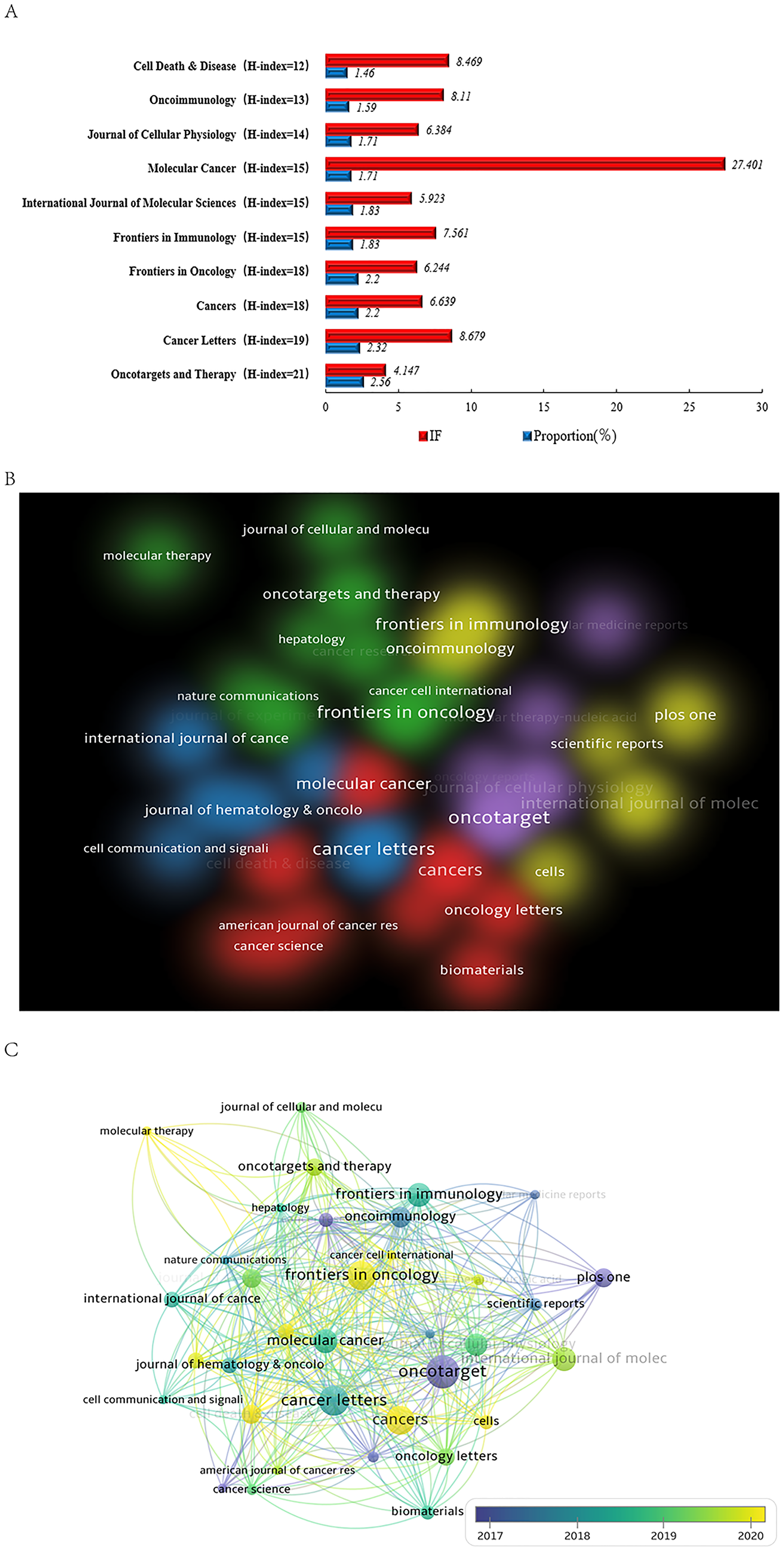
Distribution of journals focusing on exosomes in cancer immunology. (A) Top ten journals in the number of publications on exosomes in cancer immunology. (B) 42 Journals leading in the number of publications. (C) The links between journals. The latest link is shown in yellow.
Top-10 Articles in Terms of the sum of Citations
The top-10 articles in terms of the sum of citations are listed in Table 1. The article that was cited most times was “Pancreatic cancer exosomes initiate pre-metastatic niche formation in the liver” from the USA. It was cited 1234 times and was published in 2015. This was followed by the article titled “A doxorubicin delivery platform using engineered natural membrane vesicle exosomes for targeted tumor therapy,” from China with 785 citations. The article that ranked third was a review titled “Extracellular vesicles: unique intercellular delivery vehicles” also from the USA with 542 citations. Four of the top-10 articles were from the USA while two of the top-10 were from China. The remaining top-10 articles were from Denmark, Switzerland, Sweden, and Italy. Of the top-10 articles, three focused on the noncoding RNA, four focused on the transportation of the medicine, and the remaining three focused on the metastasis of malignant tumors.
Top 10 Articles in the sum of Citations

Institutions with Research Publications on in the Field of Exosomes in Cancer Immunology
Shanghai Jiao Tong University in China ranked first in terms of the institution with the highest number of publications on this topic, with 30 records (3.66%), followed closely by Nanjing Medical University in China, with 29 records (3.54%). Sun Yat-sen University in China ranked third with 21 records (2.56%). China's investment in basic science has thus returned in terms of the number of publications since Chinese institutions took eight of the positions in the top-10 list. The other two positions were taken by the USA, which is plausible, as the USA has led the advancement of science for nearly a century (Figure 5A).

Distribution of institutions focusing on exosomes in cancer immunology. (A) Proportions of top 10 institutions in the field of numbers of publications. (B) The yellow represents more recent publications while the blue represents more early publications. (C) The thickness of the strings represents the intensity of the links between institutions.
We used the VOS viewer to visualize the cooperation between institutions around the world. In these figures, yellow represents more recent publications, whereas the color blue represents more early publications (Figure 5B). Fudan University, Southern Medical University, Center South University, and Zhengzhou University are institutions that have recently transferred their attention to the field of exosomes in cancer immunology. Figure 5C shows than strength of cooperative relationships between different institutions, indicating the intensity of connections by the thickness of the strings.
Keywords in Publications on in Field of Exosomes in Cancer Immunology
We used the VOS viewer to analyze the keywords from the 820 studies that were included to determine the popular topics and possible future research hotspots. We identified 88 keywords with at least 29 occurrences and classified them into three different clusters: mechanism research, treatment application research, and diagnosis and prognosis research (Figure 6A). As shown in Figure 6B, diagnosis and prognosis research cluster was apparently the latest overall cluster.

The analysis result of exosomes in the field of cancer immunology. (A) Keywords classified into three clusters. The red represents the cluster of mechanism research. The green represents the cluster of treatment application research. The blue represents the cluster of diagnosis and prognosis research. (B) The yellow represents keywords appeared recently while the blue represents keywords appeared early. (C) Top 20 keywords with the strongest citation bursts.
Citespace was used to identify keywords with the most occurrences for the longest time (Figure 6C). Apparently, “Membrane vesicles” and “vesicles” were keywords that lasted the longest time whereas “pancreatic cancer”, “suppression,” and “tumor suppressor” were important keywords that appeared recently.
Within the mechanism research cluster, “biomarker” (186 times), “reviews” (142 times), “molecules” (142 times), “extracellular vesicles” (140 times) and “vesicles” (138 times) were the most frequently mentioned keywords. Within the treatment application research cluster, “vitro” (145 times) had the highest frequency of occurrences, followed by “immune response” (116 times), “T cells” (113 times), “mouse” (112 times), and “response” (111 times). Within the cluster of diagnosis and prognosis research, the primary keywords were “expression” (325 times), “level” (195 times), “miRNA” (194 times), “analysis” (185 times) and “macrophages” (180 times). The latest keyword within the cluster of mechanism research was “tumor microenvironment” (average appearing year 2019.6364). The latest keyword within the treatment application research cluster was “PD-L1” (average appearing year 2019.881). The latest keyword within the cluster of diagnosis and prognosis research was “M2 macrophage” (2019.6364). Specific information regarding the keywords is presented in Supplemental Table S1 and Figure 7.

The prediction of potential hotspots in this certain area. The potential hotspots are predicted by the form of mechanism of related immune responses of cancer.
Topics
Both the topics of the articles belong to and the articles cited belong to are presented in Figure 8. The subject that most articles belong to is molecular biology immunology. This subject is most medical research focusing on the mechanism. The subject that most cited articles belong to is molecular biology genetics. This is the subject that most functions of exosomes relate to since exosomes contain different kinds of RNA. The role of exosomes in cancer immunology requires a combination of different subjects.

The comet map of the related subjects. The left side is the front of the flow and the right side is the tail of the flow. The front of the flows represents the branch the articles belong to while the tail of the flow represents the subject the cited articles belong to.
Discussion
Our research content is briefly presented in Figure 9. The status of publications concerning exosomes in cancer immunology was analyzed from the aspects of countries, institutions, journals, and their collaborative relationships and future trends in this area were explored by analyzing keywords and potential hotspots. We summarized the interactions between exosomes and cancer immunology and predicted promising research directions based on these data. This research will help researchers understand this field more thoroughly and will guide them to advance in medical research.

The thumb view of our inclusion process and research results.
When it comes to countries, China, the USA, and Germany ranked as the top-3 countries in terms of publications in this field. Both the USA and China have led the research in the field of exosomes in cancer immunology. Although the USA did not have the same number of publications and sum of citations as China, it did have an edge in the H-index as the h-index of China was 285 while the h-index of the USA was 310. We believe that the dominating power of the USA in the economic and scientific fields contribute to its incomparable status in this field. As far as exosomes research is concerned, the USA ranked first in terms of the number of publications with 1949 articles accounting for 38.42% and in the sum of citations with 81501 citations between 1994 and 2017. 23 In terms of cancer immunology, the USA accounted for 83 of the 100 top-cited articles published between 1986 and 2016. 24 The advantages of the USA in the field of exosomes and cancer immunology determines its remarkable achievements in the field of exosomes in cancer immunology. China has also achieved significant improvements in this area, particularly given that it is still a developing country and is a relatively recent newcomer in the field of medical research. As for other developing countries, few of them have made sufficient contribution to this field that rank in top countries. China and Iran were the only developing countries present among the top-10 countries in terms of publications in this field. A prosperous economy, solid education industry, and modern public health system are all necessary for medical research which is rather rare in developing countries and the achievements of developing countries rely heavily on the investment of their authorities. Both China and Iran have put much effort into higher education and medical system over the past few decades which could explain their leadership among developing countries in this certain academic research field.
We also found that the USA took the lead in the cooperation between countries, although its number of publications was not the largest overall. It is often the case that collaborations could promote the advancement of fundamental science and increase the sum of citations. As Figure 3A shows, the articles from the USA not only had high quality but were also published relatively recently which indicated that the USA has achieved much progress in the field of exosomes in cancer immunology. Of the top 10 articles in the sum of citations related to exosomes in cancer immunology in terms of the sum of citations, four were from the USA. The most impressive phenomenon was that three of the top 4 articles came from the USA which shows the strong capability of the USA in medical research vividly.
The RRI is a relatively fair index that excludes the impact of the advancement in science worldwide. It directly shows the developing trend in the field of exosomes in cancer immunology. The RRI of exosomes in cancer immunology kept growing from 2011 to 2021 which represents enormous efforts made in this field. These efforts could promote the clinical translation of this field as well as further research on the mechanisms of action of exosomes in cancer immunology. The RRI of this area has witnessed two acute increases in the past ten years: One between 2016 and 2017 and one between 2018 and 2019.
The top 10 articles in terms of the sum of citations are presented in Table 1 which are important articles in this area over the past 10 years. We believe important articles published in 2014 to 2015, such as “Pancreatic cancer exosomes initiate pre-metastatic niche formation in the liver” and “A doxorubicin delivery platform using engineered natural membrane vesicle exosomes for targeted tumor therapy,” strongly pushed forward the increase between 2016 and 2017. On the other hand, significant articles published in 2017, such as “Extracellular Vesicles: Unique Intercellular Delivery Vehicles” and “Exosomes: Therapy delivery tools and biomarkers of diseases,” pushed forward the increase between 2018 and 2019. This corresponds with both acute increases from 2016 to 2017 and from 2018 to 2019. The article that was cited the most times in the past ten years was completed by researchers from the USA in 2015 and described the role of exosomes in the liver metastasis process of pancreatic ductal adenocarcinomas. 25 The article ranking second was from China which focused on utilizing exosomes to minimize the immunogenicity and toxicity of chemotherapeutics. 26 The third most-cited article was a review that systematically introduced the functions and possible clinical application of exosomes, particularly in cancer immunity. 27 While four articles in the top-10 were from the USA, researchers from China also published two articles that ranked second and fifth, respectively. The top-10 articles were from Denmark, Switzerland, Sweden, and Italy. We also found that the authors of these articles were important researchers either in the field of exosomes or in the field of cancer immunity. By analyzing the content of the top-10 articles, we found that those articles with the most influence tended to focus on the relationship between exosomes, tumor metastasis, and immunotherapy. The unique role of exosomes excreted from tumor cells in tumor metastasis could be related to the polarization of macrophages and their influence on tumor surveillance which could induce the immune escape of tumor cells. 28 In contrast, exosomes excreted from immune cells can fulfill the duty of attacking tumor cells by releasing FASL, perforin, NKG2D and other proteins and by inducing the differentiation of abnormal cells by the various proteins they contain. 29
As Figure 4 shows, the IF of the top 10 journals in terms of the number of publications on exosomes in cancer immunology ranges from 5.923 to 27.401. The distribution of IF remained high representing the high quality of the whole articles in this field. We believe that the attention paid to the field of exosomes and cancer immunology has also contributed to the high IF of journals publishing articles related to exosomes in cancer immunology.
Eight of the top-10 institutions in terms of the number of publications were from China while the other two were from the USA which indicated the great efforts that China has put into this field and the fundamental accumulation of the USA.
As Figure 6 shows, the keywords of the retrieved publications are classified into three clusters: mechanism research, treatment application research, and diagnosis and prognosis research. The diagnosis and prognosis research cluster was clearly the newest of the three clusters (Figure 6B). Clinical trials have been put on the agenda of many institutions leading in the field of exosomes in cancer immunology recently who are interested in the early detection and dynamic monitoring of cancer via examining the blood exosomes. For example, Shanghai Chest Hospital started to combine the detection of ctDNA and exosomes to identify benign and malignant pulmonary nodules on October 8, 2019. The details of this clinical trial can be found on the following websites (https://clinicaltrials.gov/, NCT04182893). These recruitment studies are closely connected with diagnosis and prognosis research and can provide biomarkers and potential therapeutic targets for cancer immunology.
The latest keyword within the mechanism research cluster is “tumor microenvironment” (average appearing year 2019.6364) which is an important component in the process of tumor metastasis. TEX can not only transform the microenvironment of target cells into a suitable tumor invasion environment but can also influence target cells directly from this microenvironment. 30 With the function of presenting antigens, suppressing immune cells, and transmitting certain signals, exosomes can play both pro-tumor and antitumor roles. 31 Exosomes can excrete HSP70, MHC- I, MART-1, and other molecules to activate immune cell responses and suppress tumor growth. 32 By stimulating the immune surveillance of NK cells and macrophages, directly presenting antigen to CD8+ T cells, and indirectly presenting antigen to CD4+ T cells via dendritic cell, these exosomal cytokines play critical roles in anti-tumor responses. 33
The latest keyword in the treatment application research cluster was “PD-L1” (average appearing year 2019.881) which is a protein expressed on the surface of tumor cells. Inhibitors targeting PD-L1 are very promising treatment methods because they may restart the immune responses against the tumor cells. 34 Researchers have proven that metastatic tumors can release exosomes carrying PD-L1 on their surface to suppress the immune system systemically, providing a rationale for using exosomal PD-L1 as a predictor for anti-PD-1 therapy. 35 The binding of PD-L1 to its receptor PD-1 on CD8+ T cells inhibits antitumor immunity by counteracting T-cell-activating signals. 36 Antibody-based PD-1-PD-L1 inhibitors can induce durable tumor remission in patients with diverse advanced cancers, and the expression of PD-L1 in tumor cells and other cells in the tumor microenvironment is of major clinical relevance. 35
Apparently, “membrane vesicles” and “vesicles” were the keywords that lasted for the longest time whereas “pancreatic cancer”, “suppression” and “tumor suppressor” were important keywords that appeared lately. It has been reported that exosomes excreted by pancreatic cancer can highly express macrophage migration inhibitory factor (MIF) which prepares liver premetastatic niche formation and metastatic. 25 By blockading this target, we can suppress pancreatic cancer liver metastasis. Both antitumor and pro-tumor immune responses can contribute to immune therapy for cancer as the former response can be activated to suppress tumor growth and the latter response is conducive to proliferation, metastasis, and invasion of tumor cells could become targets for precision treatment. 37
The latest keyword within the cluster of diagnosis and prognosis research was “M2 macrophages” (2019.6364). Macrophages can change their phenotype into different subtypes: classically activated (M1) and alternatively activated (M2). 38 Differently polarized macrophage populations may lead to different prognosis of the cancer. 39 The M1 polarization may indicate a good result whereas the M2 polarization is related to a poor prognosis which implies that the macrophages reprograming could become an important target in the diagnosis, treatment, and prognosis of the cancer. 40 The polarization of macrophages is regulated by both miRNAs and immune factors. Exosomal miRNA-138-5p, miRNA-301, miRNA-1246 and other miRNAs mediate crosstalk between tumor cells and macrophages. 41 By inhibiting the expression of KDM6B, those miRNAs released by cancer-derived exosomes can modulate the polarization of tumor-associated macrophages.42,43 Dendritic cells can also be regulated by exosomal miRNAs and are inhibited by PD-L1. 44 Immune factors delivered via exosomes associated with M1 polarization include IL-6, TNF-α, and IL-1β while immune factors related to M2 polarization include CD163, Arg1, IL-10, TGF-β and VEGFA. 45 These genes and immune factors are reliable indices for detecting polarization of macrophages. 46 TEX can carry noncoding RNAs to modulate the polarization of tumorassociated macrophages (TAMs) through targets like JMJD3 to promote the invasion and metastasis of tumors. 47 These exosomal noncoding RNAs are promising markers for cancer prognosis and are targets for cancer treatment. 48 According to our further literature investigation, those immune responses related to tumor cells are summarized in Figure 7.
Although we have put much effort into this bibliometric study, we realize that this study still has many defections. Since 2018, many researchers have used the terms “extracellular vesicles” instead of “exosomes” which caused some difficulties in our research as extracellular vesicles include exosomes, apoptotic bodies and microvesicles. As the term “extracellular vesicles” covers much more than merely exosomal research, our search strategy could not be both accurate and comprehensive. Another limitation is that papers, including original research reports, are of low quality, lacking proper experiments, while some reviews lack meaning for the purpose of publication, which could confound our findings.
Conclusion
The trends in publications showed that cooperation between different countries and institutions contribute to the development of this field and researchers should strengthen their collaborative efforts in order to advance this knowledge. The rising RRI indicated that the field of exosomes in cancer immunology is a popular research area with great potential. As for hotspots, we believe they will be transferred from mechanism-related research to clinical research, and particularly to methods of increasing the survival rate and improving the prognosis of cancer patients as exosomes and their contents are promising biomarkers for the early diagnosis and prognosis of cancer. As for keywords, polarization, and PD-L1 are likely to continue to appear in the field of exosomes in cancer immunology research, as exosomes play an important role in regulating the tumor microenvironment. Therefore, we believe that the polarization of macrophages and the application of PD-L1 in tumor immunotherapy are both aspects worth further exploration.
Supplemental Material
sj-docx-1-tct-10.1177_15330338231199892 - Supplemental material for Global Trends and Prospects Regarding Exosomes in Cancer Immunology Research Over the Past 10 Years
Supplemental material, sj-docx-1-tct-10.1177_15330338231199892 for Global Trends and Prospects Regarding Exosomes in Cancer Immunology Research Over the Past 10 Years by Demeng Xia, Rui Wu, Sheng Wang, Gaoqi Chen, Ye Lu and Liang Zhao in Technology in Cancer Research & Treatment
Footnotes
Abbreviations
Authors' note
Sheng Wang's affiliation has changed to Department of traumatic orthopedics, Shanghai Fourth People's Hospital, School of Medicine, Tongji University, Shanghai, 200434, China.
Availability of Data and Material
Datasets generated for this study will be made available by the authors, to any qualified researcher on request.
Consent for Publication
All the authors have read and approved the final version of the manuscript and have provided their consent.
Declaration of Conflicting Interests
The authors declared no potential conflicts of interest with respect to the research, authorship, and/or publication of this article.
Funding
The author(s) disclosed receipt of the following financial support for the research, authorship, and/or publication of this article: This article was funded by Foundation of Shanghai Municipal Commission of Science and Technology [grant number 21S21901700].

Supplemental Material
Supplemental material for this article is available online.
References
Supplementary Material
Please find the following supplemental material available below.
For Open Access articles published under a Creative Commons License, all supplemental material carries the same license as the article it is associated with.
For non-Open Access articles published, all supplemental material carries a non-exclusive license, and permission requests for re-use of supplemental material or any part of supplemental material shall be sent directly to the copyright owner as specified in the copyright notice associated with the article.
